
Showing posts with label sabato. Show all posts

Monday, June 02, 2014

Is This The Time For a Constitutional Convention?

For any of the readers who've been following my political blogging since Day One, you might remember I started off with the idea of blogging over a specific issue: the need to reform our federal government through any number of amendments that would fix things.  I even had the address as reformamendment.blogspot.com...

Of course, that all changed: I ended up ranting about current politics and election woes (GET THE DAMN VOTE OUT) more often, so I re-named the blog (see the banner) and re-created a new address (that old reformamendment one no longer takes you anywhere).

But the interest in reforming/fixing our federal system of governance is still here, which is why I perked up when I saw an Atlantic article asking "Is it time for a Constitutional Convention?":

In January, Gallup found that Americans from across the political spectrum picked the failure of “government” as the top problem facing America today. The vast majority link that failure to the influence of money in politics. Yet more than 90 percent of us don’t see how that influence could be reduced. Washington won’t fix itself, so who else could fix it?
It turns out the framers of our Constitution thought about this problem precisely. Two days before the Constitution was complete, they noticed a bug. In the version they were considering, only Congress could propose amendments to the Constitution. That led Virginia’s George Mason to ask, what if Congress itself was the problem?...
Which lead to the alternative solution: allowing a 2/3rds number of states to call for a convention to submit amendments for consideration.  Which is the point the article writer - Lawrence Lessig, one of the major constitutional scholars out there - is getting at.  He's openly musing over the possibility of enough states getting together for the express purpose of fixing Congress through the amendment process.

I've seen other calls over the years - Larry Sabato has been relatively consistent on the matter - for amendments, and I've joined in on the cry every so often, but I've been reluctant more often than not about pushing amendments as a solution because of one thing: a lot of the proposed amendments are f-cking disasters waiting to explode.

Lessig's article links to another article in Slate, highlighting the movement going on within conservative-led states to get this convention idea off the ground.  One of the primary amendments being pursued is that damned monster known as the Balanced Budget Amendment.  You know, the amendment Republicans conveniently ignore when they're in control of all three branches of government (between 2001 to 2007) but then trumpet and proclaim as our salvation whenever there's a Democrat in the Oval Office (especially now with Obama as President).

I've railed against that damnable balanced budget amendment before: the damn thing is rigged the wrong way.  Every conservative suggestion for a balanced budget involves making it impossible to ever raise tax rates or even create new taxes to, you know, actually pay for sh-t government needs to spend on to make this nation work.  They require a supermajority to raise a tax, yet require a simple majority to cut a tax: they make it too hard to do one thing and too easy to do the opposite, essentially ensuring that the easy thing ALWAYS gets done while the hard (yet sometimes NEEDED) choice never even gets considered.  This doesn't balance anything: all it does is force the government to take different actions, such as massive spending cuts to achieve that "balance" in a false and painful way.

And that's not the only one: that Article V Convention movement - named after the provision allowing it to happen - is also focused on passing amendments allowing Congress to override Supreme Court decisions (and preventing the President from overriding that override with a veto), essentially killing off a checks-and-balance system between the three branches of the federal government; an amendment abolishing the 17th Amendment that provided direct election of U.S. Senators, essentially taking away an individual voter's right and something fully ignoring the corrupt history of state-nominated Senators; an amendment allowing up to 34 states to override any federal laws or regulations deemed "exceeding an economic burden of $100 million," effectively destroying the Commerce Clause under Article I and pretty much giving those states license to kill off FDR's New Deal, LBJ's Civil Rights and Medicare laws, and everything ever born from those two eras.

These aren't exactly the amendments we need: we need genuine reform in federal government such as putting an end to corrupt campaign finance laws that have basically given the uber-rich direct access and control of our elected officials; we need to set tighter limits on a President's power to wage unlimited war and waste trillions of dollars without oversight or accountability; we need an amendment granting us all better voting rights and protection from intimidation and refusal, especially making voting a universal given for all citizens and making it easier to vote period.

Lessig's argument that a state-pushed Constitutional Convention is weak tea: he's arguing for a movement that is not working in the best interests of the American people.  He may have an honest intent - any potential for reform that Congress is unable to even consider is an honest one - but he's backing the wrong damn horse, and he's siding with the wrong team here.  The team he's arguing for is looking to UNDO every genuine reform our nation's had since 1900.

There's an even better solution than this, Mr. Lessig: it's called voter turnout geared towards removing every obstructionist vote in Congress in both the House and Senate.  It's called throwing the damn Far Right Wingnuts OUT of Congress, period.  Every failure of government the last 10-15 years can be laid at the Republicans' doorstep: the refusal to balance their own damn budgets from 2001 until 2007, creating the massive deficits we live with today; the refusal to work with Obama, deciding on obstructing every effort he makes to force history to label Obama "a failure" forever; the failure to maintain ANY oversight of the war efforts in Iraq and Afghanistan, leading to massive human rights abuses along with literally billions of dollars vanishing into thin air by 2005.  With no-one from that tenure ever being held accountable for the fraud, theft, lies, murder...

We need to vote out a Republican leadership in Congress that DOES NOT lead.  That will go a long way to breaking the damn logjam giving us a broken Congress in the first place, where we won't need a constitutional convention to fix any of that.


Friday, December 07, 2012

Changing the Senate AND Changing the Veep

I mentioned earlier I had some ideas about fixing the Senate, especially when we consider how undemocratic that body of legislature is today.  What had been a balancing force between states and regional politics has altered into a logjam of political ideology, because the number of states have grown and the population difference between large states and small now unwieldy.

At the same time, I've had some issues regarding the Vice President, that it is for all intents an archaic office with only three functions: being the tie-breaking vote for the Senate (as President of the Senate), service as replacement/back-up to the sitting President, and of course protecting the space-time continuum.

So, like all mad scientists, I figure why not solve both problems with one solution?  (either that or create a giant monster, but for that I need a government grant)

First off, let's look at the office of the Veep: why does it exist, really?  Back in the beginning of the Constitution's formation, the Vice President was the second-place runner-up for the Presidency.  The Roman concept of co-consulships had appealed to the Founders, but they figured a true executive had to be in one person, so to the winner..  The consolation prize for getting second place was getting the President of the Senate, a body that was designed for even-number membership no matter what, meaning the need for a tie-breaker vote.  The Vice-Presidency was there to establish a chain of succession in case of emergency (which would get tested by 1841), and to grant the Senate body a slightly better rank of value over the House (and the Speaker of that body).

However, party formation f-cked that idea up by 1800.  The Founders didn't count on party factions trying to run on two-person tickets to secure both the Presidency and Vice-Presidency, creating a major constitutional crisis that had to be fixed with the Twelfth Amendment.  Now, the runner-up didn't get the Senate tie-breaker seat: the President got a loadstone around his neck in the form of a Veep who had no constitutional office within his own administration while the Senate got someone who answered more to the White House than the Capitol.

The thing is, a Vice President isn't really needed.  In terms of creating a succession chain, the Twenty-Fifth Amendment already establishes the means of determining who can replace the President if death, illness, impeachment and/or criminal prosecution happens.  And it can be tweaked as needed (for example, there is an ongoing push to revamp the succession among Cabinet members to have more national-security type offices - such as the newest one Homeland Security - get priority over other Secretaries such as Education or Housing/Urban Development).  What IS needed even if a VP is no longer part of the Executive branch is a tie-breaking vote for the Senate.

What's also needed for the Senate is a means to counter the unbalanced power that the smaller populated states - such as Wyoming or Montana or Delaware - have over the larger populated states - California and Texas and New York et al.  A handful of senators from enough small states can thwart the political will of senators from larger ones: in essence, a minority of the population can completely stymie the interests of the vast majority.  While the rights of the political minorities ought to be protected, that shouldn't come at the expense of the majority... EVERY... FREAKING... TIME.

More senators elected from the larger states might help counter that: it's been suggested before, so hello Professor Larry Sabato.  Another suggestion was to make ex-Presidents into permanent standing senators representing the whole nation: while it gives former Prezes something to do, it's not exactly a democratic answer (and having a Senator Dubya or Senator Jimmy Carter doesn't look too helpful, ya)... but the idea of nationally elected senators is more promising.

Nationally-elected senators would have the appeal and support of the nation's majority of voters (meaning those residing or sharing in the values of the larger states), providing a counterbalance to those senators from smaller (or more partisan-leaning) states.  Creating these new offices would also provide a start-point for those politicians tempted to run for higher national office (ahem, President) who may not be able to appeal at their residential state's level but at the national level (for example, a moderate Republican residing in Alabama able to run, or a centrist Democrat from Vermont).

Ergo, we can do this:
  • Drop the Vice President office.  Presidential campaigns are now free to pursue a life of political fulfillment without juggling the demands of party factions.
  • Create electable offices for the U.S. Senate for nationwide representation.  Make it an odd-then-even number of open offices to be filled for each of the Senate election cycles: three open seats for the first cycle, two (or four) open seats for the second, and then two (or four) open seats for the third.  You end up with seven (or eleven) National Senators.
  • Have it so that the incoming Senate body votes between the incoming National Senators (who will not vote, as they are the candidates) for the office of Senate President (what the VP is supposed to be).  This is where the odd total number works: the appointed Senate President does not sit on committees but presides over the body, enforces decorum, and casts any tie-breaking votes as needed.  This might also provide wacky hijinks if say the Senate body is mostly one party but the national senators from another: trying to see who gets picked as Senate leader would be fuuuuunnnny (or of course create another constitutional crisis, but then again every action has its own unplanned consequence).
  • Every new incoming Senate gets to vote on the Senate President.  It's possible for that person to just serve the two years: it all depends on that person's performance and/or the makeup of the new Senate.
  • Insert the Senate President into the chain of succession as part of the Twenty-fifth.  Placed below the President and above the Speaker of the House, where the VP currently has the spot.  This means whoever gets chosen by the Senate to serve as Senate President has to fulfill the office requirements (over 35, resident of the nation 14+ years, must be a natural-born citizen).
  • The remaining nationally elected Senators get to sit on committees and vote as regular members of the Senate.

Viola!  The National Senators replace the office of Vice President, and nothing gets lost.  The President no longer has to worry about a Vice President that could serve as a loose cannon or represent an inter-factional force against her (or his) own interests.  The Senate gets to choose their own Senate President who got elected on his/her own terms.  And the interests of the nation's majority has a better chance of getting heard and resolved.

Add this to the other proposal of increasing the number of senators elected from the ten or fifteen most-populated states (Sabato argues for 2 additional, but I feel 1 addition fits within the election cycle), and we reduce the damage that can be done by a small-population Senator even more.

This is a do-able amendment idea that can fix a lot of what's wrong with the U.S. Senate: the other fix - getting rid of Secrets Holds and weakening if not eliminating the filibuster altogether - has to be done by the Senators themselves.

To quote the wise man: What do you think, sirs?

Monday, December 03, 2012

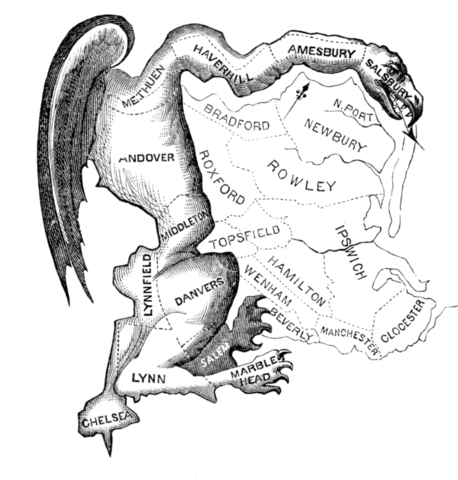
Killing The Gerrymander

Not a huge fan of the gerrymander.


Because it does these three things:
1) promotes one political party over the other by crafting "safe" congressional districts where registered voters are a majority/plurality over opposing parties, with such safe districts that incumbent officials can rarely be removed from office through honest vote;
2) distorts honest representation of communities by dividing them up and sharing them out to outlying, more sparsely populated areas that could now overwhelm that portion of a large community;
3) simple unfairness: a state could have one party with a larger registered voter base but - thanks to gerrymandering - the smaller party can retain control of local and congressional offices... and worse carve out supermajority control of state-level offices disproportionate to actual representation.  This could allow the more extreme positions of that minority party to pass legislation harmful (at least spiteful) to the actual majority of state residents who would oppose such laws.

Basically, gerrymanders create wasted votes.

First Problem is... the parties in power don't really want to see gerrymandering go away.  Let us be honest here: this IS one of the few times that claiming "both sides do it" is accurate (ask Florida Democrats, ask Illinois Republicans).

Second Problem is... how the hell can it be stopped?  The carving out of districts has to happen: democratic/republican government has to allow regions - cities, metropolises, counties - to provide local representation.  Each representative required to stand for a certain number of the populus, and done so at equal numbers so that one official does not represent a handful while another represents a vast number.  So districts have to get made.  But the people tasked to map them out are still people: biased and favored at best, corrupt at worst.

Some solutions are in place in various states, with hope that they can reduce if not end the threat of the gerrymander altogether.  Some states have non-partisan independent committees assigned the task of mapping out redesigned districts every Census count (10 years), and to do so without party consideration.  Other states - like here in Florida - passed state amendment laws forcing the state legislature (most state gov'ts control the process) to draw districts with strict limits - only by population density, must be reasonably shaped (rectangular as much as possible), etc. - to reduce the most blatant aspects of gerrymandering (the stretching out a district in bizarre shapes to provide the "safety" of that district).

But even these options have their limits and flaws: the Republican-held Florida legislature was still able to figure out how to carve out enough safe districts under the new rules to keep a solid GOP majority in both state houses, despite the fact there are more registered Democrats in this state.  So clearly, more needs to be done to kill the gerrymander.

Some ideas I've been mulling:

Increasing the number of representatives to Congress/state offices.  I've scoffed before at this idea of making more seats in the U.S. House to make Congress more responsive to the voters.  But now I think the guy who suggested this - professor Larry Sabato - might be right.  Not so much the need to drop the number of people represented from roughly 650,000 per district down to a more manageable 150,000... but because increasing the number of districts makes it harder to shape them into gerrymandered districts.
Look at it like this: Florida's got 27 Congressional districts right now.  Say we doubled that number to 54... and still requiring that districts have to be carved out based above all on population density as the state amendments require.  It makes it suddenly a lot easier for urban, densely populated areas to get more districts; and makes it a LOT harder to carve out those districts to share with the sparsely populated areas.  Ergo, fewer gerrymanders.

The cap on the number of representatives at 435 total isn't set in stone: it was capped back in 1929... back when the U.S. population was 123 million... we've nearly tripled that by now at 330 million for 2010.  An argument can be made that the cap set 100 years ago is no longer feasible and should go up.  Trick is, by how much?  There are only so many office spaces in D.C. to go around...

I would argue for a change in base representation, where the smallest populated states get one representative and that's it.  I'd suggest bumping that up to two representatives for the smallest states, just to give every state some diversity in representation.  Then I'd take that divided number of the fifth-least-populated state (currently South Dakota at 824 thousand or so) and use that (412,000 or so) as a basis for district drawing for all other states (dividing Wyoming as the least-populated would have given us district sizes at 284,000 which might be going too small).

Let's do the math for the most-populated state (California, 37,692,000 or so) with that 412,000: we get 92 representatives compared to the current 53.  It's not that huge a boost (close to double the current, yes, but not over).  For Texas (25,675,000) they get 62, over the 32 current.  By the way this is tracking out, it looks like a 42 percent increase of representatives per state.  Not sure how it will total up in the House, but I figure it's an extra 182 seats, minimum.  Can we afford/handle a 618-seat House?

Creating more districts does make sense as well at the state level... except in New Hampshire, they have 400 members for a state population of 1.3 million.  Florida's got 25 million residents, at least our house numbers (120) seem more sensible although a slight increase to say 150 reps is doable. 

Another option might be to create a Lottery system of randomly dividing up the registered voters per seat.  Get rid of districts for a state, change it over to just seating at Congress, and then allow for the technology to randomly assign a House seat per voter.  Your neighbor may end up voting for a candidate for Seat 12 while you get to vote on who gets Seat 24.  And your friend down the street gets Seat 5 while her neighbor gets Seat 7.  No-one gets to say who gets assigned to a Seat vote.  No favors.

This has the advantage of getting rid of "safe" districts altogether.  It also forces the two parties to run candidates for EVERY seat rather than selectively put their energies into those "safe" districts.  It also prevents parties from putting up candidates who might be extreme enough for that "safe" district - hi, Steve King of Iowa! - but who can end up being toxic for statewide voters as a whole (note the lack of super-crazy Senators: yes, most are partisan but even the most partisan of them aren't as wingnut as some of their House counterparts).  But the disadvantages are huge: this does have the effect of eliminating genuine community representation.  Local issues - trade vs. tourism, for example - will diminish as state issues dominate.  And there runs the ever higher risk of rigged lottery disbursement of voters.

Those are pretty much the two ideas I've got going.  If anyone else has sensible suggestions, please leave a comment here on this blog.  (again, if the Blogger system is NOT favorable to your login needs, let me know through other means such as my direct email, thanks) 

Also, if anyone else out there is coming to this blog via the Iran Day Six entry I wrote 3+ years ago... why are you still linking to that article?  Is it the pictures I have on that entry?  Is it the article itself?  I'm still getting steady traffic thanks to that one article, I'd like to know why...

Wednesday, August 05, 2009

I Wanna Apologise to Larry Sabato

Early on in this blog, during the period I was actually able to write up amendment ideas instead of obsessing over political sideshows, I spent some time reviewing the ideas that professor Larry Sabato (University of Virginia) put down in a book he wrote, A More Perfect Constitution.

One blog post focused on the idea of expanding Congress, increasing representative counts in both the House AND Senate as a means of ensuring better representation (smaller constituencies, the idea goes, means the representative will be more aware of what his/her district wants).

At the time, I was incredulous. I didn't much approve of the idea of increasing the House to an even 1,000 members: I thought it would merely increase the number of bought members to be owned by the Beltway lobbyists.

I also felt that Sabato's idea of adding more seats to the Senate via population counts - top ten large states get 2 extra Senators, next fifteen mid-sized states get 1 extra - was disrupting the Great Compromise that the Founders used to settle the debate between small- and large-populus states over how the legislature would be seated.

On that point, I want to apologize to Dr. Sabato. You might be right about this.

For one thing, we shouldn't hold EVERYTHING the Founders did as stuff carved into marble for permanent display. After all, another compromise the Founders did was the 3-out-of-5 count of slaves for population rolls, not to mention allowing slavery to exist period. And our nation had to spill a lot of blood four score years later to revise that mistake. They also didn't give women the vote, didn't establish due process across all the states, and allowed for the consumption of vile alcohol which led to the 18th Amendment banning beer... which led to the 21st Amendment unbanning it less than 20 years later. But I digress.

So we can allow for changes to the Constitution. The question was, is, and will always be, do we need to make a radical change to the make-up of the Senate?

Originally, the Senate was meant to be the great equalizer between the states making up the nation. Here, each state gets 2 Senators to represent, regardless of population size. All states therefore equal. Wyoming having as much say as Texas, North Dakota as much as North Carolina, Alaska as much as Florida. The House gets proportioned by population: there California rules all, with Wyoming sitting in a back corner wondering why nobody likes them.

But now, we're at a point where representation in the Senate is massively unbalanced, not by seating but by accountability. To quote Matthew Yglesias:

...but it does strike me as worth noting that when you read a puff piece in The New York Times about the Gang of Six bipartisan dealmakers in the Senate that vast power is being wielded by people who, in a democratic system of government, would have almost no power. We’re talking, after all, about Max Baucus of Montana, Kent Conrad of North Dakota, Jeff Bingaman of New Mexico, Susan Collins of Maine, Mike Enzi of Wyoming, and Chuck Grassley of Iowa. Collectively those six states contain about 2.74 percent of the population, less than New Jersey, or about one fifth the population of California. The six largest states, by contrast, contain about 40 percent of Americans.

We're currently in a major health-care crisis in the country, all related to rising costs. There's a bill (or twenty) stuck in the Senate, all facing blockage because a) the Republicans are playing the role of Obstructionists AND b) Max Baucus is obsessed with the idea of 'bipartisanship' even though his party now commands a 60-seat majority in the Senate and the other party is, again, playing the role of Obstructionists.

Some of it might also have to do with the fact that Baucus comes from a low-population rural state, which leans conservative more often than not and would be less likely to vote for things that even hint of 'socialism' (yeah, that word again). But Yglesias has a point: there are now Senators who are more powerful than other Senators, disproportionate to their state's actual place in our country's size.

Back in the beginning, when we had 13 states, this wasn't really that big a deal. Population disparity wasn't that pronounced, and the large population states (Virginia, New York, Massachussetts) were divided on certain regional issues to prevent any overt bullying of the smaller states. So you could live with an even number of Senators per state. But today: Today we have 50 states, and the population shift between the smallest and the largest are more pronounced. Those states that Yglesias lists (Wyoming, Montana, Maine, North Dakota, Iowa, New Mexico) barely total to New Jersey, which is at 8 million people only 11th on the list. Iowa tops out that list of Six at 3 million. Florida is over 18 million at the 4th spot. California is at 37 million. A majority of Californians may want health care reform... and a majority of Texans (sorry Ross Douthat but Texas ain't the Utopia you think it is) might want it, and I *know* living here in Florida there's a lot of people who want health care reform... but you've got six Senators from nowhere states thisclose to killing it. The proportions are now seriously WAAAAAY off.

So Sabato is right about the Senate needing a fix, that we need to include population size in adding more Senate seats so that the larger states get better representation.

Although I'm not entirely sure boosting the top ten with two additional seats is feasible. Given how the Senate rotates their 6-year terms over 2-year election cycles, you're gonna have overlap of 2 Senate seats up for grabs in one election year. A more modest proposal would perhaps give the top 15 states one additional Senate seat each. That caps out to 3 Senators per big state, and each election year with a Senate seat up for grabs with no overlap. It might also allow for the mid-size states to more often rotate who gets the extra seat every 1o-year census: while the top 8 states are so overly populated that they may never lose that extra seat (barring natural disaster or an insane state tax code killing off all social services), with this system the states between spots 9 to 17 will be more... interested in maintaining their population figures. If 15 states is too small a portion, we can go to 20 states getting an extra seat and get all the important states (except poor Minnesota, which might declare war on Wisconsin to get that coveted 20th spot).
Giving 15-20 states one extra Senator would also be more fair than giving the top 10 two extra Senators: that could give California, Texas, New York, Florida and the other six mayhaps TOO much representative power. Even if the next 15 states in Sabato's proposal get one extra.

So again, to Professor Larry Sabato, my apologies. We do need to make the Senate more responsive and accountable to the overall population of the United States: we need to reduce the choke-hold small-population states may have over large-population states. We need a government more responsive to the People, not the States.

But still... Yeah I know, I shouldn't be adding a "But..." to an apology. But I just want to point out that while this proposal will fix representation in the Senate, it won't fix the undue influence lobbyists have on government as a whole. (dammit, I had an article online that showed the health care industry's contributions to both parties over the years, and now I can't find it... grrr) THAT is gonna take a whole different amendment... and maybe a class revolt or three...

Monday, January 14, 2008

A Review of Sabato's amendments book

Ezra Klein does a review of Sabato's A More Perfect Constitution on the Barnes & Noble site. I still am waiting for a copy of the book meself (curse ye, WorldCat! It takes months for the sucka to get a book from Alaska to Florida...).

Saturday, December 15, 2007

So, I emailed Larry Sabato

Having spent a few threads discussing the amendment ideas he'd brought up in his book A More Perfect Constitution, I decided on a whim to email Mr. Sabato and offer my alternative suggestion regarding the representation in Congress for both the House and Senate. I wrote as politely as possible, noted I had seen the threads on Moderate Voice, added that I was waiting for a copy of my own of his book (waiting via Interlibrary Loan), then offered up my suggestion and sent in the email. Here's a copy of it:
Hello.

I had spotted the Moderate Voice's overview of your book A More Perfect Constitution. As someone interested in reform, especially the type of reform only constitutional amendments could achieve, I gave the entry a good look, and I am attempting to get the book through my library for a more thorough reading.

I did have a few issues with some of your suggestions. For one, the need to expand the number of representatives and senators. To expand the House to an even 1,000 may improve the ratio of representation, but it does not guarantee *effective* representation. As of now, given the nature of the political beast, expanding to 1,000 congresspersons is simply giving lobbyists and deep pockets more targets to bribe with billion-dollar campaign warchests. I understand the desire to improve representation, to give voters better opportunities to meet and confront their representatives. But first, get rid of the current lobbying system that perpetuates corruption, then maybe we can see about expanding the number of representatives.

I also have issue with the suggestion of having the number of senators expand by giving the most populous states 2 more senators, and the next tier of populous states 1 extra senator. I'm sorry, but that defeats the purpose of the Great Compromise to have the small states get equal representation in the Senate. I think, if you want to expand representation in the Senate, there is a simpler method: just bump the number of Senators from 2 to 3. Right now that gives you 50 extra Senators. You get the benefit of having the states now vote every election cycle (2 years) a new Senator instead of skipping one cycle.

With regards to expanding the number of House representatives, if possible they could bump the small states with one lone representative up to the same number of Senators (right now at 2, with my suggested boost it would be 3). Having only one representative for the smallest states seem so... lonely.

Also, about having ex-Presidents serve as "national" senators seems a flippant way of trying to solve the age-old question of what to do with them. I don't think there are going to be a lot of people who would be thrilled to see Carter, Clinton or Dubya serve in government like that. After all, not every ex-President is going to be a Harry Truman or Herbert Hoover post-term. Though I'm still partial to one politician's suggestion that ex-Presidents be sent in exile to small islands. ;-) Or maybe the Disney President's Ride...

I do support your overall suggestion about our need to reform government via constitutional amendments, and I would love to see at the state level more active attempts to get a convention (or at least pressure on Congress) going on the matters that need to be addressed.

I do await getting your book so I can read it in greater detail.


I do admit, I did get a little snarky in that email.

Having tried for years to get short stories published, I didn't expect much back: I've rarely gotten replies, and of the rejections that did come back they were along the lines of "Gosh, we're impressed you can read and write." I was pretty sure Sabato, a public figure in political punditry, was someone swamped with messages, complaints, hassles, half-baked amendment proposals, and Viagra offers (hey, even my sister gets those!).

However, I did get a reply. It was, pretty much, a "Gosh" reply, sent by a colleague of Mr. Sabato's who apparently had to answer the mail this week:

Mr. Wartenberg,

Thank you for your e-mail last week to Dr. Sabato regarding A More Perfect Constitution. I am glad you are taking an interest in the subject. Dr. Sabato has been out of town on book tour but send his best. I think most of the questions you have presented here are addressed in detail in the text of the book. Please let me know if you have further questions once you have looked into it.

Best,

Michael


Didn't exactly read like he/they had viewed the whole email, nor that there were any qualms or rebuttals of the issues I had with Sabato's push for increased numbers of representatives. Just a simple cookie-cutter response. At least it was a reply, I hadn't been expecting one. Wasn't expecting anything like a C-SPAN debate or anything, although that would have been nice...

So anyway, here I am, thinking up a Christmas wish list of constitutional amendments for the holidays. Coming soon!

Saturday, December 01, 2007

Reviewing Sabato, Part III: The Election System

As part of my looking at Larry Sabato's Amendment suggestions of his own, the next set of ideas relate mostly to the election process itself:

  • Write political parties into the constitutional framework by adding an article governing partisan Presidential elections.

I'm not entirely sure what Sabato is getting at here as I need to read in full what the Moderate Voice points to in his book. Something about having the states and regions having more of a say in the four-year election cycle for the Presidency. For what I know of the Constitution, it *was* designed without partisan politics in mind, a serious shortcoming by the Founders. This amendment depends entirely on how it can rein in the more vicious partisanship of the two-party system we have, and if it can ensure viable third party start-ups.

  • Enact a four-region primary system, with the order selected by lottery at the beginning of the election year. Primaries would occur in the four months preceding the August conventions (one region per month, with states choosing the specific day within their region’s month to hold their primary or caucus).

I am entirely opposed to the idea of a divided primary. Whichever region goes first is essentially going to choose the leading candidates for the Presidency, to the detriment of the remaining three regions. The only fair way is to have ALL states vote their primaries at the same time, something a lot of other Americans agree with.

  • Mend the Electoral College by increasing its membership, making the assignment of electoral votes automatic, and ending the ‘unit voting’ rule in the event of an election being thrown into the House.

I'm one of those who, if given a choice, would prefer to scrap the Electoral College system altogether. The 2000 election chaos essentially proves that it's not a good way to represent the majority view of the nation's voters. It also forces the campaigns to focus entirely on states that would secure an Electoral victory and not ALL the states the way a President should, at the expense of getting a majority of voters from across the board.
I understand why there was an Electoral College set up in the first place: the Founders did not trust the voting majority. They didn't even have full voting rights (slaves obviously couldn't vote, nor women, and it may surprise people today to find out that back then even those who didn't own property in any way were barred as well) for every citizen. From what I've read, the Founders at the Constitutional Convention really wanted the Electoral College to blunt any popular vote, force the states to be represented by easier-to-control Electors, and even fail to declare a clear winner to force the results into the House and have the Representatives choose the 'Winner'. Something we've had a few times (1824, 1876), and both times complete disasters.
The thing is, our nation has evolved since the beginning of our federal government to grant nearly everyone in the country to have a vote (the only limits now are set on felons, illegals, and those under 18 years), with the caveat that you have to actively register to vote - something most citizens don't do anymore (insert sobbing noises here). We have evolved to where we directly vote for our Senators: why can't we evolve the system further to have the President directly voted for too? As is it now, the Electoral System means we elect a President who represents certain states, and not the whole nation.
The only positive I can think of for keeping the Electoral system is that, by its counting method, it can grant an elected President the illusion of having a "Mandate" to lead. For example, in the 1980 election Reagan beat Carter by 10 percentage points, 50 percent of all voters to 41 percent (with the remaining 9 percent split among the Indy candidate John Anderson and other minor parties). But the Electoral College result was a whopping 489 to 49. Does that not impress you? By pointing to the Electoral count, Reagan could claim a Mandate to do whatever the hell he wanted to do. Many elections have it so that the winning candidate is only up on the loser(s) from 1 percent to 5 percent, something that would look like a razor-thin win that would lack authority.
However, that one positive note I provided is even now a very flimsy reason: Bush the Lesser, who barely had an Electoral lead (271 to 266) in 2000, still claimed a Mandate to lead. He got worse on his 2004 re-election (286 to 251, which was still rather close compared to other Electoral results), convincing himself to push a massively unpopular agenda in 2005 (Social Security privitization, anyone?) that seriously hurt his political standing. I'm of the opinion now that any President can claim a Mandate to lead regardless of the Electoral lead, but if he's a stupid idjit he's bound to screw it up royally. So... no more Electoral College. Thnxbye.

  • Reform campaign financing by allowing Congress to limit “spending by the wealthy from their family fortunes, and mandate partial public financing for general election House and Senate campaigns.

Okay, I do think this was poorly written, by focusing a little too much on candidates who are personally wealthy. Yes, I did complain earlier about how only the rich get to run as they're the only ones to afford it, but the way this idea is written out those rich guys are being unfairly singled out. Part of the problem also involves the well-connected, those who can get their wealthy buddies to foot the bill, something Sabato's idea seems to overlook.
The real solution is to cap all fund-raising for elections to only the specific year that the election takes place: no stockpiling, no warchests, none of that. The part of the amendment making public financing mandatory for elections is a good one, but make sure the amendment leaves no wiggle room or confusion of any kind.
The amendment also focuses on the Congressional elections: I don't see any caps on the Presidential elections. I would rewrite this one, Sabato, think it through a little better.

  • Eliminate the requirement that Presidents be natural-born citizens, replacing it with a twenty-year citizenship floor.

Ahh, this. The original intention behind the Presidential limit that you need to be natural-born came from the European experiences of having foreign-born princes take over other countries. England was at the time led by the Hanoverian kings of Georges Uno, Dos and Tres. Amazingly George the III was the most English of the set (disregard George the IV, I think most Brits did then and do now). You had European nations fight over Spanish Succession during the early 1700s. The fear back then was that a fledgling nation like the U.S. could be tempted into having an established "name" guy from overseas moving in to a nice home in Boston, and then immediately take over the reins of government without adequately understanding American values and political niceties.
Do we still need a limit today? The United States is an established power of its own: our own culture has established a kind hegemony on a lot of other nations. Our values are well-known, our political system well-recognized and stable. As a nation supposedly formed from a wellspring of immigrants, allowing immigrants a chance at representing us as Chief of State would appear sensible. Some could also argue that the arriving newly minted citizens are more passionate about being citizens and about fulfilling their duties to this nation than many natural-borns who take it all for granted and do nothing about it.
The thing is, this is a middling issue at best. Immigrants can still represent as Congresspersons and other elected officials. The President as Chief of State does indeed represent this nation to all other nations: to an extent, it has to be one of our own, someone who has been directly born into this culture, into this lifestyle, and imbided since childhood with the core beliefs of being an American. This isn't a key issue, and it's not really needed.

Well, that's all I can discuss at this time. Next up: a Constitutional Amendment requiring Peppermint Ice Cream be served at all times of the year and not just October to December.

Tuesday, November 06, 2007

Expanding Congress?! Part II: The Doomage

One thing I didn't touch on in my earlier post was the suggestion of expanding the House of Representatives from 435 to an even 1,000. My first response, like I figure a lot of others' response would be, was "What?! We need MORE corrupt bastards in office?"

Sabato's focus is on improving statistical balance in representation: we're currently at 650,000 per Representative (in the states that have multiple Congresspersons), which he feels is too many to properly represent. So he's looking at increasing the number of Reps, and then balancing the numbers out to get that number down to about 150,000 per Representative.

The problem here is that there's still no guarantee of effective representation: most Congresspersons care more about their lobbyists and special interest support groups than they do their own constituents. If we did have effective representation in the House, by Representatives actively responding to their constituents' needs and beliefs... Cheney would have been executed for high crimes months ago, and Bush standing before the Senate on about 100 counts of impeachment.

Going to 1,000 Representatives would make more sense if we had guarantees that those Representatives would actually listen to the voters. So... for now, not buying it.

I *would* consider shifting the Representation to have the small states start off with 3 Representatives rather than a lone one (to balance out the suggestion I have of bumping up to 3 Senators per state), and then balancing out the Representatives from there.

Wednesday, October 24, 2007

Expanding Congress?!

Sabato's book A More Perfect Constitution addresses primarily how to fix the mechanisms of the three branches of government, which I think is a smart play here (he's avoiding the divisive social issues like abortion and flag burning that always pop up in amendment discussions). They've got a summary up at the Moderate Voice and I'm going by that, although I plan on finding the book and reading it meself asap...

The first thing up is Congress, and how Sabato wants to reform it:
  • Increase the size of the Senate by adding two additional senators for each of the ten most populous states and one extra senator for each of the fifteen next most populous (to be determined by each census).
  • Allow former presidents and vice presidents to hold the position of ‘national senator’, participating and voting in the Senate but not holding seats in the Electoral College.
  • Mandate nonpartisan decennial redistricting for the House of Representatives based on the guiding principles of compact districts, increased partisan competition, and the needs of voters.
  • Expand membership in the House of Representatives to approximately 1,000 members (keeping staff resource allocations steady to level the playing field).
There's a few other items under the reforming of Congress, but I'll start with these four.
The things that leap out first is that Sabato is arguing for MORE representatives in both Houses, which brings up the knee-jerk reaction of "OMG more CORRUPT BASTARDS in the halls of power!" Once we work past the automatic disdain Americans have for elected officials, we have to look at the reasons Sabato is giving for increased representation. First, representation in the House of Reps, which is always based on state population. Originally it was 1 Rep per 60,000 voters. Thing is, populations grew. States grew. The size of the House of Representative sexpanded until at some point the PTB realized if they didn't cap the number of Reps they would run out of floor space. So they capped the number of Representatives at 435, and from then on they shift the proportion of representation. It's now closer to 1 Rep per 600,000, give or take a city. Sabato has to be arguing that the level of representation is now far too meager, far too spread out, for 1 Representative to be representing so many people. So he wants to increase the body count of Representatives to try and get representation down to a more manageable number, and to where a Representative may be more responsive to their constituents. My problem with that is that there is still no guarantee that you will get better representation even with more Congresspersons: more that likely, you're just going to make it more expensive for the lobbyists and deep pockets to buy up more Congresspersons.
The argument Sabato is making to increase representation in the Senate doesn't fly either. He wants to allow the 10 largest states to get 2 additional Senators, and the next 15 largest to get 1 additional. He's obviously thinking again that larger states need more representation. There's a problem: THE FOUNDERS DID NOT SET UP THE SENATE THAT WAY. Remember the Great Compromise? The Senate is NOT BASED on population counts: large states have to have the same count of Senators as the smaller states. That way the smaller states can place a check on any large-state majority push that would come at the expense of the smaller states. By giving the larger states more senators, the smaller states will have no stake in the governance of the nation.
If Sabato wants more representation for people in the Senate, he needs to think more broadly, and ensure that the small states benefit as well as the big ones. There's a simple solution: bump the total of senators up to 3 per state. You increase the current count of Senators up to 150, and that should ease any staffing/committee issues you might have. It might also free up various logjam procedurals that occur more often in a smaller body of Senators. Better yet, it aids in the term schedules. Senators serve 6 year terms, with the states electing each Senator on a staggered schedule. With 2 Senators, there's been an open election year: With 3 Senators, each election term now will have a Senator on the voting bloc, and each state a chance to redefine their Senatorial representation each election. Bumping to 3 Senators works better than just letting the big states have more Senators.
His idea of putting former Presidents into the Senate as 'National Senators' reeks of the age-old problem of "What should we do with Ex-Presidents?" I'm not sure a lot of people would like to see Jimmy Carter, Bill Clinton or George W. anywhere near a political office again. Not every Ex-President is going to be a Harry Truman, doc.
The non-partisan, non-gerrymandered voting district suggestion is, of course, a fracking NO-BRAINER. WE NEED TO GET RID OF THE GERRYMANDERS.

More to follow.

Tuesday, October 23, 2007

There's a book on suggested amendment ideas!

Many thanks to Jeremy Dibbell's Charging RINO blog, who has pointed out a new book from U. of Virginia's Larry Sabato, A More Perfect Constitution.

Dibbell's working a summarization of the book on another blog, the Moderate Voice, going over each amendment proposal. I'm gonna go take a look...

(long look)

Okay. I've got some issues with Sabato. This is gonna take some time... first up, his ideas about enlarging Congress (?!?!?).