Showing posts with label Cuba. Show all posts

Wednesday, May 27, 2026

Failing One War in Iran, Starting Another with Cuba

We're in yet another week of trump proclaiming a peace deal with Iran is in the works, and yet every sign that trump isn't going to gain concessions or any true victory the way he thinks (via David A Graham at the Atlantic):

Repeatedly over the past nine years, Trump has gotten rolled by counterparts during high-stakes exchanges. North Korea, Russia, Russia again, China, and China again have gotten the better of the United States. Trump has had to slink back to Washington without much to show except empty talk about friendship with whatever dictator has just run circles around him. He’s had some success in brokering agreements when acting as a third party (though not nearly as much as he pretends) but much less luck when his own government is a participant. The one glaring exception came when he was effectively negotiating with himself, getting his own administration to set up a $1.8 billion slush fund for his political allies.

(Absolute rage regarding that mess, but I digress)

The newest example of Trump’s artlessness is Iran. Let’s review the past few days: Trump posted on Saturday that he was close to striking a deal with Tehran that would end the war he started earlier this year and reopen the Strait of Hormuz. As the outlines of the agreement began to emerge, it looked both incomplete and bad: Trump had postponed discussing the hardest issues—matters, such as nuclear weapons, that led him to go to war—in exchange for opening the strait, which was open before Trump started the war. Hawkish Trump allies promptly criticized the deal, and despite histrionic pushback from Trump aides, the president had begun backing off claims of an imminent agreement by Sunday. “If I make a deal with Iran, it will be a good and proper one, not like the one made by Obama,” he posted. “Our deal is the exact opposite, but nobody has seen it, or knows what it is. It isn’t even fully negotiated yet.” Yesterday, in a sign that a deal might not be near at all, the U.S. military conducted what it called “self-defense strikes” against Iranian targets—directly contradicting the administration’s previous claims about having wiped out any threats to the United States in Iran.

Take a moment to notice how trump is obsessing over the nuclear deal in 2015 Obama made with Iran that trump impulsively tore up: A deal that in hindsight was working in spite of trump's refusal to accept anything Obama did as President (or accepting Obama as human, period). trump doesn't even know what the deal is, or even cares: All he cares about is that it'll be "better" than what Obama did. And trump is too clueless personally to comprehend how fucked he is:

First, Trump is unprepared. Some effective presidents (Dwight Eisenhower, George H. W. Bush) came to the White House with a history of deep engagement in public affairs and foreign relations, which made them ready to handle sensitive foreign negotiations. Others brought a formidable work ethic and a ruthless intellect (Barack Obama, Bill Clinton). Both types surround themselves with smart advisers whose input they take seriously. Trump is 0 for 3 on these conditions, which is one reason he wrote off the risk of Iran closing the strait in the first place: He both surrounds himself with less qualified aides than past presidents did and refuses to heed their counsel...

Second, as the roller-coaster weekend demonstrates, Trump is mercurial. Keeping one’s bottom line ambiguous in a negotiation is canny, but Trump doesn’t appear to have any bottom line in his own mind. He has cycled through different rationales for the war, including regime change and stopping Iran’s nuclear program, but hasn’t landed on one. Lacking a goal in the war means he also lacks a goal in the peace talks. Iran may be able to use that to its advantage, but even if its leaders are eager to make a deal, they will be understandably reluctant to agree to anything that requires a leap of faith, because Trump may change his mind at any moment, as appeared to happen amid Republican backlash in recent days.

Third, Trump is desperate for a deal, and everyone knows it. His misjudgments have led him to corporate bankruptcies and cheap sales in business, and he’s in a similar situation now. Every conflict between an autocracy and a democracy (however fragile this one may be) is asymmetric: Trump has to be concerned about public opinion, whereas Iran’s leaders have shown not only that they are indifferent to the suffering of their people; they are willing to massacre them by the thousands. But as the war drags on with no positive resolution in sight, and the U.S. economy looks shakier, Trump has become visibly more frantic to reach a peace agreement...

There is another reason that Graham doesn't note for why trump is desperate for a deal, desperate to crawl away declaring victory in a war with Iran he's clearly lost: trump wants to start another war with a visible target, one that the Far Right would be happy to see (even if most Americans don't want any wars at all right now). The likelihood of attacking - if not straight-up invading - Cuba keeps ticking higher (via Paul McLeary at Politico):

The Pentagon has spent months positioning the troops and weapons needed for the U.S. to launch a military attack on Cuba — all it needs is a final go-ahead from Donald Trump.

The president has floated an invasion of the island after economic and political pressure failed to topple the Communist government. But the Navy’s built-up presence in the region — the largest in the world outside the Middle East — would allow the U.S. to act immediately.

This is something that should get cleared with Congress, but Republican congresscritters have abandoned their role in government and so we're facing yet another unwanted war.

These strategically placed assets set the table for military action, from a capture of Havana’s leadership much like the seizure of former Venezuelan President Nicolas Maduro, to a series of precision strikes. And they open the possibility that the U.S. throws itself into the third international conflict of the Trump administration.

Cuba is “in a lot of trouble,” Secretary of State Marco Rubio said Wednesday at a full Cabinet meeting. “Having a failed state 90 miles from our shores is a threat to the national security of the United States.”

Cuba is a failed state thanks to decades of American sanctions and a more recent blockade on any oil/fuel getting to Cuba to keep their lights on, but of course Rubio's not going to admit to that. It doesn't help that Rubio is a Cuban expat whose entire political identity is tied into being an anti-Castro advocate eager to invade his family's old country: Exacting revenge against the Castro regime that drove the hardline Cubans out.

I've mentioned these anti-Castro types before: I met some of the original generation - those from the 1960s - at various political functions in South Florida when I worked in Broward County and was a McCain supporter. That generation was rabid in their hatred of anything they deemed 'Communist' or favoring their demon Fidel. Given how Rubio is from my generation, that hatred has passed down to the current generation in power, and they are still fantasizing about pulling off a Bay of Pigs that won't fail.

But that's the problem: Whatever promises Rubio and others are whispering into trump's ear to get him to sign off - the promise of an easy military victory, the hope of being more manly than the wimps who failed to recapture Cuba for wingnut glory - even something as simple as staging an invasion on an island 90 miles off the Florida Coast is going to be too hard for this administration. Back to McLeary:

But the administration faces a timeline to act. Many of the biggest warships deployed in the summer are approaching 10 months at sea, far beyond the usual six to seven months. This has caused defense officials to worry about overextending crews, and adds to the stress on a naval force that is also conducting a blockade of Iranian ships in the Arabian Gulf...

“These back-to-back long deployments will add up over time,” said a defense official, granted anonymity to speak candidly about military operations. “Keeping them out there so long creates more problems in the long run when it comes to refitting and repairing those ships once they come home.”

The prolonged missions come on the back of the record-setting 11 month deployment of the USS Gerald R. Ford aircraft carrier, which ended this month after sailing from Europe to the Caribbean for the Maduro operation and then to the Middle East for the Iran war...

But the long deployments take a toll on the crews and Marines, who had planned for a normal rotation and are now months past their initial scheduled return home.

With our military troops stretched thin already, do we really have enough manpower to go into a jungle-covered, mountainous region like Cuba to try and capture their officials and occupy the lands? And the problems with logistics are already showing with the current deployed fleet: We're already aware how supplies and food under Hegseth's command at the War Defense Department are mismanaged to the point of futility (if not starvation for the front-line troops).

All Cuba has to do is the same thing Iran did: Deny trump a quick victory, make enough strikes to bloody America's nose (it's obvious Florida would be a rich target to strike ports, utilities, and key transportation hubs to disrupt the state), and survive long enough for trump's declining poll numbers to sink the whole Republican Party by the midterms. P.S. Most Americans don't want to invade Cuba, making it likely trump's approval will go lower if he decides to.

This is an administration of Far Right Republicans looking for any kind of military success to justify their Alpha Male fantasies, driven at the top by a madman who wants to win peace prizes while bombing three to seven nations at a time. This is also an administration made up of the least-qualified people for the jobs they're handling, meaning they are making bad decisions into worse policy that will lead to disaster.

And our troops are going to be the ones paying for those bad decisions. At the least. In a fight with Cuba, that is something that can come stateside far faster and far bloodier than we could ever expect.

In a trumpian train wreck bound to get worse - WE WARNED YOU, AMERICA - by every moment, this is getting seriously worse.

Saturday, November 26, 2016

Castro Is Dead. Cuba Can Live On If the Right People Do The Right Thing

One of the things I teach about writing in Microsoft Word class is how publishers work with Font Size. Normal reading text is 11 or 12 point font. Book publishers have chapter titles usually between the 24 to 32 point font sizes. Newspapers and magazines usually go between 24 to 36 point sizes for their minor stories under the fold or inside the pages. Anything over 42 point font size is for major news stories.

Anything Earth-shattering - the start of a war, landing on the moon, Hillary getting a replacement server for her email account - and we're talking 72 point at the least. Sometimes the headline banner will take the entire front page.

So when one of history's more pivotal players on the global stage of the last 60 years passes away - a person who was the target of hatred on a scale comparable to Hitler, Stalin, and that guy cutting you off at the McDonald's drive thru - it's gonna be headline news at the largest possible font you'll ever see. I guarantee you the front page of this morning's Miami Herald had to be printed on extra-sized paper to handle this:

Fidel Castro is dead.

You can't begin to imagine, even if you've lived in South Florida for nine or more years, just how hated Fidel was down in Miami-Dade. It was a passion, more fiery than a thousand suns and more dark than a thousand nights. I met anti-Castro Cubans from time to time back when I was a registered Republican at some of the party gatherings - most memorably at a rally for John McCain's Presidential campaign in 2000 - and those guys were rabid about Commies and Fidel.

To quote the Herald:

Millions cheered Fidel Castro on the day he entered Havana. Millions more fled the communist dictator’s repressive police state, leaving behind their possessions, their families, the island they loved and often their very lives. It’s part of the paradox of Castro that many people belonged to both groups.
Few national leaders have inspired such intense loyalty — or such a wrenching feeling of betrayal. Few fired the hearts of the world’s restless youth as Castro did when he was young, and few seemed so irrelevant as Castro when he was old — the last Communist, railing on the empty, decrepit street corner that Cuba became under his rule.
He held a unique place among the world’s leaders of the past century. Others had greater impact or won more respect. But none combined his dynamic personality, his decades in power, his profound effect on his own country and his provocative role in international affairs...

Castro rose to control Cuba by wrenching power from a corrupt regime, promising major reforms and an end to that corruption. But he also delved whole-hearted into Communism and alienated Cuba from their closest neighbors, above all a United States that did not enjoy the idea of a Commie nation just ninety miles away from Key West.

Whatever benefits Castro brought to Cuba, he also brought major civil liberties violations - his record of homophobia in particular was deplorable - and essentially quashed dissent or differing views. He held onto his Communist ideals even after the fall of the Soviet Union by 1991, unable to find enough allies to share that ideology to keep his nation fiscally afloat. By the time he retired in 2011, all he had left was pretty much Venezuela, and that nation is in worse shape (that nation is one bad day away from food riots that could topple everything).

The only thing that kept Castro and his party in power was his open defiance of a United States government that could never abide his Communist ways. To a Latin American culture that never enjoyed the dominant - sometimes arrogant - behavior of the United States, Castro was a quaint middle finger aimed at Washington DC.

What happens next with Cuba, and with the United States, is anyone's guess. But the last four/eight years had seen encouraging signs that relations between the neighboring nations were finally opening.

Trapped in the reality that the global economy can no longer let nations isolate themselves, Cuba under Raul Castro began undergoing various economic reforms aimed at lifting US sanctions. Obama, sensing the opportunity of being the President who ended 50-60 years of Cold War hostilities with Cuba, did lift enough sanctions to signal approval. Both sides made outreach efforts to open up Cuba to travel, which is supposed to allow air travel with regular flights to Cuba and back (there are still some restrictions on who goes and why, but the rules have so many loopholes involved that if you can give the State Dept. a decent excuse they'll let you go). And as of last March, Obama promised that the whole embargo on Cuba will end (although arrangements haven't actually finalized yet).

This could be a huge coup for Obama if he could, within the last two months of his Presidency, work out a final deal with Cuba that would see an end to this sorry and painful split between two neighboring nations. He doesn't have much time, because with Trump entering the Oval Office in January there's no telling how this could go FUBAR. The Republicans, left to their own agenda of petty grievance and bullying habits, could easily refuse sensible compromises and push for even harsher sanctions to try and break the Communists still in control in Cuba.

If Raul cares for his brother's legacy - that some semblance of an independent Cuba still stands apart from the United States even as they reconcile into a partnership that could benefit both nations - he should deal with Obama as soon as possible. If they can get something figured out by Christmas, that would help.

Any deal with Trump would likely involve terrible Trump-owned casinos and massive corruption on a scale even Batista never signed off on. And waiting on a wingnut-led Republican Congress to do anything sane or legal is a bad idea no matter what.

It's turning out 2016 is a historic year all right. Sliding into outright horror if the right people in charge of things don't do what makes the most sense. Just saying, Raul, you'll get a better deal from Obama than anybody else. And Obama wants to get this deal made, he wants to leave office on a high note. Whatever the sticking point is, take a step back and recognize what can be done to fix it, and get the deal done.

History is waiting. The year isn't over yet.

Tuesday, March 22, 2016

A Crazy Kind of Tuesday, March 22 2016 Kind Of Day

It's something the Horde picks up on, how Tuesdays as a work day can be.

It's a crazy day around here for certain.

My library has events today to cope with this week being Spring Break for the county schools. So our children's librarian invited in a local farmer who raises Angora Wabbits for their fur, and will display some woven items and let the kids pet a bunny or two.

Meanwhile, our Friends of the Library are hosting a three-day book sale for used children's books to promote our Friends group, their ongoing book sales, and the library in general. I just want to ask the seven readers of this blog to Support Your Local Libraries all the time, please and thank you.

In the rest of the world, the ongoing primary slog travels west to Arizona and Utah I believe, maybe Idaho.

There's tragic news coming out of Brussels and Belgium of a series of terror attacks. Wish this crap would just end, but there's enough bastards out there who want war and who want to hurt others and until we get rid of that hate this violence is not going to end...

There's more hopeful news about Obama's current diplomatic visit to Cuba. No major announcements yet, but usually a trip like this garners some kind of financial or political exchange of promises.

And we're rooting for the Tampa Bay Rays to win today in their game against the National Cuban squad.

So, busy day, scary day, hopeful day.

Update: Rays Win!
Trying to embed video of the game:


Busy day, scary day, hopeful day.


Sunday, March 20, 2016

Breaking News: OBAMAS IN CUBA.

HISTORIC


EPIC

I hope he brings back a peace treaty, arrangements for open elections, an end to dissident arrests, and some good lunch recipes so he can open up a Cuban / Crafted Beer restaurant in DuPont Circle after 2017.

What's This About MY BOYS the Tampa Bay Rays Playing In Cuba

So yeah, I'm a bit of a sports nut.

So yeah, I'm from the Tampa Bay area and I root for my homeboys. GO BUCS! GO BOLTS! GO... uh, we don't have a basketball team. Oh, and GO RAYS!

So yeah, I'm a little stoked that my baseball team THE TAMPA BAY RAYS are going to travel to Cuba this week and play an exhibition game against the Cuban National team. It's the first trip since 1999 by a major league franchise to the country that produces a ton of pro-caliber baseball talent and yet due to our political divisions we have no official contact with them.

But this trip is a little different. This time the Rays are playing to a Cuban crowd at a time our American-set sanctions are lifting one by one to free up travel and communication between the U.S. and Cuba. The relationship between our two nations have been at their best ever since 1960.

And this is a huge game because President Barack Obama - the President whose foreign policy efforts toward diplomacy allowed this thaw to occur, the President who has bucked forty-plus years of hardline policy that never resolved matters - will be in attendance. Obama is traveling to Cuba this week as part of an attempt to further open relations, make more arrangements and deals to bring to an end more than five decades of Cold-War hostility between two nations separated by 90 miles of Caribbean waters.

What will it be like for the Rays to be there during a potentially historic week? A week where Obama could finalize deals with Cuba to establish open elections, end the arrests of political dissidents, normalize business ties and resolve reparations of lost properties from the 1950s? Where Obama could bring back to DC a major peace treaty that even the most hardline obstructionist Republican Senators know they can't shut down without killing themselves?

Okay, maybe that doesn't all happen. But isn't it pretty to think so?

The game is going to be on Tuesday March 22 during the afternoon, I gotta work that day but I'm going to do what I can to listen in or view via the Intertubes.

This is an historic event.

I hope the Rays win.

Friday, January 16, 2015

Take This Plane to Cuba

And from today onward you don't have to hijack said plane to do so.

While the travel rules aren't completely opened, you can meet one of twelve criteria to make a trip to Cuba.  As Ferdman writes in that article, the rules are flexible to where the American traveler "...will no longer have to obtain a special license from the government, which seems to pave the way for a future in which leisure travel is more common, if not completely legal. As part of the updated regulations, those hoping to travel to Havana will only need a general license, which they can declare as individuals. In practice, this will effectively mean that people can claim they are traveling under one of the dozen approved categories, and then book a flight..."

So for example I could claim I was traveling to Cuba to obtain research materials for a book on Caribbean history I've been writing since 1996, check off a box on the State Department paper claiming so, make a 10-minute visit to Cuban archives to photocopy some pages from Jamaica Today, and then spend about two more days on the coast without worrying I'm facing jail time or lawsuits when I get back to the U.S.

I hope.

In strictly legal sense, the 12 criteria covers a lot of professional and personal reasons to make the trip: the best part is allowing family trips, for members of the exiled community here in Florida and elsewhere in the U.S. to make the 90-mile journey across the waters to return "home" and visit those who stayed behind.

One of the expected impacts of this loosening of travel is how it will make it easier for U.S.-based Cubans to ship over money and resources to the more impoverished relatives back on the isle.  The other is that the interactions without repercussions can lead to a softening of the harsh divisions between the exiles and homeland.  While that heated opposition won't go away overnight, it could - and should - diminish to where reasonable solutions towards ending the 50-plus years of hostility between the sides can be reached.

Meanwhile, I'm now conflicted between either saving up money for a trip to Ireland or a trip to Cuba.  Should I flip a coin, seven blog readers?

Monday, December 22, 2014

Brief Thoughts On Cuba, Again

I'd written about Cuba before (back in 2008), noting how the 50-plus years of sanctions and embargoes had proven to be a colossal waste of time and resources:
...The big reason why there won't be any change is because of us, the United States. Our stance on Cuba has not changed in 49 years (then), and at some points have even worsened, simply because of ideology and stubbornness. While we have legitimate grievances against Castro's communist (and post-Soviet authortarian) regime, we've never attempted genuine diplomacy and dialog. Instead we've forced embargoes, sanctions, denials, covert ops, basically every hardliner stance we could think of. We'd also tried invasion once. We'd also tried exploding cigars and Nair assaults on Castro's beard (I'm not kidding!).
The problem is that all our efforts are wasted: other countries do not observe the sanctions and embargoes, so Cuba stays afloat (barely) financially. Castro and his buddies, meanwhile, use our bullying ways to act defiant and manly, and they get to look good while they do it. And what's worse, we know it's working for them, and not for us.
But we can't change, can we? Even with all the expert advise, all the obvious clues, we can't change our behavior towards Cuba because no one in D.C. wants to upset 200,000 plus Cuban exiles sitting in South Florida... even though a growing number of them think the sanctions and embargoes need to go...
This month, President Obama changed the rules: he's making open gestures to the Cuban government to work towards ending this half-century of hostility (via Jeffrey Goldberg):

...Critics of the Obama administration, and critics of the Castro regime, will say that today's decision to normalize relations between the two countries represents a victory for one-party rule. I think they are wrong; there is a very good chance that the U.S. comes out the winner in this new arrangement, and not only because Alan Gross is now home.
It is difficult for a Castro to agree to normalized relations with the United States; anti-Americanism is a pillar of the regime. But looking around Cuba earlier this year, it was apparent that there was an opening for the Obama administration to change direction and actually influence the course of events inside Cuba.
President Obama—and Benjamin Rhodes, the National Security Council aide who led the negotiations with Cuba—saw an opportunity to open up Cuba to American influence, and they took it. They will be criticized mercilessly—they already are—for giving too much ground to the Cuban regime. But Obama and his team knew something that many previous administrations before them also knew: U.S. policy toward Cuba was self-defeating. Five decades of an embargo, five decades of hostility, had not dislodged the Castro brothers, and had not brought even a suggestion of democracy to the island...
At first, my immediate response was to think - and claim elsewhere - that 50 years of sanctions had not worked.  But... kinda... in a way it did.  While the embargo and open hostility made the United States into an international bully picking on our neighbor state, and while it made Cuba under the Castro brothers into an intransigent one-party dictatorship with a horrible record of human rights violations, it also made Cuba into a very weak, economically unstable regime.

Goldberg's own article opens with him showing his kids around the backroads of Cuba, where poverty was constant and nearly everything rusted out and worn down.  Where most other Caribbean and Central/South American nations have at least kept up with economic growth and the Internet thanks to various trading deals with the U.S. as a major partner, Cuba's been stuck - literally - in 1959.

The only things keeping the Castro regime in power - after the fall of the Soviet Union in 1991 - were its ardent anti-American stance, and an alliance with Venezuela that kept it supplied with oil to keep up with energy needs.  And now with Venezuela facing dire bankruptcy problems of its own, Cuba is running out of trading partners - other nations don't respect the embargoes too much, but those sanctions have crimped how much they can do with Cuba - to keep it afloat.  In this regard - economics - the sanctions did have an effect.

Where the sanctions failed was forcing the Castros and their leadership partners into any kind of political reforms.  As long as the sanctions were in place and as long as the anti-Castro forces poised along the Florida coastline stoked with anger towards them, Fidel and his brother Raul were in no rush to do anything like open elections.

The current push for openness between Cuba and the United States is noticeably limited and still requiring a lot of negotiation.  This is where diplomacy - actual dialog, not gunboat - comes into play.  If the United States deals from a position of respect - not strength, which was how those sanctions have been viewed all these decades - with the Cuban leadership, they can craft a decent economic and cultural deal that can directly impact the nation towards a path of media and social openness in ways to affect the political.

Goldberg's follow-up article covers why diplomacy with Cuba compares a lot to the U.S. dealing with other one-party (formerly Communist) nations like China and Vietnam, with one notable exception where U.S. intervention might help:
There will be many ways to test whether the Obama administration, and those who support its decision to reestablish ties with Cuba after a half-century hiatus (including yours truly), are correct in arguing that broad exposure to America, to its people and to its businesses, will translate into greater openness and freedom for ordinary Cubans. One of the most important ways to measure this will be to watch levels of Internet connectivity—open, affordable, unfiltered connectivity. Many Cubans I've met have quite literally never been on the Internet. In two years, if rates of exposure to the Internet remain the same, then the great Obama experiment could be judged, provisionally, a failure.
Critics of Obama's overture to Cuba argue that close U.S. ties with Vietnam and China are proof that exposure to America does not translate into political freedom—it translates into greater access to Coca-Cola products, but not to the spread of American ideals of free speech and pluralism. These critics have a point, of course (though critics of these critics also have a point: If the U.S. can have normal diplomatic and commercial ties with China, a terrible violator of human rights, why should it not have normal diplomatic and commercial ties with Cuba, a country ruled by a government that is less malignant than China's?)...
Cuba, of course, is not China, and it is not Vietnam: China is large enough to create its own weather, and Vietnam is 8,000 miles away. The U.S. will have influence in Havana—a 45-minute flight from Miami—in profound and useful ways...
What Goldberg is getting at is how the United States' influence on Cuba will be overwhelming, not just economically but culturally. It's the closest Caribbean nation to us where tourism will become a major industry practically overnight (since all the others already have it): considering the curiosity factor alone, the first year of open travel would be huge.  Take the tourism numbers (and dollars) of places like Jamaica and Bahamas (two of the biggest destinations for Americans), and add them together to consider how many will travel to Cuba as a bucket-list thing to do.  Cuba's not part of the cruise line stopovers: once a deal's in place, every line will bid like mad for friendly ports (and a lot of construction at those ports for hotels, restaurants, amusement parks, shopping venues.  Infrastructure such as roads, water and sewage, communication networks will see a huge business boom).

And more than just the massive influx of tourism dollars, it will be the exposure to Americans and Cubans, person-to-person in ways we don't do enough with China and Vietnam (literally half the world away).  I'd like to think enough decent Americans visiting over there will meet enough decent Cubans to where Cubans will see American attitudes - and, let's be blunt, our bluntness - as our way of being open and honest with ourselves and with others.

And that's just the tourism bit.  One of the big benefits of ending the hostility will be the chance of families - the Cuban exile community - divided by decades of political bullheadedness having a chance to go home in peace, or at least visit regularly and rebuild lost legacies.

Again, a lot of this is going to have to involve delicate dealings with a lot of egos on both sides to soothe: the pro-Castro regime is not going to like any demands from the anti-Castro exiles and vice versa.  The sticking point will be settling reparations or restorations of properties/businesses from the 1960s.  The anti-Castro groups will most likely insist on criminal charges for human rights violations as well (as anyone fighting over the U.S. torture regime and our failure to indict any of those criminals will attest, it's a messy argument).

Thing is, let's face facts: the Cold War is over.  We won.  Yay capitalism.  Our ongoing hostility towards Cuba was really going nowhere in terms of our international standing.  Out of sheer spite - out of America's paternalistic political world-view of North America as our personal playground - we've been perpetuating an economic lockdown of a nation that could prove a solid trading ally and a force for regional good instead of evil.

It's been eleven Presidnets - Eisenhower, Kennedy, Johnson, Nixon, Ford, Carter, Reagan, Bush the Elder, Clinton, Bush the Lesser, Obama - since those sanctions were placed.  Ever since Bush the Elder's tenure, when the Soviet Union fell and Cuba lost its protector, we should have been making this effort to normalize relations and use peace to end the Castro regimes.

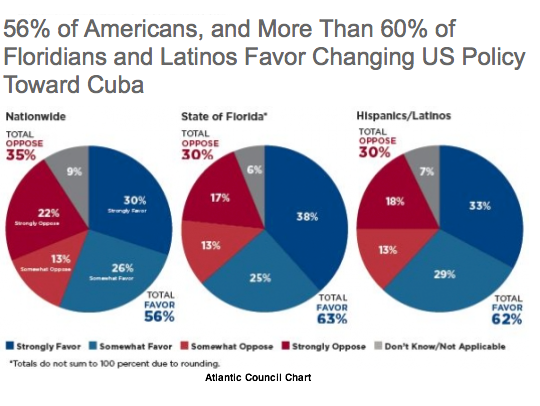
At least Obama is making the effort now.  While the Republicans and the Far Right (among them the exile hard-liners) will scream bloody murder about this, nearly every other player involved - our allies, local nations, a majority of Americans a lot of whom weren't even alive when the Cold War ended - will see this as a good thing.
via Huffington Post


And with luck, Disney will be smart enough to keep the 1950s Art Deco retro look when they turn all of Havana into an Epcot Center.

(caveat: I am writing this from Florida.  Any Floridian will tell you: Do Not F-CK with Disney.  They're like Hyman Roth, only with better PR.  If they wanna turn all of Havana into an Epcot, nothing's gonna stop them)

Wednesday, February 20, 2008

The Cuba Question Part CXLVIII

Yesterday was a momentous time: Pakistan's election openly repudiated Musharraf; Wisconsin's primary openly repudiated Clinton (Jebus! She got creamed by double digits in a blue-collar state that she's supposed to win); Toshiba surrendered to Sony Blu-Ray; and Castro resigned from official duties as Cuba's President.

What's amazing is that all at once Castro's resignation, with obvious signs of old age and illness, both means so much and so little. Even though Musharraf's huge loss has more meaning, Castro dominated the news chatter all day: at the same time, Castro's departure from the main stage doesn't really, honestly, change a thing.

Castro may be leaving office, but he's kept in place a circle of political elites running Cuba that have no incentive or desire to reform their government. His own brother is technically in charge now, and while Raul is talking considerations of reform there's no sign he'll follow through on anything substantial.

The big reason why there won't be any change is because of us, the United States. Our stance on Cuba has not changed in 49 years, and at some points have even worsened, simply because of ideology and stubbornness. While we have legitimate grievances against Castro's communist (and post-Soviet authortarian) regime, we've never attempted genuine diplomacy and dialog. Instead we've forced embargoes, sanctions, denials, covert ops, basically every hardliner stance we could think of. We'd also tried invasion once. We'd also tried exploding cigars and Nair assaults on Castro's beard (I'm not kidding!).

The problem is that all our efforts are wasted: other countries do not observe the sanctions and embargoes, so Cuba stays afloat (barely) financially. Castro and his buddies, meanwhile, use our bullying ways to act defiant and manly, and they get to look good while they do it. And what's worse, we know it's working for them, and not for us.

But we can't change, can we? Even with all the expert advise, all the obvious clues, we can't change our behavior towards Cuba because no one in D.C. wants to upset 200,000 plus Cuban exiles sitting in South Florida... even though a growing number of them think the sanctions and embargoes need to go.

There's also the issue of all the land, property and businesses that Castro seized from the Cuban exile community. A lot of the older exiles who originally owned that stuff insist on getting them back. Unfortunately, it's not just Cuba owning those properties now, other nations have invested and bought them up, so the issue of ownership has gotten waaaaay more complicated. Even Castro's departure isn't going to fix that...

So, what will happen with Cuba? Not much is going to change, not right now. Our politicians will continue to demand political reform, and that Cuba hold open elections, etc. The Cuban leadership will mock, snerk, and insist on their sovereign right to laugh in our general direction.
The older Cuban exile community will continue to sulk; the younger community will head out to dance clubs. The Cubans at home will live with censorship, meager income, low standard of living and high standard health care.

Oh, and everyone is still waiting for the upcoming Batman film. That's about it.