Showing posts with label truman. Show all posts

Wednesday, August 18, 2021

What To Say About Afghanistan In the Aftermath

Me, I'm just a lowly blogger with no direct military, national intelligence, or foreign policy creds.

But I read a number of people on the Intertubes who ARE well-credentialed, and sometimes it's best to just link straight to them to get an idea of 1) what might have happened that led to Afghanistan's government swift fall to the Taliban, and 2) who's accountable for what happened in Afghanistan.

I've quote Adam L. Silverman here before, with his intel analysis and experience that he posts at Balloon Juice, and here he is going into detail about what led up to this past weekend's collapse:

...The agreement negotiated by Ambassador Khalilzad, the Special Representative for Afghan Reconstruction working under the direction of Secretary of State Mike Pompeo on the direct orders of then President Trump makes the Treaty of Versailles look like strategic genius.

The abject surrender is in part one and sections 2 and 3 of part 3. Part 2, which is the Taliban’s responsibilities as a result of the agreement, are not enforceable by the US once the US and its Coalition allies complete the withdrawal from Afghanistan and because of what the US agreed to in part 1: to never again threaten to use force, use force, or interfere in any way in Afghanistan.

What did the US agree to:

1. Release of Taliban prisoners,

2. Lifting of all sanctions,

3. Complete withdrawal from Afghanistan,

4. To never again threaten to use force, use force, or interfere in any way in Afghanistan

5. To seek positive relations with the Taliban

6. To establish economic reconciliation with the new post occupation Islamic government of Afghanistan...

Essentially, the great deal-maker donald trump traded away an entire pro football roster for the sake of getting a Third Round draft pick to snag the best-available college punter. 

Back to Silverman, who noted that the Afghan President Ghani issued a stand-down order that basically made the nation's military surrender, and also noted strong evidence that the manpower of the Afghan military and police were overstated with no-shows and payroll grifts:

We have four documentable, verifiable reasons for why the Taliban were able to so quickly and easily retake Afghanistan and not a single one of them was the result of something the Biden administration did...

Which leads to the second part of what we need to discuss, and I'd like to link to Stonekettle - whose bio has him with an extensive military background - at his blog Stonekettle Station to quote a few words from his article "Bitter Pill" (you should follow the link to read the article in full. It is bitter and brutal and honest and factual about all the follies our nation's done from Vietnam to now in the name of war):

The ragged American forces left in-country are in full retreat, falling back and back to the airplanes that will maybe get them out of the carnage. No time to destroy their equipment. No time to destroy classified materials. No time to save our allies. No time left but to run. And it's the fall of Saigon all over again. All it needs is a sad Billy Joel ballad and some helicopters being pushed into the sea on the Six-O-Clock news. If Joel was still writing ballads and we still had such a thing as the evening news anyway. 

And it's all Joe Biden's fault.

Yes it is. 

But that's not surprising, is it?

No, that's not surprising at all. 

Because that was the plan...

It enraged Trump that the military experts and the diplomats wouldn't kiss his ass like the rest of his cabinet. Wouldn't do what he wanted, just get out of Afghanistan, quit the war and bring the troops home. You're so smart, Sir! So handsome and brilliant! 

No, instead the military experts told Trump what would happen if we just pulled out. They told him how it would go, just like it's going right now. He didn't care ...until his handlers, Bannon, Miller, maybe Ivanka, told him how it would look. 

It would be a disaster, it would be Saigon, and it would be all on him.

He couldn't keep his promise. 

Now, all presidents learn this. 

All presidents discover pretty quickly that they aren't going to be able to keep their campaign promises. 

It happened to Obama. He promised to close the prison at Guantanamo Bay. He couldn't. Congress, Republicans and Democrats alike, wouldn't let him. He had to eat it and he did. Obama learned, like the presidents before him, that the political realities of the office are vastly different when you're actually sitting behind the Resolute Desk. 

But not Trump...

But then, Trump lost the election.

Joe Biden won.

Trump lost the White House and Republicans lost the Senate. 

And that's when Donald Trump could finally make good on his promise. 

As soon as it became certain that he would have to leave office, Trump ordered American forces out of Afghanistan. Trump and Pompeo invited the Taliban to Camp David -- not the actual government of Afghanistan and our alleged allies, but the Taliban. And he turned thousands of Taliban prisoners loose, one of which is now the de facto president of Afghanistan...

And now, Joe Biden owns this disaster. 

Because that's how it works. 

I didn't say it was right. I didn't say it was fair, because it most assuredly is not.  I said that's how it is. That's how public perception and politics work. The buck stops at the Resolute Desk and America will remember this as Joe Biden's disaster. 

Trump, with the support of the most radical elements of the Republican party, finally made good on his promise and left Joe Biden holding the bag

That was the plan...

If everyone in the mainstream media is mad at Biden (and a lot of them are), that's by their own design. Many pundits do not care for the history or causes of why our foreign invasions/occupations seem to collapse upon themselves, they only care to defend their own world-views ("Here's how I'm right and everyone else is wrong") and place blame on those leaders who fail in their (flawed and partisan) judgment.

If the Republicans are mad at Biden - and that's a fucking given thanks to their decades-long partisan rancor and obstructionism - it's a means to deflect the blame for Afghanistan's failures away from the bastards and warhawks who drove us into that nation in the first place after 9/11: The Republicans don't want the pundits or historians to remember that George W. Bush, Dick Cheney, and Donald Rumsfeld sent in our armed forces without a realistic Exit Strategy; and then fucked up the end game even more by dividing our focus and military strength into a needless occupation of Iraq.

The Republicans are desperate to blame anyone else in order to avoid the blame they truly deserve.

And so here's Joe Biden, who has been tossed this hot potato, this live grenade of an ongoing Afghanistan occupation for the United States closing in on twenty goddamned years, all because NOBODY ELSE sitting in the White House - Bush the Lesser, Obama, trump - wanted to fall on that grenade and end the war, because they all knew it would end like Vietnam with the local bad guys in control and American prestige in tatters (although thanks to that prolonged indecision, our prestige already suffered).

And yet Biden has the courage to fall on that grenade. We ought to recognize that.

In Biden's own words, he did not want to pass this burden onto another generation of men and women in a military already fatigued by decades of fighting. In other moments he's quoted saying "I know my decision will be criticized. But I would rather take that criticism than pass this on to a fifth president," said Biden. “I am the president of the United States, the buck stops with me."

With that, Biden defers to Harry S Truman, a President who made hard choices and stuck by them, even as the public opinion soured and when history proved he made the best possible moves.

These are the things we need to remember when we talk now about Afghanistan.

We also need to act and do what our nation can do to provide sanctuary for the thousands of Afghani civilians and government officials who aided the United States in their desire to rebuild a nation that is no longer safe for them.

The Occupation of Afghanistan is over. The fight to save people is still ongoing.

Saturday, March 14, 2020

The trumpian Failure at Presidential Accountability

(update 3/16/20: dammit as always when I least expect it, Batocchio adds me as a link to Crooks & Liars' Mike's Blog Round-Up. Sigh. I DID NOT HAVE CAKE OR PIE READY... nevermind, just hope you enjoy the site, please leave valid and life-affirming comments, and learn the Vulcan greeting salute because handshakes are no longer safe)

Still dealing with a number of real-life issues - things are changing at work, not to mention how my work at a public library is going to get affected by the ongoing Coronavirus pandemic - to where the best I can blog about right now is WHAT THE EVERLOVING F-CK DID trump SAY NOW???

This past week we witnessed trump's White House try to control the messaging on the likely spread of COVID-19 while doing little to nothing about pressing for more testing kits and isolation policies to reduce the risk of that spread. He performed a televised speech to allay fears... during which he ad-libbed falsehoods that caused more panic than calm.

By trying to play to the concerns of Wall Street, trump actually caused two of the greatest stock market crashes in financial history within three days of each other. And as this all went on, most Americans went on a panic run at the grocery store buying up all the hand sanitizer (they should have bought more soap, that helps better) and toilet paper on the shelves (to be fair, if you end up stuck at home for more than two weeks if a quarantine becomes necessary, you'd want the security of reliable bathroom trips too).

So for this Friday, in order to present himself as in charge and in control, trump scheduled a big televised press conference, timed exactly just as the stock markets were closing... just so he could end up showing how little control he had and even worse openly admit he was in charge of nothing.

Think I'm exaggerating? Here's the ABC News clip about it:


"I'm not taking any responsibility at all." Doesn't matter what he's avoiding responsibility for, the fact that he's AVOIDING responsibility ought to anger every American living and past.

FOR THE LOVE OF GOD, RESPONSIBILITY FOR SERVING AND PROTECTING THIS NATION IS IN THE JOB DESCRIPTION.

Let's look back at all the Presidents confronted with the demands of responsibility.

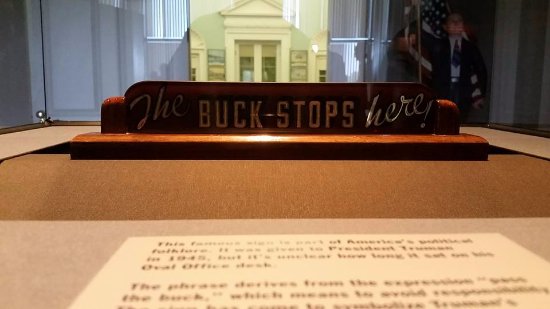
Harry S. Truman, a personal fave, famously had a desk sign:


This photo of Harry S. Truman Library and Museum is courtesy of Tripadvisor

"The BUCK STOPS HERE!" This is now a required meme for anyone sitting in the Oval Office (except of course for the cowardly current occupant who dares not utter it).

Here's somebody that trump won't like to hear from: President Barack Obama taking responsibility for intelligence failures back in 2010. Via Josh Gerstein at Politico:

President Barack Obama on Thursday accepted responsibility for intelligence shortcomings that led to a failed Christmas Day bombing plot on a Detroit-bound airliner, saying, “Ultimately, the buck stops with me.
“As president, I have a solemn responsibility to protect our nation and our people, and when the system fails, it is my responsibility,” Obama said...
Obama’s buck-stops-here message marks a change in tone from earlier statements in which Obama and other officials repeatedly noted that the watch-listing system that failed to flag the suspect, Umar AbdulMatallab, was put in place under the Bush administration.
But while Obama promised to bring more accountability into the counterterrorism system, he indicated he had no plans to fire anyone involved in the missteps prior to Christmas.
“It appears this incident was not the fault of a single individual or organization but rather a systemic failure across organizations and agencies. … I am less interested in passing out blame than I am in learning from and correcting these mistakes to make us safer,” Obama said...
Want more?

While this isn't a quote that happened during his Presidency, Dwight D. "Ike" Eisenhower spoke of responsibility serving as the Allied Commander overseeing the Western European theater. For the Normandy Invasion he wrote two letters. The First Letter congratulated the Allied troops and exhorted them to victory. The Second Letter was in case the landings failed (given the harsh weather and stout German defenses, this was a legitimate concern):

"Our landings in the Cherbourg-Havre area have failed to gain a satisfactory foothold and I have withdrawn the troops... My decision to attack at this time and place was based upon the best information available. The troops, the air and the Navy did all that bravery and devotion to duty could do. If any blame or fault attaches to the attempt it is mine alone."

The letter wasn't needed: D-Day was a bloody but successful landing and led to the Liberation of France within months. Less than a year later, the Nazis fell between the pincers of Ike's forces in the West and the Soviets to the East. However, that letter highlighted character of the man: Eisenhower accepted the responsibility of leadership... and the people knew it. That's one reason "I Like Ike" worked as a slogan, that's a reason why Americans elected him President.

So here comes trump, facing a global pandemic health care crisis that requires bold thinking, getting out ahead of the problem, staying in touch with all players to make sure things get done properly and to the good of all.

Unfortunately, trump's spent the last three years dismantling the government systems, understaffing agencies if not outright sabotaging them. Redirecting efforts towards projects that won't help in this crisis or any other. He oversaw the dismantling of a National Security panel tasked with coordinating pandemic responses, which left much of the federal and state agencies in the dark on who was in charge during the first months of this crisis (starting back in December 2019).

trump's response to all of this? Shifting blame on Obama instead of admitting his own involvement. Arguing that it's Obama's fault there's not enough test kits for this crisis when it should have been something trump's administration ordered done the minute it became clear - mid-January - that the coronavirus was going global. Like Obama would have known back in 2016 this particular virus was going to erupt three years after he left office.

"I'm not taking any responsibility at all."

This isn't even the first time trump has shifted blame in his life. He avoided accountability for his many bankruptcies, he avoided accountability by settling out of his many fraud trials, he avoided accountability for his destruction of a sports league, he avoided accountability for every broken promise and every theft made. And these were all before he ran for the Presidency.

"I'm not taking any responsibility at all."

Here's the one thing required by law in the Constitution, written out as the Oath one must take when entering the Oval Office:

"I do solemnly swear that I will faithfully execute the Office of President of the United States, and will to the best of my Ability, preserve, protect and defend the Constitution of the United States."

Those words REQUIRE the oath-taker to execute the office of the Presidency, to preserve protect and defend the Constitution of the United States which means ensuring the safety of the People - all of US - who keep that Constitution standing. These are words, this is an Oath that REQUIRES responsibility out of the person who swears to it.

trump won't take that responsibility. he's openly admitting to it now, something a lot of us knew for years and we saw this moment coming.

We're in a major crisis this month and the person most responsible to lead us through it won't be responsible at all.

We are so very royally extremely sickeningly fucked.

Sunday, September 25, 2016

Comparisons

If I had to compare the two major Presidential candidates to previous office-holders - so that people could see what the potential administration would be like after 2017 - I'd have to go like this.

To compare Donald Trump to three previous Presidents, in reverse chronological order, I'd go:

George W. Bush. AKA Bush the Lesser.

Even though Dubya did have a Positive outlook on the role of the Presidency - and came into the office with enough experience to at least fake competency (until it was too late) - he shares with Trump one glaring sin: Sheer ignorance of the real world when it comes to making informed decisions. Trump as President will get caught flat-footed and clueless on far too many crisis moments, making bad decisions and even no decisions allowing emergencies to turn into disasters. Anything along the lines of a Katrina can happen, and on a greater scale.

Richard Nixon.

Just on the constant lying alone, Nixon and Trump are soul brothers. In other details, Trump has a recklessness when it comes to delegating authority to untrustworthy underlings. Trump has clearly made enemies and has made it known he'll use the White House to inflict revenge. Whereas Nixon at least grasped foreign policy and to my knowledge worked with our allies as well as our opponents, Trump never will. And Nixon did show a level of bipartisanship with Congress to pass legislation and get things done: even with a fully Republican Congress there is a likelihood Trump's ego will burn too many legislators.

Andrew Jackson.

I know this is a bit of reach going back that far, but honestly in terms of temperament Jackson is a very good example to suggest how a Trump Presidency would look. Jackson led with his massive and angry ego: every political issue he made a personal matter, and obsessively went after the institutions to fulfill his Populist agenda without care or concern of the consequences. Jackson had a slash-and-burn mentality that wrecked his own party, creating political divisions that haunted the nation for decades afterward. Trump will lead the same way. Consider also Jackson's horrific record mistreating Native Americans, and you have a carbon copy with Trump's open hostility to Blacks, Mexican, Chinese, and Muslims.


To compare Hillary Clinton to three previous Presidents, in reverse chronological order, I'd go:

Bill Clinton.

The guy standing next to her at most formal functions and the dude to make the history books as the first President to be the First Husband. Where I listed Bill as an Active-Positive, Hillary will not share his skill set as an effective bipartisan deal-maker. Bill is also effective and inspirational as a speaker, able to speak to the issues with a touch that few modern politicians can master. Hillary does share Bill's empathetic nature, but hasn't established a style that can display it well. With Bill in the same White House as hers, he will become an invaluable advisor able to keep her focused on positive agenda while she pushes with a more aggressive style he deployed.

LBJ.

The most direction comparison I can make for Hillary. They share a lot of traits: the need for control, the need to prove him/herself, stubbornness disguising itself as will-to-power, the noticeable insecurities of being in someone else's more popular shadow (for LBJ that was FDR and Kennedy: for Hillary that's Obama and her own husband). Johnson was one of the better Presidents when it came to getting bills through Congress even against incredible odds. Hillary will have the same temperament to get the job done, and has enough understanding of how Congress works - having been a Senator - to follow in LBJ's footsteps. The problem here is that Hillary's stubbornness and Us vs. Them mentality she's displayed before as First Lady (her handling of the 1993 Health Care bill failures) is exactly akin to Johnson's: it's the same kind of mindset that led to Vietnam turning into a quagmire and Johnson's own Great Society agenda turning into a bureaucratic mess.

Harry S, Truman.

The direct comparisons aren't noticeable because Truman's more Active-Positive mindset towards governance conflicts with Hillary's more Active-Negative world-view. However, they share a handful of virtues topped off by driven dedication to homework and awareness of the issues at play. Truman governed with a Confident style, which is what Hillary can aspire to as opposed to a more confrontational one.

So, that's how I see the candidates.

Trump will be the next Dubya, the next Nixon, the next Jackson. Each one of them leaving legacies of economic and political disasters. There are no upsides here. No likelihood of improvement or effective leadership, and every likelihood of civil unrest and economic collapse.

Hillary will be much like her husband Bill, and like Johnson, and hopefully in her better moments another Truman. At her worst she'll be another LBJ coping with a morally dubious debacle that could sink her administration. At her best she'll be maintaining a solid yet underperforming economy with a few foreign policy wins, overseeing  Left-leaning shift in the Judicial system, and in strong position to earn a second term in 2020.

Saturday, September 28, 2013

Presidential Character: Week Thirty-Three, Serving Crow Since 1948

A statesman is a politician who's been dead for ten years. - Harry S. Truman

To flashback to earlier Presidential Character reviews, I've often lamented the failings of how the party candidates screw up their selecting Vice Presidents to balance out an election ticket.  Ever since the ticket system was designed - 1800 election with Jefferson / Burr - it's been more headache than solution.

Part of the problem has been - remains - the need to literally balance the ticket between the winning Presidential candidate representing the party with someone who represents one of the losing factions that needed placating.  As a result you'd get a Veep who would not only be philosophically opposed to the President but most likely psychologically opposed as well.  You'd start off with an administration behaving in one way following the President's Active/Passive - Positive/Negative habits... and then if something bad happened to that President you'd get an administration suddenly following different traits, sometimes for the worse.

More often than not - Harrison to Tyler, Taylor to Fillmore, Lincoln to Johnson, Harding to Coolidge - you'd get a radical shift of personalities that ruined the political dynamics of the era.  There's been a few transitions where the incoming Vice President - Chester A. Arthur, Theodore Roosevelt - proved to be a boon rather than a bust, but when it comes down to it the parties ought to do a better job of selecting their Vice President candidates with an eye towards a risky future.

The first time - in some respects the only time - a serious effort to line up a candidate for the Vice Presidency was in 1944 for Franklin D. Roosevelt's fourth campaign.  It was pretty much a given that FDR was going to win: the nation was full into World War II, things were going well on the home front and the front lines, and FDR had remained popular with voters.  There was no need to "change horse in midstream," the standard argument against voting out an incumbent during wartime.

However, everyone within FDR's circle knew Roosevelt was dying (himself included).  In 1940 Roosevelt had campaigned with an extreme liberal Henry Wallace to shore up the far left faction of the Democrats on the eve of World War II, but Wallace's soft stance on Communism (the Soviet kind) made the party worry by 1944: while the Allies had teamed up with Josef Stalin and the Soviet Union to defeat the common enemy of Hitler's Axis, Stalin was still a devil and having someone like Wallace eagerly dealing with him as President was a horrifying thought.

The party leadership - the backroom dealers and FDR's inner circle - began searching for a suitable replacement.  One name kept coming up: Harry S. Truman, Senator out of Missouri.

Truman wasn't the first choice, though: James Byrnes out of South Carolina was.  Byrnes had served in a variety of state and federal offices, and was one of FDR's closest advisors.  But where Wallace was too liberal, Byrnes was too conservative, and Truman quickly became the kind of compromise candidate a party chooses for the top half of the ticket.

It wasn't hard to see why Truman's name raced to the top of the list.  He'd been a solid and loyal party member since before World War I, someone who may have come from a corrupt political machine but was himself honest and incorruptible, and a major Senatorial player supporting the New Deal from the get-go.  Truman served in the first world war, earning the rank of captain and showing his stripes as a battlefield leader.  Really making his reputation was his stellar work on an oversight committee during the first years of the War Effort that clamped down on waste and war profiteering (on a budget of $360,000 Truman saved the nation around $15 billion from waste and fraud).

But there had to have been another factor at play here, and James David Barber makes note of it during his review of Truman's style:

Truman's style in decision making had two large elements. One was the close attention to detail, the studious homework he drew out of his early reading, his experience in detailed jobs, and his successful canteen management and personal reconnaissance in the Army.  Truman as President could and did study hard... The other element was the decisiveness - the habit of nearly impulsive assertion of definite answers - that was the bring him such difficulties as he "shot from the hip"...  In a world of uncertain people, Harry's style of deciding - yes or no, on the spot, right now - could be impressive, could bring him a reputation for leadership. (p.313)

Barber had Truman in the Active-Positive category, partly because of that decision-making (pure Active) but also because Truman was a hard political campaigner: working in the rough world of state-level politics - especially southern politics with its racial issues and populist anger - taught Truman to fight hard for the offices he campaigned for.  While not a practiced or well-known orator, Truman was a font of quips and one-liners, a Deadpan Snarker who disdained puffery and went after what he saw was the truth (and because of that attention to detail Barber noted, it was truth based on researched fact).  A-Ps in Barber's evaluation were tireless campaigners, enjoying not so much the fight but the chance to get in front of the issues, make a case, confront a problem.

Roosevelt himself was an Active-Positive, and one thing A-Ps love are fellow A-Ps (the other Roosevelt thought he found a fellow Active-Positive in Taft which was why Taft got tabbed as his successor... when Taft proved Passive-Positive Teddy came to regret that move).  Roosevelt saw in Truman a dedicated New Dealer, someone who would carry the banner of the cause on his own terms but still one that FDR would recognize; a tireless worker whose fraud-busting efforts showed a commitment to honest government.

Ironically, Truman didn't want the Vice Presidency - he was convinced Byrnes would be the choice, and even kept a nominating speech for Byrnes with him during the early stages of the convention - and had to be pressed into taking the nomination during a staged phone call between FDR and a room full of party leaders.  Truman knew to some extent of FDR's frail health, but wasn't entirely in the know, and so in most respects he was genuinely stunned when 82 days into the fourth term FDR died and Truman became President.

While Truman didn't want the job, the A-P trait of being Self-Confident became the defining trait of his administration.  Truman's Presidency desk famously displayed a message: The Buck Stops Here.  And Truman meant it: when he made a decision he followed through, owned up to it, made his arguments, did his best to accept the criticisms of his allies and did even better shooting down the criticisms of his enemies.

The clearest example of Truman's decision-making was his earliest decision: making the call on using atomic weapons on key Japanese targets.  Having only been told of the Manhattan Project right after ascending to the Oval Office, and facing in mid-summer the sobering possibility of a massive invasion of a fortified Japan.  Confronted with the projected losses following the fierce and bloody Battle of Okinawa - both military and civilian lives lost on the Japanese mainland into the hundreds of thousands - and also confronted with weapons that could fell a single city with a single bomb, Truman made the decision to use the bombs our nation had to press Japan into surrender before a mass invasion was needed.

The decision has been debated since the moment it was made.  Proponents siding with Truman noting that Japan's martial culture would have guaranteed a massive and bloody defense against any landings; opponents arguing that the use of such weapons - more lethal to civilians than military targets - were tantamount to war crimes.  In hindsight an argument could have been made that diplomacy could have worked: but it would have taken months or years with no guarantee of peaceful resolution, and the Japanese Army was adamantly against any surrender.

If the estimated casualties of Operation Downfall were correct even at the most conservative - about 23,000 during the first 90 days - it would have been bloody but far less than the total death count of Hiroshima and Nagasaki (150,000).  If the larger calculations throwing in a civilian uprising were right, it would have gotten into 1.7 million American casualties and 5 million Japanese, and those death tolls for the atomic bombs would have been a more acceptable - but still painful - alternative.

Truman owned up to the decision of dropping the bombs - he insisted on military targets only - but wasn't aware at the time of how destructive such a weapon could be.  When it came out how the devastation wiped out civilians as much as military bases, Truman had to have learned from that... because the next time the use of atomic weapons came up - the Korean War, and China's intervention into it - he flat-out opposed it.

Past that, Truman's Active-Positive traits carried him through his first term.  He carried on the War Effort towards victory in Europe and in Japan.  He presided over the formation of a United Nations, an attempt to improve on the failed League of Nations, this time with an active United States backing it up.  Remembering his own experiences of post-war economic downturn after World War I, Truman did what he could to keep the post-war economy churning through price controls.  When unions struck, Truman used the power of the office to "draft" the unions and nationalize the affected industries to keep them working.

When Stalin openly reneged on his promises and seized control of Soviet-held nations in 1947, Truman issued his Doctrine of supporting "all free peoples who are resisting subjugation."  This went towards keeping Greece and Turkey from falling under Soviet domination (albeit at the cost of rather messy civil wars).  This was followed up with the Marshall Plan, an ambitious foreign aid program to rebuild war-torn Western Europe before the Stalin-backed Communist factions could use the economic malaise to their advantage.  And part of all this was the Berlin Airlift, Truman's solution to a Soviet blockade of West Berlin (Germany and Berlin had been divided up into allied-controlled sections, with West Berlin a sore point in Stalin's control of East Germany).  Rather than press a military confrontation on the ground, Truman coordinated flights into West Berlin daring Stalin to shoot down the planes performing publicly recognized humanitarian supply efforts.  Pretty much the best display of Truman's Adaptive skill, it worked: Stalin wouldn't cross that line and the blockade was lifted.

All of these were actions an Active-Positive President would preside over: the use of government power not for the personal gain but for the gains of others.  He didn't display the A-P trait of Adaptive, but instead showed the willingness to be Confident in the use of executive power to get done what needed doing.  But wait, there's more.

Harry S. Truman was the first President since Reconstruction to make serious gains in ensuring civil rights for Blacks.  He had followed the struggles of Black soldiers during efforts at integration during World War II and had been sickened by the reports of lynchings that occurred during and after the war.  By 1948 he issued an executive order desegregating the armed forces, the first major blow for civil rights since the 15th Amendment.

Truman also became the first global leader in 1948 to recognize Israel's right to exist as a nation.  Warned it would upset Arab nations and cut off American access to much-needed oil, Truman couldn't ignore the fact that the Nazis had just attempted a Final Solution to wipe out Jews altogether, and that the Jewish people required a homeland to ensure their survival.

In these, Truman was using the A-P initiative of getting ahead on civil rights issues and sticking to it.  He pursued these points even in the face of political opposition, especially as 1948 was an election year.

By 1948 Truman and the Democratic Party was facing long odds indeed.  Despite the successful conclusion to the war, there was the struggle to rebuild Europe and Asia and the home front, there had come a kind of political fatigue to the whole thing.  Democrats had been in charge of things since 1933, a full decade had passed and then some, and the strain of a prolonged rule was showing.  The failures of the Republicans leading up to the Great Depression had almost been forgotten.  Truman's popularity wasn't all that great, and the Democratic Party had developed serious internal factions during FDR's prolonged tenure.

Henry Wallace was pretty bitter about getting booted out of the Veep spot for being too liberal, and like all wingnuts (leftist and rightist both) was truly convinced of his liberal platform.  He broke off and formed his own Progressive campaign.  When the Democratic platform at the convention came out with a strong civil rights policy that Truman publicly adopted, the Southern Democrats (Dixiecrats) walked out of the convention.  And when Truman signed that executive order desegregating the armed forces two weeks later, South Carolina's (yeah, them again) governor Strom Thurmond announced his own campaign for the Presidency on a racist "States Rights" platform.  The Democratic Party had basically disintegrated into three parts, where the Electoral system favored two parties (Democrat and Republican).  The Republican Party - nominee Thomas Dewey as their candidate - could pretty much lean back and coast to victory.

Except for the fact that the Republicans and Dixiecrats and Progressives were all up against Active-Positive Harry S. Truman.  A-Ps love the fight not for the sake of the fight but for getting something accomplished.  And Truman was up for this.

Truman's campaign was aggressive from the start.  He went after the Republicans in Congress for their conservative attempts at culling back the New Deal and at the gains workers - and an increasing middle class - had made.  Calling them "Do-Nothing", Truman made a show of calling for a special session of Congress to pass economic legislation.  Considering it a trap of sorts, the Republicans showed up but did little, inadvertently playing into Truman's accusations.  Truman effectively ignored both Wallace and Thurmond, since they were both in effect single-issue candidates lacking genuine broad appeal.  And Truman went on a whirlwind railroad tour of the nation, derisively called "whistle-stops" by Republican-backing newspapers but in fact hosting turnouts in the hundreds of thousands of supporters.

The national media didn't even seem to notice.  Mostly owned by conservatives or following "conventional wisdom", the newspapers failed to keep up with any polling past September and failed to notice Truman's public support.  It had become "conventional wisdom" that Truman was unliked and that it was due time for Republicans to return to the White House.  Assurances of Dewey's victory in November were rampant.  Right up until Election Night itself.

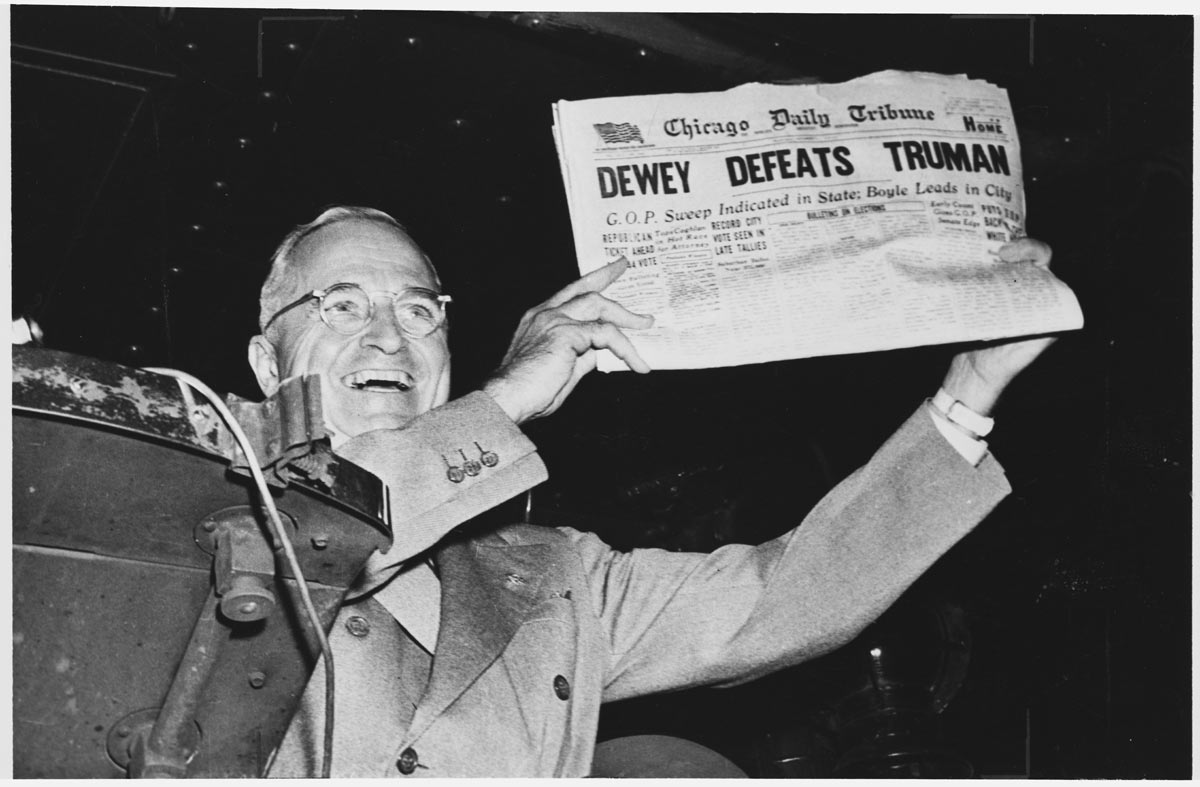
From the National Archives.  There's a reason Truman is smiling, and it involves being a badass.
That photo is arguably one of the most famous in American history.  One of the great reminders that "it ain't over until it's over," and that Truman had the political skill of the Active-Positive driving him to success (also it was another reminder that the geniuses inside the Beltway aren't as smart or as informed as they think they are).

The second term of office proved much tougher (history proves us that, regardless of the success or skill of any President): above all, Stalin encouraged his North Korean allies to invade South Korea, setting off the Korean War and the first major test of Truman's containment policy.

It was Truman's Confident trait that caused half the problems he faced going into this fight: he pursued an international coalition through the newly formed UN as both an effort to boost the UN's prestige and to avoid getting a declaration of war out of Congress that he felt wasn't necessary.  Both moves hurt him stateside.

The other half of the problem was dealing with Douglas MacArthur.  One of the most quixotic generals in American history, MacArthur could be a strategic genius and a tactical moron.  At the same time.  Having blundered through the first half of the Second World War and then regaining prestige and popularity towards the end of it, MacArthur was the general placed in charge of the Korean War efforts.  Pulling off one of the best military maneuvers in history at Inchon - making an amphibious assault under harsh conditions - MacArthur proceeded to overplay the UN's agenda by pursuing the North Korean forces right up to China's borders well enough for China to worry about invasion.  Despite Truman's warnings not to provoke the Chinese, MacArthur did so... and drew the Chinese 2 million strong into what was supposed to be a small-scale police action.

When the tide of fighting turned to stalemate, MacArthur pressed for the use of nuclear weapons, and worked under the belief that he had control of the arsenal - and ultimately the Army - and not Truman.  This was a critical moment in American history.  While there had been differences between Presidents and Generals before, tradition had developed that the civilian leadership controlled the military, that the President was Commander-in-Chief and that it kept the military in check.  MacArthur believed in Total Victory regardless of the objectives: Truman believed in containing Communism but avoiding perpetual warfare. Worse, MacArthur was privately and publicly undercutting Truman's authority as President.

Truman fired the son-of-a-bitch.

One other thing to note about Active-Positive Presidents: they do not do things because they are popular.  They do things because they are hard, and worth doing.  Firing MacArthur was political suicide in 1951: calls for impeachment were rampant and MacArthur returned a hero.  As the months passed and as Congress investigated Truman's decision, a lot of MacArthur's bullheaded actions were made public, and the decision Truman made became reasonable.  But the damage was done.  And Truman took the heat for it.

By 1952 the Korean War was a stalemated mess.  America got hit with a recession, and Truman's popularity was right around 22 percent, one of the lowest ratings in the history of polling such data.  When Truman's early forays into primaries for re-election went sour, he saw the writing on the wall and made the decision to not run again (he was exempt from the passage of the 22nd Amendment capping Presidential terms).  Truman did not leave office on the best of terms, but he left them on his terms and took his retirement to heart.

When historians speak of Truman's legacy, the first thing they'll note is that Truman is one of the first Presidents to have his reputation improve dramatically within years of leaving office.  It helped that a lot of what Truman believed in - keeping the New Deal agenda strong, avoiding full war in Korea/China, avoiding further use of nuclear weapons - turned out to have been the right calls.  Whenever a President drops significantly in the polls nowadays, they'll point straight to Truman and use him as an example of being unpopular but correct (despite how incorrect such a failing President might be).  Truman tends to appear in the Top Ten of any Presidential list ever since such lists were made, and if he's not he's usually slipped to Number 11.

Can't end this Truman fest without posting one of his best known quips: My choice early in life was either to be a piano-player in a whorehouse or a politician. And to tell the truth there's hardly any difference.

I motherfucking love this guy (except for the whole "Nuking Japan" thing, and even then I'll grant that was a tough call to make).  I'm glad I share a birthday with him.

Next Up: Everybody Likes Ike... Despite His Traits