(This is the fourth article, going Four For the Fourth on the 4th of July, hope you read the others)
Thank God there's a decent-looking Superman movie on the horizon:
In terms of technical skill, the Snyder Man Of Steel/DCU movies were okay, but too grim and dark for the more aspirational, brightly lit world of Superman. It may have worked for Nolan's Dark Knight trilogy as Batman is meant for the shadows and moral compromises, but not for a hero who represents Hope. Well, along with Truth and Justice. Just not "the American Way," because in these trumpian times the American Way is sadistic and cruel.
So here we are September 4th, 2023 set as Labor Day holiday, when our hyper-capitalist society/government pays lip service to the vitality of Workers' rights (while businesses stay open forcing those workers to miss any actual vacation time).
So while we can cheer on the screenwriters and the actors who are fighting for their livelihoods - for better and consistent pay, for ensuring AI doesn't remove the human element of creativity, for bigger pieces of the pie that the CEOs are hogging for themselves - we should also take note of what Labor Day also signals: The unofficial end of the summer.
Technically, autumn begins on the equinox (this year's is September 23) but as most of our lives revolve around school (as kids and as parents and workers) we think of our seasons in that regard. Summer is when school breaks (usually after Memorial Day) and when school resumes (most places the week before Labor Day, although some places planning ahead for bad weather days have moved it earlier).
Hollywood noticed the summer months were great for business, starting in the 1970s when crowd-pleasing blockbusters like Jaws and Star Wars realigned the production model for the decades that followed. As a result, every weekend between Memorial Day and Labor Day were programmed for budget-busting extravaganzas that the studios gambled on generating insane profits to cover their losses on the gambles that failed.
While the summer blockbuster calendar has evolved over the years - Hollywood has found April as good a time for big-budget films as May - it's become an annual tradition. It's also become an annual tradition for Hollywood to release certain types of films in the other seasons: Autumn becomes a time for romance and horror (Halloween, kiddos) flicks, and Winter (at least before January) the time for stylish low-budget movies to get into the film critics Year's Best lists and aim for the Golden Globes and Oscars awards to give themselves artistic pretensions. January is when you dump the movies you don't expect audiences to enjoy - although some do become blockbusters because the studio heads didn't get it or else the film plays to a timely issue - before a mini-cycle of romance and horror flicks in February to lead into the next cycle.
Having grown up to the Blockbuster era - ever since I got hooked on Star Wars - I've paid some attention to how this system works, and have gotten a little frustrated over the years about how Hollywood and their film academy mistreats the big money-makers of the summer when it comes to doling out the awards signifying great work and craftsmanship.
I was livid in 2008 when the Dark Knight got ignored for a well-deserved Best Picture nomination, and it's been a point of contention with me since Mad Max Fury Road that Hollywood needs to realize that despite the money-making interest of blockbusters many of those films are genuinely well-made. Audiences may be lured to spectacle but they're also lured to well-written stories, well-acted performances, and eye-stunning camerawork. The Oscars do hand out technical awards and the production-value awards like Visual Effects and Sound Editing, but the top-tier awards like Best Actor/Actress, Best Director, Best Picture? It's insanely rare for a crowd-pleasing blockbuster to win any of those awards much less get nominated, especially if it was a summer release film.
To that I say "No More." It's high damn time that we start recognizing the effort, sweat and blood and tears that go into the blockbuster films and crowd-pleasing surprise hits. If there was anything good about the backlash following the Dark Knight snub was how it opened up the Best Picture category to cover up to 10 films, expanding the odds that a box-office winner can win the Oscar as well. Here's my list of "YOU BETTER NOMINATE THESE FOOKING MOVIES ELSE THE STREETS OF L.A. WILL SEE RIOTS" nominations:
M3GAN: It's about time the January dump movies get a champion to rally their cause. Yes, it's a campy horror movie. Yes, it's another "Robot Turns Violent" movie. Yes, it's not supposed to win awards. But the audiences picked up on the black comedy, caustic criticisms of the Silicon Valley business model of rushing production, and sly way the whole thing got put together. Getting any of the technical awards would be likely, but also Best Makeup or Costuming (for the work on making M3gan a believable humanoid) as well as Best Screenplay alongside the Picture nom. Horror movies need more love, dammit.
Granted this is another horror-comedy movie in the M3GAN vein, with the caveat that this film had its own interesting real-life backstory that ensured a built-in audience. What gives this film the award-worthy boost is the quality of the cast - a surprising number of A-Listers and award winners - and people involved in its production (Phil Lord and Chris Miller, two guys responsible for the best post-modern franchise works of the past decade). Despite the silliness - and shocking gore - of the film's plot, there's a lot here to qualify Cocaine Bear for Best Picture, along with Best Actor (DAMMIT RAY DESERVES IT) and Best Catering.
Admit it, this is the Hero Shot for Cocaine Bear
Spider-Man Across the Spider-Verse: When the Dark Knight got snubbed in 2008, another critically-acclaimed blockbuster in Wall-E also failed to receive a Best Picture nomination. That snub was due to Wall-E being animated, which exposed the Academy's snobbery when it came to animated film. Apparently, nominating Disney's Beauty And the Beast back in 1991 did not set the standard: All it did was create a new Oscar category so that the award voters could go right back to ignoring high-quality animated works.
Thing is, animated movies still count (Foreign feature films, after all, can get nominated for Best Picture as well). So Spidey better be under consideration Academy members, because GODDAMN this film was a literal work of art. Pulling from different art styles - watercolor, diagrammatic, cut-paste, stop-motion - and layering it with thousands of details - and thousands of differently drawn Spider-Men - you can hang individual cels from this movie in museums. Tying it all together are impressive voice-acting performances (ANOTHER thing that ticks me off is how the Oscars ignore voice acting, but that's another rant) and a tight yet expansive screenplay pulling on the Spider-Man mythos to set up legitimate drama, humor, pathos, and tears. The last third of the movie itself is considered one of the best (and darkest) cliffhangers since Empire Strikes Back.
This is a movie that deserves Best Picture consideration as well as Best Director, Best Editing, Best Sound and Sound Editing, Best Screenplay (adapted), and with any luck FINALLY a vocal performance - Shameik Moore, Hailee Steinfeld, Daniel Kaluuya, Oscar Isaac - getting an acting nom.
This is NOT the Hero Shot for Miles Morales or Spider-Gwen Stacy. You have to watch the movie to see their individual moments of AWESOMENESS.
It is hard to separate each movie now, not just because of the cultural memes that the Barbieheimer Event generated, but because of the eerie similarities and reflections shared between both films. Both movies with auteur directors deserving of Oscar consideration. Both movies with surprisingly well-plotted screenplays addressing the human condition (vanity, fear, the questioning of our place in the cosmos, gender role expectations (yes even in Oppenheimer)). Both movies with deep pools of actors that could earn the films multiple Acting nominations.
There is a terrifying possibility that given Barbie's blockbuster status (still ongoing) as one of the biggest box-office hits of all time that the Academy will ignore it for the Big awards - Picture, Director, Actor, Actress, Screenplay, Cinematography - when this year's nominations are made. They dare not. Every critique and review of the movie spells out the artistic merits in spite of it being a mere "Intellectual Property" product. Audiences are not going back to re-watch that movie because of the memes but because Barbie - especially its themes of women's identity - speaks to them as an experience, something very few films - even the artsy pretentious ones - can affect.
Oppenheimer - as I mentioned before - was clearly Oscar bait from the get-go, but genuinely earns that consideration due to the high quality work put into it. That it will get Best Picture, Best Director, Best Actor (Cillian Murphy), Best Supporting Actor (Robert Downey Jr), Best Screenplay (adapted), and likely Cinematography and Editing won't even be up for debate.
What will be up for debate will be which of the two movies - joined at the hip by fate forever now - will actually win the big awards when the time comes next February 2024 when they open the envelopes and hand out the Oscars.
(glances back and forth)
I say go for it. Academy voters, figure out the math and plan ahead to make it so that BOTH Barbie and Oppenheimer tie in each category they qualify for. DO IT. SHARE THE OSCARS. Share the Acting trophies (Murphy and Gosling for Actor, Robbie and Blunt for Actress), share the Director's (Nolan and Gertwig), share the Editing, share the Cinematography, share the Best Picture (it's what they should have done for La-La Land and Moonlight). Hell, share the Sound Editing and Set Designs and the Costuming awards. I think the only things you can't share are the Screenplays (Barbie may be an IP but the script is original) but get the Original and Adapted anyways!
BARBIEHEIMER 4EVAH.
Granted, this will suck if you're a Spider-Man fan, but honestly Best Animated Feature by itself is still a worthy award...
ANYWAY. GET TO IT, HOLLYWOOD. MAKE IT SO THAT WE ONLY AWARD THE TWO BEST MOVIES OF THIS SUMMER TO---
Okay, with all the chaos going on in the political world, are we the United States ready as a nation to handle a cultural moment like having two movies not compete but complement and co-exist with each other?
Because we're at that moment July 21 2023 where the Hollywood tradition of "counterprogramming" - where a movie release of obvious blockbuster proportions makes it difficult to release other films, except giving a smaller sometimes more artistic movie a chance to attract audiences that are not attuned to that blockbuster - offered us the movie Barbie - a comedic, lighthearted, brightly colored goofball type of movie based on "Intellectual Property" (IP) bringing in an established and fervent fanbase designed solely to entertain and make $500 million at the box office - versus Oppenheimer - a dramatic, darkly lit serious biographical epic focusing on the man most responsible for the atomic bomb and the world-shattering implications of such a weapon, and designed to be Oscar Awards bait - to be the highlights of a movie summer season.
Except something weird happened. The movie-going fanbases got into the "counterprogramming" effort - we are now as a species in a kind of post-modern awareness of tropes - and started complementing each other's films to where a contingent of filmgoers openly planned to watch both films as a double-header.
At a glance, the audience overlap isn’t clear. “Oppenheimer,” starring Cillian Murphy, Robert Downey Jr. and Emily Blunt, is a somber character study about the theoretical physicist who led the development of the atomic bomb. “Barbie,” featuring Margot Robbie and Ryan Gosling, is a neon-hued fantasy comedy about Barbie-Land expats who go on a quest for self-discovery in the real world. Visually, “Oppenheimer” is moody and intense, while “Barbie” is a physical manifestation of the color pink. Yet the contrast is the very thing that’s galvanizing film lovers.
“This could have been something dividing the masses, but instead it’s bringing everyone together,” says Nicole Boisseau, a 21-year-old Richmond, Va. student. Her dad, Jay Boisseau, who also has tickets to both films at Alamo Drafthouse on opening weekend, says that jokes aside, the mismatched scheduling works out for viewers. “Since they are so different, it’s not like you’re going to spend six hours watching the same thing,” he notes.
And as Rubin points out, as the fandoms got more into the idea of the double-feature, the situation got weirder as people noticed that the two films are going to be stunningly similar in archetypal ways:
But his daughter believes the movies have more in common than meets the eye. “They’re both questioning the nature of humanity.” (She’s serious. During one hilarious scene in the “Barbie” trailer, Margot Robbie’s life-size doll turns to her friends at a dance party to ask: “Do you guys ever think about dying?”)
That wham line from the trailer did indeed spark a new wave of discussions among the Barbie faithful, as more clues from other trailers and teasers pointed to that film sending their character on a Hero's Journey to find out what is wrong with herself (more specifically, what is wrong with the young girl that Barbie represents). The "something weird" got weirder... and more profound.
The audiences began realizing that instead of a cheap, fun, almost perfunctory piece of entertainment - like the animated Super Mario Bros movie released earlier this year that performed to box office expectations - they were getting a Barbie movie from a film auteur willing to explore the deeper ramifications of the doll's cultural impact since its introduction in 1959, alongside a bioepic film about the inventor of nuclear Armageddon from an equally imposing film auteur who knows how to stir emotional awe and enlightenment out of the darkness itself:
Some cinephiles believe it’s because the two filmmakers inspire a particular kind of loyalty in their fans. Nolan, who has delivered commercial winners like “The Dark Knight,” “Inception” and “Interstellar,” and Gerwig, the indie favorite behind “Lady Bird” and “Little Women,” are the rare directors who can draw audiences on their name alone.
“It comes down to the filmmakers, who are widely respected. They complement each other in a weird way,” says Meredith Loftus, 30, of Los Angeles. She compared the scheduling to an unusual double-header in 2008 of Nolan’s superhero epic “The Dark Knight” and the kitschy musical “Mamma Mia!,” which opened on the same day...
I'd discussed Nolan's Dark Knight before, when honoring Tiny Lister's passing, and how Nolan took an IP themed "product" - Batman - and crafted a noir-ish operatic epic that not only won the box office but wowed the film critics. I'd written elsewhere how The Dark Knight deserved Oscar love and yet got snubbed in such a way that the outrage reshaped the awards to accept more films for Best Picture (and opened the door for action thriller-type movies like Mad Max Fury Road to achieve the honor of getting nominated).
We're now facing a similar moment with Greta Gerwig taking an IP themed Barbie and turning it into an Oscar contender. Seriously, more than just the (deserved) Set Design and Costuming nods the film's likely to get (just the fact alone that the production used up every pink paint and dye on the planet should get the awards).
We're talking about a movie where the early reports about the plot - confronting the themes of Stepford Wives-ish suburban conformity, the gender roles that Barbie (and Ken) impart to the girls and boys who play with them (and reflect back onto themselves), the struggle between matriarchy and patriarchy as the fantasy of Barbies who can do everything - doctor, lawyer, President, mermaid - crash into the harsh real world where men are mostly in control and Barbies are treated as sex objects, even the fact that Barbie is an "Intellectual Property" of Mattel that the company (represented by Will Ferrell's CEO) insists on "keeping in a box" ("biting the hand" humor indeed) - that clearly makes the film more philosophical and wistful than a simple Product Placement movie is expected to be.
Anchoring all that are performances that fans are already expecting to be excellent. Margot Robbie arguably was born to play Barbie her whole life - naturally blond, dancer's legs, the slim body that the Barbie doll is (in)famous for - but with an expressive face that can convey incredible gravitas (and she's been Oscar nominated before, so unless Meryl Streep and Helen Mirren and Natalie Portman and Jennifer Lawrence and Angela Bassett all come out with jaw-dropping lead actress roles this autumn, Robbie should get her due). Ryan Gosling - he of the Photoshopped washboard abs - is also getting critical acclaim for his role as Ken, the "boyfriend" that culturally has been reduced to just another accessory for Barbie but whose exposure to the real-world "Alpha Male" movement threatens the stability of the fantasy Barbieland back home (Gosling has also received Oscar nominations before, so as long as Leo DeCaprio and Jamie Foxx and Timothee Chalamet and Andrew Garfield and Denzel Washington and Tom Hanks don't come out with serious lead actor roles this autumn, Gosling should get his due).
In the face of all that, the expectations for Oppenheimer are lower in terms of box office but higher in terms of critical acclaim: There is already Oscar talk for actor Cillian Murphy, and Nolan is bound to get another shot at Best Director. Given the A-list talent - Matt Damon, Robert Downey Jr, Emily Blunt, Kenneth Branagh, Florence Pugh, Rami Malek - on-board other acting nominations are likely, and a lot of technical award nominations as well.
There's not much spoilers to what the audiences will know about the plot: We all know what happened July 16th 1945 when the Trinity Bomb test took place and the Atomic Age was no longer a product of Science Fiction. We all know there were serious debates among the physicists, military leaders, and politicians about the ramifications of weaponizing the atom. And we all endured the decades of Duck And Cover, the Cuban Missile Crisis, the Doomsday Clock, Mutually Assured Destruction, "Shall We Play A Game?", and the post-Cold War nightmare of rogue nations carrying suitcase bombs.
Like all the other epic biographical films of before - Lawrence of Arabia, Gandhi, Weird: The Weird Al Story - Oppenheimer tries to delve into the background and motivations of a real-world figure whose personal life is still not well-known or understood. The general awareness is of a scientist who pushed during the Second World War for the creation of nuclear weapons before Nazi Germany could unleash them first, only to realize the dangers he himself brought to the world and later tried to atone for the damage he'd caused.
We knew the world would not be the same. A few people laughed, a few people cried. Most people were silent. I remembered the line from the Hindu scripture, the Bhagavad-Gita; Vishnu is trying to persuade the Prince that he should do his duty, and to impress him, takes on his multi-armed form and says, 'Now I am become Death, the destroyer of worlds.'
From all this, director Nolan is clearly creating a serious, almost bleak film that is going to be more adult, more frank about the human condition than Barbie ever could be. And yet, Nolan has a visual style - a desire to make things as realistic as possible, and yet as stunning as possible - that will also clearly dazzle the eye and leave audiences gasping. Look to his earlier stand-alone works like Inception or Interstellar: While based on Science Fiction/Fantasy, the visuals and technology on display were grounded in realism to where audiences could believe such things were possible. One of the fun facts of Interstellar was how Nolan's push to computer-generate an actual black hole (singularity) led to scientists discovering - and proving - previously unknown traits that black holes exhibit in real life.
The fact that Nolan is claiming his film contains no CGI - no computer animation to enhance images, implying he's somehow mocked-up a nuclear explosion using practical effects - is going to be a major draw for people wondering how he pulled that off.
And in this telling, Nolan is likely going to use the similar Hero's Journey framework - detailing Oppenheimer's path from a student of nuclear physics to Destroyer Of Worlds - that Barbie will follow, creating a compare-and-contrast of two major figures that affected the entire post-war world of the last-half of the 20th Century.
It's no wonder Barbieheimer (or Barbienheimer?) is a thing.
This will be a day long remembered by the geekdom:
The only remaining argument is "Which order to see both movies?" If you go see Barbie first, you want to get the frivolity and fun out of the way before dealing with the nuclear nightmares that Oppenheimer elicits, and coming to terms with death in a sober manner. If you see Oppenheimer first, it means you want to wrap up the day/evening with the floating party that is the Barbie life by seeing the movies and then dance the hidden pains away.
Go to it, America.
Today is the day.
Now I am become Death, the Destroyer of Barbie Worlds...
Update 7/23/23: I survived Barbieheimer. I went to Barbie first at 11:15 AM and then Oppenheimer at 1:40 PM.
Wait, why was Barbie more expensive than Oppenheimer? Barbie was the first showing, isn't that usually a cheaper deal?!
In real life, mobster Henry Hill's worst day happened in April, but for the purposes of the epic movie Goodfellas they moved up the date stamp to May 11th, 1980.
The sequence of Henry Hill driving about town on errands, high on drugs, paranoid about a helicopter tailing him, intermixed with songs of the era that echo his mindset - including an incredible use of Harry Nilsson's "Jump Into The Fire" - is considered one of most expertly edited sequences in film history. That this movie failed to win Best Director for Martin Scorsese or Best Editing for Thelma Schoonmaker (Thelma critiqued her own work noting various continuity flaws may have hurt her chances) remains a glaring oversight with an Academy that often fails to see greatness in the moment (I'm still livid with the Oscars overlooking TRON for Best Visual Effects. TWICE).
Still, back to the movie, which was a darker historical take on the downfall of the America Mafia from the 60s to the 70s, in which Henry Hill (played by Ray Liotta in an also-snubbed epic performance) narrates the moments of violence, greed, and self-immolation that doomed himself, his family, and his gangster friends.
Goodfellas is a time capsule of sorts, a shadow history of Americana during a transition of great upheaval, and the bittersweet sense that something was lost - even something as violent as what the Mafia represented - as we moved into the modern day.
One of the things I'm into as a librarian/amateur historian/amateur literary buff is the archetypes and tropes that define our understanding of the world. Have you ever heard of The Matter of Britain (Arthurian mythos), or The Matter of France (Age of Charlemagne) or the Matter of Italy (Roman Republic/Empire)? "Matter" equaling Legends, the cultural baseline that defines each of those cultures' expectations and shared archetypes that unify a nation?
I often wonder what would be the defining Matter of America, and I'm torn between the historical events of the Civil War - the struggle between freedom and slavery - or the Wild West - the settling of a frontier symbolized by the street wars such as the Gunfight at the OK Corral - or the rise and fall of the Mafia - tied to our immigration, capitalist ideals, and urban lifestyles.
If the Matter of America is indeed the Gangster narrative, then Goodfellas takes a serious spot in our national identity (alongside The Godfather and the 1930s Gangster films that codified the "rise and fall" cycle).
If you are (White) Generation X, you will know this quote.
“We mustn't dwell. No, not today. We can't. Not on Rex Manning Day!”
Empire Recordswas a quirky teen comedy movie in 1995 about an indie record store where the employees were coping with interpersonal traumas, the threat of getting bought out by the big retail stores, and coping with an aging pop star in Rex Manning who hadn't realized the 1980s were over.
The movie was pretty much screwed by the studio that forced drastic cuts to the film, failed to test the appropriate markets, and dumped the movie with little fanfare or advertising. Even with a well-received soundtrack of 90s hits, the movie was considered a huge flop. It had to take cable viewings for the right audience - the above-mentioned (White) Gen Xers - who had lived through that era of Grunge/post-Pop to fall in love with the characters and wacky antics.
So today, break out those vinyl records - because yes, they've made a comeback! - and dance, DANCE I TELL YOU! to the happy hoppy tones of Rex Manning's "Say No More Mon Amour!"
It's the last Monday of May, the day where we think back to the soldiers who died and survived the various wars we've sent them to fight.
It's a time to visit the cemeteries, plant flags at the statues and plaques honoring the fallen, and break out the binge watching of Band of Brothers and any World War II movies we got for check out from the library shelves (or in these modern days, streaming off a service).
But as a real war rages on in Ukraine - and as a decades-long war in Syria continues its bloody stalemate - we need to remember that it's not just soldiers who are caught on the battlefields.
Far too many wars over the centuries were fought near cities, towns, settlements, places where the common folk were struggling to survive on their own without raiding parties or sieges laying waste to their communities. As the wars grew bigger, as the mechanized armor developed and grew, as the air became a war zone all its own bringing bombs dropped from above, the range of destruction by war spread. By the first World War, entire nations could get enveloped, occupied, devastated, flattened into poppy fields. By the second, the entire continent of Europe was on fire, with few safe havens to flee.
Every place - from the Home Front of London, to the occupied streets of Paris, to the bombed-out neighborhoods of Warsaw, Stalingrad, Leningrad, so many other cities - knew the horror of war.
This fact got my notice a few years ago when - during a channel surf looking for something to watch during summer break - I came across a little-heralded Italian movie titled The Four Days of Naples. As a history buff - especially for WWII - I kept watching it, as I had started up at the moment when the story really kicked off.
For those who don't remember what happened to Italy in the Second World War, the nation had fallen to Fascist control - the originator, in fact - by the mid-1920s in response to their failings in the previous war, and their leader Mussolini had attempted to forge the nation into a military regime. Thing was, they weren't the Romans of old, and most of their military plans - conquering much of the Mediterranean from Greece to Africa - were flawed and wasteful. When Nazi Germany came along as a military ally, Italy signed up to form an Axis Powers with them... and quickly turned into the junior partners as the Nazis were more thorough - and nasty - when it came to war.
This is where Four Days of Naples opens, early September 1943, with the citizenry hearing word that the Fascist government had collapsed. With that, the streets erupt with Neapolitans - the term for "Citizen of Naples", no not the ice cream that's NEOpolitan - celebrating, thinking that for them the war is over.
Unfortunately, their city and indeed much of Italy itself has a lot of German troops based there... and the Germans were not about to surrender to the Allies. Nor were they going to give up such prime real estate like the rough Italian terrain...
(The YouTube link below is to the entire movie, it may have fallen into public domain but please respect any copyright laws if needed)
The film is based on the real-life events of that September 1943, focusing heavily on four days - September 27 through September 30 (with October 1st being the day the Allies arrived). The director Nanni Loy employed what's known as the Italian Neorealist style: Where the storytelling focuses on the poor or working classes, intermingling various story threads for each characters weaving a larger story towards the conclusion. It also relies on filming in location (no sets or stages), and working with non-professional actors (although one or two actors would play some of the more emotionally demanding roles).
What you get is a kind of semi-documentary feel to the film, especially with Four Days where the incidents unfold spontaneous in the way the real-life events did. And the events we're watching were astounding.
What the Germans did to Naples after the Italian Fascists fell was to turn it into occupied territory, ending whatever hopes the locals had that their war was over. The army began taking civilians hostage in order to force the rest to comply to their orders. The Germans also began conscripting the men to serve either as forced labor at their "work camps," or turn them into front-line cannon fodder for their planned defensive effort to keep the Allies from reaching Central Europe through the south.
The brutality of the German round-ups became too much for Neapolitans, and by September 27 the Germans were accosted by civilians, mostly women who braved the machine guns to rescue their husbands and sons. With that, the city was in open revolt.
In Loy's film, the chaos of the moment carries every scene forward, from the brutality of the Nazis towards the defiance of the Italians. Entire scenes are breathtaking as we witness them: The most brilliant sequence when an entire neighborhood overlooking an alleyway full of Germans erupts into a rainfall of every possible piece of furniture that could get thrown from the windows.
We're carried along by the drama of the characters themselves. We're introduced to a Hollywood-handsome Italian sailor, with the early scenes - flirting with a melancholic young prostitute, riding a bike through the city as celebrations begin in earnest - hinting he would be the main POV character of the entire movie. (Spoilers: He's the unnamed sailor executed by the Germans at the beginning of the occupation to send the people of Naples a warning) We come across mothers greeting their sons who had gone into hiding to avoid army conscription, only to see those young men seized by Germans, driving those mothers to rebel. There's a couple - the man loves the woman, but she married a wealthier man long before - playing out a melodrama that happened a lot apparently during the Big War. There's a school of orphans, led by a teenage resister who rebukes their schoolmaster when the city rises up against the occupiers. There's a little boy lost in the chaos of the uprising, eagerly chasing from one fight to the next to watch the battles, innocently unaware of the dangers of war...
When the movie came out in 1962, the Second World War was still fresh in the memory for those who lived it (the film itself relies on the damaged buildings that had remained standing for almost 20 years as background). Four Days was a moderate success, and had even been nominated for several awards (for Best Foreign Film and for a Best Screenplay award with the Oscars). And then, well, it's almost hard to find. There doesn't seem to have ever been a DVD release honoring it. I'd rarely seen it on the cable networks ever since I saw it years ago. Someone on Twitter thankfully pointed out the YouTube link to me.
It's an important film. Unlike most war movies that focus on the battles, or the generals, or the soldiers, this was a film that focuses on the civilians who get caught in the crossfire, and the many moral - sometimes noble - decisions they have to make to survive.
I hope you all watch this. It's a breathtaking perspective of what war is for those who don't want to fight in one.
Just when you thought it was safe to dive into the Sharknadoes once more...
When you consider this was a year full of tragedy and trauma and MURDER HORNETS, it's the kind of year that would make any documentarian cream their shorts to make a dramatic 2-hour retrospective aboot. And yes, even before the year ends, someone's done that!
Tom “Tiny” Lister Jr. has died. Although he gained some acclaim from a short-lived wrestling career in the WWF in the early 1990s, Lister was best known as an actor, contributing his unforgettable physical presence to literally hundreds of TV shows and movies across a 30-plus-year career. As the villainous Deebo in the Friday films, the no-nonsense president in Luc Besson’s The Fifth Element, and a nameless, noble prisoner in Christopher Nolan’s The Dark Knight, Lister intimidated, elevated, and impressed in equal parts. Per Variety, he died today after reportedly displaying symptoms of COVID-19. Lister was 62...
And in the meantime, well: Lister worked. His 200-plus-role resumé is a laundry list of small roles made much harder to forget by the man performing them: A Klingon in Star Trek: Enterprise here, a brief turn on Nash Bridges there, a major role as one of the demonic brothers in Little Nicky over there. (His political role as “Galactic President” in The Fifth Element might not be entirely clear, but the gravitas he brought to the part certainly was.) And that’s the point: It’s not that Lister was big, or that he had an intriguing face. (He was born with a detached retina in his right eye, giving his gaze a distinctive mien.) It’s that he was able to project certainty in a way few other actors could, and practically never with so few words...
All of which brings us to The Dark Knight, and one of the most memorable (if small) roles in Christopher Nolan’s entire superhero trilogy. As the prisoner who rejects the Joker’s attempt to turn a ferry full of Gotham City inmates into one of his sick social experiments, Lister’s character—identified only as “Tattooed Prisoner”—stands right at the heart of Nolan’s film. Intentionally invoking the “scary black man” tropes that unfortunately defined what could and should have been a far more varied career, Lister projects calm—even a bit of seduction—into the request for the prison officials to hand over the deadly remote. And then the real performance comes through just as powerfully, as he calmly chucks the device through the window, weary contempt visible on his face. It’s a small performance, a blip in a movie that stretches to sometimes histrionic heights. But like the man giving it, it was also deceptively huge...
That last bit has to be put in context. Throughout the movie, the Joker had been playing a game of Sadistic Choice, forcing his victims to make decisions they normally would not commit - often with a gun or bomb threatening their lives - to prove the Joker's point that humans are bastards willing to turn on each other once the mask of civilization falls away.
I just did what I do best. I took your little plan and I turned it on itself. Look what I did to this city with a few drums of gas and a couple of bullets. Hmmm? You know... You know what I've noticed? Nobody panics when things go "according to plan." Even if the plan is horrifying! If, tomorrow, I tell the press that, like, a gang banger will get shot, or a truckload of soldiers will be blown up, nobody panics, because it's all "part of the plan". But when I say that one little old mayor will die, well then everyone loses their minds!
It culminates in a point where the Joker has threatened the entire city of Gotham itself, forcing residents to flee on ferries on which the Joker's mooks had hidden bombs on two of them. Because the police under Gordon's (battlefield promotion) authority as Police Commissioner was worried Joker's plan would involve breaking out criminals to unleash chaos on the city, one of the ferries was commandeered to transit the worst of the worst. The second ferry was filled with scared civilians ranging in income, ethnicity, gender, and age (families are prominently shown).
The Joker stalls the ferries in the middle of Gotham Harbor, and issues his next "joke" (his ultimate step to prove himself right about the darkness in people): The detonator for each ferry's bombs are on the other boat. One ship has to turn the key on their detonator to blow up the other ship by midnight, otherwise the Joker detonates both ships. If the ferry filled with prisoners overwhelm the guards to seize their switch, they blow up innocent lives. If the ferry filled with families are terrified enough that the other ferry will jump first, they blow up criminals but must live with the guilt that they themselves became killers. Either way, the Joker wins.
The civilian ferry goes through the process of rationalizing their guilt by going through a quick vote on whether to do what the Joker wants. While the majority vote is clearly in favor of saving their own lives, nobody at first is willing to do it. Even the ferry captain holding the detonator is openly pondering "we're still here, the other boat hasn't done it yet" implying hope that he won't have to do the deed.
Meanwhile on the prisoner ferry, the prisoners are rioting but held at bay by the guards while the warden trembles holding the detonator. When it seems like the prisoners will risk getting shot to get at the switch, the scariest-looking of them (Lister) stands up and approaches the warden. Not even the guards aim at him, terrified at his approach.
You don't want to die, but you don't know how to take a life. Give it to me. These men would kill you, and take it anyway. Give it to me. You can tell 'em I took it by force. Give it to me, and I'll do what you shoulda did ten minutes ago.
When I heard him say that in the theater first time I saw the movie, I sat upright and nodded. I understood exactly what Lister's character was going to do...
Meanwhile back on the civilian ferry, a frustrated businessman stands up and declares he's willing to make the hard decision nobody else on the boat wants to make. This is a clear contrast to the black criminal who just made a moral decision to spare the civilian ferry. The businessman makes a lot of bluster about doing it, but with the detonator in his own hands he finds he can't cross that line himself, and quietly puts the switch back in its box.
The Joker, watching all of this from a nearby skyscraper, was eagerly waiting with a captive Batman to see the fireworks. He was genuinely convinced both ships would be blowing the other up by the midnight deadline. The laughing grin fading into confused disappointment is one of the great moments in an already great movie. The Joker was finally confronted by two things he could not comprehend: That innocent civilians had hope that the worst would not happen; and that hardened prisoners can have moral compasses seeking atonement.
In that moment, Lister's unnamed prisoner - moreso than the businessman character - was the moral hero Gotham needed.
It may be a small scene, just mere minutes in an epic film, but Mr. Lister's understated, important performance in a key scene in a movie that will be watched and praised forever will echo through the ages.
The Scottish actor was best known for his portrayal of James Bond, being the first to bring the role to the big screen and appearing in seven of the spy thrillers.
Sir Sean died peacefully in his sleep in the Bahamas, having been "unwell for some time", his son said.
His acting career spanned five decades and he won an Oscar in 1988 for his role in The Untouchables.
Sir Sean's other films included The Hunt for Red October, Highlander, Indiana Jones and the Last Crusade and The Rock.
DAMN YOU 2016 2020 for taking my childhood celebrities from us!
I first remember seeing Sean Connery here and there in snippets of any of the Bond films playing on rerun on the evening television matinees, but I really saw him first in a theater in the movie Time Bandits, playing Agamemnon as a king with surprising depth and humanity:
And charm. That quickly became the thing I noticed watching the films he made. There was a level of self-confident whimsy to himself that seeped into most of his performances, not just as a not-so-secret British agent but also as Robin Hood, or a Chicago beat cop, or a professor of archaeology.
Connery came to stardom in the early 1960s, working in bit roles in the late 1950s before getting lead roles in stuff like Darby O'Gill and the Little People (no really) in which he caught the eye of movie producers looking to cast the first James Bond in Dr. No (no, REALLY).
Trying to explain how Connery not only filled the role of Britain's greatest fictional spy but defined the style and charm of fictional Cold War spies across the genre would take books to spell out. He portrayed Bond as a man who wouldn't be out of place at a tuxedo gala nor a Jamaican beach bar, able to flirt and bully his way into any office, any dining room, any bedroom. Someone with an upper class sense of judgment - look at his snobbery over wine and fine cuisine - but a middle class determination to get his hands dirty and get the job done.
His personality didn't fit the literary appearance of Bond, but writer Ian Fleming acknowledged the influence Connery had by changing Bond's biography to fit Connery's own (giving Bond a Scottish background, for example).
Connery achieved an effect few other actors get to make: creating from his own cloth the cultural and memetic traits of a character - "Bond, James Bond" - who achieves legendary status. Nimoy did with Spock, Basil Rathbone almost did it with Sherlock Holmes (although Jeremy Brett in the 1980s took that title away and kept it for good). Every other actor who followed Connery in the role - George Lazenby, Roger Moore, Timothy Dalton, Pierce Brosnan, Daniel Craig - faced stiff comparison to how Connery did it. While Moore, Brosnan, and Craig were able to achieve their own takes, they still had to match up to the overall panache that Connery brought to the role.
Post-Bond, Connery struggled a bit in the 1970s with meaty roles in more dramatic films - The Man Who Would Be King so-starring his best friend Michael Caine, for example - but didn't hit box office success until the 1980s and 1990s during the action movie craze as a man in his fifties and sixties fighting battles more suited to men in their thirties... and yet pulling it off because of that charming self-confidence that underlined every role.
Not to mention sticking to a Scottish accent in his dialog even when playing a Russian submarine captain:
People still bought it because SEAN FREAKING CONNERY.
But Connery was a brilliant actor, not necessarily someone trained for Shakespeare but capable of impressing and enticing audiences to root for him. Someone who did on-screen present male role models of determination and skill, and in some moments genuine emotion and gravitas.
These were some of his best moments:
(Note: I will go to my grave arguing that Connery should have won the Best Supporting Oscar for Last Crusade over Untouchables)
(Update 8/31: Thank you again Batocchio for the link to Crooks&LiarsMike's Blog Round-Up! Please do click on the link below to John Lewis' eulogy as well, thank ye)
2020 is starting to suck in ways that even 2016 never thought of.
...(Chadwick) Boseman is well known in our realm for playing T’Challa the Black Panther in the Marvel Cinematic Universe but famously also played Jackie Robinson in 42, along with roles in Draft Day, Gods of Egypt, Marshall, and more...
There's a saying in pop culture: Representation matters. It's why little girls look up to giant posters of Wonder Woman and cry when running into Gal Gadot (it's why getting a Wonder Woman movie made period since the superhero movie boom of the late 1980s was a big f-cking deal). It's why not just African-Americans but Africans looked to Black Panther as a role model since the 1960s when Lee and Kirby created his character. It's why the push for Asian heroes to get introduced into the next phase of the Marvel Cinematic Universe is front-page news.
Comic books, it should be noted, is a place where legends are formed and cultures shaped. The best tales, the best heroes, become larger-than-life figures who can inspire and motivate. It's not that Superman can lift cars over his head, it's that Superman can show up on a ledge next to a teenage girl and talk her down from suicide. It's that Captain Marvel can stand up after all these men knock her down with the awareness she doesn't have to prove a damn thing to them. It's that Black Panther can defend an African nation - all of Africa in some stories - from the scars and damage of colonization to build a better future.
This is a huge passing. Boseman was poised to carry the Marvel Cinematic franchise into the 2020s, playing a character whose legendary status is on par with Wonder Woman, Spider-Man, in some places even Superman. Representation matters. Black Panther is a global hero, and the actor playing him helps build that identity in ways that any replacement actor will struggle to achieve (look to how hard it is to find someone to fill Christopher Reeve's iconic take on Superman, or filling Leonard Nimoy's role as Spock).
Also lost in this passing is a good person, who had been fighting colon cancer (stage 3, which is serious) while starring in a string of movies - not just Black Panther and the Avengers movies, but played Thurgood Marshall in a biopic and in a Spike Lee Da 5 Bloods Vietnam War tale - since 2016. Boseman was an actor with range, pathos, and wit.
If anything, Boseman helped confirmed the folly of white people and potato salad forever:
"Ah Hell Naw, Karen, keep your bland-ass potato salad to yourself!" "In the face!"
Okay, I know there's a ton of spinoffs out there and there's no way the story will end here...
But this is the official Canon series, the one Lucas envisioned when he first drew up his outlines for a possible Flash Gordon reboot he wanted to film.
I started this when I was seven years old. I'm 49 now, but I don't want this part of my childhood to go away...
Who will be there with me when this happens, at long last...?
By 1999 I was in my fifth year working at Broward North Regional Library. One year away from turning thirty. In some respects I still hadn't grown up, my mentality was still feeling like I was in college, was still goofing off... but in terms of being into comic books - weekly trips to the comic book stores on University Avenue - and video gaming - getting into the Myst series - and geekery - totally dedicated to my X-Files fandom - and all that jazz.
By 1999 I was totally waiting for the return of a major piece of my childhood geekdom.
Star Wars was going to come out with a prequel film series. Episode One. The Phantom Menace.
See, back in 1983 we had known George Lucas wanted to tell a generation-spanning science fiction series, which started with Star Wars itself in 1977. When he planned it out, however, he realized he needed to tell the early history of how the Empire rose and the Old Republic fell, so he retconned the original into Episode IV and broke the series down into three parts of trilogies: the Original Series - IV then V then VI - then the prequels - I II and III - before completing the whole thing with Episodes VII VIII and IX.
Problem was, after all the hassles Lucas had getting Empire Strikes Back and Return of the Jedi made, he got tired of it and held off making the rest of the series. As a result... the fanbase for Star Wars kind of withered on the vine, keeping up with the occasional book series and spinoffs like cartoon shows and video games (X-Wing series in particular was an industry-changing trendsetter).
Until advancements in visual effects in the early 1990s seemed to change Lucas' mind. The near-real quality of computer graphic effects (CGI) that made Terminators into liquid metal and dinosaurs look really alive seemed to convince him he could make the movies fit the vision he had for the series: a lush, David Lean-esque galaxy of marvelous vistas and epic scales.
After updating the Original series with revamped visual effects and adding deleted scenes - some successful, some not (HAN SHOT FIRST!) - in 1997, Lucas made the announcement that he was ready to make his prequels, the epic telling of the Fall of The Republic through the rise of Anakin Skywalker, the father of Luke and Leia and fated to become Darth Vader Lord of the Sith.
The Star Wars fanbase, geeked up by the Special Editions, went crazy.
A lot of us who were kids when the Original trilogy came out were now adults, some of us parents, all of us still nostalgic for the toys and gameplay and costuming of our youth. All of a sudden, a lot of twenty- and thirty-somethings were breaking out lightsabers and Jedi robes and building droid units to play with.
And we were all doing this now in the era of the Internet. Before, geeks had to keep up with fanzines and newsletters. By 1997, we had Usenet forums and AOL chats and emails and early stages of photo/video sharing (was MySpace up yet?). Everyone was plugged in.
It felt like the geek universe had quadrupled into itself. Science Fiction and fantasy fandom had been kept alive through Star Trek and the early stirrings of newer shows - X-Files already mentioned, also Babylon 5 and dozens more - but Star Wars was the Big One. The Blockbuster. EVERYONE knew what it meant.
The anticipation for the first episode was high when Lucas announced the title and previewed the first trailer:
Before YouTube, people had to see these trailers in the movie theaters. People bought tickets to see the newest movie release that weekend and then left the movie.
People were a little underwhelmed by the title - The Phantom Menace - but were jazzed by seeing the clips. Mass speculation abounded. The new villain - Darth Maul - was deemed impressively scary-looking and became a sought-after action figure. Toy stores stocked like mad.
Someone carved out a website called CountingDown dot com (the link has aged out) where all it was had a timer ticking down by minute, hour and day until the official release in theaters.
People camped out weeks ahead of the release, dressed up. They bought the books. They bought the music CDs - it was JohnWilliams doing Star Wars, shut up! - and "Duel of the Fates" was on heavy rotation on a lot of players.
And then the movie came out.
...
Well, it was pretty to look at...
Okay, I'll step back a little. NO movie, not even a Star Wars, could live up to the anticipation and hype that this one got. And when I left my first viewing of the movie - with my library co-workers - I had few complaints. I even went back several times to view it, having promised to see it with my high school friends back in Pinellas County. I can remember their youngest boys, about four or five years old, were entirely pumped during the Jedi duels and were out of their seats hopping up and down. I was spiritually with them on that: the lightsaber duels were the highlight of the film.
But it was a few months later that the dread settled in, the worrying realization that Menace was... off. It wasn't as much fun as the Original series as I remembered.
I found myself doing the worst thing a fan does: Nitpick.
I focused on the one thing most critics of the Prequel pick on: the character of Jar-Jar Binks. A clear attempt by Lucas to create a kid-friendly sidekick alien for the Jedi main leads, who nonetheless acted / behaved too clumsily and awkward to be believable as someone who could have survived on his own without tripping over his own shoelaces (if he had any). I read other people's criticisms of the character, where they pointed to how Jar-Jar was a callback to early film blackface, a caricature of minstrel shows, and I cringed at the realizations. I know the actor Amhed Best did what he could to make Jar-Jar likable, but it all boiled down to whatever the hell Lucas was thinking when he made Jar-Jar to be slapstick comic relief. In the Original trilogy, Lucas had comic characters like R2-D2 and C3PO, but he made them with a little more care and character, more than the flat, one-note character that Jar-Jar turned out to be.
Alongside the Jar-Jar problem, Lucas had made the other new alien races - the Trade Federation, and Watto, Anakin's slave owner - into painfully clear stereotypes as well. The up-front bad guys of the Prequels, the Trade Federation talked and dressed in Oriental, almost Japanese fashion. And Watto... ouch. An almost Elizabethan caricature of the Jewish figure in British theater.
I also wasn't too wowed by the poor kid they got to play young Anakin. He looked to be five years younger than Natalie Portman - whose character Princess Amidala was getting set up as Anakin's future lover/wife - and he behaved ten years younger than he should have. I can't even remember his name right now - had to check IMDB, it was Jake Lloyd - but I heard years later the poor kid went through a lot of abuse from fans who hated him for Anakin. I didn't blame the actors - not Amhed, not Jake - but for how their characters were written/created. It was like Lucas didn't know what he was doing drawing them up from his plot ideas.
The final thing that finally got me upset was trying to reconcile my understanding of the Jedi faith in the Force with the prequel revelation of bacterial midichlorians that turned out to be a symbiotic lifeform that gave the Jedi (and the Sith) their links to mystical powers. I got the feeling Lucas was responding to criticisms of not grounding the Force upon any scientific rationale, so he went with "superpowered bacteria" as an excuse rather than a character's innate ability to connect from the Force and learn/live from it. It felt clunky, like a last-minute excuse, and noticeably a lot of post-Prequel stories avoid going into any further detail.
By the end of 1999, I felt regret and maybe some shame from having like Phantom Menace. I realized I got more out of The Matrix film that year, along with enjoying other big movies that surprisingly made it one of the better years in film history.
I think what really bummed me was when I came across a fan-made retelling of the movie called The Phantom Edit. At the time an anonymous creation - later identified as a film editor (Mike Nichols) and named on the Wiki page - the film cut out a lot of the slapstick, redid Jar-Jar's and other Gungan dialog as alien speak to make them sound more like a Proud Warrior race, dropped the midichlorian subplot, edited in deleted scenes to make the plot more sensible, and essentially tightened the film with crisper cutscenes. It essentially made me realize what had been wrong with Episode I... and it haunted me all through the following movies Attack of the Clones and Revenge of the Sith.
It made me realize an unconstrained George Lucas was a danger to his own visionary work.
When I looked back at Episodes IV through VI, Lucas was under creative limits: He answered to other Producers - in particular Gary Kurtz - and had other people working on his scripts - Lawrence Kasdan in particular. He had others direct Empire and Return. When I looked at Episodes I through III, Lucas had no co-creators (there may have been a Producer Rick McCallum, and there was a co-screenwriter for Clones in Jonathan Hales, but Lucas was clearly in control).
Granted, an artist has a right to create as he or she sees fit. A poem can't be made by committee, a sculpture never looks good if there's twenty different people carving out the marble twenty different ways.
But sometimes, there has to be some kind of input and feedback. Someone standing off to the side saying "Okay, why is this speech about sand so romantic, George? Why is Obi-Wan's facial expression so flat in this scene, can't Ewen emote just a little for the fans to see the whimsy that Alec Guinness provided? Is there any way to make it feasible to have these characters NOT be so racist...?"
I think without that kind of feedback, without some kind of editorial control, George indulged in ALL his ideas and didn't weed them down to the good ones, the ones that made the Original trilogy so good. He made serious efforts to create good films, and in hindsight the pictures themselves are on a grand, epic scale and impressive to see. He didn't underplay the political drama that made the Originals genuinely subversive tracts for their era (yes, I got the politics of how the Republic fell). He did make a few memorable new characters among the handful that were one-note and perfunctory (although Jango Fett, Boba's father, was a bit of a disappointment. Good actor, but underdeveloped).
But Lucas was terrible at writing romance. The scenes between Anakin and Amidala were awkward at best. Portman is a good actress and the older Anakin played by Hayden Christensen was suitably imposing and yearning, but the romantic plot was just... who talked like that? I know I have no social skills, but half the dialog between them had little emotional impact, and yet they hooked up anyway. Bleh.
If Lucas just had someone who had a better ear for dialog, for building up character relationships, the key element of the prequels - how Anakin fell in love and betrayed everything good in the process, becoming the haunted man-machine Vader - would have gone over a lot better, and I'd be able to rewatch them the way I rewatch the Originals.
I know it sounds very nitpicky, but I'm a writer meself. I've dabbled in the craft. And my best work that got published by others had gone through a tough editorial process with other eyes critiquing me. It didn't curb my output or my artistic intentions: It sometimes made me a better writer. It created better-received stories.
So when the Final Trilogy was announced, after Disney had bought up Lucasfilm rights and reset the franchise (clearing out some popular novelizations but also a lot of chaff), I was very much relieved to find out that Lucas ceded most of the creative control this time to other writers and directors (much like he did with the Originals). I'm sure he still had input and some creative control, but the films were going to have other hands and as long as the fun was there.
And yes, I loved The Force Awakens and yes I liked The Last Jedi (oh Good God, the incel hate towards that movie, I will never understand).
We'll just see how Episode IX wraps this saga up. Hopefully as true to Lucas' vision as possible... with better dialog dammit... (ow stop Force Choking me, George)
This summer is coming up faster than expected, and in some ways I'm not ready for some of the films that are due to break loose starting next week:
I mean, YES on Avengers: Endgame and YES on Godzilla: Gonna Slap Me a Ghidorah and YES on Spider-Man: I Got Better. I might actually go see MiB if only because Hemsworth and Tessa Thompson were fantastic as teammates in Thor: Immigrant Song. But the rest? For some reason, not really pumped about John Wick again even though I loved the first and liked the second (I worry about serial escalation making it more absurd than it should be). I don't agree with Disney live-action remakes of their animated movies, never understood the appeal. Lost interest in Fast & Furious when it turned into James Bond (and I like James Bond... but on its own merits). The X-Men movie is actually the hardest pitch for me: I'm not a huge fan of the rebooted timeline and Dark Phoenix looks like an attempt to remake the Last Stand fiasco but not in a good way.
Where's the Leonard Elmore adaptations? For awhile there in the late 90s, those were fun summer movies, crime thrillers with a dash of humor. Sigh, regrets...
So this is it, OLD GODS AND NEW. I need to live this long, at least. I don't want to die, not now, not with the world like this, but at least grant me this one boon to survive and watch the last official Star Wars saga film EVER. (Spinoffs are unavoidable at this point)
WILL THERE BE EWOKS? Maybe, one shot suggests being on Endor's Moon.
WILL THERE BE PORG? Well, Chewie's gotta eat SOMEthing...
WILL THERE BE A REINCARNATED EMPEROR PALPATINE? ...HOLY SSHHHHIIIIIIII---
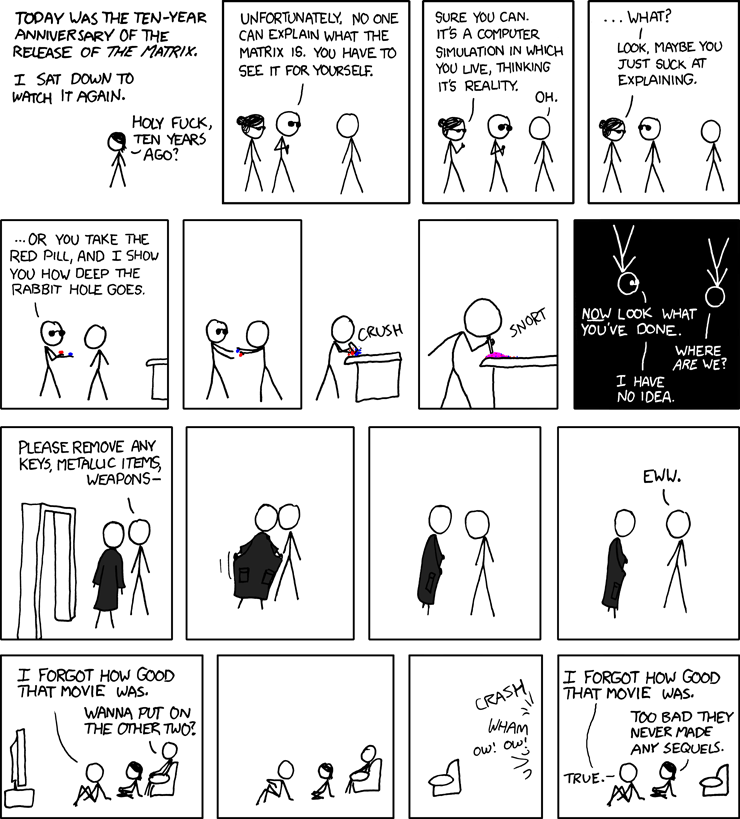
Just saying, ten years ago the xkcd comic ran a comic freaking out about how The Matrix was ten years ago...
Meaning we're now at the TWENTY YEAR MARK about freaking out over The Matrix.
Yeah, I know. I've been freaking out about getting old ever since they cast Winona Ryder to be Spock's Mom in the Star Trek reboot. Stay with me on this though...
Looking back, I remember 1999 being a big year because of something else: the long-awaited return of the Star Wars storyarc that Lucas had promised during the original trilogy. The Phantom Menace's release was such a big deal an entire webpage was created - countingdown.com (no longer valid, it's been outpaced by so many other sites especially YouTube and IMDB) - to report on the release and keep track of the building hype. Everything else that movie year paled in comparison: Austin Powers sequel? Pfft. This weird cult movie making waves on the 'Net called Blair Witch Project? Please. Bruce Willis in some psychological thriller called The Sixth Sense? Who's even directing that thing...!
So there's a level of irony here that the most anticipated movie of that year turned out to be the bigger dud. For all the advancements Lucas made in digital effects directing, Phantom Menace was just... meh, lacking any kind of reason or narrative focus fans were expecting.
Anyway, I vaguely remember the trailer for this Matrix film. Starring an actor I had grown up to - Keanu Reeves, from my high school/college years of Bill & Ted movies and then the surprisingly good Speed action flick - this Matrix thingee looked like some sort of computer heist / spy thriller that somehow involved giant spider robots. Yeah, it didn't make sense to me. I doubt the studio releasing it knew either 'cause they dumped it in the early April schedule before all the summer blockbusters were due to come out.
But as a Keanu fan, and with little else to do back then - my social life then and now was/is meager - on my day off from work I went to the Sawgrass multiplex in Broward County and caught an early screening (I was in the habit of trying to avoid the crowds).
And about two and a half hours later I stumbled back out into the bright sun of South Florida. I pulled out round sunglasses and slid them onto my face as I slow-walked to the nearest Burlington Coat Factory. I found a trenchcoat, paid for it with a credit card, alerting the computer overlords of my rebellion, and wore that thing back out to the heated parking lot where I sweated ten pounds off driving back to my apartment to play the PvP mods on Quake II until I became like Neo.
Okay. I might not have played Quake II. I was terrible at PvP. But the rest of it is real. I TOOK THE RED PILL, PEOPLE.
Even as I was watching it, I could tell the plot was a pretty straightforward "Hero Becomes Messiah" story. But the details of the thing were astounding. The filmmakers - at the time the Wachowski brothers - employed a mashup of cultural archetypes, ranging from Asian anime and kung-fu elements to Western shootouts and explosive overkill. The story blurred the line between Christian (Gnostic, which was probably the first time most people even heard of it) and Buddhist philosophies: "The Matrix is run by a set of rules." "Stop trying to hit me and hit me." "There is no spoon." There had been earlier movies that questioned the very nature of reality itself - Dark City had a similar vein and even shared the same sets - but The Matrix was the one that did so with a deep understanding of what had to be real and what wasn't. It's been called the best cyberpunk movie ever made, considering earlier attempts like Johnny Mnemotic (hi, Keanu again!) never tried to go as in-depth to cyber-reality as the Matrix did.
The movie was unafraid to create a universe that for all intents was a graphics-intensive computer game. The Matrix established in film how a Massive Multiplayer Online universe could actually work. (Ironically, a Matrix MMO game that came out after the third movie ended up too buggy and shut down in 2009) Using a revolutionary filming technique that became known as "Bullet Time," the camera itself did not remain static in a scene, it could move and rotate during a fight in-progress to make the fight more intense. Much in the way a gamer's POV moved during the FPS, or how it would float above a fight during a PvP death-match, the camera was now closer to the action than ever before.
Just the opening sequence of Agents attempting to capture Trinity, with unknowing human cops trying to arrest her only to face a computer expert who "cracked" the cheat codes to the Matrix, was a mind-blowing moment. A woman (Carrie Anne Moss) in an all-leather cat-thief outfit suddenly turned into a lethal gravity-defying assassin, pulling stunts that looked done real-world. Except for the moment where she jumps up, pauses while the camera repositions itself, and finishes off her flying kick move that sends the unlucky cop into the far wall. There had never been anything like that on film before.
From that point on, the Matrix was the defining film in a year - 1999 - crammed with them. It didn't do more than just revolutionize visual effects and cinematography, it changed storytelling. It challenged the Hero narrative (while, yes, sticking to the Campbellian template). It added a diverse cast of supporting characters (Laurence Fishburne as Morpheus leading a multicultural crew fighting the machines) and mixed in Eastern themes that most Western audiences rarely saw. The movie not only questioned the defined role of the hero - the machine Agents constantly call the hero "Mr. Anderson" as an insult, leading him to declare "My name... is NEO." - it questioned self-identity (are you an office drone or a superhero?), it questioned gender roles and gender itself (a funny but overlooked moment is when Neo meets Trinity - with a men's haircut and lack of feminine markers - for the first time: "I thought Trinity was a guy." "Most guys do.")
Just some other thoughts to throw out there: As noted earlier, I had a pretty good idea how the movie would play out once the plot got going (when Morpheus' crew unplugs Neo from the Matrix). While the filmmakers seem to make a big deal about the Oracle "not what we were expecting," I actually knew enough by 1999 about such archetypes - we call them tropes now - to expect the Oracle (Gloria Foster) to be a wise elder woman baking cookies in her kitchen. Still, I loved Foster's performance for the human grace it added to the story.
Watching today, Neo seems like the poster boy for a disaffected Generation X, a non-conformist who escapes his dull life as a cubicle drone to become a god. (In fact, one of The Matrix’s closest thematic companions from the fertile cinema du 1999 is probably Mike Judge’s Office Space—another sad ballad about humans being swallowed whole by faceless corporations, though Judge’s film has a few more jokes...)
There's some things to be said about the sequel films, which felt inevitable when the original Matrix became such a huge hit - it was arguably the best reason to start buying into the newly-introduced DVD discs (the tech came out in 1995), improving its revenue pull for the studio - but now is not the time to get into those arguments.
In terms of anniversaries, it may be time to look back at a lot of other movies that came out in 1999 - yes, I'm sure I'll talk about Phantom Menace when the time is right - and marvel at how we were poised in that moment to break free of the standard blockbuster formats of film watching (and film making). But for now...