Showing posts with label generation x. Show all posts

Friday, April 05, 2024

Anniversary: My Generation, Still Coping

It's April 5th, which for a solid number of Gen Xers is a melancholic anniversary. I wrote this ten years ago:

But it was a little-heralded band out of Washington state - part of the Seattle music scene that soon became known as "grunge" - called Nirvana that blew the speakers out of every teenager and college student's sound systems that year.  A song - "Smells Like Teen Spirit" - that was part Ramones up-tempo rock, part metal, part protest - just hit the right damn notes with the Gen X age group.  From epic opening riff to the fading scream of singer Kurt Cobain shouting "A denial...", it spoke to a generational apathy of teens and college students who wanted to unplug from a crazy world, couldn't, and just had to cope.

Nirvana went from a garage band that traveled to shows in beat-up vans to a headlining act filling packed arenas and stadiums.  Cobain became the iconic grunge rocker: dressing in hand-me-down flannels, with shaggy hair and three-day beard growth, walking about with a dazed look in the eyes and a knowing grin.  Everyone thought it was cool.

Except for Cobain.  He never asked to be a hero or a rock star.  He wanted to be a rocker, sure, but someone who plugged in, played a few chords, moved on.  He had his own heroes - other post-punk and college radio bands that he eagerly talked up in interviews, which gave them brief bumps in popularity - but he also had his own demons...

Cobain didn't expect so many people to get into what he was doing, and was dismayed a lot of his work was getting overplayed... or worse played out of context.  One of the things that haunted him was finding out his song "Polly" - a disturbing tale of an unconcerned man raping a girl, based on a real-life serial rapist who haunted the Pacific Northwest - was being sung by two rapists assaulting their own victim.  Cobain got disgusted finding out that as Nirvana got more popular they were attracting the same jerk jocks and frat-boy bullies that made his teen years a living hell, many of them not even getting the fact that a lot of Cobain's own songs were raging against them.

Not helping matters were Cobain's history of drug use - some of it psychiatric, some of it to cope with a chronic stomach ailment, some of it recreational with the hardest of them being heroin - and getting into a volatile relationship with Courtney Love.  Due to the couple's drug use, they temporarily lost custody of their daughter Frances Bean and he continued to live under the fear of losing her again.  In this environment, a handful of drug-using moments seem to turn into suicide attempts.

By the end of March 1994, Cobain was confronted with an intervention and convinced to put himself in detox/rehab in Los Angeles.  He only stayed for about a day, then hopped the clinic's six-foot wall and fled.  By April 2nd, he was spotted in a few places around his stomping ground Seattle.  By April 5th, he ended up at his big secluded home.  His body was found April 8th, shotgun to the head, body pumped of heroin, a suicide note nearby...

Man, I've been blogging so long even my articles are having anniversaries. But I digress.

As I've noted before, my generation - X - remains an odd, almost schizophrenic grouping split between overly aggressive conservative wingnuttia and the apolitical disaffected. Caught between the hypocrisy of the Boomers and the confusion of the Millennials, we've become a rather cynical, disconnected lot. Cobain's fate seems to echo down the years for us.

We're in our fifties now, well into aging parenthood with OUR kids graduating college while we're sitting around wondering where our MTV went (music videos are mostly on YouTube anymore). We're a bit miffed that CDs are getting phased out for streaming services, unable to place our Nirvana albums on any sound system that might still be in our living rooms. At least vinyl is making a comeback.

Time keeps moving. We're further away from April 1994 than ever before, and next year will be farther still. Frances Bean is in her 30s now, just married her second time and trying to get on with her life, and it's just a sad regret that Kurt didn't stick around to see if she's happy or not. 

Saturday, April 08, 2023

April 8 is Rex Manning Day

If you are (White) Generation X, you will know this quote.

“We mustn't dwell. No, not today. We can't. Not on Rex Manning Day!”


Empire Records was a quirky teen comedy movie in 1995 about an indie record store where the employees were coping with interpersonal traumas, the threat of getting bought out by the big retail stores, and coping with an aging pop star in Rex Manning who hadn't realized the 1980s were over.

The movie was pretty much screwed by the studio that forced drastic cuts to the film, failed to test the appropriate markets, and dumped the movie with little fanfare or advertising. Even with a well-received soundtrack of 90s hits, the movie was considered a huge flop. It had to take cable viewings for the right audience - the above-mentioned (White) Gen Xers - who had lived through that era of Grunge/post-Pop to fall in love with the characters and wacky antics.

So today, break out those vinyl records - because yes, they've made a comeback! - and dance, DANCE I TELL YOU! to the happy hoppy tones of Rex Manning's "Say No More Mon Amour!"

DAMN THE MAN! 

SAVE THE EMPIRE! 

OPEN 'TIL MIDNIGHT!

...

MIDNIGHT!!!


Tuesday, October 25, 2022

The Mindset of My Schizoid Generation

Update: Well now, Tengrain has linked this article to another Crooks & Liars' Mike's Blog Round-Up! Just a reminder to PLEASE FOR THE LOVE OF GOD GET THE VOTE OUT AND EVERYONE VOTE DEMOCRAT! #BlueWave2022 !!! 

There's been a bit of discussion in the media about the role Generation X - my generation, the generation of Slackers and Grunge and mullets and Gangsta Rap and crazy hair and MTV and Star Wars and neon fashion and (skip a bit, brother) - is playing in modern politics, especially when a recent poll came out suggesting the current set of 50-somethings (NO WE'RE NOT OLD, WE'RE NOT OLD, WE STILL WANT OUR MTV) could arguably be more conservatively radical than even the Nixon-age Boomers.

Well, it may be worse than that: My fellow Gen Xers may be more conspiracy-addled and wingnut-driven than all the other generational groups in America. All the MAGA and QAnon craziness in one easily packaged demographic.

We turn to Shirin Ali at Slate (paywalled) to see how bad the post-punk, post-modern, post-sanity mindset of the Slacker Generation has gotten: 

The Gen X cohort, born between 1965 and 1980, certainly did experience one specific set of significant events that could have defined their politics: They grew into adulthood while Republicans held the White House for 12 years, as Politico points out... They also became the first generation to grow up with personal computers while also experiencing shaky economic times as children and young adults in the 1980s and ’90s.

But it’s not just about what they’ve lived through—it’s also about what they’re approaching. Retirement is an area of concern for Gen X, with the demographic expected to retire in the early and mid-2030s. It’s something they are seriously concerned about, showcased in a study from Transamercia Center for Retirement Studies that found only 22 percent of Gen X were “very” confident they would be able to fully retire with a comfortable lifestyle and 78 percent said they were concerned Social Security would not be there for them when they did decide to retire. This could explain the rightward bend...

I don't know how that could happen: If Gen X is worried about Social Security not being there, you'd think they would avoid the Republicans who are openly planning to gut Social Security if the Republicans retake Congress next year. Back to Ali:

But a closer look doesn’t paint such a simple, red picture for Xers. A Gallup poll conducted from January to July 2022 found that 30 percent of Gen X identified as Republican while 44 percent were independent—the highest proportion of independent voters in any generational block. And Gen X doesn’t actually seem to be aging into conservatism either, in fact, it’s the opposite: In 1992, Gallup found that adult members of Gen X were even more likely to identify as Republicans than Democrats, 32 percent to 24 percent. So really, Gen Xers have swung a little more toward the Democratic party over time (now 27 percent identify as Dems)...

Whew. So if there's any good news, it's that my generation has stuck to the habit of not joining up for shit. Still, where's our collective head at?

Currently, the oldest Gen Xers are 57 years old, and along with every other generation, they likely formed their partisan presidential voting patterns when they were around the ages of 14 to 24, according to a working paper by Columbia University’s Yair Ghitza and Andrew Gelman from 2014. They attempted to debunk the idea that as people age they inevitably become more conservative by arguing that most people’s political orientations in early adulthood carryover at least until late middle age. The theory wasn’t assigned to a specific political ideology, but instead whatever political views people developed through adulthood tend to stick throughout life, whether it’s Democratic-leaning or Republican...

It seems that, yes, our childhoods and college years - the years we form our world-views - do radicalize us for the rest of our lives. Growing up under Reagan and the Bush the Elder term that extended into the early 90s - and then under the Clinton years that stuck to a pro-Capitalist, centrist political policy - made it so that a majority of us Xers - even Indy and Democratic voters - are still affected by the Rightward world-view that instructed us as teens:

Reagan captivated the country and was reelected for a second term in a landslide, followed by Bush I. By the time Bill Clinton landed in the White House, Reagan Conservatives were roughly 30 years old, well past the peak of political socialization.

In other words, Gen X isn’t a political novelty, it’s a cohort that came into adulthood when Republicans dominated the White House, and that likely influenced their voting patterns as they aged. Like Gelman’s research found, white voters born in 1952 and socialized during the Kennedy and Johnson administrations were 5-10 percentage points more likely to support Democratic presidential candidates than those born in 1968 who went on to become Reagan conservatives...

Ali also points out something else: About 61 percent of Generation X is White. Of the post-Boomer generations aging into political power, we're the least ethnically diverse... and as such not as affected by social justice issues that the Millennials and Gen Z groups are. While Gen Xers are still informed by some of the racism and sexism they witnessed - Rodney King, the awareness of workplace sexual harassment, et al. - they are not directly affected by those external issues.

Considering this matter as an Xer myself, I have to look back at how I perceived my own demographic and how short-sighted I was. When Obama won the Presidency in 2009, I was under the impression that my generation - which was coming to that moment that the Boomers were starting to age out of power allowing Xers to fill the gaps - would be more Left-leaning than how we turned out. I knew me and mine grew up under Reagan and were influenced by his role, but I had hoped we were also too jaded and cynical to buy into the Far Right Ayn Randian fantasies that had been in vogue during the 80s. 

I know we grew up to "Red Dawn" and "Rocky IV" and "Top Gun," reading "Atlas Shrugged" instead of "Great Gatsby," all of that. But I know that also we grew up to the downfall of the Soviet Union and the collapse of Communism as a political-economic global threat. I would have figured a majority of my fellow Xers would have turned away from the "socialism"-baiting of the Far Right: Where "socialism" was Dog-Whistle code for the anti-Semitism and racism that still informs much of the hatred and extremism of the modern Conservative movement. 

I had hopes that my generation - which brought us Grunge and the Internet and a Slacker mentality - would have been too split, too schizoid to cause any damage to the nation and world. It seems I was wrong. Too many of the kids from the 1980s grew up to be the QAnon conspiracy nuts of the 2020s.

What has happened is that the large plurality of Generation X has tuned out, given the high percentage of non-party affiliation my generation has today. But it's left my era a bit over-represented by the Reagan-spawn who are leading the rabid mobs of the modern GOP voting base, which is a shame. It'd be nice if more of the independent-minded Gen X voters reappraised their place on the political battlefield and realize the Far Right Fantasy is a nightmarish realm of racism, poverty, and pain.

It's not too late, Xers. You can still vote Blue this midterms and save the next generations from wingnut doom. GET THE DAMN VOTE OUT FOR DEMOCRATS THIS 2022!!! 

Sunday, September 19, 2021

Hark! A Ranking of Nirvana Albums (w/ Update)

Nothing ages a Generation Xer faster than the realization we've grown into Baby Boomer levels of nostalgic anniversary awareness.

For example, waking up the last couple of months to realize that two of the albums that truly defined our generation - Pearl Jam's Ten and Nirvana's Nevermind - have reached their 30th year anniversaries.

(Suddenly, all the hair turns white or falls off) (A wheelchair appears and knocks the Gen Xer into the seat) (one of those giant megaphone cones that people used before the invention of hearing aids shows up as a prop in one hand) "What's that sonny? 'Smells Like Teen Spirit' is on the radio? TURN IT UP! Not because I can't hear it mind you, actually yeah it's because I can't hear so good anymore..."

I kid. Most of us Xers are still able to hear things at high decibel output as well as operate heavy machinery, trust us.

Still, the reality that it's been thirty years since the great generational awakening - the moment in the early 90s when we (speaking as a White Boy) as a demographic moved into early adulthood and our own decision-making, away from the gaudy, glamor-filled, gleaming 80s - when our musical tastes moved into the more cynical and caustic Grunge movement (or the more cynical and caustic Gangster Rap movement with the rise/fall of NWA and their spinoffs Ice Cube/Dr. Dre). Our tastes in cinema and television were also turning darker, but into their own elements that would require other deeper essays to express (you could glance at my take on the Matrix anniversary for an idea how our worldview affected movie-making even by 1999).

It seems funny that the spearhead of this shift were bands like Soundgarden and Mudhoney - well-regarded bands in their own right whose Seattle Sound was turning attention away from L.A. hair metal - but it was the "debuts" of bands like Pearl Jam and Nirvana that launched Grunge into the upper atmosphere to turn a status-quo music industry on its head. And while Pearl Jam's Ten is considered a masterpiece in its own right, we still look to Nevermind as the cultural keystone, the one big thing that shattered standard operating procedures and sent a lot of record label studios across the planet looking for the next Nirvana to feed off the growing Grunge scene.

As for Nirvana the band itself, I had already written a few words about that when I wrote about their frontman Kurt Cobain. Lyricist, guitarist, singer (more like screamer on half the songs), Cobain was the essential man of the lineups. Alongside bassist Krist Novoselic, the two would go through a cycle of drummers - notably Melvins' drummer Dale Crover, and Chad Channing which whom they recorded their first album Bleach - before hooking up with Dave Grohl (who impressed the two when they saw him drum for another local band Scream). That was the lineup that ended up recording Nevermind... and entering music history forever.

I still can't fully explain to you the impact Nevermind had on the cultural landscape. It was like overnight the bright neon shininess of the 1980s was turned off and the half-lit moodiness of the 1990s dominated every media outlet. Lyrics about mental health, dysfunctional relationships, coping with an uncaring world started showing up even in pop songs.

But it wasn't all doom and gloom. A weird sense of whimsy was still on display, a kind of haphazard "well, we gotta live with this" mentality came through all the weirdness. 

Not to mention the sudden dominance of flannel shirts in the fashion stores.

And as I wrote, that whole moment... just seemed to last that moment. By 1994, Cobain had become jaded and cynical enough, burned out by the sudden celebrity status, and strung out by his bad drug habits, that he took his own life in April and sent whatever made up the Grunge movement into its own death spiral. In some respects, the hard rock scene never fully recovered (the musical landscape is now covered with pop divas and hip-hop).

The impact of Nirvana's brief moment upon the global stage can't be overlooked: Reflection and Respect must be paid. So into that, I bring you another ranking of albums by a band I follow, and so Hark upon this friends.

Given the shortness of Nirvana's actual existence and the few studio albums they released during Cobain's lifetime, there isn't a real way to rank one album greater than another. So I present this brief listing in chronological order.

Ranking Nirvana Albums

Epic to Epic

Title: Bleach

Reasons: Nirvana's first album in 1989 was an Indie release via a local (Seattle) label called SubPop, which had also been instrumental in 'finding' other Seattle bands like Soundgarden and Mudhoney that were key to the emerging Grunge scene. Recorded with drummer Chad Chadding (with previous drummer Dale Crover on several earlier recorded songs), Bleach's overall sound is one of distorted, fast-riff guitar noise over incredibly simplistic lyrics even by Cobain's usual standards (Kurt later admitted he wrote the lyrics in a rush right before studio time and was in an angry mood when he did). Pressured into conforming to what the early Grunge sound was like in the Seattle scene, the album was meant to be a shift away from Nirvana's original output. That attempt didn't work. Even in this full rookie effort, you can see the style Nirvana will get noticed for: Punk-earnest lyrics mixed with hard-rocking up-tempo beats and working with a distorted noisy grind that harmonized into its own. 

After the band got big (and after Cobain left us), the re-releases for Bleach included several other songs such as “Big Cheese” and “Downer” to fill out the history of Nirvana's rise from SubPop to everything. 

Epic Song(s): About a Girl, Negative Creep
Great Song(s): Blew, Love Buzz, Scoff, Swap Meet, Big Cheese
Good Song(s): Floyd the Barber, School, Downer

Title: Nevermind

Reasons: I catch myself using the phrase “blew the doors off everything” when describing certain albums, like the Beatles Please Please Me (and Rubber Soul, and Revolver, and Abbey Road, and...), or U2's Joshua Tree, or Van Halen's self-titled debut. But that's because those albums DID hit the world like a storm, with an impact that other artists couldn't ignore and with a sound or voice we've never heard before.

Nevermind was such an album. For the entire music industry, this was a Before/After break in their history.

Starting with recordings with SubPop on their next album, Nirvana shifted gears when Chadding left forcing Cobain and Novoselic to find another drummer, which ended up with Dave Grohl when his band Scream had recently broken up. With Grohl in place, Nirvana then shopped for a new studio when SubPop was facing financial difficulties, ending with the DGC label under Geffen Records. With that settled, they got the album completed by June for release a few months later. Unhappy with the initial recordings, the band and producer Bruce Vig brought in more professional help to smooth out the takes, which ended up making the album sound much like the current “hair metal” bands of the 1980s. Ironically, this may have helped the album reach more audiences.

Nevermind arrived on the scene in late 1991 at a moment when reforms in album sales tracking – which had been over-promoting pop sounds like Madonna and Michael Jackson at the expense of little-heralded rock bands that people did listen to – opened up the chances a lesser-known band could see better sales numbers to encourage more radio play, meaning more listeners to notice them creating a nice cycle of positive reinforcement. Combine this to a shift in what audiences – Gen X – wanted to hear towards college/alternative style sounds (why yes, we WERE in college or heading there at the time), and that all turned this album from a minor introduction into a global phenomenon. Sales overwhelmed the expected best-sellers for that year, and carried over in 1992 as the Grunge movement crossed over to other similar bands with their own seminal releases. What was expected to sell about 200,000 copies ended up selling 1,000,000 (Platinum level), and then 2x Platinum, and then... well, by then everyone heard “Smells Like Teen Spirit.”

As mentioned before, Nevermind brought with it a punk mentality in the lyrics with a more up-tempo yet melodic sound. Influenced from Ramones to the Pixies to R.E.M. (the Alpha and Omega of College Sound), the emphasis was less on the distorted guitar noise (you can still hear it on “Breed,” “Lithium,” and “Endless Nameless”) and more on basic guitar chords that could shift from stanza to stanza. Cobain's anger in most of the song lyrics seemed more inward, cynical and self-deprecating, but offered with a grin as though no harm done (If we only knew...). 

As far as great albums go, Nevermind is still an uneven work where some songs fall flat where others shock you with how high they can rise: not fully polished like Joshua Tree or Revolver or any of the other respected masterpieces, but arguably more impactful with the songs that do reach you hitting you years after you've heard them. For a generation, what Cobain expressed in this album reflected a lot of the anger, cynicism, despair, and hope we had for ourselves.

Epic Song(s): Smells Like Teen Spirit, Come As You Are, Lithium, On a Plain
Great Song(s): In Bloom, Breed, Polly, Drain You, Something In the Way
Good Song(s): Territorial Pissings, Lounge Act, Stay Away

Title: Incesticide

Reasons: When Nevermind turned into a behemoth, the record studio DGC/Geffen reached out to grab anything Nirvana that they could repackage to sell while the Grunge going was great. This meant regional EP (extended play mini-albums) released overseas, Indie singles, and unreleased demos and cover songs saved to tape somewhere. The result was this, a compilation album of every leftover that could get repackaged as Filet Mignon. 

As a result, it's not the best-sounding album released while Cobain was alive, but it does provide context and understanding of how his lyrical style developed and how the band's overall sound evolved. This is arguably the hardest album to listen to, not because of any lyrical dissonance – this is Nirvana/Cobain, it's ALL lyrical dissonance! – but because a lot of these songs were not released earlier for a reason (okay, Kurt, you like feedback, we get it...).

Epic Song(s): Aneurysm
Great Song(s): Sliver, Son of a Gun, Aero Zeppelin
Good Song(s): Dive, Stain, Been a Son, Hairspray Queen

Title: In Utero

Reasons: The follow-up to a breakthrough album, Cobain and his bandmates were caught in a moment where expectations were greater than they'd ever known. Pressured to release an album to sell to the masses yet trying to stick to their own artistic bents, Cobain in particular wanted to push back against those expectations to make an album he'd respect. In some ways, the sound self-sabotaged by going back to the earlier distorted noise prevalent in Bleach: A rawness to the chords, an uneven rhythm to the backbeat, more of Cobain screaming into the void. The lyrics and attitude matched the noise: Songs like “Radio Friendly Unit Shifter” (an obvious punch-back at how the music industry was over-hyping the band and the Grunge scene) were anything but friendly for radio play.

Even with that, In Utero impressed the fanbase and sold well, extending the band's fame. In spite of the distortion, traces of melody still got through. The simple direct wording of Cobain's lyrics still expressed complexity of emotions. Fans got “All Apologies” and “Dumb” and understood where the self-deprecation was coming from. This isn't as fun to listen to as its predecessor, but it's just as self-reflective, and in some regards more haunting because of what came after. 

Epic Song(s): Heart-Shaped Box, Rape Me, Dumb, All Apologies
Great Song(s): Frances Farmer Will Have Her Revenge on Seattle, Very Ape, Pennyroyal Tea
Good Song(s): Serve the Servants, Milk It, Radio Friendly Unit Shifter

Title: Unplugged in New York

Reasons: Added to this list as one of Nirvana's final recordings, done when the band performed for MTV's popular “Unplugged” series of acoustic performances by artists of the day in November 1993. With Cobain's death in April 1994, this concert became one of the last that we knew Cobain had done, and so an album was crafted from the broadcast and offered as the swan song to Nirvana as a band (the two surviving members Novoselic and Grohl wisely broke up, knowing any attempt to continue would be demeaning of Cobain's memory). 

Anyone listening to this album will likely know this backstory, and likely will listen with an ear to seek out clues to every haunting, haunted song performed here. There is still a beauty to this work: Away from the loudness that the studio albums and normal live shows go for, this album is more low-key, focused on the melody, played at a more reflective, introspective pace (It still has distortion because Cobain could not go full acoustic and had brought an effect pedal as a “security blanket”). Covering all parts of Nirvana's brief history, with soul-stirring versions of “About a Girl” all the way up to an orchestral-like “All Apologies,” and intermixed with cover tunes - mostly from the band The Meat Puppets, some of whom were backing instruments on this concert - that the band enjoyed playing, the Unplugged album remains with us like a ghost, reminding us of the musical potential the band had, especially Kurt... 

Epic Song(s): About a Girl, Come As You Are, The Man Who Sold the World (Bowie cover, and oh was Bowie pissed afterward because clueless Nirvana fans kept thinking he had covered them), Dumb, Polly, Plateau (Meat Puppets cover), Lake of Fire (Meat Puppets cover), All Apologies
Great Song(s): Oh Me (Meat Puppets cover)
Good Song(s): Where Did You Sleep Last Night (Lead Belly cover)

And... that was it, everyone. Nirvana in a brief moment of our lives.

“Fuck you all, this is the last song of the evening.”
- Cobain before singing Lead Belly's “Where Did You Sleep Last Night” on Unplugged.

Update 7/20/22: This was one of the five articles submitted to this 2022 Florida Writers' Association's Royal Palm Literary Awards, and good news it's passed the Semifinalist stage to try for the Finalist judging next. Nice new logo from FWA to go along with the news... 


Update 8/12/22: I am happy to report this article survived the Finalist round! Now, from what I learned the first time I reached this spot, this does not guarantee a top three finish. There can be 5 other blog articles that reached this level, there could be 10 or 20. But there is still a good chance this could win first, second, or third prize in the Nonfiction - Blog category. So now I have to show up at the banquet... Also I get this FWA Finalist logo.


Sunday, May 19, 2019

Back In the Day, Counting Down to Phantom Menace

By 1999 I was in my fifth year working at Broward North Regional Library. One year away from turning thirty. In some respects I still hadn't grown up, my mentality was still feeling like I was in college, was still goofing off... but in terms of being into comic books - weekly trips to the comic book stores on University Avenue - and video gaming - getting into the Myst series - and geekery - totally dedicated to my X-Files fandom - and all that jazz.

By 1999 I was totally waiting for the return of a major piece of my childhood geekdom.

Star Wars was going to come out with a prequel film series. Episode One. The Phantom Menace.

See, back in 1983 we had known George Lucas wanted to tell a generation-spanning science fiction series, which started with Star Wars itself in 1977. When he planned it out, however, he realized he needed to tell the early history of how the Empire rose and the Old Republic fell, so he retconned the original into Episode IV and broke the series down into three parts of trilogies: the Original Series - IV then V then VI - then the prequels - I II and III - before completing the whole thing with Episodes VII VIII and IX.

Problem was, after all the hassles Lucas had getting Empire Strikes Back and Return of the Jedi made, he got tired of it and held off making the rest of the series. As a result... the fanbase for Star Wars kind of withered on the vine, keeping up with the occasional book series and spinoffs like cartoon shows and video games (X-Wing series in particular was an industry-changing trendsetter).

Until advancements in visual effects in the early 1990s seemed to change Lucas' mind. The near-real quality of computer graphic effects (CGI) that made Terminators into liquid metal and dinosaurs look really alive seemed to convince him he could make the movies fit the vision he had for the series: a lush, David Lean-esque galaxy of marvelous vistas and epic scales.

After updating the Original series with revamped visual effects and adding deleted scenes - some successful, some not (HAN SHOT FIRST!) - in 1997, Lucas made the announcement that he was ready to make his prequels, the epic telling of the Fall of The Republic through the rise of Anakin Skywalker, the father of Luke and Leia and fated to become Darth Vader Lord of the Sith.

The Star Wars fanbase, geeked up by the Special Editions, went crazy.

A lot of us who were kids when the Original trilogy came out were now adults, some of us parents, all of us still nostalgic for the toys and gameplay and costuming of our youth. All of a sudden, a lot of twenty- and thirty-somethings were breaking out lightsabers and Jedi robes and building droid units to play with.

And we were all doing this now in the era of the Internet. Before, geeks had to keep up with fanzines and newsletters. By 1997, we had Usenet forums and AOL chats and emails and early stages of photo/video sharing (was MySpace up yet?). Everyone was plugged in.

It felt like the geek universe had quadrupled into itself. Science Fiction and fantasy fandom had been kept alive through Star Trek and the early stirrings of newer shows - X-Files already mentioned, also Babylon 5 and dozens more - but Star Wars was the Big One. The Blockbuster. EVERYONE knew what it meant.

The anticipation for the first episode was high when Lucas announced the title and previewed the first trailer:


Before YouTube, people had to see these trailers in the movie theaters. People bought tickets to see the newest movie release that weekend and then left the movie.

People were a little underwhelmed by the title - The Phantom Menace - but were jazzed by seeing the clips. Mass speculation abounded. The new villain - Darth Maul - was deemed impressively scary-looking and became a sought-after action figure. Toy stores stocked like mad.

Someone carved out a website called CountingDown dot com (the link has aged out) where all it was had a timer ticking down by minute, hour and day until the official release in theaters.

People camped out weeks ahead of the release, dressed up. They bought the books. They bought the music CDs - it was JohnWilliams doing Star Wars, shut up! - and "Duel of the Fates" was on heavy rotation on a lot of players.

And then the movie came out.

...

Well, it was pretty to look at...

Okay, I'll step back a little. NO movie, not even a Star Wars, could live up to the anticipation and hype that this one got. And when I left my first viewing of the movie - with my library co-workers - I had few complaints. I even went back several times to view it, having promised to see it with my high school friends back in Pinellas County. I can remember their youngest boys, about four or five years old, were entirely pumped during the Jedi duels and were out of their seats hopping up and down. I was spiritually with them on that: the lightsaber duels were the highlight of the film.

But it was a few months later that the dread settled in, the worrying realization that Menace was... off. It wasn't as much fun as the Original series as I remembered.

I found myself doing the worst thing a fan does: Nitpick.

I focused on the one thing most critics of the Prequel pick on: the character of Jar-Jar Binks. A clear attempt by Lucas to create a kid-friendly sidekick alien for the Jedi main leads, who nonetheless acted / behaved too clumsily and awkward to be believable as someone who could have survived on his own without tripping over his own shoelaces (if he had any). I read other people's criticisms of the character, where they pointed to how Jar-Jar was a callback to early film blackface, a caricature of minstrel shows, and I cringed at the realizations. I know the actor Amhed Best did what he could to make Jar-Jar likable, but it all boiled down to whatever the hell Lucas was thinking when he made Jar-Jar to be slapstick comic relief. In the Original trilogy, Lucas had comic characters like R2-D2 and C3PO, but he made them with a little more care and character, more than the flat, one-note character that Jar-Jar turned out to be.

Alongside the Jar-Jar problem, Lucas had made the other new alien races - the Trade Federation, and Watto, Anakin's slave owner - into painfully clear stereotypes as well. The up-front bad guys of the Prequels, the Trade Federation talked and dressed in Oriental, almost Japanese fashion. And Watto... ouch. An almost Elizabethan caricature of the Jewish figure in British theater.

I also wasn't too wowed by the poor kid they got to play young Anakin. He looked to be five years younger than Natalie Portman - whose character Princess Amidala was getting set up as Anakin's future lover/wife - and he behaved ten years younger than he should have. I can't even remember his name right now - had to check IMDB, it was Jake Lloyd - but I heard years later the poor kid went through a lot of abuse from fans who hated him for Anakin. I didn't blame the actors - not Amhed, not Jake - but for how their characters were written/created. It was like Lucas didn't know what he was doing drawing them up from his plot ideas.

The final thing that finally got me upset was trying to reconcile my understanding of the Jedi faith in the Force with the prequel revelation of bacterial midichlorians that turned out to be a symbiotic lifeform that gave the Jedi (and the Sith) their links to mystical powers. I got the feeling Lucas was responding to criticisms of not grounding the Force upon any scientific rationale, so he went with "superpowered bacteria" as an excuse rather than a character's innate ability to connect from the Force and learn/live from it. It felt clunky, like a last-minute excuse, and noticeably a lot of post-Prequel stories avoid going into any further detail.

By the end of 1999, I felt regret and maybe some shame from having like Phantom Menace. I realized I got more out of The Matrix film that year, along with enjoying other big movies that surprisingly made it one of the better years in film history.

Twenty years later, Biblo, it still hurts...

I think what really bummed me was when I came across a fan-made retelling of the movie called The Phantom Edit. At the time an anonymous creation - later identified as a film editor (Mike Nichols) and named on the Wiki page - the film cut out a lot of the slapstick, redid Jar-Jar's and other Gungan dialog as alien speak to make them sound more like a Proud Warrior race, dropped the midichlorian subplot, edited in deleted scenes to make the plot more sensible, and essentially tightened the film with crisper cutscenes. It essentially made me realize what had been wrong with Episode I... and it haunted me all through the following movies Attack of the Clones and Revenge of the Sith.

It made me realize an unconstrained George Lucas was a danger to his own visionary work.

When I looked back at Episodes IV through VI, Lucas was under creative limits: He answered to other Producers - in particular Gary Kurtz - and had other people working on his scripts - Lawrence Kasdan in particular. He had others direct Empire and Return. When I looked at Episodes I through III, Lucas had no co-creators (there may have been a Producer Rick McCallum, and there was a co-screenwriter for Clones in Jonathan Hales, but Lucas was clearly in control).

Granted, an artist has a right to create as he or she sees fit. A poem can't be made by committee, a sculpture never looks good if there's twenty different people carving out the marble twenty different ways.

But sometimes, there has to be some kind of input and feedback. Someone standing off to the side saying "Okay, why is this speech about sand so romantic, George? Why is Obi-Wan's facial expression so flat in this scene, can't Ewen emote just a little for the fans to see the whimsy that Alec Guinness provided? Is there any way to make it feasible to have these characters NOT be so racist...?"

I think without that kind of feedback, without some kind of editorial control, George indulged in ALL his ideas and didn't weed them down to the good ones, the ones that made the Original trilogy so good. He made serious efforts to create good films, and in hindsight the pictures themselves are on a grand, epic scale and impressive to see. He didn't underplay the political drama that made the Originals genuinely subversive tracts for their era (yes, I got the politics of how the Republic fell). He did make a few memorable new characters among the handful that were one-note and perfunctory (although Jango Fett, Boba's father, was a bit of a disappointment. Good actor, but underdeveloped).

But Lucas was terrible at writing romance. The scenes between Anakin and Amidala were awkward at best. Portman is a good actress and the older Anakin played by Hayden Christensen was suitably imposing and yearning, but the romantic plot was just... who talked like that? I know I have no social skills, but half the dialog between them had little emotional impact, and yet they hooked up anyway. Bleh.

If Lucas just had someone who had a better ear for dialog, for building up character relationships, the key element of the prequels - how Anakin fell in love and betrayed everything good in the process, becoming the haunted man-machine Vader - would have gone over a lot better, and I'd be able to rewatch them the way I rewatch the Originals.

I know it sounds very nitpicky, but I'm a writer meself. I've dabbled in the craft. And my best work that got published by others had gone through a tough editorial process with other eyes critiquing me. It didn't curb my output or my artistic intentions: It sometimes made me a better writer. It created better-received stories.

So when the Final Trilogy was announced, after Disney had bought up Lucasfilm rights and reset the franchise (clearing out some popular novelizations but also a lot of chaff), I was very much relieved to find out that Lucas ceded most of the creative control this time to other writers and directors (much like he did with the Originals). I'm sure he still had input and some creative control, but the films were going to have other hands and as long as the fun was there.

And yes, I loved The Force Awakens and yes I liked The Last Jedi (oh Good God, the incel hate towards that movie, I will never understand).

We'll just see how Episode IX wraps this saga up. Hopefully as true to Lucas' vision as possible... with better dialog dammit... (ow stop Force Choking me, George)

Sunday, March 31, 2019

The Matrix Still Has Us, Morpheus

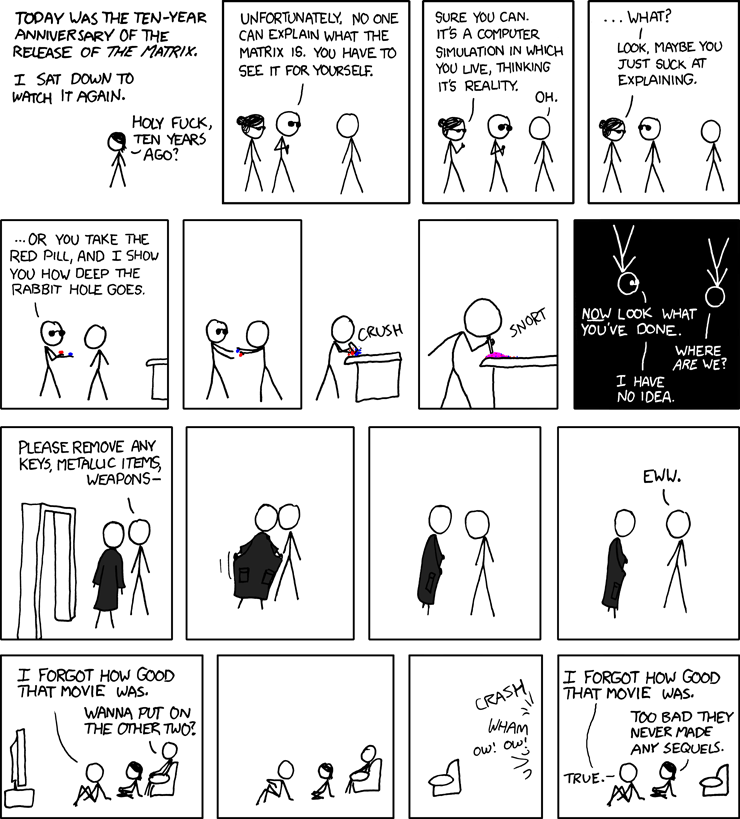
Just saying, ten years ago the xkcd comic ran a comic freaking out about how The Matrix was ten years ago...


Meaning we're now at the TWENTY YEAR MARK about freaking out over The Matrix.

Yeah, I know. I've been freaking out about getting old ever since they cast Winona Ryder to be Spock's Mom in the Star Trek reboot. Stay with me on this though...

Looking back, I remember 1999 being a big year because of something else: the long-awaited return of the Star Wars storyarc that Lucas had promised during the original trilogy. The Phantom Menace's release was such a big deal an entire webpage was created - countingdown.com (no longer valid, it's been outpaced by so many other sites especially YouTube and IMDB) - to report on the release and keep track of the building hype. Everything else that movie year paled in comparison: Austin Powers sequel? Pfft. This weird cult movie making waves on the 'Net called Blair Witch Project? Please. Bruce Willis in some psychological thriller called The Sixth Sense? Who's even directing that thing...!

So there's a level of irony here that the most anticipated movie of that year turned out to be the bigger dud. For all the advancements Lucas made in digital effects directing, Phantom Menace was just... meh, lacking any kind of reason or narrative focus fans were expecting.

It's been twenty years, Bilbo, it still hurts...!

Anyway, I vaguely remember the trailer for this Matrix film. Starring an actor I had grown up to - Keanu Reeves, from my high school/college years of Bill & Ted movies and then the surprisingly good Speed action flick - this Matrix thingee looked like some sort of computer heist / spy thriller that somehow involved giant spider robots. Yeah, it didn't make sense to me. I doubt the studio releasing it knew either 'cause they dumped it in the early April schedule before all the summer blockbusters were due to come out.

But as a Keanu fan, and with little else to do back then - my social life then and now was/is meager - on my day off from work I went to the Sawgrass multiplex in Broward County and caught an early screening (I was in the habit of trying to avoid the crowds).

And about two and a half hours later I stumbled back out into the bright sun of South Florida. I pulled out round sunglasses and slid them onto my face as I slow-walked to the nearest Burlington Coat Factory. I found a trenchcoat, paid for it with a credit card, alerting the computer overlords of my rebellion, and wore that thing back out to the heated parking lot where I sweated ten pounds off driving back to my apartment to play the PvP mods on Quake II until I became like Neo.

Okay. I might not have played Quake II. I was terrible at PvP. But the rest of it is real. I TOOK THE RED PILL, PEOPLE.

Even as I was watching it, I could tell the plot was a pretty straightforward "Hero Becomes Messiah" story. But the details of the thing were astounding. The filmmakers - at the time the Wachowski brothers - employed a mashup of cultural archetypes, ranging from Asian anime and kung-fu elements to Western shootouts and explosive overkill. The story blurred the line between Christian (Gnostic, which was probably the first time most people even heard of it) and Buddhist philosophies: "The Matrix is run by a set of rules." "Stop trying to hit me and hit me." "There is no spoon." There had been earlier movies that questioned the very nature of reality itself - Dark City had a similar vein and even shared the same sets - but The Matrix was the one that did so with a deep understanding of what had to be real and what wasn't. It's been called the best cyberpunk movie ever made, considering earlier attempts like Johnny Mnemotic (hi, Keanu again!) never tried to go as in-depth to cyber-reality as the Matrix did.

The movie was unafraid to create a universe that for all intents was a graphics-intensive computer game. The Matrix established in film how a Massive Multiplayer Online universe could actually work. (Ironically, a Matrix MMO game that came out after the third movie ended up too buggy and shut down in 2009) Using a revolutionary filming technique that became known as "Bullet Time," the camera itself did not remain static in a scene, it could move and rotate during a fight in-progress to make the fight more intense. Much in the way a gamer's POV moved during the FPS, or how it would float above a fight during a PvP death-match, the camera was now closer to the action than ever before.

Just the opening sequence of Agents attempting to capture Trinity, with unknowing human cops trying to arrest her only to face a computer expert who "cracked" the cheat codes to the Matrix, was a mind-blowing moment. A woman (Carrie Anne Moss) in an all-leather cat-thief outfit suddenly turned into a lethal gravity-defying assassin, pulling stunts that looked done real-world. Except for the moment where she jumps up, pauses while the camera repositions itself, and finishes off her flying kick move that sends the unlucky cop into the far wall. There had never been anything like that on film before.


From that point on, the Matrix was the defining film in a year - 1999 - crammed with them. It didn't do more than just revolutionize visual effects and cinematography, it changed storytelling. It challenged the Hero narrative (while, yes, sticking to the Campbellian template). It added a diverse cast of supporting characters (Laurence Fishburne as Morpheus leading a multicultural crew fighting the machines) and mixed in Eastern themes that most Western audiences rarely saw. The movie not only questioned the defined role of the hero - the machine Agents constantly call the hero "Mr. Anderson" as an insult, leading him to declare "My name... is NEO." - it questioned self-identity (are you an office drone or a superhero?), it questioned gender roles and gender itself (a funny but overlooked moment is when Neo meets Trinity - with a men's haircut and lack of feminine markers - for the first time: "I thought Trinity was a guy." "Most guys do.")

Just some other thoughts to throw out there: As noted earlier, I had a pretty good idea how the movie would play out once the plot got going (when Morpheus' crew unplugs Neo from the Matrix). While the filmmakers seem to make a big deal about the Oracle "not what we were expecting," I actually knew enough by 1999 about such archetypes - we call them tropes now - to expect the Oracle (Gloria Foster) to be a wise elder woman baking cookies in her kitchen. Still, I loved Foster's performance for the human grace it added to the story.

I'm not the only one being nostalgic for this: Other places are writing up their favorite moments and remembrances. As David Sims notes in that Atlantic review:

Watching today, Neo seems like the poster boy for a disaffected Generation X, a non-conformist who escapes his dull life as a cubicle drone to become a god. (In fact, one of The Matrix’s closest thematic companions from the fertile cinema du 1999 is probably Mike Judge’s Office Space—another sad ballad about humans being swallowed whole by faceless corporations, though Judge’s film has a few more jokes...)

There's some things to be said about the sequel films, which felt inevitable when the original Matrix became such a huge hit - it was arguably the best reason to start buying into the newly-introduced DVD discs (the tech came out in 1995), improving its revenue pull for the studio - but now is not the time to get into those arguments.

In terms of anniversaries, it may be time to look back at a lot of other movies that came out in 1999 - yes, I'm sure I'll talk about Phantom Menace when the time is right - and marvel at how we were poised in that moment to break free of the standard blockbuster formats of film watching (and film making). But for now...

EVERYBODY WAS KUNG-FU FIGHTING!

(YouTube clip failed to link) (Processing HTML) (Shockwave Flash failure) (terminal disconnected)

THE MATRIX STILL HAS YOU, WITTY

...Dammit, Dark Computer Overlords, do NOT tell people my online gamer name...!


Saturday, June 11, 2016

Ferris Bueller Movie is 30 Years Old This Weekend

Esquire magazine just reminded me Ferris Bueller's Day Off is 30 years old this weekend.


To all my fellow Gen-Xers (those born between 1965 and 1977) lemme just say this:

AHHHHHHHHHH WE'RE OLD WE'RE OLD WHERE THE HELL DID OUR HIGH SCHOOL YEARS OF WACKY HIJINKS GO?!?!?!?!?!

At some point nostalgia gets horrifying.

I can only hope that we're ready now - with our collective disdain for Isms that Ferris taught us - that my generation can become leaders on the global stage and save you all from evil Boomer plans.

At least we know our culture has left a lasting impact on future generations.


Chicka-chicka.

Friday, April 04, 2014

Anniversary: My Generation, And The One Who Fell Behind

No I don't have a gun/
No I don't have a gun...
- Kurt Cobain and Nirvana's lyrics to Come As You Are

Cobain, you goddamn liar...
- Paul Wartenberg, after finding out on April 8 1994 along with everyone else what happened to the guy


Friends, Americans, Culturists, lend me your media feeds.  I come to praise Generation X, not to bury it.

And no, I'm not talking about the punk band or the Marvel graphic series.  I'm talking about the boys and girls who were born roughly between 1965 - the year Dylan went electric - and 1980 - when Lennon was assassinated - so that they had to be three years old at least when Return of the Jedi was out and Reagan was in the White House.  I'm from 1970 - Year of the Dog - so me and the Class of 1988 (Go Spongers) are right in the middle of it.

We were the following generation of the Baby Boomers, the genealogical anomaly of a birthing group (1945 to 1963) that came after the Depression / War generation.  Where the War generation was defined by sacrifice, blood sweat and tears, and superhero comics, and where the Baby Boomer set defined by middle class affluence, reactionary rebellion, and rock n roll, the Generation X was defined by the X.  A random elusive variable...

Gen Xers were the generation that grew up in the wake of the national malaise post-Vietnam and post-Watergate, when our political and social institutions were beset with scandals.  We were the generation that was the first to be mostly self-raised as our parents both went to work (Latchkey kids), where divorce was common compared to previous generations or where single parents were becoming a norm.  We had to cope with the consequences of the burgeoning War on Drugs, the spread of sexual diseases in the aftermath of the Sexual Revolution, and the disaster that was New Coke.

But it wasn't all bad.  Ours was the generation that grew up to Star Wars, a cultural milestone akin to the Beatles.  We had the benefit of cable TV bringing us more Sports (ESPN), more news (CNN), more weather.  We got our MTV.  We gamed to Dungeons & Dragons despite the moral outrage, we danced to Prince and Madonna despite the moral outrage, we permed our hair and wore mullets despite the moral outrage.

We are, were, still will be, a generation rather schizophrenic to the core: both jaded and optimistic, sarcastic and sincere, conspiracy-minded and complacent.  We were the generation doomed to barely survive as the Boomers sucked all the oxygen out of the room as they came of age of political and economic power in the Nineties (when they all turned 40 and became CEOs and Presidents).

And we had our heroes and icons, the ones who spoke to us, spoke for us, on the national media stage.

1991 was a major turning point in our culture.  The Cold War of the last 25 years was ending as the Soviet Union literally withered on the vine.  The Berlin Wall had already fallen and the political threats were no longer coming from Asia but from the Middle East.  Movies were about to turn into special-effects behemoths as CGI effects in Terminator II showed that anything was visually possible.

Music was also changing as the decades changed.  The video-driven 80s pop and hair metal bands that dominated MTV and radio were getting stale.  Rap was still having a problem getting outside of the ghettos of L.A. and New York.  Michael Jackson was making a major media campaign to prove himself relevant in the 90s as he had been the previous decade, but was doing so in a heavy-handed, self-defeating way.

But it was a little-heralded band out of Washington state - part of the Seattle music scene that soon became known as "grunge" - called Nirvana that blew the speakers out of every teenager and college student's sound systems that year.  A song - "Smells Like Teen Spirit" - that was part Ramones up-tempo rock, part metal, part protest - just hit the right damn notes with the Gen X age group.  From epic opening riff to the fading scream of singer Kurt Cobain shouting "A denial...", it spoke to a generational apathy of teens and college students who wanted to unplug from a crazy world, couldn't, and just had to cope.

Nirvana went from a garage band that traveled to shows in beat-up vans to a headlining act filling packed arenas and stadiums.  Cobain became the iconic grunge rocker: dressing in hand-me-down flannels, with shaggy hair and three-day beard growth, walking about with a dazed look in the eyes and a knowing grin.  Everyone thought it was cool.

Except for Cobain.  He never asked to be a hero or a rock star.  He wanted to be a rocker, sure, but someone who plugged in, played a few chords, moved on.  He had his own heroes - other post-punk and college radio bands that he eagerly talked up in interviews, which gave them brief bumps in popularity - but he also had his own demons.

Like a good number of other Gen Xers, Cobain grew up in a broken home in an economically-depressed town.  He grew up as an artist (his family had a history of musical talent and his grandmother encouraged his drawing), which made him a target for a good amount of school bullying by the jock clique (it didn't help that Cobain's father tried to get him to play sports).  It got worse when Cobain befriended a gay student which made those jocks think Cobain was gay as well (Cobain eventually made many pro-gay gestures around town in order to piss off the homophobes, and later opined he was bisexual despite all the girlfriends he lived with).

After getting thrown out of his mother's home - having dropped out of high school, having problems finding work - Cobain lived the struggling artist life, finding part-time work where he could, going to music shows across the Northwest, starting up his own attempts at music, hooking up with girls in the scene, and making his way onto the stage with one band line-up after another.  Teaming up with Krist Novoselic to form Nirvana in 1987, they went through a series of drummers until they tabbed Dave Grohl for the job in 1990.  Then they went in to a major studio to record the album Nevermind...

Cobain's work as a musician and lyricist focused on dynamic contrasts: the lyrics themselves would have a stanza of meaningful incoherence followed by a repetitive chorus back to another stanza before closing out with a repetitive chorus that underscored a melancholic dread or a resigned fate.  "Smells Like Teen Spirit" worked that way, as did "Come As You Are", "Lithium", "Polly", later songs like "Heart-Shaped Box" and "Rape Me"...  The songs were tinged with political rage and social despair, but sung in a light-hearted disconnected tone.

Cobain didn't expect so many people to get into what he was doing, and was dismayed a lot of his work was getting overplayed... or worse played out of context.  One of the things that haunted him was finding out his song "Polly" - a disturbing tale of an unconcerned man raping a girl, based on a real-life serial rapist who haunted the Pacific Northwest - was being sung by two rapists assaulting their own victim.  Cobain got disgusted finding out that as Nirvana got more popular they were attracting the same jerk jocks and frat-boy bullies that made his teen years a living hell, many of them not even getting the fact that a lot of Cobain's own songs were raging against them.

Not helping matters were Cobain's history of drug use - some of it psychiatric, some of it to cope with a chronic stomach ailment, some of it recreational with the hardest of them being heroin - and getting into a volatile relationship with Courtney Love.  Due to the couple's drug use, they temporarily lost custody of their daughter Frances Bean and he continued to live under the fear of losing her again.  In this environment, a handful of drug-using moments seem to turn into suicide attempts.

By the end of March 1994, Cobain was confronted with an intervention and convinced to put himself in detox/rehab in Los Angeles.  He only stayed for about a day, then hopped the clinic's six-foot wall and fled.  By April 2nd, he was spotted in a few places around his stomping ground Seattle.  By April 5th, he ended up at his big secluded home.  His body was found April 8th, shotgun to the head, body pumped of heroin, a suicide note nearby.

There's been the conspiracy theories, of course: Generation X grew up with Roswell and the Kennedys and King getting shot and the CIA MK/Ultra stories and the FBI Conintelpro scandals.  The idea that Courtney Love had Kurt killed for some reason or another.  But the sad truth is that everything we know about Kurt Cobain, the pains and the addictions, the fact he fled on his own, that he wandered (wondered) about town his last few days, by himself for the most part, alienated and disconnected... the suicide has all the markings of the bliss of a man who'd decided to unplug for good...

This was all twenty years ago.  I was working as a part-time librarian in Clearwater at the time - St. Pete (then Junior) College - and I came home to my mom telling me the kids in her classroom were talking about Kurt.  I turned on the news, to MTV, and watched.  It was a kick in the gut.

Cobain was 27 when we died.  Same age as my older brother.  He was three years ahead of me.  He could have been my brother, or someone I knew at school.  Like him, I had to deal with bullies and not fitting in, and coping with a world that seemed so painful.  Still I got some of the lyrics he sang, not all of them, but I got them.  I felt the tempo of the music, understood the mood.  Like Cobain and millions of other Gen Xers I had depression, but I coped.

And I hated Cobain for what he did.  He chickened out.  He had more going for him, more to live for (a daughter for God's sake), than I would ever know.  Not just the money or the fame.  He had friends despite the disconnect that seemed to be there.  He had the ability to enjoy the world on his terms - with wry bemusement - that I can only barely do on my own.  And still he couldn't cope.

Cobain fell.

It's 2014.  On Facebook recently I saw a shared photo of famous dead artists with the poster asking which of these artists would you like to see perform one more time?  For me, that poster isn't asking about whether we'd want to see them perform, it's if we want to see them... meet them, before the moment those talented souls fell to their fate, to drugs or illness or madness or worse.  Warn them, save them somehow, so that they'd still be here in the real world rather than in our fading memories.

Generation X are now in our 40s, mostly.  We're well within the age of being parents, raising our own kids, coping as always only now we're on the older side of things bearing witness to this new generation - the Millennials - learning to cope on their own with their hopes and fears and cultural touchstones ("Call Me Maybe"?  Sigh...).  We're about the age of becoming CEOs and Presidents ourselves, although the Boomer generation hasn't ungripped the reins of power just yet and we're suffering - much like our own kids among the Millenial crowd - from the short-sighted Boomer self-indulgences...

Except for Cobain, who fell behind, stuck at 27 forever.  Stuck as a reminder that not all of us got out of the Nineties alive.  Stuck on the same last repeating lyric.

A denial... 
A denial... 
A denial... 
(bemused grin that quickly disappears as the video ends)