Showing posts with label cold war. Show all posts

Wednesday, November 29, 2023

No Nice Thing to Say: Kissinger Dead

It's a good thing I'm wrapping up my NaNo project because now I have time to go back to blogging just as this news alert broke tonight:

Henry Kissinger is (finally) dead.

The NPR report from Tom Gjelten is mostly hagiography - in that he describes Kissinger's public persona as a foreign policy giant - and it's not until halfway through the article that Kissinger's hard-line - bordering on war crimes - policies regarding Cambodia and Latin America are even mentioned.

This was what I wrote back in May when he turned 100:

There's a reason why whenever a beloved celebrity like Tina Turner passes away, the immediate social media reaction is "Why the fuck is Kissinger still alive?"

Kissinger still lives because he converted political connections into personal power, and because the United States refuses to hand him over for war crimes or any other crimes against humanity he clearly caused across his career (and the bloody legacy he left in his wake).

Kissinger defends himself to this day by arguing the global struggle against Communism required a "realpolitik" response: That is, to be as brutal and undermining as the Stalin-backed insurgencies had been in the 1950s across Eastern Europe and then the Third World. In this, Kissinger describes himself as a Machiavellian, in that "the ends justified the means" in ensuring American economic and political influence on the world stage.

If Kissinger truly is a Machiavellian, he overlooked one of the key teachings: In Machiavelli's question "whether it is better to be Loved or Feared," Machiavelli answered his own question by pointing out "It is more important to avoid being Hated" because in that moment you lose the Respect a Prince - or any leader - needs to keep himself in power.

In Kissinger's wake were dozens of nations broken, bloodied, left to suffer under dictatorial regimes backed by American muscle. The citizenry of those nations did not, will not forget that the United States - selling ourselves as a beacon of liberty and justice - became hypocritical monsters turning a blind eye to the suffering of those who begged for liberty and justice for their own.

Erik Loomis over at Lawyers Guns & Money shows less mercy:

One of the most vile individuals to ever befoul the United States, Henry Kissinger is dead. A man responsible for the deaths of millions of people around the world and yet the most respected man within the American foreign policy community for decades, Kissinger’s sheer existence exposed the moral vacuity of Cold War foreign policy and the empty platitudes and chummy gladhandling of the Beltway elite class that deserves our utter contempt...

When Richard Nixon became the Republican nominee in 1968, Kissinger immediately made a close connection with him. In fact, they had a lovely thing to bond over: committing treason in defense of Nixon’s presidential ambitions. After Lyndon Johnson decided not to run for reelection, he hoped to end the Vietnam War. Nixon feared doing this would undermine his chances to win that fall, especially after LBJ announced the moratorium on bombing Hanoi. Luckily for Nixon, Kissinger agreed. Kissinger was serving Johnson as his advisor on the Vietnam peace talks. He let Nixon know that a peace treaty was imminent. This allowed Nixon to use his own connections in the Thieu government in Saigon to tell them he would recommit the U.S. to the war and thus they should refuse to agree to peace. This worked. Thieu boycotted the peace talks and nothing happened. Saving millions of Vietnamese lives and tens thousands of American lives had little meaning compared to the noble goal of getting Nixon elected to the presidency. Nixon repaid him by naming him National Security Advisor. Between 1968 and Kissinger’s “peace at hand” statements shortly before the 1972 elections, 20,000 American soldiers died. Thanks Hank and Dick...

But let’s not overstate the positives of Kissinger. The man was an absolute monster. Kissinger was the architect of Nixon’s policy of bombing Cambodia and the 1970 invasion that led to the biggest protests against the war and the shootings at Kent State and Jackson State University. The bombings of Cambodia killed up to 150,000 people between 1969 and 1973 and destabilized that already struggling nation, helping to usher in the Khmer Rouge, while also not doing anything at all to win the war in Vietnam that we should not have been fighting in to begin with. Kissinger told his assistant Al Haig that Nixon “wants a massive bombing campaign in Cambodia. He doesn’t want to hear anything. It’s an order, it’s to be done. Anything that flies on anything that moves.” And Kissinger and Haig made sure that happened. Kissinger then went on to be supportive of the Khmer Rouge! He saw Pol Pot as a counterweight against the real enemy: North Vietnam. He asked Thailand’s foreign minister to tell the Khmer Rouge, “we will be friends with them. They are murderous thugs, but we won’t let that stand in our way. We are prepared to improve relations with them.” Luckily, the Vietnamese themselves finally put an end to the genocide in Cambodia, with no thanks to Henry Kissinger or the United States...

Kissinger committed massive crimes against humanity, even if you only consider his actions in Chile. First, Kissinger neither knew anything about Latin America nor cared. He thought the region utterly irrelevant. He once rejected the offer of a childhood friend who became an official at the Inter-American Development Bank to provide information about the region by responding, “If I need any information on Latin America, I’ll look it up in the Almanac.” He later stated, “Nothing important can come from the South. The axis of history starts in Moscow, goes to Bonn, crosses over to Washington, and then goes to Tokyo. What happens in the South is of no importance.”

In this worldview, Latin America only existed to serve U.S. interests. Salvador Allende’s socialist and democratic government was outraged Nixon and Kissinger. That Allende was elected democratically despite massive CIA interference in 1970 to defeat him only outraged them more. So they sought to undermine him at every opportunity...

When General Augusto Pinochet rose to prominence and eventually overthrew Allende in a violent coup, Kissinger was behind him every step of the way. The CIA and Kissinger knew of the coup head of time and had ongoing relationships with people such as Pinochet, not to mention had previously supported an attempt for a coup in 1970. The horrifying aftermath, with torture and killing abounding, hardly quieted Kissinger’s ardor for Pinochet. By 1976, Kissinger was Ford’s Secretary of State. When Pinochet ordered the assassination of dissenter and former U.S. ambassador Orlando Letelier on U.S. soil, blowing up his car in Washington, Kissinger was totally fine with it...

He took a similar role in Argentina as he did in Chile, supporting the 1976 coup that overthrew the elected government of Isabel Perón by a right-wing military regime that then disappeared its opponents through such lovely methods as throwing them into the ocean from airplanes. Kissinger was completely fine with all of this. He told them about murdering leftists, “the quicker you succeed, the better.” His primary admonition to the Argentine junta was to warn them that Congress might consider sanctions if they continued with these things and so advised them maybe to stop such obvious tactics...

On top of all of this, there is Pakistan. Kissinger completely supported the military junta in Karachi using extreme genocidal force to force East Pakistan, now Bangladesh, to stay in that nation. In 1971, the Pakistani military invaded its restive eastern province. The death toll was shocking. The CIA estimate is 200,000. The Bangladeshi government estimates the deaths at 5 million. The number is almost certainly closer to the Bangladeshi estimate. Ten million refugees fled into India. Kissinger and Nixon basically agreed to stand aside. They issued a couple of broad admonitions not to fire on civilians, but threatened no pulling of aid and used no leverage at all to ensure that Pakistan did not massacre people. Even after the massacres were known, Kissinger and Nixon threatened no sanctions, no loss of aid, no consequences at all...

All of these war crimes made Kissinger persona non grata, right? Of course not! Very little speaks more to the festering wound that is “respectable” Beltway culture than the bipartisan adoration to the monster that is Kissinger in his retirement. For decades, he appeared on Charlie Rose whenever he wanted. Hillary Clinton’s embrace of Kissinger during her campaign was utterly grotesque. In 1977, Kissinger was given an endowed chair at Columbia University, despite significant students protests against making the monster a home there. He taught at Georgetown for several years in the late 70s and early 80s as well. He served on the board of directors for a raftload of companies, all of whom use his endless connections to promote their business interests...

Kissinger’s late life continued to be a deep dive into supporting the scummiest leaders of the world. That included Vladimir Putin. Kissinger found the need to intervene in Putin’s imperialist war in Ukraine in 2022 to support the idea that the West should bully Zelensky into giving up a bunch of territory to the Russians. He used his typical language of realpolitik to do so and as usual, it demonstrated a complete indifference to justice and death in favor of playing up to one of the most violent leaders in the world...

That Kissinger remained feted and "respectable" among the Beltway Media speaks to the indifference - if not outright sadism - of those in the journalism profession who traded away any integrity and morals for "access" to the powerful, even when those "powerful" were utter monsters.

For everything Kissinger approved of, the juntas and dictators he supported eventually fell, their sins exposed, the damage done. For all his obsessions with defeating or containing Communism as a global threat during the Cold War, in the end it wasn't Kissinger's policies it was Soviet Russia's internal rot and Communist China's turn towards authoritarian capitalism. Millions of people died and suffered for nothing. And Kissinger openly supported the authoritarian powers - especially Putin - that rose to fill the void of the Post-Cold War world.

There is nothing nice to say about Henry Kissinger. His "successes" at foreign policy were failures of human dignity and common goddamn decency. If there is any hope for America and the world after all this, it's that every policy idea Kissinger ever promoted should be dumped into the scrap pile of history and every acolyte who still obeys his twisted agenda barred from any civil role at all.

Goddamn Kissinger forever.

Saturday, May 27, 2023

The Dark Machiavellian More Hated Than Feared: Kissinger at 100

If you want to know why Henry Kissinger is the most demonized motherfucker on the planet, read the quick historical rehash by Slate's Fred Kaplan of Kissinger's body counts while handling the United States' foreign policy efforts at the height of the Cold War between the 1960s through 1970s (with a dark realization his policy ideas lived on well into the modern-day War On Terror). 

Kissinger had his moments of triumph in his years of power, from 1969–76: U.S.–Soviet détente, the opening of China, and his shuttle diplomacy in the Middle East (though it was President Jimmy Carter who, a few years later, forged an enduring peace between Israel and Egypt).

Still, the dark side of Kissinger’s tradecraft left a deeper stain on vast quarters of the globe—and on America’s own reputation.

Chile is the darkest blotch on Kissinger’s legacy. He was the chief architect of the U.S. policy to destabilize the regime of Chile’s democratically elected socialist president, Salvador Allende...

This was not a case of Kissinger merely doing Nixon’s dirty work. In fact, Nixon was considering a proposal by a senior State Department official—one of Kissinger’s aides—to reach a modus vivendi with Allende. Kissinger postponed a White House meeting with the aide and convinced Nixon to crush the new government instead...

He did the same thing three years later, after the Argentine coup, whose military leaders were even more brutal and murderous. In fact, he berated an aide who suggested issuing a démarche to the Buenos Aires government. Instead, Kissinger turned a blind eye to Operation Condor, an assassination operation against left-wingers throughout much of Latin America. In that context, he told Argentina’s foreign minister, “Look, our basic attitude is that we would like you to succeed.” And he urged him to succeed—that is, to put down dissidents and critics—as quickly as possible. State Department officials and ambassadors started issuing protests to the dictators in charge of Condor. Kissinger put the kibosh on their efforts, demanding that “no further actions be taken on the matter.”

Kissinger also gave a green light to Indonesia’s 1975 invasion of East Timor, which resulted in the killing of more than 100,000 civilians. He told Gen. Suharto, Indonesia’s leader, that his use of U.S. weapons “could create problems”—that is, legal problems for Nixon and Kissinger—but added, “It depends on how we construe it: whether it is in self-defense or is a foreign operation.” An East Timor Truth Commission later concluded that U.S. political and military support for Suharto was “fundamental to the Indonesian invasion and occupation.”

This was all of a piece with Kissinger’s actions, back in the spring of 1971, after the East Pakistan coup led by Gen. Agha Muhammad Yahya, which led to the deaths of millions of civilians. “To all hands,” Kissinger supported the coup, writing in a cable to diplomatic personnel, “don’t squeeze Yahya at this time.”

And, of course, dominating Kissinger’s entire time in power, there were the massive bombings of North Vietnam, which did nothing to turn or stop the war, and the secret bombings of Cambodia. The latter—a ferocious stream of aerial attacks that began in March 1969 and roared on for more than a year under the code names “Breakfast Plan” and “Operation Menu”—killed as many as 150,000 civilians. It also so destabilized the entire country of Cambodia that the Khmer Rouge moved into the vacuum and murdered at least 2 million more, roughly a quarter of the country’s population.

There's a reason why whenever a beloved celebrity like Tina Turner passes away, the immediate social media reaction is "Why the fuck is Kissinger still alive?"

Kissinger still lives because he converted political connections into personal power, and because the United States refuses to hand him over for war crimes or any other crimes against humanity he clearly caused across his career (and the bloody legacy he left in his wake).

Kissinger defends himself to this day by arguing the global struggle against Communism required a "realpolitik" response: That is, to be as brutal and undermining as the Stalin-backed insurgencies had been in the 1950s across Eastern Europe and then the Third World. In this, Kissinger describes himself as a Machiavellian, in that "the ends justified the means" in ensuring American economic and political influence on the world stage.

If Kissinger truly is a Machiavellian, he overlooked one of the key teachings: In Machiavelli's question "whether it is better to be Loved or Feared," Machiavelli answered his own question by pointing out "It is more important to avoid being Hated" because in that moment you lose the Respect a Prince - or any leader - needs to keep himself in power.

In Kissinger's wake were dozens of nations broken, bloodied, left to suffer under dictatorial regimes backed by American muscle. The citizenry of those nations did not, will not forget that the United States - selling ourselves as a beacon of liberty and justice - became hypocritical monsters turning a blind eye to the suffering of those who begged for liberty and justice for their own.

In this, the United States remains a target of hate across the Third World nations that we need to deal with in our ongoing efforts to maintain global political stability (which we've learned is a better way to maintain our interests through strong economies built on trade and cooperation).

Because of that legacy, Henry Kissinger remains a Prince more Hated than Feared, and clearly never Loved. I don't care what Jill St. John saw in him.

Wednesday, August 31, 2022

Gorbachev, Accidental Breaker of Wheels

Daenerys: Lannister, Targaryen, Baratheon, Stark, Tyrell: they're all just spokes on a wheel. This one's on top, then that one's on top, and on and on it spins, crushing those on the ground.

Tyrion: It's a beautiful dream, stopping the wheel. You're not the first person who's ever dreamt it.

Daenerys: I'm not going to stop the wheel, I'm going to break the wheel.

-- Daenerys' famous "Break the Wheel" speech from Game of Thrones. Tyrion didn't realize she meant she was going to wipe out all the warring Houses completely.


We had just witnessed last December the anniversary of the Fall of the Soviet Union, a monumental historical moment at the beginning of the 1990s that had ended more than 80 years of political division that affected Europe and the world.

One of the architects of that historic moment, Soviet leader Mikhail Gorbachev, just passed away yesterday, and in such moments those of us who follow history and politics are going to need to pause and reflect on the impact a man like Gorbachev had on the great march of humanity.

There is some irony to consider when thinking of Gorbachev as one of those Great Men (and Women) of History, the individuals who rise to the challenges of a crisis and affect the world with tough decisions and glorious outcomes. Because what Gorbachev accomplished - an end to a Cold War that could well have ended in nuclear fire, the breaking up of East/West divisions in Europe to allow for a more unified continent to emerge under more peaceful, conciliatory conditions - were things Gorbachev didn't plan on doing.

Gorbachev didn't mean to end the Soviet Union. His importance to human history is totally by accident.

As I wrote in my take on the 25th anniversary of the fall of the USSR:

It would take a book - no, a library full of books - to go into how the Communist Utopian ideals of the 19th Century gave way to the revolutionary violence of Lenin's overthrow of Tsarist Russia, and the steps towards corruption - the rise of Party elites, the rise of Stalin to place all power into autocratic rule, the buildup of party bureaucracy that calcified Soviet society, the Greed of elites that always threatens every economic system we know, and everyday state-sanctioned brutality that dulled the Russian population into despair - that created by the 1980s a Soviet empire incapable of maintaining itself without serious reforms.

With respect to Gorbachev, it was that need for reform that led to his rise to high office in the first place. Problem was, the reforms that were needed most - honesty from leadership, cracking down on party corruption, curtailing the high costs of maintaining a war footing in a 40-year-long Cold War that included policing their own Eastern European "allies" (occupied territories, really) - were reforms that Gorbachev's own party couldn't abide.

During all of Gorbachev's early steps to fix a broken empire, the Soviet Union was hit hard by the reality of their own corruption causing for example the meltdown of the Chernobyl reactor, exposing not only their engineering failures but their political failures to respond effectively to crises. The empire itself came to an end when Gorbachev freed the Eastern European nations to decide their own policies to enact local reforms: Instead, nearly every nation from Poland to Bulgaria to Czechoslovakia to Hungary to East Germany broke off from Soviet influence as their Communist regimes collapsed with mass uprisings and protests overthrowing them...

Whatever ideology Gorbachev was trying to use to keep the Soviet Union itself intact wasn't sticking. The push for Glasnost - open transparency of the political bureaucracy - and Perestroika - economic reforms to shift away from Communism to a more Socialist model - met with pushback by lower rungs of the system that preferred the corrupt status quo...

Gorbachev was, to his credit, sincere in his calls for reform and willingness to liberalize in more humane ways. He was reluctant to apply force, refusing to fall back on the traditional power moves of Russian leaders to brutalize the population into submission. There were attempts to impose force here and there, but they gave way to acts of compromise. Gorbachev was genuinely trying to lead the Soviet Union... it was just that empire didn't want to go where he wanted it to go. The Soviets were so calcified by their corruption they chose Death By Incompetency when the inevitable coup attempt by old-liners that took place in August 1991 failed through sheer cluelessness by the plotters.

Anne Applebaum over at the Atlantic shared some of the same observations (paywalled):

The one time I saw Mikhail Gorbachev in public was on November 9, 2014. I can pin the day down because it was the 25th anniversary of the fall of the Berlin Wall. We were in a very large, very crowded Berlin reception room, and he was sitting at a cocktail table, looking rather lost.

Gorbachev had been invited to this event as a trophy, a living, breathing souvenir of the 1980s. He was not expected to say much of interest. The fall of the Berlin Wall had happened by accident, after all; it was not something Gorbachev had ever planned. He had not set out to break up the Soviet Union, to end its tyranny, or to promote freedom. He presided over the end of a cruel and bloody empire, but without intending to do so. Almost nobody in history has ever had such a profound impact on his era, while at the same time understanding so little about it...

Real change had to wait until the Chernobyl nuclear catastrophe of April 1986. News of the accident was initially hushed up, just as bad news was always hushed up in the USSR. Hundreds of thousands of Ukrainians were allowed to march in the Kyiv May Day parade even as radioactivity spread silently across the city. But the scale of the disaster finally convinced Gorbachev that the real problem with his country was not alcohol, but its obsession with secrecy. His solution was glasnost—openness—which, like the anti-alcohol campaign, was originally meant to promote economic efficiency. Open conversation about the Soviet Union’s problems would, Gorbachev believed, strengthen communism. Managers and workers would talk about what was going wrong in their factories and workplaces, find solutions, fix the problem...

But once glasnost became official policy, once Soviet citizens could talk about whatever they wanted to talk about, then factory efficiency was not their first choice of topic. Nor did they want to rescue the sinking ship of socialism. Instead, there was an explosion of debate and discussion about the past, about the history of mass arrests and mass murders, about the Gulag and Soviet political prisons. Historical accounts, memoirs and diaries that had been hidden in desk drawers raced off the printing presses and became best-sellers. Newspapers printed stories of sleaze and mismanagement in the economy, politics, culture, and everything else. Calls for the creation of a different kind of society, a more democratic society, a more law-abiding society, began immediately. The economists whom Gorbachev had silenced started openly talking about the end of central planning. Poles, Czechs, East Germans, Ukrainians, Balts, Georgians, and others then inside the Warsaw Pact and the Soviet Union itself all began talking about the end of the empire too. Contrary to the retrospective Putinist historiography now prevalent in Russia, the glasnost era was a creative, exciting, hopeful time for millions of people, even millions of Russians.

Gorbachev seemed bewildered, and no wonder. Having lived much of his life at the top of the Soviet nomenklatura, he never understood the depth of cynicism in his own country or the depth of anger in the occupied Soviet satellite states, most of whose inhabitants rejected even the reformed communism of his youth: They didn’t want the Prague Spring; they wanted to join Western Europe. He never understood the depth of the rot inside Soviet bureaucracies or the amorality of the bureaucrats. In the end he wound up racing to catch up with history, rather than making it himself...

If we speak of Mikhail Gorbachev anymore, it was how he was both a victim of circumstance - put in charge of an empire caught in a death spiral no one could have stopped without mass violence - and a good man who ultimately refused to use violence to keep himself in power. He did see the need to cut back on the arms race between Soviet Russia and the United States, leading to the "trust but verify" disarmament treaties with Reagan and Bush in the late 1980s, which reduced the likelihood of Nuclear Armageddon and one of the truly great strides towards world peace we've seen in our lifetimes.

He himself was not remembered fondly in Russia after his fall from power and his retirement/exile from the international stage. If Gorbachev still had any fans or acceptance, it was in the European states - like Germany, who invited him to that 25th anniversary as gentle "um, thanks" gesture - who felt relief from the end of a nuclear stalemate that had their continent as a giant bullseye.

Most of what happened after he ended the Soviet Union and walked away isn't entirely his fault: The rise of an autocrat to dominate a still-corrupt Russian federation seemed like an eventuality even back in the 1990s. Historians and sociologists who were still paying attention were dropping warning signs of how the government wasn't fixing its corruption and that the population were receptive for another "strongman" to rise up. The difference in world-views between Russians and the rest of Western culture when it comes to democratic norms never improved, and even Gorbachev seemed unable to understand what "democracy" could really do.

Gorbachev didn't want to end the Soviet Union, but he was the one who had to end it. It may not have been the legacy he wanted to leave the world, but it was for the world a good legacy to leave behind.

Tuesday, February 22, 2022

Ukrainian Paradox

The more you tighten your grip, Tarkin Putin, the more star systems will slip through your fingers.

-- Princess Leia, updated for 2022

Well, it's official: The Cold War is back. Russia is marching in troops to Ukraine 30 years after the Soviet Union broke up: Intensifying hostilities with a Western Europe sensing Putin's enmity towards NATO, and an Eastern Europe not wanting to fall back under Russian control.

To quote Tom Nichols at The Atlantic (paywalled):

Russian President Vladimir Putin, in a long speech full of heavy sighs and dark grievances, made clear today that he has chosen war. He went to war against Ukraine in 2014; now he has declared war against the international order of the past 30 years.

Putin’s slumped posture and deadened affect led me to suspect that he is not as stable as we would hope. He had the presence not of a confident president, but of a surly adolescent caught in a misadventure, rolling his eyes at the stupid adults who do not understand how cruel the world has been to him...

Even discounting Putin’s delivery, the speech was, in many places, simply unhinged. Putin began with a history lesson about how and why Ukraine even exists... But Putin’s point wasn’t that the former subjects of the Soviet Union needed to iron out their differences. Rather, he was suggesting that none of the new states that emerged from the Soviet collapse—except for Russia—were real countries. “As a result of Bolshevik policy,” Putin intoned, “Soviet Ukraine arose, which even today can with good reason be called ‘Vladimir Ilyich Lenin’s Ukraine’. He is its author and architect.”

It is true that Soviet leaders created the 1991 borders. That is also true of what we now call the Russian Federation. Putin, however, went even further back in history: “Ukraine never had a tradition of genuine statehood.”

By that kind of historical reasoning, few nations in Europe, or anywhere else, are safe...

If you follow a lot of foreign policy and intelligence punditry in the U.S. media - I tend to read first from Adam L Silverman at Balloon Juice who's been covering the Russia/Ukraine conflict for years now - you may have noticed a number of observations how Putin was attempting a game of brinkmanship (and failing): Threatening over the past year to escalate the border conflict ongoing since 2014, in order to force concessions from NATO nations that NATO could never fully concede.

The reason NATO could never concede on what Putin wants, was because what Putin wants is total subjugation and submission of Ukraine to Russia's his control. And only Ukraine - their politics, their people - can decide that.

And Ukraine wants nothing to do with Russia. This is from Steven Pifer at Brookings back in 2017:

Following the Soviet Union’s collapse, Ukraine and Russia maintained relations that at times were testy, but their differences largely appeared manageable. That changed in 2014, when the Kremlin used military force to seize Crimea and then supported armed separatism in the eastern Ukrainian region of Donbas. As a result, attitudes within Ukraine toward Russia have hardened to a consider­able degree, and the appeal of Western institutions such as the European Union and NATO has grown...

One result of the ongoing conflict is hardening attitudes among the Ukrainian population toward Russia and Russians. When Ukraine first regained its independence in the early 1990s, some nationalists held sharply anti-Russian views, but they constituted a small minority. The large majority of Ukrainians generally hoped to get along with Russia; many spoke Russian as their first language and had family and/or friends in Russia.

Russia’s aggression changed that dramatically. Since 2014, a Ukrainian national iden­tity has taken hold. It includes a strong anti-Russian animus. In an April 2017 public opinion survey conducted by Rating Group Ukraine, 57 percent of Ukrainians polled ex­pressed a very cold or cold attitude toward Russia, as opposed to only 17 percent who expressed a very warm or warm attitude...

Those opinions in favor of NATO and the EU have only grown since then: in 2019 they added a constitutional amendment seeking eventual membership in NATO. Today, a solid majority of Ukrainians want NATO and EU membership in direct spite of Russia's growing hostility over that.

Pifer is only noting the current animus between the two bordering nations. A deeper look into history shows a harsh, often violent connection between Russia and Ukraine that underscores a lot of bad blood. Caught between the imperial rises and falls of neighboring Poland and Russia - from the 1600s until the rise of the Soviet Union in the 1920s - Ukrainians became second-class citizens in their own region. Treatment under the Soviets was no better: Between 1932 to 1933 Stalin's regime starved out the population with famine, an act of genocide leading to the deaths of about 3 million people. It's the sort of thing Ukrainians can't ignore or forgive.

And yet here comes Putin, claiming - like most other Russians will - that Ukrainians and Russians are the same ethnicity, the same people: Even though he'll more than likely resume treating Ukrainians as second-class citizens the way they were treated for centuries by Russians.

If we refer to a relationship metaphor: It's like Russia is the drunken abusive boyfriend to Ukraine, who has had to put up with decades if not centuries of emotional abuse, gaslighting, insults, and the occasional beating from a Russia that doesn't understand why Ukraine doesn't love them as much as they should.

(How do you say "Why do you make me keep hitting you, sweetie" in Russian? Also "The beatings will continue until morale improves" would work here...)

Hence the paradox the world faces today.

Russia (Putin) doesn't want Ukraine to go running off to another European alliance like NATO or the EU, but they can't offer anything to Ukraine that would honestly entice Ukrainians to take Russia back as a political/economic partner. So instead, Russia (Putin) will try to "encourage" their relationship by force, not caring that such bullying behavior will only drive Ukrainians more towards joining Western Europe against Russia.

Ukraine is never going to give in to Russia's demands here, they will not agree to any deal absolutely barring them from even thinking about joining NATO. They dare not. Even the mere threat of joining NATO is the only leverage Ukraine has against outright invasion and occupation. Paradox: Every move Russia makes to stop Ukraine from joining NATO only pushes Ukraine further towards joining NATO.

And yet, when you look at it from Russia's perspective - and you do have to give them some sympathy here - the possibility of having a Western-oriented military alliance physically on their border if Ukraine joins NATO would be a straight-up threat to national security. Their own history of invasion and occupation - from Mongols to the East, Napoleon and Hitler from the West - has helped make the Russians a little paranoid about their safety. Being in an ideological Cold War vs. the United States and the West for most of the 20th Century hadn't improved things.

There has always been cultural and political differences between Western Europe and Eastern Europe. Whereas Russia prides itself on being more European than Asian - being one of the nations to straddle those two continents - there are still Western cultural norms that aren't normal to them, which keeps them wary and feeling unwelcome. Their history of corruption and human rights abuses doesn't endear them much in Western eyes as well. 

So to the Russians, having some kind of geographical barrier between them and the West makes some kind of twisted sense. In the post-World War era, that meant occupying Eastern Europe to forge a Warsaw Pact to divide Europe against itself for 40 more years. Today, it means trying to undermine democratic institutions across all of Europe to break up NATO and bring nations like Ukraine and Poland back under Russian influence.

And yet, the more Putin and Russia does all this, the more this will drive Ukraine further into siding with the West and guarantee a NATO agreement that would fulfill Putin's darkest fears. It's also forcing NATO members to reaffirm their agreement and support for each other, meaning Putin's efforts to break it up is going for naught.

Everything going on right now as Putin sends more troops closer to Kyiv and closer to outright war with Ukraine is a downward spiral that neither side can stop. Ukraine can't because their very existence as a nation and as a people are under direct threat. Putin and Russia can't because they dare not leave themselves vulnerable to a Western Europe that would challenge their corruption and abuse. NATO and the United States can't stop because Putin threatens our economic integrity (yes, we have some at least compared to him) and our own political/cultural institutions.

The one who COULD stop all of this is Putin. He's the one really triggering all of this and pushing it all into a downward spiral of conflict. But he won't. He's fully committed to this agenda, if he stops himself he will become weak to his own corrupt allies, so he will keep forging ahead until either Ukraine falls completely or Russia collapses from its own failings.

Until then, all the rest of the world can do is push back as best they can, avoiding outright war if we can.

Because THAT kind of war can spiral well out of control and turn the whole Earth to ash.

Gods help us. 

Saturday, December 25, 2021

Anniversary: End of the Soviet Union

It's an event from 30 years ago that signaled a major tidal shift in the long river of history. On this Christmas Day back in 1991, the leader of the Soviet Union - ye olde USSR, the stronghold of Communism since World War I, the scourge of Capitalist Western Values, shaky ally against the Nazis in World War II, the superpower rival to the United States since 1945 - Mikhail Gorbachev resigned from his office as President and ended the Soviet Union once and for all.

Via Vladimir Isachenkov at AP News:

People strolling across Moscow’s snowy Red Square on the evening of Dec. 25, 1991 were surprised to witness one of the 20th century’s most pivotal moments — the Soviet red flag over the Kremlin pulled down and replaced with the Russian Federation’s tricolor.

Just minutes earlier, Soviet President Mikhail Gorbachev announced his resignation in a live televised address to the nation, concluding 74 years of Soviet history.

In his memoirs, Gorbachev, now 90, bitterly lamented his failure to prevent the USSR’s demise, an event that upset the world’s balance of power and sowed the seeds of an ongoing tug-of-war between Russia and neighboring Ukraine.

“I still regret that I failed to bring the ship under my command to calm waters, failed to complete reforming the country,” Gorbachev wrote.

Political experts argue to this day whether he could have held onto his position and saved the USSR. Some charge that Gorbachev, who came to power in 1985, could have prevented the Soviet breakup if he had moved more resolutely to modernize the anemic state-controlled economy while keeping tighter controls on the political system...

Thing was, Gorbachev really couldn't: No one outside of a full-on autocrat could have forced through the economic reforms because the political corruption and economic corruption were too intertwined. Just look at today: Putin has the political power but does so through economic corruption which is sapping at modern Russia's strength. An autocrat in Gorbachev's situation wouldn't have made any attempts at reform in the first place, he'd have kept the stagnant system chugging along.

It would take a book - no, a library full of books - to go into how the Communist Utopian ideals of the 19th Century gave way to the revolutionary violence of Lenin's overthrow of Tsarist Russia, and the steps towards corruption - the rise of Party elites, the rise of Stalin to place all power into autocratic rule, the buildup of party bureaucracy that calcified Soviet society, the Greed of elites that always threatens every economic system we know, and everyday state-sanctioned brutality that dulled the Russian population into despair - that created by the 1980s a Soviet empire incapable of maintaining itself without serious reforms.

With respect to Gorbachev, it was that need for reform that led to his rise to high office in the first place. Problem was, the reforms that were needed most - honesty from leadership, cracking down on party corruption, curtailing the high costs of maintaining a war footing in a 40-year-long Cold War that included policing their own Eastern European "allies" (occupied territories, really) - were reforms that Gorbachev's own party couldn't abide.

During all of Gorbachev's early steps to fix a broken empire, the Soviet Union was hit hard by the reality of their own corruption causing for example the meltdown of the Chernobyl reactor, exposing not only their engineering failures but their political failures to respond effectively to crises. The empire itself came to an end when Gorbachev freed the Eastern European nations to decide their own policies to enact local reforms: Instead, nearly every nation from Poland to Bulgaria to Czechoslovakia to Hungary to East Germany broke off from Soviet influence as their Communist regimes collapsed with mass uprisings and protests overthrowing them (Only Romania fell through mass violence and bloodshed, alas). By November 1989 the Berlin Wall fell and Communism as an economic utopian ideal fell with it.

Whatever ideology Gorbachev was trying to use to keep the Soviet Union itself intact wasn't sticking. The push for Glasnost - open transparency of the political bureaucracy - and Perestroika - economic reforms to shift away from Communism to a more Socialist model - met with pushback by lower rungs of the system that preferred the corrupt status quo. Any economic reforms implemented failed with supply shortages and mismanagement.

By 1991, resistance to reform led to rebellion by a faction of Community Party leaders who wanted to go back to the way things were under Stalin Khrushchev Brezhnev. In August - responding to Gorbachev's plan to decentralize power to the 15 Soviet states that made up the USSR - that faction staged a coup attempt by "arresting Gorbachev" and passing power to Gorbachev's VP Gennady Yanayev, with the faction becoming a "Committee" overseeing the "state of emergency" they themselves were staging.

In the bleak style of Russian humor, they failed. Nothing they did went right. It was like the coup plotters believed that all they had to do was capture Gorbachev, go on state television to announce a calm transfer of power, and the majority of the population would just roll over like always.

Except too much had changed by then. In the Machiavellian measurement of "being Loved or Feared," the old Soviet hacks thought they were still Feared. But decades of party corruption had turned much of that fear into Hatred, and the Russian population - along with the other ethnicities that made up the USSR - had seen enough out of the Soviets to rise up in protests against the coup.

Helped by the fact that Gorbachev's decentralization plan would have empowered them, the regional leadership - especially Boris Yeltsin, a political rival of Gorbachev - called for the protests and avoided arrest. Attempts by the coup to shut down radio stations failed. When they called in troops to establish control of Moscow, the brief skirmish left three protestors dead and only enraged the mobs more. There was this quiet realization that the plotters hadn't thought this through, and hadn't counted on escalating any crackdowns.

Whereas Stalin wouldn't have hesitated to send in tanks and let his secret police round up everyone for executions, Yanayev and his bunch couldn't work up the nerve. Which was a good thing for the protestors and for history in general. Without that threat of violence to back them, the plotters turned on each other (several committed suicide) and were arrested themselves.

It was Soviet Communism's last dying gasp.

From then on, Yeltsin held the upper hand over Gorbachev, who no longer had a Soviet state or Communist party he could control. The decentralization plan went through, creating a Commonwealth of Independent States by early December with Russia itself a federation. By then, Gorbachev's departure wasn't a matter of If it was a matter of When, and Christmas seemed like the best time to do it.

Thirty years later, we're still dealing with the ramifications.

Russia as its own state is still a major global player: A permanent stock of nuclear weapons will do that for a nation. In terms of economic power, it's actually slid out of the top bracket - nations like Brazil and India generate more GNP - and they're still struggling to regain any foothold there. 

The corruption that led to the end of the Soviet Union never went away. The kleptocracy that defined the Communist Party re-emerged with the oligarchy - and organized crime - that controls Russia today. Putin's authoritarian power flows from the greed of the national elites, each side feeding off the other to keep Russia broke, stagnant, and hungry to steal from every other nation around them.

In some respects, the threat was never Communism, nor was it Capitalism. It's Greed. A universally recognized human sin that caused the collapse of one empire (USSR), consumed its remnants (Russia), and threatens our American empire here.

I'd wish that was the lesson from history the rest of us could have learned.


Monday, December 22, 2014

Brief Thoughts On Cuba, Again

I'd written about Cuba before (back in 2008), noting how the 50-plus years of sanctions and embargoes had proven to be a colossal waste of time and resources:
...The big reason why there won't be any change is because of us, the United States. Our stance on Cuba has not changed in 49 years (then), and at some points have even worsened, simply because of ideology and stubbornness. While we have legitimate grievances against Castro's communist (and post-Soviet authortarian) regime, we've never attempted genuine diplomacy and dialog. Instead we've forced embargoes, sanctions, denials, covert ops, basically every hardliner stance we could think of. We'd also tried invasion once. We'd also tried exploding cigars and Nair assaults on Castro's beard (I'm not kidding!).
The problem is that all our efforts are wasted: other countries do not observe the sanctions and embargoes, so Cuba stays afloat (barely) financially. Castro and his buddies, meanwhile, use our bullying ways to act defiant and manly, and they get to look good while they do it. And what's worse, we know it's working for them, and not for us.
But we can't change, can we? Even with all the expert advise, all the obvious clues, we can't change our behavior towards Cuba because no one in D.C. wants to upset 200,000 plus Cuban exiles sitting in South Florida... even though a growing number of them think the sanctions and embargoes need to go...
This month, President Obama changed the rules: he's making open gestures to the Cuban government to work towards ending this half-century of hostility (via Jeffrey Goldberg):

...Critics of the Obama administration, and critics of the Castro regime, will say that today's decision to normalize relations between the two countries represents a victory for one-party rule. I think they are wrong; there is a very good chance that the U.S. comes out the winner in this new arrangement, and not only because Alan Gross is now home.
It is difficult for a Castro to agree to normalized relations with the United States; anti-Americanism is a pillar of the regime. But looking around Cuba earlier this year, it was apparent that there was an opening for the Obama administration to change direction and actually influence the course of events inside Cuba.
President Obama—and Benjamin Rhodes, the National Security Council aide who led the negotiations with Cuba—saw an opportunity to open up Cuba to American influence, and they took it. They will be criticized mercilessly—they already are—for giving too much ground to the Cuban regime. But Obama and his team knew something that many previous administrations before them also knew: U.S. policy toward Cuba was self-defeating. Five decades of an embargo, five decades of hostility, had not dislodged the Castro brothers, and had not brought even a suggestion of democracy to the island...
At first, my immediate response was to think - and claim elsewhere - that 50 years of sanctions had not worked.  But... kinda... in a way it did.  While the embargo and open hostility made the United States into an international bully picking on our neighbor state, and while it made Cuba under the Castro brothers into an intransigent one-party dictatorship with a horrible record of human rights violations, it also made Cuba into a very weak, economically unstable regime.

Goldberg's own article opens with him showing his kids around the backroads of Cuba, where poverty was constant and nearly everything rusted out and worn down.  Where most other Caribbean and Central/South American nations have at least kept up with economic growth and the Internet thanks to various trading deals with the U.S. as a major partner, Cuba's been stuck - literally - in 1959.

The only things keeping the Castro regime in power - after the fall of the Soviet Union in 1991 - were its ardent anti-American stance, and an alliance with Venezuela that kept it supplied with oil to keep up with energy needs.  And now with Venezuela facing dire bankruptcy problems of its own, Cuba is running out of trading partners - other nations don't respect the embargoes too much, but those sanctions have crimped how much they can do with Cuba - to keep it afloat.  In this regard - economics - the sanctions did have an effect.

Where the sanctions failed was forcing the Castros and their leadership partners into any kind of political reforms.  As long as the sanctions were in place and as long as the anti-Castro forces poised along the Florida coastline stoked with anger towards them, Fidel and his brother Raul were in no rush to do anything like open elections.

The current push for openness between Cuba and the United States is noticeably limited and still requiring a lot of negotiation.  This is where diplomacy - actual dialog, not gunboat - comes into play.  If the United States deals from a position of respect - not strength, which was how those sanctions have been viewed all these decades - with the Cuban leadership, they can craft a decent economic and cultural deal that can directly impact the nation towards a path of media and social openness in ways to affect the political.

Goldberg's follow-up article covers why diplomacy with Cuba compares a lot to the U.S. dealing with other one-party (formerly Communist) nations like China and Vietnam, with one notable exception where U.S. intervention might help:
There will be many ways to test whether the Obama administration, and those who support its decision to reestablish ties with Cuba after a half-century hiatus (including yours truly), are correct in arguing that broad exposure to America, to its people and to its businesses, will translate into greater openness and freedom for ordinary Cubans. One of the most important ways to measure this will be to watch levels of Internet connectivity—open, affordable, unfiltered connectivity. Many Cubans I've met have quite literally never been on the Internet. In two years, if rates of exposure to the Internet remain the same, then the great Obama experiment could be judged, provisionally, a failure.
Critics of Obama's overture to Cuba argue that close U.S. ties with Vietnam and China are proof that exposure to America does not translate into political freedom—it translates into greater access to Coca-Cola products, but not to the spread of American ideals of free speech and pluralism. These critics have a point, of course (though critics of these critics also have a point: If the U.S. can have normal diplomatic and commercial ties with China, a terrible violator of human rights, why should it not have normal diplomatic and commercial ties with Cuba, a country ruled by a government that is less malignant than China's?)...
Cuba, of course, is not China, and it is not Vietnam: China is large enough to create its own weather, and Vietnam is 8,000 miles away. The U.S. will have influence in Havana—a 45-minute flight from Miami—in profound and useful ways...
What Goldberg is getting at is how the United States' influence on Cuba will be overwhelming, not just economically but culturally. It's the closest Caribbean nation to us where tourism will become a major industry practically overnight (since all the others already have it): considering the curiosity factor alone, the first year of open travel would be huge.  Take the tourism numbers (and dollars) of places like Jamaica and Bahamas (two of the biggest destinations for Americans), and add them together to consider how many will travel to Cuba as a bucket-list thing to do.  Cuba's not part of the cruise line stopovers: once a deal's in place, every line will bid like mad for friendly ports (and a lot of construction at those ports for hotels, restaurants, amusement parks, shopping venues.  Infrastructure such as roads, water and sewage, communication networks will see a huge business boom).

And more than just the massive influx of tourism dollars, it will be the exposure to Americans and Cubans, person-to-person in ways we don't do enough with China and Vietnam (literally half the world away).  I'd like to think enough decent Americans visiting over there will meet enough decent Cubans to where Cubans will see American attitudes - and, let's be blunt, our bluntness - as our way of being open and honest with ourselves and with others.

And that's just the tourism bit.  One of the big benefits of ending the hostility will be the chance of families - the Cuban exile community - divided by decades of political bullheadedness having a chance to go home in peace, or at least visit regularly and rebuild lost legacies.

Again, a lot of this is going to have to involve delicate dealings with a lot of egos on both sides to soothe: the pro-Castro regime is not going to like any demands from the anti-Castro exiles and vice versa.  The sticking point will be settling reparations or restorations of properties/businesses from the 1960s.  The anti-Castro groups will most likely insist on criminal charges for human rights violations as well (as anyone fighting over the U.S. torture regime and our failure to indict any of those criminals will attest, it's a messy argument).

Thing is, let's face facts: the Cold War is over.  We won.  Yay capitalism.  Our ongoing hostility towards Cuba was really going nowhere in terms of our international standing.  Out of sheer spite - out of America's paternalistic political world-view of North America as our personal playground - we've been perpetuating an economic lockdown of a nation that could prove a solid trading ally and a force for regional good instead of evil.

It's been eleven Presidnets - Eisenhower, Kennedy, Johnson, Nixon, Ford, Carter, Reagan, Bush the Elder, Clinton, Bush the Lesser, Obama - since those sanctions were placed.  Ever since Bush the Elder's tenure, when the Soviet Union fell and Cuba lost its protector, we should have been making this effort to normalize relations and use peace to end the Castro regimes.

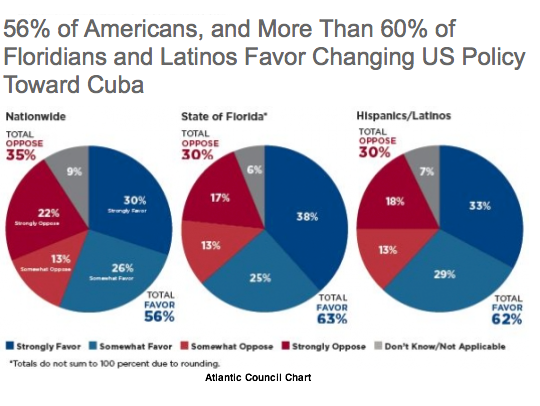
At least Obama is making the effort now.  While the Republicans and the Far Right (among them the exile hard-liners) will scream bloody murder about this, nearly every other player involved - our allies, local nations, a majority of Americans a lot of whom weren't even alive when the Cold War ended - will see this as a good thing.
via Huffington Post


And with luck, Disney will be smart enough to keep the 1950s Art Deco retro look when they turn all of Havana into an Epcot Center.

(caveat: I am writing this from Florida.  Any Floridian will tell you: Do Not F-CK with Disney.  They're like Hyman Roth, only with better PR.  If they wanna turn all of Havana into an Epcot, nothing's gonna stop them)