Showing posts with label james david barber. Show all posts

Thursday, January 16, 2025

Biden's Farewell

Update 1/20/25: Thanks again to Steve in Manhattan for including this article on Crooks & Liars' Mike's Blog Round-Up! I know today is going to be a dark and stressful one, so my suggestion to survive this day is 1) don't fcking watch and 2) hug your pets/loved ones. Good luck. We're all counting on you.


As most outgoing Presidents are wont to do - since Washington set the tone - President Joe Biden issued a formal Farewell Address to the nation, pointing out his term's successes and making dire warnings about what lays ahead (via Chris Megerian, Zeke Miller, and Colleen Long at AP News):

President Joe Biden used his farewell address to the nation Wednesday to deliver stark warnings about an “oligarchy” of the ultra-wealthy taking root in the country and a “tech-industrial complex” that is infringing on Americans’ rights and the future of democracy.

Speaking from the Oval Office as he prepares to hand over power Monday to President-elect Donald Trump, Biden seized what is likely to be his final opportunity to address the country before he departs the White House to spotlight the accumulation of power and wealth in the U.S. among just a small few.

“Today, an oligarchy is taking shape in America of extreme wealth, power and influence that literally threatens our entire democracy, our basic rights and freedoms, and a fair shot for everyone to get ahead,” Biden said, drawing attention to “a dangerous concentration of power in the hands of a few ultra-wealthy people and the dangerous consequences if their abuse of power is left unchecked...”

Biden’s speech in the Oval Office is the latest in a series of remarks on domestic policy and foreign relations he has delivered that are intended to cement his legacy and reshape Americans’ grim views on his term. Earlier in the day, he heralded a long awaited ceasefire agreement between Israel and Hamas, which could end more than a year of bloodshed in the Middle East.

“It’ll take time to feel the full impact of what we’ve done together but the seeds are planted and they’ll grow and they’ll bloom for decades to come,” Biden said. It was a tacit acknowledgement that many Americans say they have yet to feel the impact of his trillions of dollars spent on domestic initiatives...

Biden offered his own set of solutions for the problems that he laid out: change the tax code to ensure billionaires “pay their fair share,” eliminate the flow of hidden sources of money into political campaigns, establish 18-year term limits for members of the Supreme Court and ban members of Congress from trading stocks. His policy prescriptions come as his political capital is at its nadir as Biden prepares to exit the national stage, and after he has done little to advance those causes during his four years in power at the White House...

That last sentence aptly defines what could prove to be Biden's legacy: Both the long-term accomplishments he focused on working to rebuild the economy post-COVID and post-trump, and the frustration at letting too many needed reforms go pass. ALL of those things that Biden offered as solutions - especially the needed caps on campaign financing and on judicial overreach and corruption - were things HIS OWN administration could have worked on during the brief window of opportunity 2021 to 2023 when Democrats controlled both houses of Congress.

To this, I would point to Professor James David Barber's cheat sheet of Presidential Character. Where Biden falls on that spectrum - Passive-Positive - explains a lot about the lack of energy or focus when working on extensive and radical reforms. Passives are the type that don't want to "rock the boat" too hard and shake off any support from the more extreme elements of their own coalitions (and are willing to work with opponents thinking everyone's all in one big happy Starfleet); while the Positive trait of seeing the powers of high office as a good thing for the public can blind such Presidents from the need to stop corruption in government. Such Congeniality wouldn't be a problem in times of normalcy: However, we are in the Age of trump, where lies and greed are the coins of the realm, and Biden exposed himself to attacks he couldn't overcome.

This is why Passive-Positives preside over either administrations of high corruption or low energy. The good news is that Biden's personal incorruptibility - in spite of the MAGA accusations that he's corrupt like his son Hunter - drove him to surround himself with good people who did their jobs. This keeps him from getting grouped with the likes of U.S. Grant (who failed to surround himself with good people) and Warren Harding (who happily surrounded himself with corrupt friends) and Ronald Reagan (who may not have been fully aware of his regime's corruption but allowed it to happen). Biden falls in with the likes of William Taft: Who rose to power during a Progressive reformist wave and served a relatively scandal-free term, but failed to capitalize on more economic reforms and corporate regulations that were needed in that era.

As a side note, this is where Barber's Character chart of creating four major traits falls apart in the specific successes and failures of each presidency. Not all Active-Positive Presidents behave the same way, nor do Passive-Positives or Active-Negatives (there have been too few Passive-Negatives to make that observation). Even within each Character there seems to be two types: With Passive-Positives there's the type that presides over corruption because they don't want to lose friends (Appeasers) or the type that doesn't want to push harder on things that need doing (Slackers) because they feared the risks (something Actives never worry about).

Biden ended up as a Slacker President, trying to focus on big-menu items like job growth and infrastructure but unwilling to press harder on major crises such as trump's lawlessness and foreign wars/interventions such as Ukraine (where Biden's fear of Putin's nuclear retaliation paralyzed our support efforts to Zelensky) and Gaza (even as Biden claims success with a ceasefire, it took too many months and too many innocent Palestinian lives to get here).

Because of Biden's inability to see trump as a genuine and ongoing threat to American democracy and political well-being - and because he feared falling into the accusations of dictatorship if they pursued trump's criminality - he didn't push too hard - and hired a like-minded Attorney General in Merrick Garland who also didn't press the need - to see trump held accountable for his actions on January 6th. That delay cost us dearly: It allowed trump to campaign again and use his gaslighting and denials to escape justice, and return to power with a vengeance (literally).

Biden's administration is going to be less remembered for the accomplishments he did achieve - especially a key infrastructure bill that should improve local manufacturing and job growth for the next 20 years - and more remembered for all the missed opportunities to end global threats like Putin and greedhead threats like Elon Musk. He'll be among the ranks of the recently passed Jimmy Carter: A Good man who didn't exactly do a Great job.


Monday, February 21, 2022

HOLY SH-T IT'S PRESIDENTS DAY!!!

At last.

Time to honor all the great and wonderful Presidents of the United States who served this nation with honor, grace, and distinction.

That pretty much just weeds the list down to Washington, Lincoln, Teddy Roosevelt, and Obama. The rest were either too quirky, too foolish, too graceless, too foul-mouthed (dammit Truman!!!), too deceptive, too dishonorable, or served without distinction.

And oh we DEFINITELY should not honor this guy

Lemme shill for Professor Barber's Presidential Character tome of eldritch lore again!

EAT ALL THE PRESIDENTIAL PEACHES, AMERICA!!!


Saturday, May 01, 2021

Biden Going Big

As we go past the official "First 100 Days" of a Biden Presidency, the common refrain in the Beltway media is how "Biden is going big" in terms of pushing an aggressive economic agenda rivalling the New Deal for ambition and scope.

To Elia Nilsen at Vox.com

The Biden administration’s theory of policy so far is to go big. The same goes for its politics.

Taken together, President Joe Biden’s $2.25 trillion American Jobs Plan and newly introduced $1.8 trillion American Families Plan come out to slightly over $4 trillion in proposed new spending. It’s an enormous investment in American job creation; the last bipartisan infrastructure bill Congress passed in 2015 clocked in at about $305 billion — about one-thirteenth the size of Biden’s proposed plan. And Obama’s $800 billion stimulus plan of 2009 was about one-fifth of Biden’s plan, not even taking into account the $1.9 trillion in Covid-19 relief that has already been signed into law.

That sheer amount of proposed federal funding is meant to do a lot of things, but the main goal is to get as many jobs to as many people in as many voter constituencies as possible. Under Biden’s plan, infrastructure no longer calls to mind images of white men in hard hats; it includes working mothers, home health aides who care for the nation’s elderly, and workers of color across the nation. Women and people of color were crucial to Biden’s presidential win, and they are also crucial elements in his jobs plan...

To EJ Dionne at the Washington Post (watch out for paywall) Biden is harking back to the Democratic glory days of FDR and LBJ:

President Biden on Wednesday night went big, populist, folksy, hopeful, urgent — and bipartisan and partisan at the same time.

Addressing a pandemic-reduced gathering of lawmakers at the Capitol, Biden proposed a sweeping program of change that would create four more years of free schooling, expand child care and family leave, and attempt to beat back climate change through large infrastructure investments...

Biden welcomed the help of Republicans again and again, but he took clear aim at their favored economic doctrines. “My fellow Americans, trickle-down economics has never worked,” he declared. “It’s time to grow the economy from the bottom up and middle-out.”

And he took a victory lap on progress against covid-19, proclaiming that widespread vaccinations were offering “a dose of hope.”

This address wasn’t exactly the New Deal or the Great Society, but it was equally ambitious. Biden, reassuringly unradical with his plain, avuncular demeanor, is bidding to create a new common sense rooted in political lessons that Democrats have learned the hard way...

Going big - pushing for ambitious national programs on scale the United States hasn't seen since the 1960s - is more than just pushing back against the economic malaise we find ourselves in thanks to the COVID-19 pandemic: This is basically pushback against the last 40 years of the Far Right's "glorious" Pax Reaganica, where Big Government was "evil", deficits from massive tax cuts starved our public sector into a broken mess, and the rich got richer while the rest of us suffered.

This is Biden playing not only to the national audience - offering them a way out of low wages and little hope - but playing to a liberal and Progressive base eager to change the direction of the nation away from massive inequality the Far Right has been creating.  

The good news for Biden and the Democrats is how well the public is responding to these proposals. Back to Nilsen at Vox:

A range of polling shows that Biden’s expansive view of what counts as infrastructure has fairly broad support among the American public.

A recent NBC News poll found that 59 percent of respondents supported Biden’s American Jobs Plan. A recent Vox and Data for Progress poll found that 68 percent of likely voters support the plan. And a Monmouth University poll released Monday found 68 percent of respondents supported Biden’s infrastructure bill, with another 64 percent supportive of the ideas in Biden’s American Families Plan, which aims to make child care, higher education, and health care more affordable.

As Republicans and Democrats argue over the semantics of what constitutes “infrastructure,” Monmouth polling director Patrick Murray told Vox that Biden’s broad brush does not appear to be turning off voters so far.

For instance, Vox and Data for Progress polling found that a majority of likely voters of all parties supported Biden’s proposal of putting $400 billion into bringing down the costs of long-term care: 88 percent of Democrats, 72 percent of independents, and 55 percent of Republicans support the idea. And recent polling from Politico and Morning Consult shows that a large majority of Black voters support Biden’s pledge to increase housing options for low-income Americans; 80 percent of Black voters support that measure, and 58 percent “strongly” support it.

In other words, voters seem to care more about things that directly impact their lives than they do about whether these things meet a strict definition of “infrastructure...”

In short: People are back into believing that government can be a positive force in their lives, generating better jobs and better wages and better lives. The "Government is the Problem" meme is dying off, much to the horror of the Far Right clinging to the strands of political power.

But why exactly is this happening?

Isn't Biden supposed to be a Centrist, a post-LBJ pro-business Democrat who wasn't so great on issues of race and women's rights or on liberal issues in general, who tacked to the middle in order to push bipartisan deals through a Congress that is no longer the bipartisan haven he knew?

Well, kind of. This is all due to Biden's Presidential Character of being a Congenial Passive-Positive at the head of a Big Tent political party.

This isn't from my 2019 review of Biden's Character - where I worried Biden's easy-going nature made him vulnerable to Republican treachery - but from my 2020 followup that found Biden was doing a good job of building "the Big Tent" coalition of Democratic Moderates and Progressives. In fact, let's go to the direct quote from Aubrey Immelman about Biden's skills in forging that Big Tent:

Leaders with Biden’s personality profile are likely to exhibit an interpersonal leadership style, characterized by flexibility, compromise, and an emphasis on teamwork. The general tenor of a Biden presidency likely will be conciliatory, which could render a prospective President Biden vulnerable to manipulation by pressure groups and handicap him in negotiations or conflicts with foreign adversaries...

In short: Biden is someone willing to dance with those that brung him (got this from Molly Ivins). But where Immelman - and myself - might view that openness as a vulnerability to manipulation, there IS another way to view it as Biden building his teamwork between the various factions of his own party. To make that Big Tent work and push a broad, Big-Fucking-Deal agenda in a successful fashion.

Biden is pushing a big Progressive/Liberal agenda in the mold of FDR's New Deal because it's what his own Democratic ranks want. He will be more congenial and flexible with them, even as he tries to reach out to obstructionist Republicans, because he is a Democrat and they are Democrats and this is their Big Tent and that's how he'll roll, son. As long as Republicans refuse to barter or deal with Biden in any sane fashion, Biden's agenda won't reflect their interests, doubling down on their obstruction but also their obsolescence as Biden happily bulldozes forward.

Edit: I just found this article on MSNBC by Medhi Hasan and need to include it here as emphasis:

This was definitely how Biden behaved, at times, during the Democratic primaries. He never pretended to be at the head of a transformational movement, a la his former boss, Barack Obama. He didn’t enter office backed by a loyal cult, as his predecessor, Donald Trump, did.

Yet he and his administration have spent these first 100 days embracing the progressive wing of his party, along with labor unions, youth groups, climate campaigners and sundry activists. “Progressives say they’re being included, heard and respected by the Biden White House,” Politico reported in February.

Compare and contrast this outreach with the Obama era, in which White House press secretary Robert Gibbs dismissed people on the “professional left” who “ought to be drug-tested,” and White House chief of staff Rahm Emanuel denounced liberal activists as "f---ing retarded.”

Biden, on the other hand, proudly invoked Vermont Sen. Bernie Sanders’ support for the American Rescue Plan in the immediate aftermath of its passage through the Senate. His chief of staff, Ronald Klain, has been dubbed the “left whisperer,” having become “a point of rapid response for many on the left who are angling to get within earshot of the president,” The Daily Beast wrote.

Real access has been matched by real impact. Does anyone really believe the Biden who launched his presidential campaign in 2019 looking for a “middle ground” on climate issues would have committed to cutting U.S. carbon emissions in half by 2030 without pressure from groups like the Sunrise Movement...?

Here's the thing: Biden is listening. It's what Congenial characters do. And it's how he builds his world around him.

This IS what I wrote before about Biden: He's the Democratic Party answer to Ronald Reagan. Not Reagan the hard-core Conservative, but Reagan the Uniter, Reagan the Big Tent builder. Reagan was able to pull together divided Republican factions into a cohesive whole, dominating the electoral cycle of the 1980s in a way that only a Passive-Positive Congenial figure could. For all the damage Reagan did as President to the liberal foundations of 20th Century America, you have to admit his administration oversaw a massive, active period of policy changes and formation you wouldn't expect from a "passive" leader.

Biden can be the same way as President overseeing a massive wave of policy changes, only in favor of that liberal foundation that can be re-forged for the 21st Century America.

All Biden has to do is break loose the remaining obstructionist logjams - sadly enough, from Democratic Senator Centrists unwilling to see this moment in history for what it can be - and get his American Families Plan working.

This can be a big moment. Biden knows it. He knows it'll be good for his Democrats and it'll be good for his fellow Americans.

Any day now. All he has to do is get a few more Democrats to join this Big Tent moment and let it roll forth.

Wednesday, September 16, 2020

Documenting The Character of Joe Biden for the Presidency In 2020

I know I pimp heavily the work of James David Barber's Presidential Character, and I've already made my analysis of Joe Biden's traits heading into the 2020 general election.

But I wanna confirm my reading of Biden's habits and potential performance as President, so I went looking for research from other observers. It's always good for the soul to find out other people see the same things you see...

Anywho, here's some links to what I found that matches my conclusion of Biden being Passive-Positive.

From "The Political Personality of Former U.S. Vice President Joe Biden," by Aubrey Immelman in a working paper for College of Saint Benedict and Saint John's University via Digital Commons:

The personality profile yielded by the MIDC was analyzed on the basis of interpretive guidelines provided in the MIDC and Millon Index of Personality Styles manuals. Biden’s primary personality pattern was found to be Outgoing/gregarious, complemented by a secondary Accommodating/cooperative pattern and subsidiary Ambitious/confident features.

The prominence of the Outgoing pattern, in conjunction with a distinctive Accommodating pattern in his overall personality configuration, is indicative of the conciliatory extravert subtype. This personality composite provides the personological substrate for a strong affiliation motive. These individuals are driven to seek approval; they want others to like them and view them as a friend or ally. To achieve that motivational goal, they often compliment, praise, or flatter others, presenting an image of goodwill. When disagreements occur, they attempt to smooth things over, sometimes at the cost of conceding.

Leaders with Biden’s personality profile are likely to exhibit an interpersonal leadership style, characterized by flexibility, compromise, and an emphasis on teamwork. The general tenor of a Biden presidency likely will be conciliatory, which could render a prospective President Biden vulnerable to manipulation by pressure groups and handicap him in negotiations or conflicts with foreign adversaries...

In terms of presidential temperament, Joe Biden seems most similar to Barber’s (1972/1992) passive–positive presidential character — leaders such as William Howard Taft, Warren G. Harding, and Ronald Reagan, characterized by an ingratiating personality, optimism, and a desire to please. These affiliation-motivated presidents are low on the need for power and do not invest much energy in the office of the presidency but nonetheless like the job...

Here's something from a source I normally don't quote from (the American Conservative) in a June 2020 article by Robert W. Merry:

...but Biden’s ability to work with senatorial colleagues was a hallmark of his image over the decades of his congressional tenure. The highly regarded Congressional Quarterly book of political profiles, Politics in America, praised Biden for his ability to work with North Carolina Republican Jesse Helms when Helms was chairman of the Foreign Relations Committee and Biden was its ranking member. Said the book: “Biden’s ability to maintain lines of communication with all groups often has made him, rather than Helms, the key vote on Foreign Relations.”

This can be viewed as evidence of a Positive trait, based on the Barber scale. Even after 30 years in the Senate, said Politics in America, “he still exhibits the intelligence, drive and passion of his youth.” The key word here, in terms of presidential character, is “passion.” Positives demonstrate a zest for the job and an openness to people, even those in the opposition who represent impediments to success that must be dealt with through persuasion, cajolery, back-slapping, and old-fashioned horse-trading. Positives love that game; so does Biden.

On the Active/Passive scale, Biden seems to tilt toward passivity... Thus does it appear that Biden represents a likely Passive/Positive president. Recall, Barber sees presidents in this category as wanting to be loved and thus ingratiating—and easily manipulated. That indeed is one of the knocks on Biden by conservatives—that he is being manipulated in his campaign, and would continue to be as president, by his party’s emergent leftist radicals...

Merry might need to recognize that the fears of Biden being manipulated by the Far Left Progressives is mirrored by the Progressives' fear that Biden will be manipulated by the Moderates and Centrists that Merry would view as advocates to his issues. Ah well, can't please everyone.

P.S. Merry, I can explain to you why Barber graded Reagan as a Passive-Positive, drop me a message we'll talk aboot it.

To round out to a nice third entry, here's an Atlantic article from Franklin Foer about Biden's campaign struggles and rebounds:

In the face of upheaval, he’s given reason to hope that the traits that were his supposed weaknesses could prove to be his great strengths. If one of the ultimate purposes of protest is to push politicians, he’s shown himself a politician willing to be pushed. His tendency to channel the zeitgeist has supplied him with the potential to meet a very difficult moment...

More than other figures in the Democratic Party, Biden can speak warmly about the protesters without risking political backlash. With his gaffes, which sometimes veer toward the politically incorrect, he’s hardly an easily caricatured avatar of wokeness. His penchant for cringeworthy remarks, and his old-time mannerisms, help cushion whatever anxiety some white voters might have about his tough criticisms of police and blunt condemnations of systemic racism...

The challenge for the Biden candidacy is to bridge an alliance with a resurgent left. Biden, a creature of the Senate, has to convince young people rushing to the barricades that he’s worth a trip to the polls. And the challenge for the left is to accept that Biden is its greatest chance of achieving its long-held dreams. What he’s demonstrated over the past week is a willingness to play the role of tribune, to let the moment carry him to a new place...

What Foer speaks to is the conciliatory nature of a Passive-Positive, a sizable amount of humility and self-deprecation (traits sometimes shared with Active-Positives) mixed with the awareness of the moment and the ability to attune to the needs of others (in this case, the needs of Americans both Left Center and Right battered by four years of trumpian abuse).

In terms of our nation's need for a Passive-Positive figure, in many respects this makes Biden the perfect antithesis to donald trump, a pure Active-Negative and thus polar opposite in nature to Biden's Congenial traits (referring back to Merry's article, even Merry notes the unhappy, grasping and raging traits of trump puts him squarely in the A-N chart).

This is where we are at: The choice is between a benevolent, congenial Biden and a rage-filled, destructive trump.

It shouldn't be that hard a choice, America. For the LOVE OF GOD, vote Biden.


Sunday, January 12, 2020

Predicting Character: Warren Is Planning for Everything

Man this has been on the back-burner for the longest time, stuff keeps popping up, I keep getting all these distractions like I need a hole in my head (and yes, black comedy is keeping me going at the moment),

But I can't hold off on this much longer. The primaries officially kick off in less than two weeks I think, and my surgery is set almost a week away. So no more delays...

I've been tracking the habits and behaviors of the top four Democratic candidates facing off against Loser of the Popular Vote trump, having visited my personal fave Kamala Harris, then Joe Biden, then Bernie Sanders, and finally with this post Elizabeth Warren. During this stint, Harris had to drop out as she couldn't keep her early debate win momentum going (as well as keep up with the fundraising), all the while watching the dark horse candidates like Pete Buttigieg get a week or two in the spotlight much like any other primary with 2000 candidates all vying to be the Not-Hillary uh Not-Biden swaying the Democratic voting base to side with them.

We're at the point the field is winnowing (which is good) but we're also at the point where the candidates are starting to play the state-by-state pandering game that sells well in Iowa and New Hampshire but doesn't do so well for the bigger states like New York, Florida, Illinois and California where most Americans live anywho. (Yes, I am ranting in favor of a 50-state one-day primary thank you again)

All except for Warren as far as I can tell. Warren's been campaigning in a different style than most of the other front-runners. She's been campaigning as the Idea Candidate.


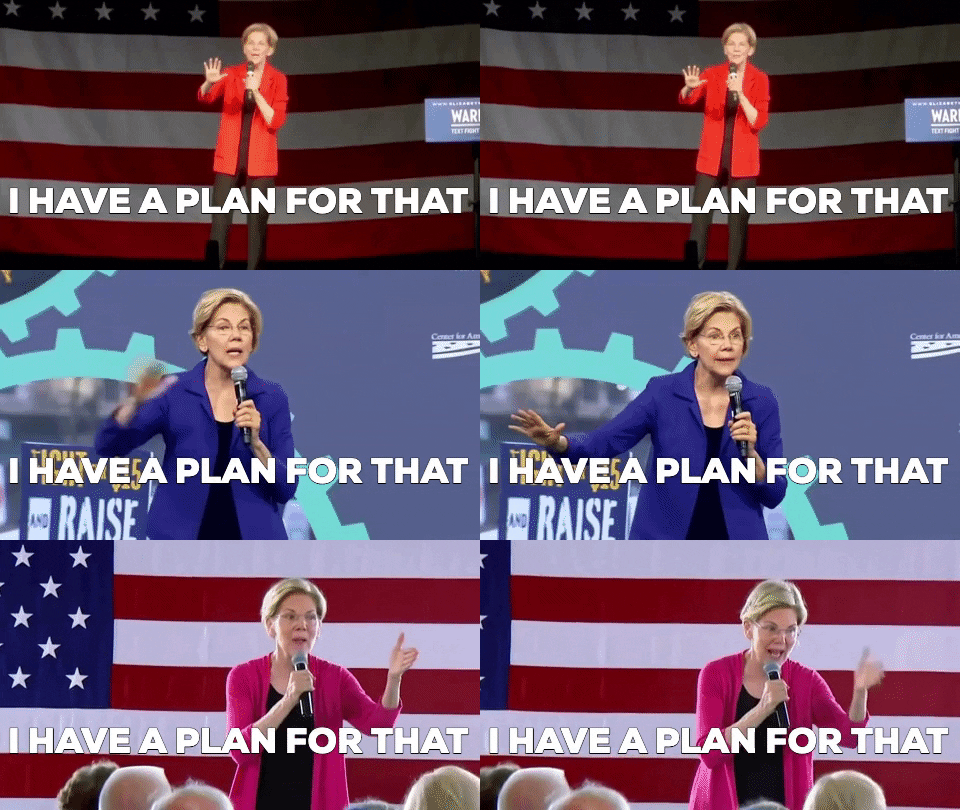
"Warren's Got a Plan For That."

Want Medicare 4 All? Warren's got a plan for that. Cancelling college student debt. She's got a plan for that. Robbing three casinos in one night? You damn betcha she got a plan for that!

Okay, I kid about the Oceans 11 thing (but hey if Warren calls me needing that guy on the computer to hack into the mainframe, I'll refer her to somebody and take the driver's gig instead), but Warren is serious about putting out plans and proposals for families and workers and everyone who's key to the Democratic voter turnout. It's why Warren has been getting a solid number of support groups like the Working Families PAC to switch their votes from Bernie to Warren.

As such, Warren is more of a threat to Bernie's hold on the Progressive Left forces in the Democratic ranks than she is a threat to Biden's hold on the Moderate/Centrist forces. Even though given Warren's range of topics she's supporting and covering puts her as a major candidate for BOTH factions.

So why isn't she polling any higher?

Because Biden's lead as a Passive-Positive figure appealing to a majority of the Democratic base is kinda hard to punch against. Because Sanders' True-Believer BernieBro faction isn't going to give up their ideal Utopia of a revolutionary democratic socialism... something they believe Warren isn't really going to support if she wins this November. Because the mainstream media still has a problem with women candidates and the harsh coverage shows.

Which is a damn shame because Warren's character traits suggest she'll be a strong Adaptive figure in the White House that trends towards an Active-Positive administration.

To refer to this New Yorker article by Sheelah Kolhatkar:

...Warren is one of the country’s foremost critics of Wall Street firms and big banks, which make much of their profit, in her view, by abusing consumers and taxpayers. It’s a perspective that has grown out of Warren’s work as an academic and has shaped her ideas as a politician, propelling her from Harvard Law School, where she was a professor specializing in bankruptcy law, to the Senate, where she has represented Massachusetts since 2013.
On many economic issues, Warren has been remarkably prescient. She has spent decades warning Americans about the pernicious effects of income inequality, predatory corporations, and consumer debt, and about the failures of our financial system—issues that are at the heart of the 2020 Presidential campaign... She is attempting to position herself as a pragmatic advocate for the middle class, someone who can bring systemic reforms to education, health care, and democracy itself. But, unlike the Presidential candidate Bernie Sanders, Warren doesn’t describe herself as a “democratic socialist,” and says that she isn’t trying to do away with capitalism. “I believe in markets,” she says, over and over. She says that she simply wants to make them work better for more people...

As I noted, it's that last bit - Warren's unwillingness to join the Far Left completely, even as she pushes for reforms that would clearly fulfill a lot of what the Far Left hopes for - that scares the BernieBro faction. But it shouldn't (back to Kolhatkar):

...With the help of advisers working from her headquarters, in Boston, Warren has been releasing a torrent of detailed policy proposals. She has issued a plan to dramatically reduce student debt and to offer free tuition at public colleges; a plan to unwind large agriculture conglomerates in order to make the market more equitable for family farms; a plan to require large corporations to pay more in federal taxes; a plan to dismantle the behemoth technology companies and regulate them like utilities; and new legislation to address opioid addiction, modeled on a bill passed by Congress in 1990 to combat the H.I.V./aids epidemic. She has announced an “Economic Patriotism” plan, intended to create opportunities for American workers, and has issued proposals targeted at Donald Trump, including one that would make it permissible to indict a sitting President.
Together, the proposals promise a new level of government intervention in almost every aspect of economic life. Some of the ideas are pragmatic; others seem aimed more at marketing than at implementation. Regardless, “I have a plan for that” has become a rallying cry for her campaign—an echo of the way that “Nevertheless, she persisted” became a tagline for Warren supporters after Mitch McConnell, the Senate Majority Leader, used it to describe Warren’s refusal to stand down during the confirmation hearing for Jeff Sessions, Trump’s former Attorney General. In May, the comedian Ashley Nicole Black wrote, on Twitter, “Do you think Elizabeth Warren has a plan to fix my love life?” Warren responded, “DM me and let’s figure this out...”

There's a couple of things to point out here about character traits: Warren's self-deprecation with that last bit, but overall a detailed, comprehensive view of every problem facing the nation and a willingness to answer those problems. A lot of this fits into what Professor Barber established as Active-Positive traits: Problem-solving, engagement, and a willingness to take stands.

When confronted with the challenges of running any election, specifically her run at the U.S. Senate in 2012, this came up:

Many voters saw Clinton as flip-flopping and opportunistic; Warren comes across as straightforward. She rarely brings up breaking the “highest and hardest glass ceiling,” as Clinton often did, although she acknowledges its existence. She told me that, when she was considering running for the Senate, in 2012, people advised her against it because of her gender. In the previous election, Martha Coakley, the Massachusetts attorney general, had been beaten by an inexperienced Republican, Scott Brown. “Massachusetts is not going to elect a woman. It’s just not going to happen,” Warren was told again and again. “Every time I heard that,” she said, “I’d think, I’m definitely getting in this race...”

As I mentioned before about Truman, an A-P figure relishes the challenges of a political fight not for their own sake but for the issues and communities affected. As an aside, it should be noted Coakley didn't do a good job of campaigning, even failing at proper support of local sports teams - it's Bawston, it mattahs - while Warren proved adept at the game.

When I asked Warren how she would survive all that, she said, “I know how to fight and I know how to win.” She pointed to two of her major accomplishments in Washington: the creation of a new regulatory agency, the Consumer Financial Protection Bureau, in 2010, and her Senate campaign against Scott Brown.
“After the financial crash, I knew that we needed a consumer agency to keep big banks from cheating people,” she said. “People told me two things: ‘It’s a great idea’ and ‘Don’t even try it. You can never get it passed into law. The big banks will never permit this. They’ll fight you every inch of the way.’”
She paused. “But we got organized. We fought for working people. We built a grassroots movement. And President Obama signed the Consumer Financial Protection Bureau into law.”
A little more than a year later, Democrats encouraged Warren to challenge Brown for his seat, despite considerable odds. “I decided that I was not going to wake up on the day after the election and he would still be my senator, voting against my values, and I would have done anything less than everything I could to stop that from happening,” she said. “And I went from down seventeen points to beating Brown by seven and a half points...

While this attitude shares the ambition of the Active-Negative, you'll notice a good amount of "we needed," "we fought," "we got organized." A good Active-Positive speaks in the "We Can" voice (opposed to the "I Must" of the A-N), which tends to be the overall delivery from Warren.

And speaking of Warren's work with the CFPB:

A person involved in the effort to get the C.F.P.B. included in the bill told me that Warren’s drawn-out bankruptcy battles had helped her acquire the skills to get things accomplished in politics. “She was pretty good about both the inside game and the outside game, and how the two intersect,” he said. “The inside game is very important: you need to get a bill passed in Congress, and she understood this and got C.F.P.B. into Dodd-Frank. And then she did a lot of press interviews and a lot of things to engage the public.”
After the legislation was approved, in 2010, Warren seemed the obvious choice to lead the new agency. But Neil Barofsky, who oversaw the bailout with her, told me that her desire for the role never entered into her decision-making. The head of the new agency would initially report to Geithner, and Barofsky recalled a hearing in which Warren aggressively questioned Geithner about his treatment of the insurance company A.I.G., which had paid its traders generous bonuses after taking taxpayer funds. “If she had pulled punches in that hearing, nobody would have known,” Barofsky said. “And she just eviscerated him, and exposed the hypocrisy and the failure of the program.”
News outlets later reported that Geithner opposed the idea of Warren running the C.F.P.B. He wasn’t alone. The financial industry mobilized to derail her potential nomination. “You remember preapproved credit cards?” Warren told me. “I was a pre-rejected nominee...”
...Obama, facing intense resistance, nominated Richard Cordray, a former Ohio attorney general, for the role. But he asked Warren to help set up the agency; she spent a year doing that. Under Cordray, the C.F.P.B. forced financial institutions to return twelve billion dollars to customers who had been targeted by scams such as unauthorized overdraft charges and illegal fees for student-loan repayments. Congressional Republicans kept up their opposition; by 2017, they had introduced a hundred and thirty-five bills and resolutions to weaken or eliminate the agency...

One measure of respect in politics is the class of enemies you make. Warren is arguably the most hated Democrat among the super-rich financial institutions and corporations trying to squeeze more money out of Americans (and the world) than ever before. In that regards, she deserves serious consideration to run against the most corrupt financial figure of the last 50 years in trump.

So how would I grade her as a candidate for the Presidency?

Elizabeth Warren - Senator, Massachusetts.
Positives: Popular Senator who has had national coverage since her consumer advocacy in the 2000s, has worked as a major player of the Consumer Financial Protection Bureau, is aware of the challenges of reining in fraud and financial corruption, she would be the one of the few candidates if elected to hold businesses accountable and do a lot of things to end the income inequality threatening the nation. Would be the first Woman President to actually sit in the Oval Office (sorry Hillary). Would be someone capable of undoing a lot of the fiscal damage trump has done since 2017. Also, Kate McKinnon can play her on SNL.

Negatives: Along with Biden and Sanders, Warren is part of an aging Boomer population (despite the appeal she has to a lot of Gen X and Millennial liberals/moderates). Still is answering for questionable past behavior revolving around a college-period claim of Native American ancestry (which trump and fellow haters are using to drag her real name through the mud). Is too Pragmatic a figure for the Progressives to accept and too Reformist for the Moderates to trust. Like Hillary before her, Warren has to overcome a legitimate problem with sexism in our nation's media and voting population.

Chances: She's currently in the mix in the early primary / caucus states for the Democratic primaries, but she's low on funding compared to Biden and Sanders (and also to the rich guys Steyer and Bloomberg who are spending millions in ads she can't afford to make and air yet). If she can pull off an upset or two early on - maybe Iowa, maybe New Hampshire - and weather the push by the media to drop out before the big states, she may gain momentum the way Obama did in 2008.

Character Chart: I've already pointed out how I view her as an Active-Positive figure. She shows the Adaptive trait of accepting and taking on policy ideas of fellow candidates (with a willingness to admit where she got the ideas from), working with a level of Self-Confidence (her primary trait IMHO) and Long-Term Planning (the gamemanship skills of a Kennedy/Obama) that other A-Ps have deployed. Like Truman before her, she does the homework to debate her points with aplomb and directness. If I had to compare Warren to anyone, it would be FDR (A-P), a reform-minded charismatic willing to fix a broken system rather than replace it outright.


Okay, that's all I got for the four three main candidates for the Democrats to choose from. Having lost my primary candidate in Harris - whom I supported for her early advocacy for better teacher pay and boosts to education funding - I've decided to put my support to Warren, whose agenda mostly matches my own hopes for a better government taking care of the citizenry. Past all that, I am willing to support ANY Democratic candidate - even Sanders but definitely NOT Gabbard - due to the reality of how dangerous it is letting trump and the Republicans retain ANY power in our government.

If I had a preference order, it'd be 1) Warren, 2) Booker, 3) Klobuchar, 4) Biden, 5) Sanders, 6) Maybe Mayor Pete, I'm not sure who's left in the equation 7) Anybody but Gabbard.


Sunday, September 08, 2019

Predicting Character: Bernie As Constant Curmudgeon

Okay, this has taken me a little longer to write than I'd hoped, mostly because I am trying to keep a promise to myself to make this as unbiased and professional a review as possible.

SO CAN YOU BERNIEBROS SHUT UP ABOUT YOUR PRECIOUS FEE-FEES ABOUT NOT GETTING YOUR WAY WITH THE DNC RULES FOR A MINUTE HERE?! Ahem. Sorry. Let's try to keep it cool, okay self? Okay.

Next up on the candidate reviews - based on James David Barber's model of Presidential Character - is a fellow we've have guest-star before, this Senator from Vermont by the name of Bernie Sanders. (Insane amount of cheering from Facebook rises up) For heaven's sake, BernieBros, can I get through this without ANY interruptions?! (boos echo through the blog) Too bad, shaddup, and read on.

This is what I wrote before in 2015 during the build-up to that election cycle:

Positives: Has electoral experience for decades serving as a congressman and then Senator.  Has a political agenda that pushes hard Left after decades that most agendas pushed hard Right (the Age of Reagan), meaning a decent chance to shift the goal-posts of the national dialog back to the center.
Negatives: As much as the Far Far Right candidates like Cruz, Rand Paul, and Huckabee (announcing very soon) are poison to the general voting electorate, Sanders is too Far Far Left.  Half of his platform will reek too much of a Socialist agenda too many Americans still despise.  Comes from a small-population state that will not help as a base of voter support.   There is a question that as an independent (not really in the party) that he may not qualify on enough state ballots to count (his campaign is going to have to work overtime to make those ballots).
Chances: Slim.  He's determined, and has a reason to run this thing as far as possible.  But the Democratic Establishment types would be horrified if he gets the nomination: the Wall Street forces will rally like mad for the pro-business candidates like Hillary and could well swamp Sanders' campaign with too much money/power (which ironically will prove Sanders correct about the corruption of campaign money). And he may not appeal across the individual states - especially the more centrist, Red/Purple states in the South and West - he'll need to win primaries.
Character Chart: Sanders' socialist agenda is aggressively behind using the powers of the federal government to the fullest extent of the law, and that government can be used to improve the economy, improve jobs and wages, and uphold broad civil liberties.  On that, Sanders has the look of an Active-Positive (views government as an effective means of change).  However, Sanders displays many of the Active-Negative traits of being Idealistic and Uncompromising: he will not bend on the issues.  The only thing I can be certain of: he will be an Active President if elected.

Ever since I put up that Character assessment, I got to see more of Bernie in action. Or to be more specific, I got to see more of his followers in action.


Here's the deal, Bernie followers: Hillary's supporters are NOT sheep nor sheeple. A majority of Hillary's followers have solid reasons to side with her this 2016 election, and they have reasons not to share the worldview you've got that make you side with Bernie with such fervor.
In your pursuit of defending your candidate, you're going out of your way to insult fellow Democrats and Left-leaning centrists who are still a vital part of the Democratic party's chances to win big this 2016.
As much as you feel alienated from having a Far Left / progressive agenda get shot down for 40-plus years since the rise of Nixon and the Republican Southern Strategy, you're not helping by alienating the more moderate, pragmatic party members who aren't going to be in the mood for your denunciations and scorn...
Look, you can argue for Bernie Sanders. Argue on the merits, argue about the need to fight income inequality. Get ahead on the issue about the growing crisis in rental and homeowning costs for a majority of Americans. Go loud and strong on dealing with the massive personal debt crisis that got ignored by the Big Banks and Wall Street.
But stop with the insults and dismissal of your fellow Democrats. THEY ARE YOU AND YOU ARE THEY both on the same side of social justice and economic fairness, despite all the stuff about Hillary being in bed with Wall Street. At the end of the day, Hillary is still talking about making things work the way Democrats want things to work...

My ongoing exposure to the Bernie fanbase has been a continuing spectacle of a fervent group who believe THEY are the true voice of Dem voters fighting against an "Establishment" party that's trying to retain enough cohesion to fucking win a Presidential election. Again. Yet it's that failure of purity that's already driving some of the more publicly-known pro-Bernie supporters to say they won't support any other Democratic candidate in 2020. Just like they promised not to for Hillary in 2016. Essentially, they're extorting the Democratic party into accepting Bernie or else suffer low turnout guaranteeing a second trump term.

In other words, the BernieBros are promising to be assholes. Again. (Booing increases from the corners of the Internet where they reside) I'm not WRONG, you jerks. Look at yourselves... Sheesh, anyway...

The current drum-beating from the BernieBro elements are that the other major candidates - Biden, Harris, even Warren - are insufficiently Progressive enough to win them over if they get the nomination. Worse, they're convinced that none of the other candidates can appeal to the coveted "working whites" voting group that went for trump in 2016, as though that voting bloc is ever attainable for Democrats in 2020. Never mind the facts - same as in 2016 - that a Democratic administration if they win would support - and even pass - enough of a Far Left platform to make the United States more secure on key issues for progressives like better wages, repairing the damage of climate change, ending trump's human rights abuses on immigration, and more.

The Bernie voters - like any Idealistic extremist world-view - want their Utopia. To them, "Merely Good" is NOT "Perfect". And only Bernie can deliver "Perfect".

So what the hell IS "Perfect" for a Bernie supporter? In short, a radical redesign of American political and social philosophy, away from Capitalism and fully attuned to Socialism (based on what Bernie calls a Democratic Socialism akin to Scandinavian nations).

I can re-argue the problem of Utopian thinking in detail (Again), but the most obvious argument here is that a majority of Americans - many of them AREN'T as Left-leaning as the Progressives want to believe - are NOT going to support a Bernie agenda that on paper looks to change everything we know about how America works

When people vote For or Against anything, the biggest concerns they will always have are What do I gain from this, and What will this cost me? A massive revamp of even healthcare away from the Obamacare system (which supports the current Capitalist view) to a Medicare-For-All system (which forces wholesale changes that even its supporters can't fully explain) will scare enough honest voters (even the ones who would benefit the most) away from supporting that.

This is where Bernie differs from much of the primary field. Even Warren - who is closest to Bernie when it comes to Progressive issues - is more focused on reforming the systems we have instead of massive change. In this regard, Warren is more an FDR New Deal supporter - which kept Capitalism but heavily regulated it - than an outright Henry Wallace-type of Far Left candidate.

And if you know your history, Henry Wallace really did not appeal to most Americans when he had his chance. For all the changes to how Americans view full-out Socialism today (especially among younger voters), there still are a lot of voters who won't accept it. Even among solid Liberal Democratic voters sympathetic to those goals.

This lack of actual support for an openly Socialist agenda is leading into the other problem: Bernie is not doing so great in the primaries this time. Last time, against Hillary and minor candidates, Bernie was the clear alternative to the juggernaut that was the Hillary campaign. But that was then. Today, Sanders is part of a field of 24 - no, wait, it's dropped down to 16 finally thank the Gods - to where there isn't a dominant Establishment figure (Hillary) against whom a single candidate could run (the Not-Hillary). This time, there's one dominant Establishment figure (Biden) against whom there are three viable Not-Bidens (Bernie but also Harris and also Warren) to split the opposition vote. Bernie cannot rely on a solid 40-45 percent of Democratic voters in the primaries, he has to fight for them vs. Warren and Harris.

Just to repeat meself: Bernie's not doing a very good job of winning over that voting base this time. Sanders' Uncompromising behavior is a big reason why (via Peter Hamby at Vanity Fair):

Sanders might be 77 years old and “salty as ever,” as CNN’s Kate Bolduan said on-air Tuesday after his announcement, but he’s still a central figure in the dialectic of the Democratic Party, its most uncompromising ideological figure, and best fund-raiser. Like Trump, Sanders didn’t get there by climbing the ladder in Washington like his fellow senators now in the presidential race; he did it by tapping into common-sense ideas about economic fairness and raising oceans of small-donor cash online in the process. He delivered his message using non-traditional media and waited for the green-room journalism crowd to catch up. A democratic socialist, Sanders might have chosen to run in 2016 as a third-party liberal in the mold of Nader. But instead, he smartly decided to disrupt the Democratic Party from the inside by seeking its presidential nomination, all while never calling himself a Democrat. Sanders became the liberal folk hero of the last campaign, the subject of graffiti murals, hipster endorsements, and D.I.Y. merch, the cool grassroots signifiers that swirled around Nader a decade and a half earlier...
Sanders’s biggest failure in 2016 was not building coalitions. He found it difficult to expand his reach beyond liberals, white workers, and young people, to win over the older women and African-Americans who eventually gave their votes to Clinton. But on CBS, Sanders told Dickerson that unlike in 2016, he can plausibly win the nomination without cobbling together a majority of Democrats. “In some ways it makes it easier,” Sanders said. “When you’re running against one person you know you gotta have 51 percent of the votes. Now who knows what you need? Thirty, thirty-five percent...?”
Sanders seems like he’d rather watch a 10-hour Bachelor marathon, Clockwork Orange–style, than do the same. He is permanently averse to playing the inside political game, gabbing with power brokers on the phone, or charming the media off-the-record. His sequel campaign will test whether those choices matter anymore, whether big speeches, lofty policy ideas, and social media alone can carry the day. This might be a Very Bill Simmons Hot Take, but Sanders is the James Harden of politics. He’ll get you 30 points a night, but it’s hard to see how he wins a championship without getting his teammates involved. Either way, he’ll still be in the conversation...
The short gist: Sanders will lead the Democratic Party but he won't work with it. Compromise is a dirty word to him. If I need to say something positive about this, I could call him an Idealist deeply committed to an alternative world-view of America as a Socialist Utopia. As much as an Idealist Bernie is, we've seen Idealists in action before: Of previous Presidents, Sanders IMHO would follow in the footsteps of Woodrow Wilson, whose ambitions and agendas surely capped the Progressive Era of early 20th Century... only to have everything crash and burn due to his stubborn ideology. And if you've read my blog enough, you know what I think of Utopias...

Add to that this bit from a Jeva Lange article I dug up from The Week back in 2015:

"Bernie's an a--hole, but he's our a--hole," one unnamed Vermont politician explained to Boston Magazine. Sanders' campaign field director put it more gently: "Bernie is a very demanding guy. He has very high expectations, and he expects people to meet them."
Chris Graff, a journalist who has covered Sanders for the past two and a half decades, expressed similar sentiments. "Bernie has no social skills, no sense of humor, and he's quick to boil over," he said. "He's the most unpolitical person in politics I've ever come across." Likewise, following Bernie's threats to walk off the stage when Black Lives Matter protesters interrupted him in Phoenix, Vermont's Seven Days newspaper described the move as "exasperating and classic Bernie... Man of the people treating the people like tiresome children, telling them what the issue is, instead of listening to what their issue, our issue, America's issue is right now."
"Bernie is so certain that what he represents politically is unquestionably correct, therefore everyone should agree," Susan Boardman Russ, the former chief of staff for Vermont Sen. Jim Jeffords, told Boston Magazine. "Not much room for compromise... it was, 'Play in my sandbox, or get out.'"

If you've read this blog enough - especially the Presidential Character stuff - you'll know the second I apply Uncompromising to describe someone I'm labeling that person Active-Negative. It's the key trait for A-Ns - just as Adaptive is for Active-Positive and Congeniality is for Passive-Positive and Duty is for Passive-Negative - where their ambition to achieve their goals outweigh their ability to actually reach those goals. Or if they do reach those goals, they fail to realize the costs - before AND after - those goals require.

If I had to redraw the Character description for 2020, it'd look like this:

Bernie Sanders - Senator, Vermont
Positives: Has electoral experience for decades serving as a congressman and then Senator. An engaging and driven personality. Aggressively pushes for a Left-leaning populist agenda that may appeal to key voting blocs. Has developed a dedicated fanbase that should provide a solid voter base in the primaries.

Negatives: Even in an election cycle where the Democratic candidates are more Progressive than ever (outside of Biden and a handful of other second-tier candidates), Sanders is still too far a Far Left figure. For all his years - since the 1990s! - at the federal level, does not have an extensive success track record with legislation: Very few sponsored bills getting passed or even voted on. Still does not show many signs of playing well with others. .

Chances: Slim. Bernie started off as the marquee name this primary cycle but was eclipsed by Biden the second Joe threw his hat in. Bernie's also been overtaken by Warren whose progressive bona fides - and more positive campaign style - has claimed a lot of the followers he had in 2016. He's determined (as already noted), and has a reason to run this thing as far as possible. But this time he doesn't have the Outsider cachet, he doesn't have the Progressive Warrior banner to himself, and this time he's worn out his welcome.

Character Chart: Before, I had little awareness of Sanders' performance and world-view outside of his stated platform. I couldn't tell then if he were Positive (politically engaged and viewing Presidential power as a means for helping others) or Negative (dedicated - obsessed even - with a particular agenda as a form of personal success). Having seen him in action since 2016, I've gotten a better understanding of how his Uncompromising stances on his Democratic Socialist agenda makes him too Active-Negative a figure to be Adaptive to the challenges any President will face. Sanders wants to be the one to turn the United States away from a Capitalist political-economic society towards a Socialist one. That's one hell of an ambitious agenda, but speaks to a world-view that will chafe against the restrictions of a Federalist system. A Sanders administration - even with a Democratic-controlled Congress - will be a bar brawl every step of the way.

The United States cannot afford four more years of trumpism. It can't even afford one more DAY of Mitch McConnell selling out our Senate to the NRA and Putin. The only way this can get solved is by backing the Democratic Party across all ballots, all elected offices. THAT'S how this nation can recover and rebuild. If the candidate is Biden, so be it, VOTE. If the candidate is Harris, so be it, VOTE. If the candidate is Warren, so be it, VOTE. If the candidate is Bernie, so be it, VOTE. If the candidate is Gabbard... okay, fucking thing's been rigged, WTF Putin even THAT would be too obvious a hack.

But here's the problem: I am not hearing from a lot of Bernie supporters that if the choice ends up being Biden or Harris or Warren they'll still vote Dem. I'm getting the vibe, hearing too much feedback that the pro-Bernie faction will - again - sit out the vote in protest and let trump and those crooks continue destroying our world.

"I will vote FOR the Democratic nominee for President in 2020." That's an easy thing to say and do, Bernie supporters. Recognize and support the Democratic candidate most likely to fulfill an agenda that makes the world close to what you want it to be. It won't be PERFECT, but it'll be better than it is now. Please and thank you.

Next up on the Presidential Character preview for 2020: Oh you better believe there's a plan for that.

Sunday, August 11, 2019

Predicting Character (again): The Jocularity of Joe Biden

Okay, that WAS the title was I going to use back in 2015 for the 2016 Presidential campaign. Gods, the time flies...

It's been almost four years since then, so has anything really changed for Joe Biden? In terms of biography, his career is something that reaches back as far as 1974 (!) and covers a lot of ground. If we can refer to Evan Osnos' New Yorker article on him from 2014 (highlighting character traits):

Over the years, Biden has acquired a singular place in the pop culture of American politics. In a White House that privileges self-containment, Biden ambles between exuberant and self-defeating. He was barely in the West Wing before the Onion declared, in a headline, “shirtless Biden washes trans am in white house driveway,” establishing a theme—“Amtrak Joe,” the hell-raiser at the end of the bar—that is so enduring that it obscures the fact that he is a lifelong teetotaller. (Too many alcoholics in his family, he says. He grew up sharing a room with his mother’s brother, and recalled of the experience, “Even as kids, we noticed Uncle Boo-Boo drank a bit heavily.”)
Instead of raging against the indignities of the Vice-Presidency, Biden luxuriates in the job. Perched in his chair during the State of the Union address, peering down on his former congressional colleagues, Biden makes a pistol out of his finger and thumb, and blasts away, winking and gunning with no evident irony... The full package—the Ray-Ban aviators, the shameless schmalz, the echoes of the Fonz—has never endeared him to the establishment, but it lends him an air of authenticity that is rare in his profession. It has also produced a whiff of cult appeal, such that his image now has more in common with Betty White than with John Boehner. In May, after a teenager invited Biden to her prom, he replied with a corsage and a handwritten note encouraging her to “enjoy your prom as much as I did mine.” On Twitter, people went affectionately berserk.
Other than the President, nobody in the White House attracts more divergent public appraisals than Biden. In a column before the 2012 election, Bill Keller, the former executive editor of the Times, urged Obama to drop Biden as a running mate and replace him with the Secretary of State at the time, Hillary Clinton. (The campaign studied the idea, too, until polls showed that it would make no difference.) ...That summer, a survey by the Pew Research Center and the Washington Post asked people to come up with a single word to describe Biden; the most frequent responses, nearly equal in number, were “good” and “idiot.” Republicans rejoice in casting Biden as the consummate pol, careless, blustery, and a fogy. “Vice-President Joe Biden’s in town,” Senator Ted Cruz said, at a dinner for South Carolina conservatives last year. “You know the great thing is you don’t even need a punch line? You just say that and people laugh.”
And, yet, in the final month of the campaign, Biden reminded everyone why he was on the ticket. After Obama’s disastrously muted performance in a debate against Romney, the Vice-President prepared to face his counterpart, Paul Ryan, the then forty-two-year-old Wisconsin congressman, who has the eyes of a foal. Onstage, Biden wore a lupine grin. He guffawed, taunted, and interrupted. (When Ryan said, “Jack Kennedy lowered tax rates and creates growth,” Biden cut him off: “Oh, now you’re Jack Kennedy!”) The theatrics drove some viewers crazy, but the campaign was thrilled; Biden had arrested the slide, and when Obama prepared for his next debate advisers reportedly told him to channel some of Biden’s pugnacious energy. In the months that followed, the President deployed Biden again, this time to Capitol Hill, where he tapped relationships built during thirty-six years in the Senate to strike a deal that averted the fiscal cliff one day before the deadline. By the end of 2012, the White House was extending him the ritual courtesy of hailing the power of its No. 2. A headline in The Atlantic asked, “the most influential vice president in history...?”

That last bit is a bit of a historical joke itself: Over the years, most Veeps had no influence at all, not until the Cold War against the Soviets where the chain of succession required better informed VPs. It is also a rebuke of the previous Veep ahead of Biden - Dick Cheney - who *did* wield incredible influence in Bush the Lesser's administration to where historians (and myself) consider Cheney a shadow President.

Back to the bio:

In contrast to Dick Cheney, Biden has made his mark by reinforcing the President’s supremacy, rather than maneuvering around it. “Cheney’s influence, while significant, was always overstated, and Cheney got dialled back as the Administration went further along,” David Rothkopf, the editor of Foreign Policy, said. “While Biden has been a strong voice on foreign policy, it has never been asserted, as it was about Cheney, that he was trying to advance his own agenda. Even when there were differences of opinion, Biden was seen as being loyal and supportive of the President...”
Leon Panetta recalled listening to Biden work the phone at the White House: “You didn’t know whether he was talking to a world leader or the head of the political party in Delaware.” Biden has an inexhaustible appetite for “the connect”—the rope line, the hand cupped around the back of the head, the eye contact with a skeptic in the crowd. “He kind of brings them in and hugs them, verbally, and sometimes physically,” Secretary of State John Kerry told me. “He’s a very tactile politician, and it’s all real. None of it’s put on.” ...To a degree that is rare among politicians, Marttila said, “the process of meeting people energizes him.” Biden is such a close talker that he occasionally bumps his forehead into you mid-chat, a gesture so minor that it’s notable only when you try to picture Barack Obama doing the same thing.
The full Biden plays better around the Mediterranean and in Latin America than in, say, England and Germany. A former British official who attended White House meetings with Biden said, “He’s a bit like a spigot that you can turn on and can’t turn off.” He added, “For all of the genuine charm, it is frustrating that you do feel as if he doesn’t leave enough oxygen in the room to get your points across, particularly for those who are polite and don’t interrupt..."
Getting, and staying, “in the deal” is one of Biden’s favorite ways to describe relevance, and he has elevated the acquisition and maintenance of respect to the level of ideology. Joseph Robinette Biden, Jr., is the son of a car salesman. His father had been wealthy as a young man, but business soured; vestiges of his brush with prosperity were a polo mallet in the closet and an acute sensitivity to signs of disrespect. Once, at an office Christmas party, the boss tossed a bucket of silver dollars onto the dance floor and watched the salesmen scramble to pick them up. “Dad sat frozen for a second,” his son wrote, in a 2007 memoir called “Promises to Keep.” Then “he stood up, took my mom’s hand, and walked out of the party,” losing his job in the process. Biden’s mother, Catherine Finnegan Biden, reinforced the hyper-alertness to status. “She told us, from the time we were little kids: Nobody is better than you,” his sister, Valerie Biden Owens, said. “And you’re no better than anybody else...”

There are also the tragedies in Biden's personal life that define a lot of the habits he sticks with to this day:

In the weeks before he was sworn in, Biden worked out of a borrowed office in Washington. His sister was helping him get organized. One day, his brother Jimmy called and asked to talk to her. She turned white. “There’s been a slight accident,” she said. Biden sensed something in her voice; he felt it in his chest. “She’s dead, isn’t she?” he said. (His wife) Neilia had been driving with the kids to get a Christmas tree when their station wagon was hit by a tractor-trailer. Neilia and (daughter) Naomi were killed. Beau, age three, and Hunter, age two, were hospitalized. Biden said later that he considered suicide. He could not imagine taking his seat in the Senate, but senior members urged him to try Washington for six months. “They had lost their mom and their sister, so they cannot lose their father, and that’s what made him get out of bed in the morning,” Valerie said. She moved in and lived with her brother and the boys for four years. He never moved from Wilmington. And so began the ninety-minute commute each way on Amtrak, the ritual that would become a fixture of his life...
(After disastrous behavior from his first Presidential campaign and bad choices during his Senate Judiciary Chair duties) Biden worked hard to rebuild his reputation. In 1994, he led the effort to pass the Violence Against Women Act, which heightened protections against abusive partners, and helped him win back the support of women’s groups. Biden always liked the old bipartisan courtesies in the Senate, and he mourned the arrival of more combative members who “really had no respect for the institution of the Senate,” he told me. “By that, I mean they wanted to make it the House. I’ll never forget the first time I heard someone on the floor of the Senate refer to the President as Bubba.” Biden’s friendships were so varied that he was the only senator who was asked to speak at funerals for both Strom Thurmond, the former segregationist, and Frank Lautenberg, the New Jersey Democrat, who called Biden “the only Catholic Jew...”
Biden became an envoy to an implacable Congress. David Plouffe, one of Obama’s political advisers, saw Biden’s mission as a question: “Where is the deal space?” His belief in compromise over ideology put him closer to the President. “They really have the same mind-set there,” Plouffe said. Biden held on to his locker at the Senate gym, where he liked to kibbitz. He coached Sonia Sotomayor before her Supreme Court confirmation hearings. When the White House needed to pass the $787-billion stimulus plan, Emanuel asked Biden to call six Republican senators. He got yes votes from three of them, and the bill passed by three votes. He became a willing deal-maker. Too willing, in the eyes of Harry Reid and other Democratic lawmakers, who faulted Biden for not driving a harder bargain in the fiscal negotiations...

There's a lot more at Osnos' biography, so I encourage you to read the whole thing.

So how does this translate for Crazy Joe Biden?

Joe Biden - Vice President, Delaware
Positives: Extensive, comprehensive political career from nearly 30 years in the Senate to Vice-Presidency. Knows as much about legislative procedures as anyone on the ticket (definitely way more than trump). Has staked out the "Establishment" Centrist position and the "Moderate White Male" role in the horse race, giving him a comfortable portion of the voter base (this is why most of the other moderate White guys running for the Dem ticket are polling under 2 percent). Is already well-positioned to appeal to non-party voters that trump is clearly losing through his partisan (and racist) governance. Is the biggest defender - outside of Obama himself - of the ACA/Obamacare reforms which many Americans now view as the baseline of healthcare (which makes him a more comfortable vote vs. the more radical Dems promoting wholesale changes with "Medicare For All"). Has a personal biography - personal brush with death, dying son which motivates Biden's healthcare ideas - that few Republicans can mock (trump will still try). Basically he's running on his association with Obama who is STILL the most respected man in the United States, and while coat-tails are hard to prove this is a legacy campaign that can attract all the voters from 2012 that made states like Ohio, Pennsylvania, Florida, Michigan, Iowa, and Wisconsin go Blue.

Negatives: This is his third serious attempt at the Presidency, and even on his third try is making gaffes and miscues that would have - and did - sunk his first two tries. Is seriously not a good campaigner on the national stage. Is running a Centrist bipartisan campaign during a primary when he OUGHT to be appealing to the more left-leaning voter base. Has openly stated he thinks once trump is out of the White House that the Republicans - even Obstructionist "Moscow Mitch" - will regain their senses and behave themselves (insert headdesking here). His platform boils down to "I'm not trump" (which also counts as a positive because there's at least 65 million people who will vote on that point alone). Does not necessarily flip any battleground states. Will get confronted on his age and personal health (even though he's barely older than trump), and is already showing signs of not keeping his facts straight.

Chances: Surprisingly steady. Where his off-color tone-deaf "jokes" - and willfully blind pandering to a bipartisanship that no longer exists - would have killed a lesser candidate's campaign, Biden's been coasting on two key traits: 1) Enough people know him from his Veep days serving with Obama to trust him, 2) and he's not leaning too far Left on the electoral spectrum to scare off the more moderate Dem voters who usually sit out these primaries. Even after getting pummeled by Harris in the first debate (where Biden lost support in the double digits) he regained those numbers and is back in the high 30s of the polling numbers. His second debate didn't create any further disasters, which for him is a major step forward and solidified his lead. Thing is, this is a long primary process and anything between now and March 2020 - when things heat up - could still crash his momentum.

Character Chart: Biden's more noticeable acts in office - both in the Senate and in the Veep's office - points to a Congenial nature. He's passed an extraordinary number of bills while in the Senate - benefits of a long career there - and during that time worked with a large number of both Democrats and Republicans to get them passed. That required knowing how to barter for votes, which requires either an Active-Negative view - like LBJ, who understood power and how to horse-trade for it - or a Passive-Positive view that required checking your Ego at the door and doing what was best to get the deals done.

This explains, partly, why he's convinced that a more bipartisan Senate/Congress is possible if he wins the Presidency in 2020: Biden still thinks of himself as a Senator, as part of a select clubhouse that despite political opposition and ambitions still share the same workspace.

It may explain why Obama picked him to serve as Vice-President: Biden was not only the counter-balance to Obama's weakness with inexperience in 2008, but Biden was a deal-maker who knew how Congress worked and could help Obama pass legislation like healthcare reform that required such skills. (The Congenial nature would also mask any personal ambitions that most politicians have, which gave Obama the room to grow into the role of national leader without a "mentor" hogging the same spotlight) Unlike the more ambitious Hillary - or most other choices Obama could have gone with as Veep - an Active-Positive like Obama could have lived with the likes of Biden without worrying about internal power struggles.

If you want the simplest, easiest-to-understand description of him: Joe Biden is the Democratic Party's answer to Ronald Reagan. The affable elder who can draw in a big tent of party voters and not upset the independent/moderate voters needed to make that tent bigger.

This explains why Biden's polling keeps leveling up instead of sinking down as the primaries drag on. Democratic voters, having been burned in 2016 by the loss of moderate-leaning Midwest/Rust Belt voters who flipped from Obama to trump, may be terrified of supporting more proactive, progressive options and want the most likable, most "electable" candidate they know. And they know Joe: Perceived in public opinion as the wacky uncle / comic sidekick to the more professional, cooler Obama. One of the more shocking polling numbers is the support among Black voters (especially Black women voters) that Biden currently enjoys. Even after getting burned on his busing stance by an actual Black Woman campaigning for the office, Biden is still the preferred choice because he's the more likable choice.

And this is in spite of the reality - something I've noted before - that Biden himself isn't all that charismatic or memorable.

Which is where the concerns kick in by the other factions within the Democratic party worried that Biden may win the nomination but then campaign poorly against a dark force like trump and lose that November. trump may not be an effective debater, but as 2016 proved the debates are almost meaningless anymore. What will matter to voters in the booths when the choice has to be made is "Will this person lead?" Granted, a lot of Americans have seen trump in action and know damn well he isn't leading he's destroying, but can Biden prove a better choice?

Biden is insanely conciliatory towards a Republican party that has shown harsh partisan behavior towards both the Democrats and the nation ever since Obama was sworn into office in 2009. There is every possibility that if the Republicans retain the Senate (and worse, win back the House) they can easily refuse to work with a Biden administration, even to the point of refusing to appoint his Cabinet and judicial nominations outright. This is not a position that can win over a lot of Democratic primary voters who have only known McConnell's obstructionist ways over that time period, but is also not a position that can win over moderate voters who want things done.

It's not that the voters will stick with trump in this situation, but that they might not show up to vote (again, but for slightly different reasons) at all. Which can hurt the down-ballot votes, etc. etc. Biden is not that safe a choice, unless the Democratic Party across the entire voter base is on board with him (and with the BernieBros already threatening to no-show against anyone NOT Bernie, this is a problem).

These are concerns, not great ones, but they need being answered well before the Convention should Biden win the primaries: He'll need to select a near-perfect Veep for the ticket one that can appease enough Progressives, and he will need to agree to a more left-leaning platform than he already has (which may mean agreeing to a Medicare-For-Many compromise), AND he will need to push hard (the whole party has to) on a campaign to flip enough Senate seats to avoid outright obstructionism. Unfortunately, Passive-Positive types like to work in a comfort zone, and some of these efforts may burst that particular bubble to where Biden won't campaign better than he needs to.

If he wins, Biden will also have to confront a lot of problems that most Passive-Positives aren't happy to confront. trump has already dismantled much of the operations of the Executive branch, probably to the point of a full rebuild of many agencies. Foreign policy issues have to fight through the toxic environments trump has created with almost all of our allies (on the bright side, those allies will be happy to get ANYBODY not trump and may forgive a few bumps while re-establishing relations). Biden would have to cope with the reality that his faith in a bipartisan Congress won't really be there when he starts working.

One other concern will be how he sets up his own White House. The potential for inviting in some of the more unsavory types - not only corrupt power brokers among Democrats but also corrupt Republicans Biden is likely to invite to create a diverse administration - will be high. While a lot of Passive-Positive Presidents (Grant, Harding, Reagan, Dubya) end up presiding over corrupt administrations - because they bring in friends or party hacks who abuse the President's trust - there is a good chance Biden won't rule over such an administration. There have been Pass-Pos leaders like Taft who worked as reasonable and relatively scandal-free leaders. A lot depends on who Biden brings with him, not only his Veep choice but also his Chief of Staff, his Cabinet, and any Congressional allies he relies on to get an agenda passed.

As a personal note: I've made a personal preference already - Harris, followed by Warren - but in all likelihood I will support the Democratic nominee in 2020. Biden will NOT worry me as much as this article may seem - I am throwing out there a lot of hypotheticals anyway - but I do worry about the poor campaign performance. At some point, the gaffes become inexcusable and the loss of general voter support could happen. I just want the best possible Democratic candidate winning in 2020. I'm not entirely sure that's Joe.

Next Up On Predicting Character: ...Sigh. Yes, I *have* to give him a fair shake...
Sunday, July 21, 2019

Predicting Character: The Force of Harris

The thing about Kamala Harris to take serious is her hardened sense of justice.

You saw that on full display in the first major debate among the 2020 Democratic candidates, where given the chance she eviscerated Joe Biden for his record as a U.S. Senator in the 1980s and 1990s opposing busing to desegregate schools. Pointing to her own childhood - how's that for anecdote - Harris argued how busing gave her chances at an integrated school to become the lawyer and political figure she is today. To her, it was a matter of social justice (integration) and legal justice (fairness).

That exchanged busted Biden, and boosted Harris to the top tier where Biden, Sanders and Warren were already tapped. She's arguably the candidate most opposed to Joe (while the narrative pits Sanders and Warren as rivals for the more Progressive primary voters).

So now that Harris is running with the big dogs now, what should we expect from her as candidate for President?

Harris' biography starts from her birth in Oakland to immigrants, a father from Jamaica and a mother from India. Both parents were scholars and social activists, which likely influenced Harris' growing up. While raised Baptist, her mom also had the family attend the local Hindu temple to keep in touch with her Indian roots. From there, Harris dual-majored in Economics and Political Science at Howard University, then returned to the Bay area to get her Juris Doctorate with UC Hastings College of Law (if she wins the Presidency, she'll be the most recent President who didn't get any degree from Harvard or Yale or Ivy League. And no, trump does not count: I doubt trump earned a college degree at all...)

Harris first came to national attention as the District Attorney in San Francisco back in 2005, when the likes of Newsweek magazine ran articles on her work. From the October 24 2005 issue (article by Karen Breslau):

...Harris... the hard-driving daughter of an Indian mother and a Jamaican father, both academics and civil-rights activists, grew up in Berkeley. But anyone who mistakes her for a softhearted liberal should think again. As a prosecutor in Oakland, Harris never lost a felony case sent to the jury. In San Francisco's most crime-ridden neighborhoods, Harris has become a hero --to mothers of murder victims, with whom she meets regularly to review the prosecutions of their children's accused killers. During her first year in office, Harris has boosted the conviction rate for felonies from 62 percent to 79 percent.
At the same time, she has also embraced innovative prevention strategies. For youthful offenders leaving prison, Harris is creating a re-entry program to provide schooling and job training. She helped raise money to build a safe house for teen prostitutes. "We have to dispense with old conversation about being 'soft' on crime or being 'hard' on crime," says Harris. "We have to talk about being smart on crime."
Harris's efforts to improve relations with the police department got off to a rough start when an undercover police officer was shot and killed shortly after she took office in 2004. Harris, a Democrat opposed to the death penalty, announced that she would instead seek life in prison for the accused killer. The decision enraged police. Despite those tensions, Harris and Fong continued to meet regularly, in part to signal to their departments that the work of law enforcement had to go on. Newsom gives the two women credit for continuing to communicate, unlike their male predecessors, who went for years without speaking to each other...
Despite the controversy, Harris seemed at least respected by local law enforcement, because her political career didn't take the hits an angry police union would dole out to anyone who crosses them.

From there, Harris moved up to California's Attorney General's office, where she made an immediate impact fighting over the post-Recession fallout (via Newsweek again in February 20 2012, byline Katrina Heron):

After multiple trips to Washington for heated closed-door sessions, Harris walked away last September from a deal highly coveted by President Obama and shepherded by a score of federal agencies, a proposed settlement between the 50 states' attorneys general and the five biggest banks involved in the home-mortgage crisis. "I have concluded that this is not the deal California homeowners have been waiting for," Harris wrote to the settlement's committee chairs, just nine months into her job, noting that more than half a million more homes in her state had fallen into the foreclosure process since discussions had begun in late 2010.
Harris's abrupt departure helped derail that agreement, and response to her move was swift. Some critics, including members of the financial community, spoke of a newcomer making an irresponsible gamble to enhance her own political stature. Those who approved saw a savvy bluff-caller doing her job for a state that leads the nation in homeowner woes, with 2.2 million borrowers currently underwater on their mortgages and seven of the 10 cities in America hardest hit by foreclosure. Still others believed Harris would never agree to a deal.
That last theory, at least, was put to rest on Thursday with the announcement that 49 states, including California, have agreed to a three-year, $26 billion settlement with Bank of America, JPMorgan Chase, Citigroup, Wells Fargo, and Ally Financial. A formidable negotiator, Harris had pushed up her state's take from somewhere between $2 billion and $4 billion to $12 billion, with an estimated $6 billion more in value to owners coming from banks acknowledging the diminished value of homes. She also extracted special concessions on how the relief will be guaranteed and distributed. Along with other, equally intransigent AGs, Harris also prevailed against the banks' bid for across-the-board immunity, preserving for states the right to pursue their own investigations into how loans were made to borrowers and how they were then packaged and resold in financial markets.
Still, some critics branded the deal a sell-out (after all, bank shares rose), pointing out that it offers scant relief for those who have already lost their homes to foreclosure. Harris herself--for whom the settlement is arguably a huge political coup and a boost for any future gubernatorial run--did not crow. "We brought an $18 billion life preserver to homeowners who need relief right now," she told Newsweek in an interview after the deal was announced. "It's a good thing, but we have a lot more work to do. By no means are we done."
Harris... has never shied from a central role in the long-running negotiations. Sitting in her office under a portrait of Martin Luther King Jr., she was roused easily from professional calm to righteous fervor, revealing shades of the career prosecutor who first made her name battling the grittiest of crimes, including child sexual abuse. Her customary uniform of dark pantsuit, high heels, and pearls suggests a rather glamorous CEO, but the bursts of intensity are that of a courtroom dynamo, by turns compelling outrage and inviting empathy, disarmingly folksy and clearly comfortable under pressure.
That combination of charm and combativeness has marked her as a comer in Democratic circles, and she's adept in a wide range of social climes. In conversation, she brings up visits with elderly African-American women who became targets for fraudulent mortgage activity--"they are my grandmothers!"--and fondly remembers the black congregants at churches in Los Angeles who supported her campaign for attorney general. At the same time, the liberal white establishment of San Francisco has been her fundraising bedrock, and one of her best friends is the socialite Vanessa Getty, wife of a Getty Oil heir.
As a young assistant district attorney in the 1990s, Harris developed an expertise in domestic violence, child sexual abuse, and sex slavery cases. As district attorney in San Francisco starting in 2003, she reframed the legal lexicon around sex crimes, replacing the pejorative "teenage prostitute" with "exploited youth," and pushed for an amended state law that would ensure stricter penalties for johns. Common to these cases was "the pathology of the predator, the bottom-feeder," Harris said, adding that "be they a runaway teenager or a homeowner, an insidious part of the equation is the predator." While opponents labeled her as soft on crime, her record proved otherwise. Another focus of hers was on reducing recidivism.
Perhaps most noticeable is Harris's penchant for moral argument, which she traces to her mother, Shyamala Gopalan, a breast-cancer researcher of some renown who died in 2009. The India-born Gopalan came to the U.S. as a 20-year-old aspiring scientist and went on to several distinguished professorships. She and her husband, Donald Harris, a Jamaican-American academic, had two daughters; after their divorce Gopalan parented Kamala and her younger sister, Maya (now a vice president at the Ford Foundation), alone. "She was 5-foot-1 and you would think she was 6-foot-2," Harris said. "She told us, 'Whatever you choose to do, do it. Fight systems in a way that causes them to be more fair, and don't be overwhelmed by what has always been. You can see the potential and make it happen.'"

During Harris' campaign for the U.S. Senate in 2016, the Economist magazine in October 29 2016 had this to say:

More than a decade later, Ms Harris still puts her faith in data, as she cites crises that Republicans and Democrats alike know need to be addressed, in fields as diverse as criminal justice, immigration, the costs of higher education or the drugs epidemic that is as cruel a scourge in conservative rural states as it is in inner cities. Over a stop for iced coffees on the campaign trail, she says transparency is the key to building trust among people, and then between communities and government. To that end in 2015 her department began releasing torrents of statistics about arrests and deaths in custody across California. Nor is keeping the trust of the police forgotten: Ms Harris's department publicizes data on law-enforcement officers killed or assaulted on duty...
Washington skeptics may dismiss Ms Harris as a typical Californian progressive. It is true that her campaign ads boast of suing big banks for fraud. She also has a distinctly paternalist streak. Greeting an eight year old in his classroom, the attorney-general solemnly coaches him: "We shake hands and look each other in the eyes." Asked by a little girl about favorite foods, Ms Harris replies: "I like French fries, but I love spinach."
But Ms Harris is a prosecutor to her core, who approaches voters as she would 12 jurors of different backgrounds: "You have to point to the facts." Contemplating a country where millions feel displaced by change, she yearns to see another approach to politics tried: "to give people an image of what the future looks like, and to paint that image in a way that they can see themselves in it." Fierce, charming and eloquent, Ms Harris may be a big part of the Democratic Party's future too...
So with that as her biography for review, how do I view her as the candidate?

Kamala Harris - Senator, California
Positives: Driven, has a strong background as a legal prosecutor that makes her a tough debate opponent. Has enough campaign experience and enough career experience in law and administration to make her an effective President. Unwilling to back down from a fight. Behaves as though public office is a public trust. Is running on popular topics such as paying teachers better. Is genuinely charismatic and can work a crowd. If elected, would be the first Democrat from West of the Mississippi River since Johnson to win, and would confirm the importance of the most-populated state in the US. The Democratic candidate most likely to throat-punch trump first chance she gets.

Negatives: Does not have many legislative successes to claim (albeit working in a GOP-controlled Senate puts a clamp on that). Her track record as a prosecutor - even with the reforms she's championed - may hurt her among Progressives railing against police brutality. Does not guarantee flipping any key battleground states (California is so solidly Blue it may not elect another Republican to major office for the next 20 years). It's not her fault, but Harris is already the target of Birtherism conspiracy talk since her parents are both first-generation immigrants and the haters are arguing she's not a natural-born citizen (OAKLAND COUNTS, you goddamned racists). She's also a woman, and reviewing how badly the mainstream media tore into Hillary on gender issues alone suggests 2020 won't be any easier for women candidates. So we gotta go through ALL THAT crap again...

Chances: Rising. From the first debate where she pummeled front-runner Biden with his questionable stance on busing/school desegregation, Harris has more than doubled her polling numbers and is strongly in the top-tier. Continued strong performances on-stage - and any positive role she can play in Congress over the next year - could make her the winner in a tightly crowded top-tier that might send the results to a contested convention in 2020.

Character Chart: Straight out of the gate, we should agree that Harris follows the Active model of accepting the powers (and responsibilities of using power) that political office holds. It's more a question if she falls under Positive (using the office to enact major reforms, engaging crises with an open mind and eager for the challenge) or Negative (using the office to attain self-defining goals, reacting to crises unwillingly with narrow and unchanging beliefs) ways of wielding political power. Given what I've read and her career, I have to lean towards viewing her as an Active-Negative character (with caveats).

She displays an Uncompromising world-view, founded on what is clearly a firm belief in justice - her entire legal career is this - combined with the calls for social justice she inherited from her family. The Ambition common with A-Ns is tempered by the Active-Positive traits of thinking more in the "We Can" than "I Must" mindset, but her track record shows habits of unbending will. In most respects, she leans more towards Carter's character traits (maybe also Grover Cleveland) than other known Democratic A-Ns like LBJ. Unlike Hillary, whose A-N worldview made her unlikable, Harris has shown better skill at outreach and teamwork. She also hasn't displayed - yet - any of the troubling self-destructive signs that A-Ns have dealing with setbacks. Of the four major candidates for 2020, Harris is the toughest one to sort, but that Uncompromising descriptor best fits her than any other known trait. She's right on the fence with A-Ps though, much like Bill Clinton was bordering Active-Positive with Passive-Positive.

This doesn't make her a bad choice as President, though. We've had Active-Negatives as President who did not self-destruct in the ways Nixon or LBJ did. Under the right circumstances, an A-N figure in the White House would be able - willing in some cases - to clean out the corruption that most A-Ns see in politics. Unlike the type of Active-Negative trump is - one who accepts political corruption as a given and thus wallows in it for self-gain (the worst of Jackson, Johnson and Nixon) - Harris would be one who would genuinely opposes such corruption and fight against it (Cleveland again is the best role model here). This is where A-Ns have an advantage over Active-Positives who get too caught up in game-playing and Big Picture reforms that ignore the base problems that won't go away.

I've argued earlier that of the Democratic candidates, Harris is my top choice. I'm normally wary of A-Ns, but I do recognize that there are times - and this is one of those times - an Active-Negative geared towards reformative action is what's needed to fix a broken nation. The good news IMHO is that Harris shows signs of being personally incorruptable thus avoiding the kind of self-destructive scandals that plague lesser Active-Negatives.

Next up on Predicting Character: The one candidate I almost tagged as Passive-Positive... so now I get another chance to do it again.