Showing posts with label eisenhower. Show all posts

Saturday, March 14, 2020

The trumpian Failure at Presidential Accountability

(update 3/16/20: dammit as always when I least expect it, Batocchio adds me as a link to Crooks & Liars' Mike's Blog Round-Up. Sigh. I DID NOT HAVE CAKE OR PIE READY... nevermind, just hope you enjoy the site, please leave valid and life-affirming comments, and learn the Vulcan greeting salute because handshakes are no longer safe)

Still dealing with a number of real-life issues - things are changing at work, not to mention how my work at a public library is going to get affected by the ongoing Coronavirus pandemic - to where the best I can blog about right now is WHAT THE EVERLOVING F-CK DID trump SAY NOW???

This past week we witnessed trump's White House try to control the messaging on the likely spread of COVID-19 while doing little to nothing about pressing for more testing kits and isolation policies to reduce the risk of that spread. He performed a televised speech to allay fears... during which he ad-libbed falsehoods that caused more panic than calm.

By trying to play to the concerns of Wall Street, trump actually caused two of the greatest stock market crashes in financial history within three days of each other. And as this all went on, most Americans went on a panic run at the grocery store buying up all the hand sanitizer (they should have bought more soap, that helps better) and toilet paper on the shelves (to be fair, if you end up stuck at home for more than two weeks if a quarantine becomes necessary, you'd want the security of reliable bathroom trips too).

So for this Friday, in order to present himself as in charge and in control, trump scheduled a big televised press conference, timed exactly just as the stock markets were closing... just so he could end up showing how little control he had and even worse openly admit he was in charge of nothing.

Think I'm exaggerating? Here's the ABC News clip about it:


"I'm not taking any responsibility at all." Doesn't matter what he's avoiding responsibility for, the fact that he's AVOIDING responsibility ought to anger every American living and past.

FOR THE LOVE OF GOD, RESPONSIBILITY FOR SERVING AND PROTECTING THIS NATION IS IN THE JOB DESCRIPTION.

Let's look back at all the Presidents confronted with the demands of responsibility.

Harry S. Truman, a personal fave, famously had a desk sign:
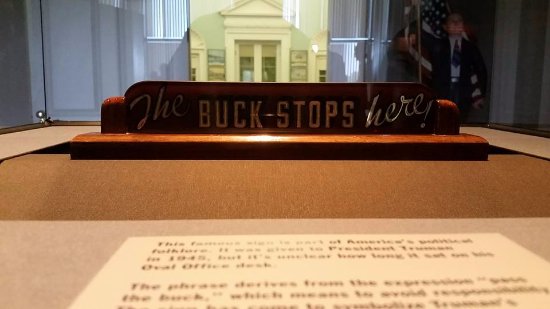

This photo of Harry S. Truman Library and Museum is courtesy of Tripadvisor

"The BUCK STOPS HERE!" This is now a required meme for anyone sitting in the Oval Office (except of course for the cowardly current occupant who dares not utter it).

Here's somebody that trump won't like to hear from: President Barack Obama taking responsibility for intelligence failures back in 2010. Via Josh Gerstein at Politico:

President Barack Obama on Thursday accepted responsibility for intelligence shortcomings that led to a failed Christmas Day bombing plot on a Detroit-bound airliner, saying, “Ultimately, the buck stops with me.
“As president, I have a solemn responsibility to protect our nation and our people, and when the system fails, it is my responsibility,” Obama said...
Obama’s buck-stops-here message marks a change in tone from earlier statements in which Obama and other officials repeatedly noted that the watch-listing system that failed to flag the suspect, Umar AbdulMatallab, was put in place under the Bush administration.
But while Obama promised to bring more accountability into the counterterrorism system, he indicated he had no plans to fire anyone involved in the missteps prior to Christmas.
“It appears this incident was not the fault of a single individual or organization but rather a systemic failure across organizations and agencies. … I am less interested in passing out blame than I am in learning from and correcting these mistakes to make us safer,” Obama said...
Want more?

While this isn't a quote that happened during his Presidency, Dwight D. "Ike" Eisenhower spoke of responsibility serving as the Allied Commander overseeing the Western European theater. For the Normandy Invasion he wrote two letters. The First Letter congratulated the Allied troops and exhorted them to victory. The Second Letter was in case the landings failed (given the harsh weather and stout German defenses, this was a legitimate concern):

"Our landings in the Cherbourg-Havre area have failed to gain a satisfactory foothold and I have withdrawn the troops... My decision to attack at this time and place was based upon the best information available. The troops, the air and the Navy did all that bravery and devotion to duty could do. If any blame or fault attaches to the attempt it is mine alone."

The letter wasn't needed: D-Day was a bloody but successful landing and led to the Liberation of France within months. Less than a year later, the Nazis fell between the pincers of Ike's forces in the West and the Soviets to the East. However, that letter highlighted character of the man: Eisenhower accepted the responsibility of leadership... and the people knew it. That's one reason "I Like Ike" worked as a slogan, that's a reason why Americans elected him President.

So here comes trump, facing a global pandemic health care crisis that requires bold thinking, getting out ahead of the problem, staying in touch with all players to make sure things get done properly and to the good of all.

Unfortunately, trump's spent the last three years dismantling the government systems, understaffing agencies if not outright sabotaging them. Redirecting efforts towards projects that won't help in this crisis or any other. He oversaw the dismantling of a National Security panel tasked with coordinating pandemic responses, which left much of the federal and state agencies in the dark on who was in charge during the first months of this crisis (starting back in December 2019).

trump's response to all of this? Shifting blame on Obama instead of admitting his own involvement. Arguing that it's Obama's fault there's not enough test kits for this crisis when it should have been something trump's administration ordered done the minute it became clear - mid-January - that the coronavirus was going global. Like Obama would have known back in 2016 this particular virus was going to erupt three years after he left office.

"I'm not taking any responsibility at all."

This isn't even the first time trump has shifted blame in his life. He avoided accountability for his many bankruptcies, he avoided accountability by settling out of his many fraud trials, he avoided accountability for his destruction of a sports league, he avoided accountability for every broken promise and every theft made. And these were all before he ran for the Presidency.

"I'm not taking any responsibility at all."

Here's the one thing required by law in the Constitution, written out as the Oath one must take when entering the Oval Office:

"I do solemnly swear that I will faithfully execute the Office of President of the United States, and will to the best of my Ability, preserve, protect and defend the Constitution of the United States."

Those words REQUIRE the oath-taker to execute the office of the Presidency, to preserve protect and defend the Constitution of the United States which means ensuring the safety of the People - all of US - who keep that Constitution standing. These are words, this is an Oath that REQUIRES responsibility out of the person who swears to it.

trump won't take that responsibility. he's openly admitting to it now, something a lot of us knew for years and we saw this moment coming.

We're in a major crisis this month and the person most responsible to lead us through it won't be responsible at all.

We are so very royally extremely sickeningly fucked.

Thursday, June 06, 2019

Anniversary: 75 Years After D-Day

On June 6, 1944, a Great Crusade by the Allies of World War II landed across the beaches of Normandy.

It was the official beginning of the Western front against Nazi Germany, an attempt to push out their occupation of France.

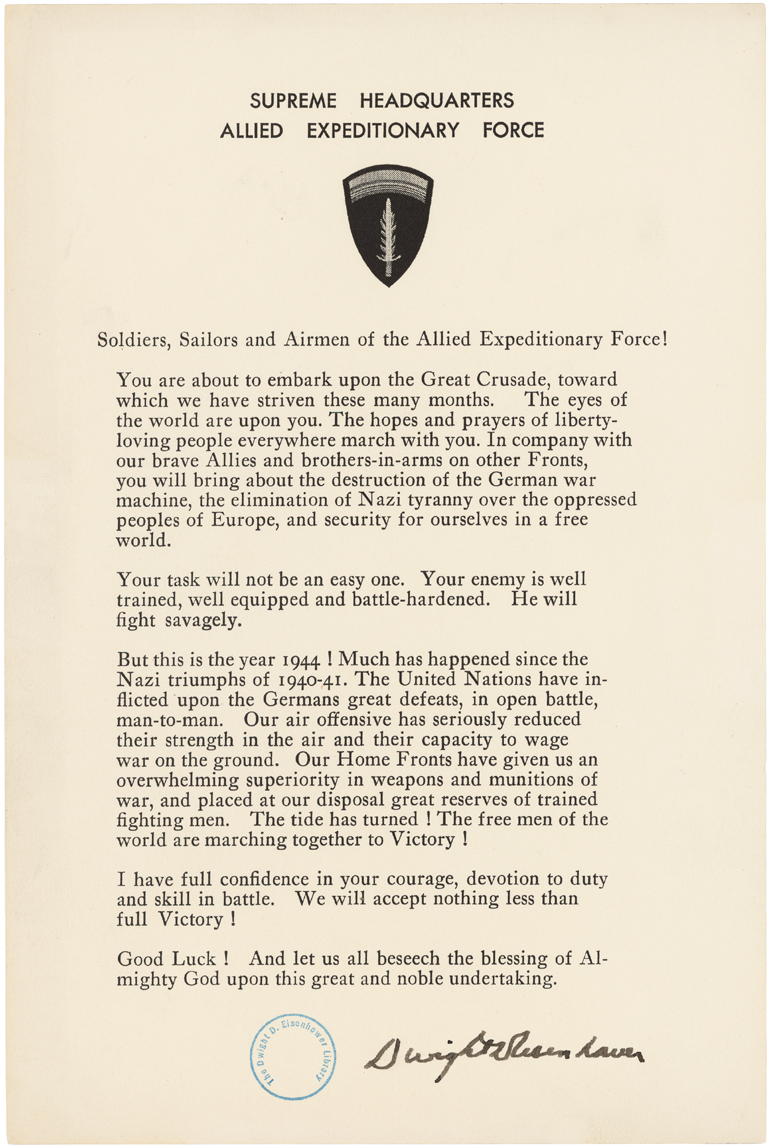
I've written about General Eisenhower's Second Letter before, but here's the one he issued to the troops, exhorting them to victory in the name of a free world.


So to the Free French forces who fought to liberate their home:


So to the British who fought to defend all bagpipers:


So to the Canadians who didn't get the glory but delivered the most ass-kicking:


And to the Americans who bore the heaviest brunt at Omaha Beach:


We the future generations after that war salute you.

Thursday, June 05, 2014

Anniversary, Longest Day Edition: Eisenhower Decides

Off of last year, where I did a brief review of Presidential Character, I had Eisenhower up, and I mentioned his leadership during the war, especially the part where he gambles on making the invasion go on June 6th, in bad weather and against his cautious nature:

Unfortunately the YouTube clip is a cropped and colorized version of the Longest Day movie, which is bound to get played on AMC or TMC or the many history/military channels on the digital cable this weekend.

But this was a big thing.  Eisenhower knew he had to send the Western armies into France and into Germany before the winter weather set in: June was the last best month to secure a foothold.

D-Day.  After North Africa, after Sicily, after Italy, each step marching towards the primary objective: liberating France as a prelude to ending Nazi Germany.

One of the most famous photos from that moment: Eisenhower meeting with the troops he was about to send into harm's way.

Eisenhower posted one letter to the troops:

Soldiers, Sailors and Airmen of the Allied Expeditionary Force! You are about to embark upon a great crusade, toward which we have striven these many months. The eyes of the world are upon you. The hopes and prayers of liberty loving people everywhere march with you. In company with our brave Allies and brothers in arms on other fronts, you will bring about the destruction of the German war machine, the elimination of Nazi tyranny over the oppressed peoples of Europe, and security for ourselves in a free world. Your task will not be an easy one. Your enemy is well trained, well equipped and battle hardened, he will fight savagely.
But this is the year 1944! Much has happened since the Nazi triumphs of 1940-41. The United Nations have inflicted upon the Germans great defeats, in open battle, man to man. Our air offensive has seriously reduced their strength in the air and their capacity to wage war on the ground. Our home fronts have given us an overwhelming superiority in weapons and munitions of war, and placed at our disposal great reserves of trained fighting men. The tide has turned! The free men of the world are marching together to victory! I have full confidence in your courage, devotion to duty and skill in battle. We will accept nothing less than full victory!
Good Luck! And let us all beseech the blessings of Almighty God upon this great and noble undertaking.

He also wrote a second letter, in case the invasion failed:

Our landings in the Cherbourg-Havre area have failed to gain a satisfactory foothold and I have withdrawn the troops. My decision to attack at this time and place was based upon the best information available. The troops, the air and the Navy did all that Bravery and devotion to duty could do. If any blame or fault attaches to the attempt it is mine alone.

The invasion succeeded.  Eisenhower didn't need to read the second letter.  He kept it on himself for a month and then showed it to an adjunct, suggesting it get thrown away.  The junior officer held onto it, and eventually it ended up in the National Archives.

The first letter was all about the troops: the airmen clearing out the skies, the home front providing them supplies and support, the men ready to go into battle.  There are a lot of "you" and "your" being used in that first letter.  The second letter was about the man who made the decision to invade: that it was his call, his judgment.  If there would have been anyone to blame if the beach landings had failed, "it is mine alone".

This was Eisenhower.

This was why a lot of people wanted him to be President.

Saturday, October 05, 2013

Presidential Character: Week Thirty-Four, Why DID Everyone Like Ike?

So, Professor Barber, why DID everyone like Ike, uh Dwight D. Eisenhower?
...Furthermore, Eisenhower often displayed optimism; he was certainly no gloomy Gus in the White House, though he was often irritable and depressed... (Presidential Character, p. 179)
...Eisenhower did not feel a duty to save the world or to become a great hero, but simply to contribute what he could the best he was able... Yet Eisenhower very much wanted to make a contribution.  Once while laboring over a speech he said, "You know, it is so difficult.  You come up to face these terrible issues, and you know that what is in almost everyone's heart is a wish for peace, and you want so much to do something..." (p.182)

To this, even with Barber's assertion Eisenhower was a Passive-Negative Character:
The key orientation is toward performing duty with modesty, and the political adaptation is characterized by protective retreats to principle, ritual and personal virtue.  The political strength of this character is its legitimacy.  It inspires trust in the incorruptibility and the good intentions of the man... (p.182)

Eisenhower came to the Presidency as the commanding general of European forces during the Second World War, one of a select group of non-political generals - Washington and Taylor - to do so (other generals like Grant, Hayes and Garfield - mostly from the Civil War - had been converted into true Republicans as part of their response to the war and Reconstruction politics).  How he came to be the general-in-chief of a major theater of war speaks to his basic character traits of Modesty and (for the Passive-Negative) Duty.

Eisenhower was not the best-known candidate for the job of representing the U.S. among the Allied forces against Hitler's Axis.  He'd been a middle-of-the-pack officer pretty much from West Point onward, and while he'd worked hard to earn his promotions up to colonel by 1940 he still lacked a few things such as battlefield experience.  But he knew tanks and how to deploy them, impressed during the training exercises before the U.S. entered the war (by 1940 FDR's administration and the Army both knew war was coming), and got promoted up to brigadier general on the eve of conflict.

One joke floating around was that General George Marshall, the head of the whole Army at the time, promoted Eisenhower to head up Allied efforts in Europe because Eisenhower had served as an aide to General MacArthur, and that the experience of massaging that huge ego made Ike the best expert to keep the British and French allied generals in line.  But the truth of it was Marshall saw in Eisenhower the organizational skills needed to manage such a massive endeavor, and the sense of Duty to the cause to make it work.

Marshall must have seen something else, the unique trait Eisenhower had that no other P-N character showed: Ike was unusually optimistic and forward-thinking.  He didn't see disasters as such, he saw them as opportunities.

During the beginning stages of the Battle of the Bulge in December 1944, Eisenhower met with his subordinate generals about counter-offensives.  Rather than take the gloomy approach that the unexpected German offensive could divide the Allied front and prolong the war, Eisenhower saw it as a chance to finally get the Germans out in the open and finished off rather than slogging through a potentially massive defensive effort.  He's on record saying "The present situation is to be regarded as one of opportunity for us and not a disaster.  There will be only cheerful faces at this table."  He then turned to General Patton - his blood knight - and asked how quickly they could relieve the American paratroopers at Bastogne.  Patton said 48 hours, and pulled it off.

Making the call on D-Day.  The weather for early June 1944 was wet, rainy, windy, terrible for beach landings and paratrooper drops.  The Germans, having developed excellent profiles on opposing generals, figured Eisenhower's overly cautious nature would never give the order to go in bad weather.  And in most cases for a P-N character they'd be right.  But there was that optimism: the Allied meteorologists told Ike there was a chance the morning of June 6th would have a slight window before dawn to work out.  Knowing that June was the last best chance to get into Europe before summer turned into winter, and that he needed to go sooner or later, Eisenhower went against his nature (ironically, his sense of Duty to get the landings over with made him do it) and made the call.  Even then, he knew it was a giant risk.  He wrote one letter praising the troops and cheering them onto victory.  He wrote a second letter in case the landings failed, and insisted that any blame be put on him ("It is mine alone.").

It was not only Eisenhower's judgment... it was not only Eisenhower's organizational skills... it was Eisenhower's Modesty, his acceptance of Duty, his non-Negative sense of Optimism in others that made him so likable.

And that likability made him the hot political ticket once World War II ended.  Like his predecessor Taylor, Eisenhower had made it a point to not even vote in elections up until 1948 or so (both Democratic Party leaders and Republicans sent out feelers).  He preferred at the time to retire out as Chief of Staff (having reorganized the entire military into the Department of Defense) and serve as school President at Columbia U.  By 1950 he accepted the call back to duty by becoming the commander of NATO forces and used his organizational skills to make that nascent military alliance work.  By 1952, with the nation deeply mired in Korea, and pressed ever more by the people around him, Ike acceded to the demand he run for office.

And he won in massive landslides (1952 and re-election 1956).  "I Like Ike" being one of the most successful - and obvious - campaign slogans of all time.

But Eisenhower didn't enter the White House at an easy time.  Solving Korea - with an armistice that has yet been resolved to this day - was one thing but the Cold War - an ongoing chess match with the Soviet Union over Europe, Asia and the Middle East - was something else.  The Cold War affected domestic issues in the form of political witch hunts (the Red Scare) led by a glory-hogging Joseph McCarthy.  And other domestic issues involved the growing Civil Rights movement that started with Truman's desegregation of the military and was moving on towards public services and education.

Eisenhower's Passive-Negative traits did not put him in with the Far Right forces of the Republican Party, obsessed as they were with hunting down suspected Communists throughout society.  But it made it difficult for him to openly confront the likes of McCarthy.  To Ike's credit, McCarthy self-destructed by going after too many targets that wanted to fight back, especially Ike's beloved Army, and he used that distance to let McCarthy bury himself which pretty much quieted down the anti-Communist fervor for the rest of the Fifties to a low boil.

As Barber noted, Eisenhower may have fit for the most part into the P-N category but as President Eisenhower defied certain traits through both his habits and his optimism.  By habits I mean his organization: the West Wing as we know it - with a Chief of Staff, organized departments handling communications, interdepartmental issues, and policy essentials - came entirely from Eisenhower.  By his optimism I point to how Eisenhower not only kept New Deal era economic policies that worked (where the Republicans would have considered them no longer essential once the economy was chugging along and the War Effort was over), but pushed his own national agendas such as the Interstate Highway system.

If Ike had weaknesses it was a maddening level of complacency, his hands-off approach to how the various departments in the Executive branch handled themselves as well as a hands-off approach with dealing with Congress.  On one hand Eisenhower's two-term administration was relatively free of scandal - the worst was that his Chief of Staff was caught lying about an oriental rug and fur coat his wife had received as gifts - but on the other the administration allowed some branches - especially the CIA with their activities in Iran and Central America - a wide scope of questionable activity.

And while Eisenhower continued Truman's work on Civil Rights - Ike declared discrimination a "National Security issue" because Communists used it as an argument against American democratic ideals - he didn't pursue it as aggressively as Truman had.  He worked with Congress to pass legislation to create offices for civil rights investigations in the Justice Department but left them ill-defined and underfunded.  In the best respect Eisenhower's greatest achievement was calling out the National Guard and 101st Airborne to Little Rock Arkansas to enforce the court rulings to desegregate schools.  But past that Eisenhower's administration did not aggressively pursue methods to end segregation in businesses and communities: Ike would only go so far in the use of executive authority.  Passive-Negatives do not like using the full weight of the Executive branch the way an Active-Positive or Active-Negative would.

Eisenhower's legacy as President was mixed when he left office and it wasn't until well into Clinton's tenure that a better understanding of Ike's performance as leader could be seen.  The argument against him was that Eisenhower didn't "do anything," (my own father, Old School Republican that he is, said this today as I was writing portions of this article over at the parental units' home, they needed help updating their computer stuff, anyways I digress) especially in the face of McCarthyism and the growing Civil Rights fight.  But in other ways Ike did in office what was expected of him: the mentor figure, the retired general / father figure neither passionate nor angry, reserved in judgment and basically right on all matters.  He focused on the job at hand and oversaw a relatively stable period of post-war growth and adjustment.  His pursuit of the Interstate Highway construction proved one of the biggest job creating government programs in history - bigger than any New Deal project - and had a major impact on interstate commerce, population growth and dispersal, and development of cultural trends (car culture, travel, etc).

Above all, much like his Passive-Negative model of old - George Washington - Eisenhower may well have been the last true non-partisan figure in American 20th Century politics.  Republican more by necessity than ideology, Eisenhower was a self-described moderate who sought to balance out the Far Right McCarthyist elements of the party through his personal example and calls for common sense solutions.  Conservative only in action rather than thought, Eisenhower today is the go-to figure of moderates (whoever may be left) within the modern GOP.

Next up: The key word is survival on the New Frontier (sorry, I keep thinking of that Donald Fagan song)