Showing posts with label reform. Show all posts

Monday, March 11, 2024

Brief Thoughts About Daylight Savings in America

Seriously: If Joe Biden pledges on the 2024 campaign trail that he will force Congress to hold an emergency session to pass legislation ending this travesty of time-wasting called Daylight Savings, and then uses the National Guard to block access to the bathrooms and soda vending machines to ensure both Republicans and recalcitrant Democrats vote passage of this reform, Biden will garner 65 percent of the national vote.

The whole stress-out over Daylight Savings Time - springing forward an hour in Spring, falling back that hour in Fall - has been a well-documented source of frustration for Americans for decades now, and we keep getting more evidence how it's not really doing us any good (via Danielle Pacheco and Dr. Dustin Coltiar at the Sleep Foundation website):

Adjusting the time by one hour may not seem like too drastic a change, but sleep experts have noted troubling trends that occur during the transition between Standard Time and DST, particularly in March. These issues include upticks in heart problems, mood disorders, and motor vehicle collisions. Furthermore, DST can cause sleep problems if circadian rhythms are not aligned with natural cycles of light and darkness. Some people also experience insomnia symptoms due to spring time changes...

Humans and other mammals are guided by circadian rhythms, which are 24-hour cycles that regulate sleep and other key bodily functions such as appetite and mood. These rhythms are largely dependent on light exposure. In order to reset each day, they must be synchronized with natural light-darkness cycles in order to ensure healthy, high-quality sleep.

The transition between DST and Standard Time has darker mornings and more evening light. This can essentially “delay” your sleep-wake cycle, making you feel tired in the morning and alert in the evening. Circadian misalignment can contribute to sleep loss, as well as “sleep debt,” which refers to the cumulative effect of not getting enough sleep on a regular basis...

While many people adapt to time changes, some studies have suggested the human body never fully acclimates to DST. Rather, their circadian misalignment may become a chronic or permanent condition. This can lead to more serious health problems, especially for those who experience “social jet lag” because their demands at work or school take precedence over a full night’s sleep. Social jet lag has been linked to a higher risk of obesity, depression, and cardiovascular disease. The effects of DST subside gradually after a few weeks...

There are a number of other things that disrupts a person's normal sleep cycle - travel, uneven work hours (morning / evening shifts), neighbors practicing with their garage band at midnight, similar hazards - but this is one directly caused by government policy. And it's a policy that continues to annoy if not enrage most Americans suffering from it. Nearly every poll out there - like this one in Business Insider - has a majority of people wanting an end to the damn thing.

The problem is nobody can agree to make Standard time - based on the actual solar cycle - or Daylight Savings - which moves ahead an hour and gives businesses more sunlight in afternoon/evenings for work - the national default.

Considering how the medical experts point to that circadian rhythm as key to our health, I'd argue to keep our hours to the Standard setting. It's how our planet works, how our bodies work, and goddammit we've lived for centuries without springing forward for anything.

The big reason we went to Daylight Savings was energy conservation during wartimes - First One and Second One - and then even more in the 1970s when the energy crisis hit our nation hard. Thing is ever since the 1980s when technology innovations with energy-saving methods improved our usage - even as we've expanded more use with computers, smartphones, and other electronics - the need to enforce energy conservation with summer daylight actually diminished.

There's a number of other issues with sleep depravation that need resolving, especially the early schooling hours that affect teens when they're forced to attend junior and high schools before dawn. They are at that age - still developing - where disruption of the sleep cycle affects them the most, and there's been a huge push to get states to move school hours to later in the day. All this Daylight Saving stuff is making this harder on the kids and their families.

Standard Time is the way to go.

If you do this, Joe Biden, you will go down in the history books as our greatest President ever.

Do it.

Save our Sleep Modes!


Friday, January 13, 2023

Fiscal Injustice On Display

In the follow-up to the guilty verdicts dropped on donald trump's corporation about a month ago, today we see the justice imposed for trump's fraudulent tax schemes. The judge imposed the largest possible fine allowed under the law... and yet the fine was honestly not enough. Via Ilya Marritz, Andrea Bernstein, and Brian Mann at NPR:

A state court in New York has ordered two companies owned by former President Donald Trump to pay $1.61 million in fines and penalties for tax fraud.

The amount, the maximum allowed under state sentencing guidelines, is due within 14 days of Friday's sentencing.

"This conviction was consequential, the first time ever for a criminal conviction of former President Trump's companies," said Manhattan District Attorney Alvin Bragg.

Bragg said he thinks the financial penalty for decades of fraudulent behavior wasn't severe enough.

"Our laws in this state need to change in order to capture this type of decade-plus systemic and egregious fraud," he said...

In context, the level of fraud trump and his corporation committed was in the hundreds of millions of dollars. Business listings - via AtoZ Databases, which is behind paywalls - put the Trump Organization's yearly revenue around $1.6 billion . Forbes magazine estimated in 2022 the value of trump's personal holdings around $3.2 billion. trump may not be the richest duck in Duckberg, but he's still rolling in enough cash that $1.61 million is literally pocket change to him. It is roughly a tenth of a percent to trump.

This is where we run into the problem with the American legal system: The limitation - nay, inability - to effectively punish wrong-doers proportional to the crimes they've committed.

In terms of massive fines or penalties to discourage would-be reckless never-do-wells from committing those crimes, there will never be a fine large enough to do so. Greed is too much a motivation for those who think they will never get caught.

Punishment itself is not an effective deterrent to stop crime. Poor people who commit crimes do it because they have to. Rich people who commit crimes do it because they want to get richer. The sad thing is, we can't walk away entirely from the penalty system we have to uphold the laws. We still need some form of a penalty for law-breakers, so those of us who are law-abiding can keep faith in the legal system.

The injustice comes into play when we look at the burden of punishment we inflict on the guilty (and sadly on the falsely accused). Poor criminals are often hit with fines in the thousands of dollars that they can't afford to pay, forcing them deeper into poverty (SEE the unjust fine system that decimated the Ferguson MO community) and more likely to commit more crimes to escape the trap. Rich criminals are often hit with fines in the thousands of dollars, which barely puts a dint in their wallets as they head out to another part of the financial industry to run another fraudulent scam.

Fine a petty thief who tried to sneak off with a flatscreen TV worth $500 with a $10,000 fine and watch that thief lose his bank account, lose any legal means of employment to pay it off, lose any property his family owned (because they'll get sucked into the debt), and never get out of that spiral. Fine a white collar criminal who set up a scam fundraiser for $10 million with a $1 million fine, and watch that rich crook walk away with $9 million that his victims can't even sue to get back except for pennies on every dollar. There are thousands more victims of white collar crime than there are grocery stores bemoaning the loss of $3 bread loaves to shoplifting.

The income inequality adds onto the injustice of a legal system that punishes the poor too much and fails to punish the rich at all.

If there were any justice in this system, the criminal trial involving the Trump Organization should have included felony charges on donald trump (and the rest of the upper management like his elder kids who were part of the scams) instead of just the company itself. The fines shouldn't be capped to an arbitrary number - which is set at a level decades ago no longer reflecting the insane wealth of the few today - but scaled to the level of revenue/income the guilty actually have, so that the rich pay a greater burden for their sins compared to the poor struggling to get food on their tables. Any criminal act that defrauded people directly should require all money stolen from them recouped and given back, supplanting any civil court attempt to recover those funds.

One of the greatest open scandals of our legal system is how law enforcement fails to take financial fraud seriously as a problem. It comes up every time there's a stock market crash or bank run or "too big to fail" failures. The damage caused by white collar crimes are far greater and far reaching than anything a poor crook can pull off, and yet we punish the poor crook with a jail cell while the rich crook goes sailing to the Caribbean on whichever yacht the IRS didn't impound.

When you look back on the terrible history of going after white collar crime in this country: We jailed Martha Stewart because she was a bitch, not a criminal mastermind. And we jailed Martha Stewart for less than what the investment firms did to our housing market in 2007, for less than what donald trump and his corporate lackeys did with their tax dodging schemes.

Any legal reforms need to start with the reality that we must hold the wealthy criminals accountable, no more walking away, no more slaps on the wrist. Send the rich to jail like they were pot dealers (and free all those who are only guilty of pot dealing or other misdemeanor petty-ante shit). 

Sunday, September 18, 2022

Florida Ballot Amendments 2022: Short But Not Simple

It's September in an election midterms cycle, so you know what THAT means!!!

PIZZAAAAAAA!!!!

...wait, I'm on a diet now. Back up, let's rethink this. Oh, now I remember.

STATE BALLOT REFERENDUMS!!!

I'm gonna do what I often do - link to Ballotpedia's page on 2022 Florida Referenda - and then provide a little commentary on why certain amendments deserve your vote and certain other amendments don't.

An interesting note about this year's referenda: There were no voter-petitioned (Initiated) amendments put on the ballot this cycle. Either the requirements for those type of amendments got stricter, or nobody had an issue that reached high enough voter interest to get enough signatures to make it. There is a possibility the pandemic made it harder during 2021-22 to get volunteers and registration tables set up to get those signatures. Still, I do wonder. If anybody in the know can tell me, please leave a comment.

Now, to the issues.

Amendment One: Disregard Flood Resistance Improvements in Property Value Assessments

The title is wordy and a bit confusing. The synopsis tells us a Yes vote means "authorizing the state legislature to pass laws prohibiting flood resistance improvements to a home from being taken into consideration when determining a property's assessed value for property tax purposes." Voting No obviously means it won't let the state do this.

What this involves is giving homeowners options to make flood resistance improvements without such expensive items impact the property value assessments that tax appraisers would use to increase the tax value of that house. Meaning a form of tax deduction on what people will owe on those properties.

On the one hand, it falls under the Far Right obsession with lowering tax revenues that the state could collect on, which IMHO hurts our state's ability to build up funds to pay for shit like schools, roads, clean water, social safety nets, etc. On the other hand, it provides a tax credit of sorts for those who DO redevelop their property to better withstand flooding issues.

It should be a huge warning sign that even state Republicans admit that climate change is getting severe enough that flooding is a bigger problem than ever. It'd be nice if they passed more laws to combat the root cause to ensure flooding recedes as a problem (aheh).

This would be a reasonable YES vote for most voters. I just wish we had better amendments that didn't focus on cutting taxes our counties would need.

Amendment Two: Abolishes the Florida Constitution Revision Commission

You might recall four years ago (2018) we had a slew of amendments on the state ballot that exceeded the number we'd see for normal referendum cycles. What happened was a constitution-required Revision Commission was at work that year. Every 20 years, that Commission shows up - filled with Governor-nominated political hacks - to put any number of amendments that the legislature may have wanted done but couldn't get past their 60 percent supermajority... and maybe any popular voter initiatives that couldn't get enough signatures.

Problem in 2018 was - and if you link back to what I posted about that cycle - the Commission crammed together a series of multi-issue referenda: Each Commission amendment had two or three disparate issues under consideration, meaning people who were voting Yes for one thing were forced to vote Yes for other things they would otherwise had voted No.

As I noted on one of the amendments that had non-related matters to vote on:

They're trying to get people to vote for the one thing that matters - the victims' rights - to one thing that the legislature ought to do itself - raise retirement age - and then to one thing that would make our legal system worse - denying courts from getting administrative input.

It angered a lot of people, even some of the Republicans, and it led to the Legislature agreeing to the idea of abolishing the 20-year Commission outright.

Here's the problem: The Commission itself is not a bad idea.

The reason for that Commission is obvious: Political logjams in the Legislature prevents certain popular issues from getting resolved; also the strict requirements for public initiatives are needed to prevent our ballots from getting swamped by extremists pushing bad agendas. The Commission is a third option, one that if applied properly could allow voters to pass needed reforms that our state government might not make.

What really went wrong in 2018 was that the Commission had no set guidelines on how to proceed - it sets its own rules rather than by court or legislative mandates - and so abused their power to cram - also called "bundling" as many unpopular and partisan ballot referendums alongside popular ones in an attempt to screw over the voters. Instead of abolishing the Commission, our state needs to reform it by setting rules and requirements to ensure it works properly.

We need to make it so that the Commission CANNOT cram multiple ballot issues onto one "bundled" amendment. Each issue should stand alone. That would be a major improvement right there. Then, there needs to be a set limit of Commission-based amendments - say, a top ten of amendments that passed their committee votes - so that way the ballot doesn't get overwhelmed, and then any left over by the Commission can be converted into public initiatives for signatures and hopefully make it onto the next election cycle's ballot. I would also argue that the membership of the Commission should not be by governor appointment (which allowed then-Governor Scott to fill it with hacks) but by popular vote: Have voters choose an open ballot of candidates in the previous election cycle, make it so each major party nominates UP TO 25 candidates (the candidates should have requirements to run to ensure no extremists get on ballot), and the top 37 vote getters go in meaning it will be an automatic mix of both parties.

Just those three fixes alone would work. Straight-out abolition of a reform method would hurt the state in the long run.

I would argue NO against this amendment. There are better ways to fix the Commission, not kill it.

Amendment Three: Yet Another Homestead Exemption for Certain Public Service Workers

If there's anything predictable about the Republicans in our legislature, it's that they want to create more and more exemptions to the Homestead Exemption on property taxes. Just keep on making it harder for counties to pay for themselves, Tallahassee! /headdesk

At some point I swear Florida Republicans will eliminate property taxes altogether, at which point everything will be paid through sales taxes that hurt the poor the most... /more headdesk

This time around, the exemption idea is for "Additional homestead property tax exemption on $50,000 of assessed value on property owned by certain public service workers including teachers, law enforcement officers, emergency medical personnel, active duty members of the military and Florida National Guard, and child welfare service employees." I thought they've already passed a ton of exemptions for law enforcement and military residents already, but hey let's give them $50,000 more of a tax cut shall we?

At least this time around they're providing tax cuts for the more "liberal" leaning professions like teachers and social workers, so this is not as bad an exemption push as the earlier ones. Any benefit to our beleaguered teachers and family welfare workers is a nice thing to consider

The only problem with this exemption? It doesn't seem to cover OTHER public service employees like county and city officials. LIKE LIBRARIANS!!!!!!! YES, I AM ANGRY I'M GETTING OVERLOOKED. I DON'T CARE ABOUT THE HYPOCRISY, I CARE ABOUT GETTING MY CONDO'S TAXES DOWN!!! AAAAUUUuuugggg.... cough cough... um, sorry about that, got a little self-serving there for a moment.

Look, previous experience has taught me that these Homestead exemption amendments are popular and tend to get passed in spite of my pro-tax (in moderation, in short "tax the rich 'cause they're the only ones who can afford to anymore") world-view. It's likely a lot of teachers and their families will vote for this, which is a broad voting base on its own. This ballot affects enough people in what they'll view as a positive that they'll likely support it.

I'll just sit over here grumbling to myself about the slight to librarians and tell you I'm personally a No on this.

--

This is, as mentioned earlier, a relatively quiet amendment cycle for Florida. It should be relatively easy for everyone to remember. If anything, the amendment that means the most this term - Amendment Two abolishing the Revision Commission - is the one I really want voters to say NO to. That's what matters here.

Also, I want a huge Democratic / Blue Wave turnout this midterms to vote that asshole DeSantis and every other Republican out of office, but you should have learned that by now.

GET THE DAMN VOTE OUT, FLORIDA DEMOCRATS!

Monday, July 04, 2022

Four For the Fourth: Fixing the Flaws

Reminder: here are links to my other Four For the Fourth blog articles, one about a plea for silent firecrackers, one about women's rights to independence, and one about needing more metal music on the TV specials dammit!

This is, as mentioned earlier, one of the most dire 4th of Julys I've ever honored.

Because the state of our nation is at a crossroads between majority progressive reform and minority violent retrenchment. As David Atkins notes at the Washington Monthly:

The Roberts Court has imperiled America’s unity. The country’s center-left majority is disenfranchised and under assault from the likes of Samuel Alito. Something has to give.

The large, productive populations of blue states like California and New York—which famously give far more to the national treasury than they get back—chafe under a system that affords far more clout to the citizens of Idaho and Wyoming. The voting majority that won seven of the last eight presidential popular votes and that constitutes 70 percent of the GDP will throw off the yoke of a conservative minority. Most Americans below the age of 40 are progressive—well to the left of today’s median Democrat—and will not buckle under the imposition of a white Christian nationalist agenda by an aging conservative minority.

They know that the Supreme Court has lost its moral authority. Republicans have won the popular vote in a presidential election only once in 30 years, yet Republican presidents have nominated most of the Court’s justices. No Democratic president has chosen a chief justice since Harry Truman in 1946. The last Republican president entered office having lost by nearly 3 million votes even with the aid of a foreign dictatorship, whose help he begged for on the campaign trail. One of those justices was stolen outright by Mitch McConnell under pretenses of it being an election year, only to see the Senate confirm another justice while votes were being cast in the next cycle. The Senate that confirmed those justices is absurdly skewed in favor of small, white, rural conservative states, such that Senate Democrats represent 43 million more voters yet are locked in a 50-50 tie. And the Senate’s skew will only become more blatantly unjust and unsustainable...

The Framers created the Senate and the Electoral College to bring small states on board with the larger national project and to temper what they worried would be the passions of the electorate. They feared demagogues—yet ironically, their solution enabled the rise of one. Their concessions to slave states failed to prevent the Civil War. They got many things wrong and could not foresee or prevent the rise of political parties. Crucially, they also expected future generations to change the Constitution frequently, yet it has barely been amended in almost a century...

The reason I started this blog back in 2006 was to start arguing over the amendments our nation needed to repair a creaky and aging federal constitution: A model of governance that needed to update for a 21st Century that was more progressive than the Founders realized, and stuck to an electoral model that wasn't meant for so many states and a population more than 50 times the nation's original size.

I mean, I got into a tweet debate with Conor Friedersdorf this morning about the problems with the U.S. Senate representation:


This is just one of the many things that need to get fixed so that the tyranny of Minority Party Rule doesn't destroy this nation.

Just amending the representation in the Senate - to end the equal seating of two Senators per state regardless of population, which has unbalanced this Senate to where the political minority of small states can logjam the entire legislative process - would be a huge reform. Changing the rules so that the ten most populous states receive an extra third Senator while the ten smallest states shrink to just one Senator would be the most rational means of doing it (although the small states will begin screaming how their representation is being taken away. Too bad. You don't have enough people to justify having that much power!). Just by changing this, the responsibilities of the Senate - especially the consent and advise for judicial appointments - will reflect the interests of the majority of voters nationwide.

Most other reforms our Constitution should focus on would be fixing a Supreme Court that has become too partisan, and too much a source of political brinksmanship that has helped polarize our parties.

The simplest fix to correct the Court right now - the near-permanent Far Right stranglehold on six seats out of nine - would be to expand the court. And this wouldn't even need an Amendment because Congress already has the power to add or subtract from the bench. This has actually happened before in the 1860s when the nation was responding to the last time the political minority - Southern slaveholding conservatives - caused this level of damage. They shrank the number of Justices in 1866 to stop Andrew Johnson from replacing retiring jurists with pro-segregationist people, and then re-expanded the number to nine (where it's been since) to give U.S. Grant and the then-liberal Republicans the chance to ensure an anti-slavery pro-rights Court would work.

So adding four seats - while the Democrats control both the White House (Biden) and the Senate (tie-breaker vote) before the 2022 midterms shake things up - would be the simplest thing but also greatest political hazard for Democrats. They worry that a future Republican-held Congress and White House would escalate like an arms race: If Dems upped the seats to 13 for a 7-6 ideological advantage, the future GOP would respond by added 10 seats for a 16-to-7 sledgehammer. Even though there IS a legitimate reason to expand to 13 seats - there are 13 judicial districts (11 state regions and 2 special jurisdictions) that require oversight by a Supreme Court Justice - the Dems don't seem to want to go that route.

Even though the Republicans would jump at the chance to expand to 13 seats right now if they were in power, and bump it up to a 10-to-3 advantage they would never let go of.

There is another way to fix the Supreme Court but it might involve an amendment: Setting retirement age limits. Right now due to wording in Article III Section I, judicial appointments may be lifetime. Best way to make sure the SCOTUS seats change hands - by either a term limit (12 or 16 years) or mandatory retirement (65 years old) - and make it harder for either party to plan any long-term control of the judiciary.

Another Amendment this nation needs in this dark hour is something, anything, to stop the partisan gerrymandering that gives the state parties too much control over who can actually run for office and who can win. We've seen the evidence and reports about how gerrymandering districts to extremes reduces voter interest and turnout. We know how gerrymandering pulls away power from the urban populations and gives that power to sparse rural areas. We've watched the last 10 years how partisan gerrymandering gave us minority party rule at both the state and Congressional levels. 

Instead of fair districts, instead of ensuring each person's vote will count, gerrymandering diminishes that power and grants it to the special interests - mostly the greedy and the evangelical - who don't care about what happens to the citizenry. If we could get a Congress responsive enough to pass such reforms... but we can't, because there's enough figures in both parties who prefer the gerrymandered status quo. The irony: Gerrymandering makes sure we don't get enough reformers elected to end gerrymandering anyway.

Oh, and getting rid of the broken Electoral College - a system that violates the will of the majority of Americans, may well deny us rightfully-elected Presidents in the future - is a must.

The United States need so many other reforms to our electoral system and to the checks and balances that ought to exist between the federal branches and the states. To get there, we as voters are going to need a concerted effort - by enough Americans across enough states - to use whatever power we have left at the ballot box to pass these reforms and restore both our rights and our safety. 

That means voting FOR those who can reform our system - Democrats - and voting AGAINT those who will corrupt it further - Republicans - for their own greedy sadistic needs.

This won't be a good Independence Day until we're independent from the corrupt powers in high places.

Good luck. Keep fighting.

Sunday, May 29, 2022

Where We Stand, Where We Fall

You can stand where I stand, but you will not see what I see.


You would think, year after year of constant mass shootings numbing the national psyche, that Americans would cheer on the simplest solution towards ending gun violence: By getting rid of the goddamned guns.

After all, every other nation struck by a mass shooting tragedy went on to pass harsh laws restricting ownership, banning certain types of firearms, and limiting the lethality of both gun and bullet.

Mass shooting at Ecole Polytechnique in Canada back in 1989?  Canada required gun safety classes, 28-day waiting periods, universal gun registration, and magazine clip capacity limits. After a mass shooting in Nova Scotia in 2020, they're trying to ban 1,500 (!) models of military-style assault rifles as well.

Mass shooting in Port Arthur, Tasmania back in 1996? Australia banned all semi-auto rifles and pump-action shotguns, and pulled off a gun amnesty and buyback program that took 250,000 guns off their streets.

Mass shooting at Dunblane Primary School in Scotland back in 1996 with semi-auto handguns using high-capacity cartridges? British Parliament passed legislation banning those types of handguns, and they maintain strict laws about the types of assault rifles allowed along with registration and certification for gun owners.  

Mass shooting in Christchurch, New Zealand in 2019? New Zealand banned semi-auto rifles, limited magazine clip sizes, and made modifications illegal. Like Australia, they hosted a buyback program to get as many of those guns off their streets.

Mass shooting in Ohio, Texas, Florida, Georgia, and any other Red State (or states compromised by Far Right / NRA lobbyist control) across the United States? Watch the Republicans in power pass new laws making it easier to get assault rifles and even worse avoid any certification or license.

What's maddening is how the Far Right, pro-gun politicians and pundits all proclaim how "if we ban guns, all it will do is make it so only criminals have guns." With the implication that we would see an increase of crime and gun violence because of it. However here in the United States, we get the inverse: Making it easier to get guns makes it easier for the angry guys who conform to the mass shooter profile means we still get the high body counts.

Note this: Nearly every mass shooting in the United States has been from someone who made legal purchases (or got the guns from someone who did) of those firearms. It's the legality of the process that horrifies along with the death of so many innocent lives.

Note this: We had an assault rifle ban in the United States for ten years - 1994 to 2004 - which wasn't renewed under Republican George W. Bush's administration (and maddeningly enough we never got it reinstated under Obama when we had a chance between 2009-10). It shouldn't surprise anyone that once the ban lifted, assault rifle sales went up and so did the body count (chart via Financial Times article by Justin Jacobs):

Everything from 2005 rightward to 2022. Those dots
multiply... and get bigger...

This shouldn't surprise us due to one thing: Most other nations do not have a Constitutional Amendment codifying the existence of firearms and what restrictions the states (and Congress) could impose on them. The Second Amendment is a very big reason why the U.S. can't just ban every firearm, as the Supreme Court spelled out with their Heller ruling back in 2008.

But that Second Amendment is a bit of a problem. When you read it - A well regulated militia, being necessary to the security of a free state, the right of the people to keep and bear arms, shall not be infringed - you'll notice the first half of the deal involves the regulation of state militias. The pro-gun forces tend to ignore that half, obsessing over the second half saying the right of people to keep and bear arms shall not be infringed.

They treat that "right" as an absolute, avoiding the whole part of "well-regulated" that could be used by Congress and our states into passing firearm regulations. You'll see them on social media insisting on SHALL NOT BE INFRINGED - all caps, for emphasis - as though it's a mantra, no worse dogma.

Because that dogma creates the very huge problem we have now in the United States: We have a very dedicated, very insistent, and potentially very violent minority of Americans - not even every gun owner is this paranoid and devout about the SHALL NOT BE INFRINGED dogma - who believe so much in their absolute right to own firearms that they will NEVER give them up or even allow any restriction on gun purchases to hinder their quest to buy even more weapons to an arsenal already filling up their gun sheds.

Search social media for families happily posing in their houses, driveways, back porches with every rifle and handgun they own. You will see them with hundreds of firearms they cannot possibly need. It's like an addiction, a craving to buy more weapons as though they'll be going out of fashion next week.

They buy that many because a lot of them do fear that sooner or later the federal government is going to get frustrated by all the mass shootings, and that a permanent assault rifle ban will finally get passed (and even a conservative Far Right SCOTUS would have to uphold).

And a good number of these gun worshippers buy up all these guns because they genuinely believe they will be in a shooting war - if they're not already - to overthrow what they view is a corrupt, demonic federal government.

Look at every "Come and take them," "Pry them from my cold dead hands," "Second Amendment solution" threat the gun nuts toss out there on social media. They genuinely believe they can take on a massive federal government - not just the agencies like the FBI or DEA or ATF, but the U.S. military both National Guard and standing armies if called upon to fight an insurrection - and win a "new revolution" for a truer, purer (Whiter) US of A.

These gun-worshipping acolytes can't stop because they dare not. And they're convinced a majority of "True" Americans - not the 65 percent who want a ban on all assault rifles, not the 80 percent who want universal background checks - will fight with them.

The gun nuts of America are convinced they are standing for their grand, godly cause of murdering everyone they view as a threat.

The rest of us are going to fall to their guns because of that.

This was never going to end well.

And the trigger moment - when we're no longer on the knife's edge of the Far Right's Culture War, falling into the blood-pits of insurrection and chaos - is closing in.

Saturday, May 01, 2021

Biden Going Big

As we go past the official "First 100 Days" of a Biden Presidency, the common refrain in the Beltway media is how "Biden is going big" in terms of pushing an aggressive economic agenda rivalling the New Deal for ambition and scope.

To Elia Nilsen at Vox.com: 

The Biden administration’s theory of policy so far is to go big. The same goes for its politics.

Taken together, President Joe Biden’s $2.25 trillion American Jobs Plan and newly introduced $1.8 trillion American Families Plan come out to slightly over $4 trillion in proposed new spending. It’s an enormous investment in American job creation; the last bipartisan infrastructure bill Congress passed in 2015 clocked in at about $305 billion — about one-thirteenth the size of Biden’s proposed plan. And Obama’s $800 billion stimulus plan of 2009 was about one-fifth of Biden’s plan, not even taking into account the $1.9 trillion in Covid-19 relief that has already been signed into law.

That sheer amount of proposed federal funding is meant to do a lot of things, but the main goal is to get as many jobs to as many people in as many voter constituencies as possible. Under Biden’s plan, infrastructure no longer calls to mind images of white men in hard hats; it includes working mothers, home health aides who care for the nation’s elderly, and workers of color across the nation. Women and people of color were crucial to Biden’s presidential win, and they are also crucial elements in his jobs plan...

To EJ Dionne at the Washington Post (watch out for paywall) Biden is harking back to the Democratic glory days of FDR and LBJ:

President Biden on Wednesday night went big, populist, folksy, hopeful, urgent — and bipartisan and partisan at the same time.

Addressing a pandemic-reduced gathering of lawmakers at the Capitol, Biden proposed a sweeping program of change that would create four more years of free schooling, expand child care and family leave, and attempt to beat back climate change through large infrastructure investments...

Biden welcomed the help of Republicans again and again, but he took clear aim at their favored economic doctrines. “My fellow Americans, trickle-down economics has never worked,” he declared. “It’s time to grow the economy from the bottom up and middle-out.”

And he took a victory lap on progress against covid-19, proclaiming that widespread vaccinations were offering “a dose of hope.”

This address wasn’t exactly the New Deal or the Great Society, but it was equally ambitious. Biden, reassuringly unradical with his plain, avuncular demeanor, is bidding to create a new common sense rooted in political lessons that Democrats have learned the hard way...

Going big - pushing for ambitious national programs on scale the United States hasn't seen since the 1960s - is more than just pushing back against the economic malaise we find ourselves in thanks to the COVID-19 pandemic: This is basically pushback against the last 40 years of the Far Right's "glorious" Pax Reaganica, where Big Government was "evil", deficits from massive tax cuts starved our public sector into a broken mess, and the rich got richer while the rest of us suffered.

This is Biden playing not only to the national audience - offering them a way out of low wages and little hope - but playing to a liberal and Progressive base eager to change the direction of the nation away from massive inequality the Far Right has been creating.  

The good news for Biden and the Democrats is how well the public is responding to these proposals. Back to Nilsen at Vox:

A range of polling shows that Biden’s expansive view of what counts as infrastructure has fairly broad support among the American public.

A recent NBC News poll found that 59 percent of respondents supported Biden’s American Jobs Plan. A recent Vox and Data for Progress poll found that 68 percent of likely voters support the plan. And a Monmouth University poll released Monday found 68 percent of respondents supported Biden’s infrastructure bill, with another 64 percent supportive of the ideas in Biden’s American Families Plan, which aims to make child care, higher education, and health care more affordable.

As Republicans and Democrats argue over the semantics of what constitutes “infrastructure,” Monmouth polling director Patrick Murray told Vox that Biden’s broad brush does not appear to be turning off voters so far.

For instance, Vox and Data for Progress polling found that a majority of likely voters of all parties supported Biden’s proposal of putting $400 billion into bringing down the costs of long-term care: 88 percent of Democrats, 72 percent of independents, and 55 percent of Republicans support the idea. And recent polling from Politico and Morning Consult shows that a large majority of Black voters support Biden’s pledge to increase housing options for low-income Americans; 80 percent of Black voters support that measure, and 58 percent “strongly” support it.

In other words, voters seem to care more about things that directly impact their lives than they do about whether these things meet a strict definition of “infrastructure...”

In short: People are back into believing that government can be a positive force in their lives, generating better jobs and better wages and better lives. The "Government is the Problem" meme is dying off, much to the horror of the Far Right clinging to the strands of political power.

But why exactly is this happening?

Isn't Biden supposed to be a Centrist, a post-LBJ pro-business Democrat who wasn't so great on issues of race and women's rights or on liberal issues in general, who tacked to the middle in order to push bipartisan deals through a Congress that is no longer the bipartisan haven he knew?

Well, kind of. This is all due to Biden's Presidential Character of being a Congenial Passive-Positive at the head of a Big Tent political party.

This isn't from my 2019 review of Biden's Character - where I worried Biden's easy-going nature made him vulnerable to Republican treachery - but from my 2020 followup that found Biden was doing a good job of building "the Big Tent" coalition of Democratic Moderates and Progressives. In fact, let's go to the direct quote from Aubrey Immelman about Biden's skills in forging that Big Tent:

Leaders with Biden’s personality profile are likely to exhibit an interpersonal leadership style, characterized by flexibility, compromise, and an emphasis on teamwork. The general tenor of a Biden presidency likely will be conciliatory, which could render a prospective President Biden vulnerable to manipulation by pressure groups and handicap him in negotiations or conflicts with foreign adversaries...

In short: Biden is someone willing to dance with those that brung him (got this from Molly Ivins). But where Immelman - and myself - might view that openness as a vulnerability to manipulation, there IS another way to view it as Biden building his teamwork between the various factions of his own party. To make that Big Tent work and push a broad, Big-Fucking-Deal agenda in a successful fashion.

Biden is pushing a big Progressive/Liberal agenda in the mold of FDR's New Deal because it's what his own Democratic ranks want. He will be more congenial and flexible with them, even as he tries to reach out to obstructionist Republicans, because he is a Democrat and they are Democrats and this is their Big Tent and that's how he'll roll, son. As long as Republicans refuse to barter or deal with Biden in any sane fashion, Biden's agenda won't reflect their interests, doubling down on their obstruction but also their obsolescence as Biden happily bulldozes forward.

Edit: I just found this article on MSNBC by Medhi Hasan and need to include it here as emphasis:

This was definitely how Biden behaved, at times, during the Democratic primaries. He never pretended to be at the head of a transformational movement, a la his former boss, Barack Obama. He didn’t enter office backed by a loyal cult, as his predecessor, Donald Trump, did.

Yet he and his administration have spent these first 100 days embracing the progressive wing of his party, along with labor unions, youth groups, climate campaigners and sundry activists. “Progressives say they’re being included, heard and respected by the Biden White House,” Politico reported in February.

Compare and contrast this outreach with the Obama era, in which White House press secretary Robert Gibbs dismissed people on the “professional left” who “ought to be drug-tested,” and White House chief of staff Rahm Emanuel denounced liberal activists as "f---ing retarded.”

Biden, on the other hand, proudly invoked Vermont Sen. Bernie Sanders’ support for the American Rescue Plan in the immediate aftermath of its passage through the Senate. His chief of staff, Ronald Klain, has been dubbed the “left whisperer,” having become “a point of rapid response for many on the left who are angling to get within earshot of the president,” The Daily Beast wrote.

Real access has been matched by real impact. Does anyone really believe the Biden who launched his presidential campaign in 2019 looking for a “middle ground” on climate issues would have committed to cutting U.S. carbon emissions in half by 2030 without pressure from groups like the Sunrise Movement...?

Here's the thing: Biden is listening. It's what Congenial characters do. And it's how he builds his world around him.

This IS what I wrote before about Biden: He's the Democratic Party answer to Ronald Reagan. Not Reagan the hard-core Conservative, but Reagan the Uniter, Reagan the Big Tent builder. Reagan was able to pull together divided Republican factions into a cohesive whole, dominating the electoral cycle of the 1980s in a way that only a Passive-Positive Congenial figure could. For all the damage Reagan did as President to the liberal foundations of 20th Century America, you have to admit his administration oversaw a massive, active period of policy changes and formation you wouldn't expect from a "passive" leader.

Biden can be the same way as President overseeing a massive wave of policy changes, only in favor of that liberal foundation that can be re-forged for the 21st Century America.

All Biden has to do is break loose the remaining obstructionist logjams - sadly enough, from Democratic Senator Centrists unwilling to see this moment in history for what it can be - and get his American Families Plan working.

This can be a big moment. Biden knows it. He knows it'll be good for his Democrats and it'll be good for his fellow Americans.

Any day now. All he has to do is get a few more Democrats to join this Big Tent moment and let it roll forth.

Thursday, June 11, 2020

The Nation Plans Accordingly...

I hear always the admonishment of my friends:
"Bolt her in, constrain her!"
But who will guard the guardians? 
The wife plans accordingly and begins with them.
-- Juvenal, Satire VI

I've been struggling the past few days to get into words what it is I want to say about the current protests and community uprisings against police brutality, tying it in with the remembrances of Tank Man and the need for protesting injustice under all circumstances.

In the meantime, this article - written by an ex-cop under the pseudonym A.Cab (the newest acronym for All Cops Are Bastards) about the systemic bias, rage, racism, sexism, and bullying in law enforcement - on Medium has turned into the must-read thing of the moment: 

This essay has been kicking around in my head for years now and I’ve never felt confident enough to write it. It’s a time in my life I’m ashamed of. It’s a time that I hurt people and, through inaction, allowed others to be hurt. It’s a time that I acted as a violent agent of capitalism and white supremacy. Under the guise of public safety, I personally ruined people’s lives but in so doing, made the public no safer… so did the family members and close friends of mine who also bore the badge alongside me.
But enough is enough...
If you’re tempted to feel sympathy for me, don’t. I used to happily hassle the homeless under other circumstances. I researched obscure penal codes so I could arrest people in homeless encampments for lesser known crimes like “remaining too close to railroad property” (369i of the California Penal Code). I used to call it “planting warrant seeds” since I knew they wouldn’t make their court dates and we could arrest them again and again for warrant violations.
We used to have informal contests for who could cite or arrest someone for the weirdest law. DUI on a bicycle, non-regulation number of brooms on your tow truck (27700(a)(1) of the California Vehicle Code)… shit like that. For me, police work was a logic puzzle for arresting people, regardless of their actual threat to the community. As ashamed as I am to admit it, it needs to be said: stripping people of their freedom felt like a game to me for many years...
In fact, let me tell you about an extremely formative experience: in my police academy class, we had a clique of around six trainees who routinely bullied and harassed other students: intentionally scuffing another trainee’s shoes to get them in trouble during inspection, sexually harassing female trainees, cracking racist jokes, and so on. Every quarter, we were to write anonymous evaluations of our squadmates. I wrote scathing accounts of their behavior, thinking I was helping keep bad apples out of law enforcement and believing I would be protected. Instead, the academy staff read my complaints to them out loud and outed me to them and never punished them, causing me to get harassed for the rest of my academy class. That’s how I learned that even police leadership hates rats. That’s why no one is “changing things from the inside.” They can’t, the structure won’t allow it...
To understand why all cops are bastards, you need to understand one of the things almost every training officer told me when it came to using force: “I’d rather be judged by 12 than carried by 6.”
Meaning, “I’ll take my chances in court rather than risk getting hurt”. We’re able to think that way because police unions are extremely overpowered and because of the generous concept of Qualified Immunity, a legal theory which says a cop generally can’t be held personally liable for mistakes they make doing their job in an official capacity...
If you take nothing else away from this essay, I want you to tattoo this onto your brain forever: if a police officer is telling you something, it is probably a lie designed to gain your compliance.
Do not talk to cops and never, ever believe them. Do not “try to be helpful” with cops. Do not assume they are trying to catch someone else instead of you. Do not assume what they are doing is “important” or even legal. Under no circumstances assume any police officer is acting in good faith.
Also, and this is important, do not talk to cops...
Reading the above, you may be tempted to ask whether cops ever do anything good. And the answer is, sure, sometimes. In fact, most officers I worked with thought they were usually helping the helpless and protecting the safety of innocent people...
And consider this: my job as a police officer required me to be a marriage counselor, a mental health crisis professional, a conflict negotiator, a social worker, a child advocate, a traffic safety expert, a sexual assault specialist, and, every once in awhile, a public safety officer authorized to use force, all after only a 1000 hours of training at a police academy. Does the person we send to catch a robber also need to be the person we send to interview a rape victim or document a fender bender? Should one profession be expected to do all that important community care (with very little training) all at the same time?
To put this another way: I made double the salary most social workers made to do a fraction of what they could do to mitigate the causes of crimes and desperation. I can count very few times my monopoly on state violence actually made our citizens safer, and even then, it’s hard to say better-funded social safety nets and dozens of other community care specialists wouldn’t have prevented a problem before it started...

This is where, in a sane and just world, instead of sending out more cops we need to be sending out more social workers. But gee, who wants to spend a billion dollar budget on social workers...? Back to the anonymous op-ed:

Police officers do not protect and serve people, they protect and serve the status quo, “polite society”, and private property. Using the incremental mechanisms of the status quo will never reform the police because the status quo relies on police violence to exist. Capitalism requires a permanent underclass to exploit for cheap labor and it requires the cops to bring that underclass to heel.
Instead of wasting time with minor tweaks, I recommend exploring the following ideas:
No more qualified immunity. Police officers should be personally liable for all decisions they make in the line of duty.
No more civil asset forfeiture. Did you know that every year, citizens like you lose more cash and property to unaccountable civil asset forfeiture than to all burglaries combined? The police can steal your stuff without charging you with a crime and it makes some police departments very rich.
Break the power of police unions. Police unions make it nearly impossible to fire bad cops and incentivize protecting them to protect the power of the union. A police union is not a labor union; police officers are powerful state agents, not exploited workers.
Require malpractice insurance. Doctors must pay for insurance in case they botch a surgery, police officers should do the same for botching a police raid or other use of force. If human decency won’t motivate police to respect human life, perhaps hitting their wallet might.
Defund, demilitarize, and disarm cops. Thousands of police departments own assault rifles, armored personnel carriers, and stuff you’d see in a warzone. Police officers have grants and huge budgets to spend on guns, ammo, body armor, and combat training. 99% of calls for service require no armed response, yet when all you have is a gun, every problem feels like target practice. Cities are not safer when unaccountable bullies have a monopoly on state violence and the equipment to execute that monopoly.
One final idea: consider abolishing the police...

As for all the calls (like this one) to "abolish the police" sounds like extreme demolition, but in the context that the op-ed writer is telling us, it's more along the lines of extreme reform. That things need to be broken down in order to rebuild something without the stain and sins of the previous shape of things. The current system, there's almost nothing good to salvage. The entire setup has to go, and a new, more humane and less violent system put in place. This requires not a revolution but determination.

A lot of this were warning signs back during Ferguson. I went back to look at what I wrote then. When the anonymous cop writes about "No More Civil Asset Forfeiture," that was one of the biggest takeaways we got from the official reports about those dark months. The way that department operated - fining the hell out of poor residents in order to raise their own revenues - created what I called an extortion racket the police couldn't give up. We had a legal system that relied on bad police behavior to the point our prosecutors and judges were accomplices after the fact. In Ferguson, much like what we've had in our cities this month, we had cops carrying firepower equal to most standing armies all to shoot and maim unarmed civilians. I still remember that quote from an actual Iraqi veteran: "We rolled lighter than that in an actual war zone."

SIX YEARS AGO, we had all these warning signs, and we've done nothing since then but let the local and county law enforcement get worse.

The need for accountability out of our guardians has always been high. The failure of our nation to hold them accountable has always been a great tragedy. Too many people have been killed and harmed already.

Who polices the police? We should, otherwise like the wife of Juvenal's satire we need to plan ourselves accordingly.


Sunday, January 12, 2020

Predicting Character: Warren Is Planning for Everything

Man this has been on the back-burner for the longest time, stuff keeps popping up, I keep getting all these distractions like I need a hole in my head (and yes, black comedy is keeping me going at the moment),

But I can't hold off on this much longer. The primaries officially kick off in less than two weeks I think, and my surgery is set almost a week away. So no more delays...

I've been tracking the habits and behaviors of the top four Democratic candidates facing off against Loser of the Popular Vote trump, having visited my personal fave Kamala Harris, then Joe Biden, then Bernie Sanders, and finally with this post Elizabeth Warren. During this stint, Harris had to drop out as she couldn't keep her early debate win momentum going (as well as keep up with the fundraising), all the while watching the dark horse candidates like Pete Buttigieg get a week or two in the spotlight much like any other primary with 2000 candidates all vying to be the Not-Hillary uh Not-Biden swaying the Democratic voting base to side with them.

We're at the point the field is winnowing (which is good) but we're also at the point where the candidates are starting to play the state-by-state pandering game that sells well in Iowa and New Hampshire but doesn't do so well for the bigger states like New York, Florida, Illinois and California where most Americans live anywho. (Yes, I am ranting in favor of a 50-state one-day primary thank you again)

All except for Warren as far as I can tell. Warren's been campaigning in a different style than most of the other front-runners. She's been campaigning as the Idea Candidate.


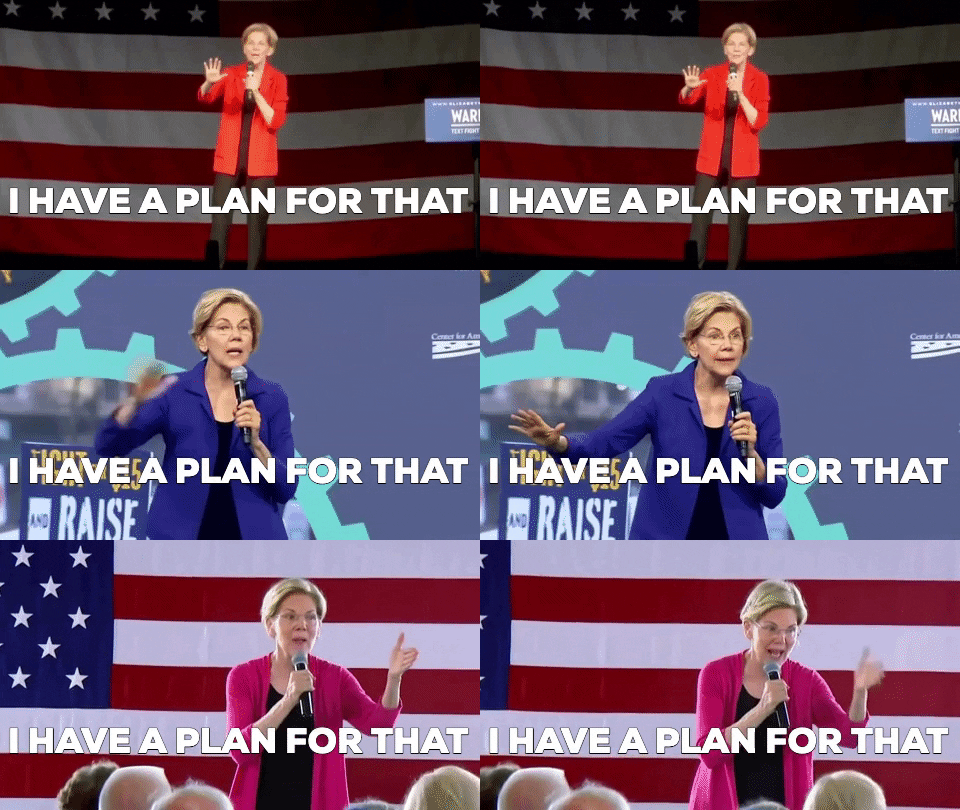
"Warren's Got a Plan For That."

Want Medicare 4 All? Warren's got a plan for that. Cancelling college student debt. She's got a plan for that. Robbing three casinos in one night? You damn betcha she got a plan for that!

Okay, I kid about the Oceans 11 thing (but hey if Warren calls me needing that guy on the computer to hack into the mainframe, I'll refer her to somebody and take the driver's gig instead), but Warren is serious about putting out plans and proposals for families and workers and everyone who's key to the Democratic voter turnout. It's why Warren has been getting a solid number of support groups like the Working Families PAC to switch their votes from Bernie to Warren.

As such, Warren is more of a threat to Bernie's hold on the Progressive Left forces in the Democratic ranks than she is a threat to Biden's hold on the Moderate/Centrist forces. Even though given Warren's range of topics she's supporting and covering puts her as a major candidate for BOTH factions.

So why isn't she polling any higher?

Because Biden's lead as a Passive-Positive figure appealing to a majority of the Democratic base is kinda hard to punch against. Because Sanders' True-Believer BernieBro faction isn't going to give up their ideal Utopia of a revolutionary democratic socialism... something they believe Warren isn't really going to support if she wins this November. Because the mainstream media still has a problem with women candidates and the harsh coverage shows.

Which is a damn shame because Warren's character traits suggest she'll be a strong Adaptive figure in the White House that trends towards an Active-Positive administration.

To refer to this New Yorker article by Sheelah Kolhatkar:

...Warren is one of the country’s foremost critics of Wall Street firms and big banks, which make much of their profit, in her view, by abusing consumers and taxpayers. It’s a perspective that has grown out of Warren’s work as an academic and has shaped her ideas as a politician, propelling her from Harvard Law School, where she was a professor specializing in bankruptcy law, to the Senate, where she has represented Massachusetts since 2013.
On many economic issues, Warren has been remarkably prescient. She has spent decades warning Americans about the pernicious effects of income inequality, predatory corporations, and consumer debt, and about the failures of our financial system—issues that are at the heart of the 2020 Presidential campaign... She is attempting to position herself as a pragmatic advocate for the middle class, someone who can bring systemic reforms to education, health care, and democracy itself. But, unlike the Presidential candidate Bernie Sanders, Warren doesn’t describe herself as a “democratic socialist,” and says that she isn’t trying to do away with capitalism. “I believe in markets,” she says, over and over. She says that she simply wants to make them work better for more people...

As I noted, it's that last bit - Warren's unwillingness to join the Far Left completely, even as she pushes for reforms that would clearly fulfill a lot of what the Far Left hopes for - that scares the BernieBro faction. But it shouldn't (back to Kolhatkar):

...With the help of advisers working from her headquarters, in Boston, Warren has been releasing a torrent of detailed policy proposals. She has issued a plan to dramatically reduce student debt and to offer free tuition at public colleges; a plan to unwind large agriculture conglomerates in order to make the market more equitable for family farms; a plan to require large corporations to pay more in federal taxes; a plan to dismantle the behemoth technology companies and regulate them like utilities; and new legislation to address opioid addiction, modeled on a bill passed by Congress in 1990 to combat the H.I.V./aids epidemic. She has announced an “Economic Patriotism” plan, intended to create opportunities for American workers, and has issued proposals targeted at Donald Trump, including one that would make it permissible to indict a sitting President.
Together, the proposals promise a new level of government intervention in almost every aspect of economic life. Some of the ideas are pragmatic; others seem aimed more at marketing than at implementation. Regardless, “I have a plan for that” has become a rallying cry for her campaign—an echo of the way that “Nevertheless, she persisted” became a tagline for Warren supporters after Mitch McConnell, the Senate Majority Leader, used it to describe Warren’s refusal to stand down during the confirmation hearing for Jeff Sessions, Trump’s former Attorney General. In May, the comedian Ashley Nicole Black wrote, on Twitter, “Do you think Elizabeth Warren has a plan to fix my love life?” Warren responded, “DM me and let’s figure this out...”

There's a couple of things to point out here about character traits: Warren's self-deprecation with that last bit, but overall a detailed, comprehensive view of every problem facing the nation and a willingness to answer those problems. A lot of this fits into what Professor Barber established as Active-Positive traits: Problem-solving, engagement, and a willingness to take stands.

When confronted with the challenges of running any election, specifically her run at the U.S. Senate in 2012, this came up:

Many voters saw Clinton as flip-flopping and opportunistic; Warren comes across as straightforward. She rarely brings up breaking the “highest and hardest glass ceiling,” as Clinton often did, although she acknowledges its existence. She told me that, when she was considering running for the Senate, in 2012, people advised her against it because of her gender. In the previous election, Martha Coakley, the Massachusetts attorney general, had been beaten by an inexperienced Republican, Scott Brown. “Massachusetts is not going to elect a woman. It’s just not going to happen,” Warren was told again and again. “Every time I heard that,” she said, “I’d think, I’m definitely getting in this race...”

As I mentioned before about Truman, an A-P figure relishes the challenges of a political fight not for their own sake but for the issues and communities affected. As an aside, it should be noted Coakley didn't do a good job of campaigning, even failing at proper support of local sports teams - it's Bawston, it mattahs - while Warren proved adept at the game.

When I asked Warren how she would survive all that, she said, “I know how to fight and I know how to win.” She pointed to two of her major accomplishments in Washington: the creation of a new regulatory agency, the Consumer Financial Protection Bureau, in 2010, and her Senate campaign against Scott Brown.
“After the financial crash, I knew that we needed a consumer agency to keep big banks from cheating people,” she said. “People told me two things: ‘It’s a great idea’ and ‘Don’t even try it. You can never get it passed into law. The big banks will never permit this. They’ll fight you every inch of the way.’”
She paused. “But we got organized. We fought for working people. We built a grassroots movement. And President Obama signed the Consumer Financial Protection Bureau into law.”
A little more than a year later, Democrats encouraged Warren to challenge Brown for his seat, despite considerable odds. “I decided that I was not going to wake up on the day after the election and he would still be my senator, voting against my values, and I would have done anything less than everything I could to stop that from happening,” she said. “And I went from down seventeen points to beating Brown by seven and a half points...

While this attitude shares the ambition of the Active-Negative, you'll notice a good amount of "we needed," "we fought," "we got organized." A good Active-Positive speaks in the "We Can" voice (opposed to the "I Must" of the A-N), which tends to be the overall delivery from Warren.

And speaking of Warren's work with the CFPB:

A person involved in the effort to get the C.F.P.B. included in the bill told me that Warren’s drawn-out bankruptcy battles had helped her acquire the skills to get things accomplished in politics. “She was pretty good about both the inside game and the outside game, and how the two intersect,” he said. “The inside game is very important: you need to get a bill passed in Congress, and she understood this and got C.F.P.B. into Dodd-Frank. And then she did a lot of press interviews and a lot of things to engage the public.”
After the legislation was approved, in 2010, Warren seemed the obvious choice to lead the new agency. But Neil Barofsky, who oversaw the bailout with her, told me that her desire for the role never entered into her decision-making. The head of the new agency would initially report to Geithner, and Barofsky recalled a hearing in which Warren aggressively questioned Geithner about his treatment of the insurance company A.I.G., which had paid its traders generous bonuses after taking taxpayer funds. “If she had pulled punches in that hearing, nobody would have known,” Barofsky said. “And she just eviscerated him, and exposed the hypocrisy and the failure of the program.”
News outlets later reported that Geithner opposed the idea of Warren running the C.F.P.B. He wasn’t alone. The financial industry mobilized to derail her potential nomination. “You remember preapproved credit cards?” Warren told me. “I was a pre-rejected nominee...”
...Obama, facing intense resistance, nominated Richard Cordray, a former Ohio attorney general, for the role. But he asked Warren to help set up the agency; she spent a year doing that. Under Cordray, the C.F.P.B. forced financial institutions to return twelve billion dollars to customers who had been targeted by scams such as unauthorized overdraft charges and illegal fees for student-loan repayments. Congressional Republicans kept up their opposition; by 2017, they had introduced a hundred and thirty-five bills and resolutions to weaken or eliminate the agency...

One measure of respect in politics is the class of enemies you make. Warren is arguably the most hated Democrat among the super-rich financial institutions and corporations trying to squeeze more money out of Americans (and the world) than ever before. In that regards, she deserves serious consideration to run against the most corrupt financial figure of the last 50 years in trump.

So how would I grade her as a candidate for the Presidency?

Elizabeth Warren - Senator, Massachusetts.
Positives: Popular Senator who has had national coverage since her consumer advocacy in the 2000s, has worked as a major player of the Consumer Financial Protection Bureau, is aware of the challenges of reining in fraud and financial corruption, she would be the one of the few candidates if elected to hold businesses accountable and do a lot of things to end the income inequality threatening the nation. Would be the first Woman President to actually sit in the Oval Office (sorry Hillary). Would be someone capable of undoing a lot of the fiscal damage trump has done since 2017. Also, Kate McKinnon can play her on SNL.

Negatives: Along with Biden and Sanders, Warren is part of an aging Boomer population (despite the appeal she has to a lot of Gen X and Millennial liberals/moderates). Still is answering for questionable past behavior revolving around a college-period claim of Native American ancestry (which trump and fellow haters are using to drag her real name through the mud). Is too Pragmatic a figure for the Progressives to accept and too Reformist for the Moderates to trust. Like Hillary before her, Warren has to overcome a legitimate problem with sexism in our nation's media and voting population.

Chances: She's currently in the mix in the early primary / caucus states for the Democratic primaries, but she's low on funding compared to Biden and Sanders (and also to the rich guys Steyer and Bloomberg who are spending millions in ads she can't afford to make and air yet). If she can pull off an upset or two early on - maybe Iowa, maybe New Hampshire - and weather the push by the media to drop out before the big states, she may gain momentum the way Obama did in 2008.

Character Chart: I've already pointed out how I view her as an Active-Positive figure. She shows the Adaptive trait of accepting and taking on policy ideas of fellow candidates (with a willingness to admit where she got the ideas from), working with a level of Self-Confidence (her primary trait IMHO) and Long-Term Planning (the gamemanship skills of a Kennedy/Obama) that other A-Ps have deployed. Like Truman before her, she does the homework to debate her points with aplomb and directness. If I had to compare Warren to anyone, it would be FDR (A-P), a reform-minded charismatic willing to fix a broken system rather than replace it outright.


Okay, that's all I got for the four three main candidates for the Democrats to choose from. Having lost my primary candidate in Harris - whom I supported for her early advocacy for better teacher pay and boosts to education funding - I've decided to put my support to Warren, whose agenda mostly matches my own hopes for a better government taking care of the citizenry. Past all that, I am willing to support ANY Democratic candidate - even Sanders but definitely NOT Gabbard - due to the reality of how dangerous it is letting trump and the Republicans retain ANY power in our government.

If I had a preference order, it'd be 1) Warren, 2) Booker, 3) Klobuchar, 4) Biden, 5) Sanders, 6) Maybe Mayor Pete, I'm not sure who's left in the equation 7) Anybody but Gabbard.

Saturday, November 24, 2018

Things That Need to Happen In Florida Before 2020

With the recounting all finished and the sad reality of Republicans winning the Governor and Senate races - DAMMIT FLORIDA RICK SCOTT IS A MEDICARE FRAUD DID YOU EVER UNDERSTAND THE SEVERITY OF THAT - the first thing to do is wipe away the tears and the second thing to do is get prepared for the chaos that will be 2020.

It is going to be a nasty election cycle, a Presidential one where the choices are going to be a handful of Democrats primarying in the spring and the Republicans amped up to defend a goddamned con artist in trump.

But a lot of other things can be on the ballot as well, above all reform amendments that can curtail a lot of the criminal misdeeds of a Florida legislature / Governor's office.

The voters just approved the amendment that would re-enfranchise ex-felons, allowing a million or more non-violent parolees to regain their rights as citizens to vote. That's a positive boon to turnout.

More needs to be done though.

Actual turnout is depressingly low. Population is 20 million, with around 16 million eligible to vote. Yet we currently have 13.3 million registered... and it's looking like barely over 8 million actually cared to vote. How much of that poor turnout is due to voter suppression, how much due to voter indifference?

There's solid evidence that the aggressive gerrymandering that affected this state the last twenty years or more discourages turnout. While anti-gerrymander amendments have passed this decade, the GOP-controlled Legislature and Governor's office have kept figuring out loopholes and means to ignore court orders, crafting districts that still favor their party in partisan ways. With another map redraw coming up for 2020 (the Census is coming), and the likelihood Florida may see another Congressional seat added, the shifting of the map is unavoidable.

If the Democratic party has any concern about breaking the decades-long grip the GOP has had on this state - a grip that has hurt our schools, poisoned our waters, and dismisses our rights - they need to approach this next election cycle in two ways.

One: push for amendment referenda that will crimp gerrymandering (such as an independent map-making committee, and stricter definitions to ensure non-partisan intent), that will improve voter turnout (by opening Early Voting more broadly and by forcing the counties to improve polling access with better voting equipment and more paid personnel), and that will ensure voter turnout (by creating universal voter registration, free IDs, same-day registration, and/or other reforms).

Two: by campaigning and challenging every available state and federal office with reliable local candidates, whether they be progressive or centrist. Florida Democrats still have problems recruiting and promoting for local elections (partly because the party leadership is wary of getting out-there Progressives that would alienate voters the way certain wingnut Far Right candidates would be for Republicans) to where local voters have few reasons to show up to vote. To hell with that. Get the best possible people to run for the State Lege. Get the local teachers (look at Wisconsin they elected a teacher to Governor) angry about low wages, get the local fishermen watching their businesses waste away in toxic algae, get the college-age Millennial railing against the gun violence that devastated her schools. Every seat needs to be challenged. Every voter needs to hear a Democratic voice arguing FOR better pay, cleaner water, safer lives.

2020 is gonna be a zoo: the train wreck that is trump makes that obvious. But Florida needs to tune that noise out and focus on what matters. Saving our state from Far Right misrule.

Get working. Two years goes by faster than you realize.

List of groups to seek out:

Indivisible

Common Cause Florida

League of Women Voters Florida

Lemme know who else to add that will be running amendment petitions for 2020!


Wednesday, January 10, 2018

Killing the Gerrymander: 2018 With the Best News Yet

Again, not a huge fan of the gerrymander.

Which is why the latest news out of North Carolina heartens me. Per David A Graham at The Atlantic:

Federal judges have yet again struck down North Carolina’s congressional districts as an unconstitutional gerrymander, dealing Republicans a blow and throwing the state’s maps into chaos just months before a pivotal midterm election.
A three-judge panel, including one circuit-court judge and two district-court judges, ruled Tuesday evening that the Old North State’s redistricting plan relied too heavily on partisan affiliation in drawing constituencies, violating citizens’ rights under the 14th Amendment’s Equal Protection Clause, the First Amendment, and Article I of the Constitution. The decision is the first time a federal court has ever struck down a redistricting plan as a partisan gerrymander...

As Graham notes, there are two other gerrymander cases on similar arguments in other courts, so we'll likely have to wait for this to get to the Supreme Court (where it could well die for partisan reasons /headdesk).

But this ruling is a huge fcking deal because unlike previous gerrymandering rulings - which focused on minority representation - this focused on Party representation: Between the difference of Republican, Democrat, and Independent/smaller Third parties. As Graham noted, earlier gerrymandering efforts based on race was shot down by the courts, so the Republican-controlled North Carolina state legislature "proudly used partisanship as their primary criterion in drawing new maps." They intentionally drew state and congressional districts to serve Republican needs:

“I acknowledge freely that this would be a political gerrymander, which is not against the law,” said Representative David Lewis, the chair of the state House redistricting committee. He also said, “I think electing Republicans is better than electing Democrats. So I drew this map to help foster what I think is better for the country.” And he suggested the committee draw maps that would produce 10 Republican and three Democratic U.S. House districts, on the basis that he didn’t think it would be possible to come up with an 11-2 map...

The court came back and told Lewis and the other Republicans that guess what IT WAS AGAINST THE LAW:

Common Cause and the League of Women Voters both challenged the law, and their two suits were consolidated into one. The plaintiffs argued that the plan violated the Equal Protection Clause, because it discriminated against non-Republican voters; the First Amendment, because it discriminated against voters based on previous political expression; and Article I, because it interfered with the right of the people to elect their representatives...
“A partisan gerrymander that is intended to and likely has the effect of entrenching a political party in power undermines the ability of voters to effect change when they see legislative action as infringing on their rights,” Judge James Wynn, an Obama appointee, wrote for the court. “We agree with Plaintiffs that a wealth of evidence proves the General Assembly’s intent to ‘subordinate’ the interests of non-Republican voters and ‘entrench’ Republican domination of the state’s congressional delegation...”
Wynn was joined in full by Judge William Britt, a Carter appointee, and in part by Judge William Osteen Jr., a George W. Bush appointee who accepted the Equal Protection and Article I arguments but rejected the plaintiffs’ First Amendment claim...

This last bit is important. The judges did not split on two of the three arguments, meaning those arguments can work at the higher appellate (and Supreme Court) levels. The First Amendment argument is open to interpretation, but the Equal Protection and Article I arguments are etched deep into the legal underpinnings of voters' rights.

This partisan gerrymandering on the part of Republicans - in fairness, Democrats have been doing this in states like Illinois as well - is one of the big reasons why we're struggling against a federal government where the Party in power does not actually represent the majority of voters. Most Americans vote Democratic: However, the nature of geography and demographics (which is affected by gerrymandering) gave Republicans more seats in Congress.

If we can get rid of gerrymandering - if we can as a nation make it so that the House AND the Senate reflect the actual voter turnout and the issues they want resolved - we should get a Legislative branch of the federal government that genuinely reflects - and serves - the nation's interests. Only the geographic limitations - on the Senate, where small states are disproportionately represented - would be a problem from that point.

We'd still have elected officials who actually earned their electoral wins, not based on "safe" districts carved out to decimate the opposing party(ies).

Here's hoping.

Tuesday, January 10, 2017

Killing the Gerrymander: A Season of Hope

Update: Hello again to the Crooks & Liars audience coming here via Mike's Blog Round-Up! Thank you as always to Batocchio for inviting onto the list, and again to everyone here please visit, I have other rants and rampages to read at this blog.


For all my ranting on the sidelines about getting rid of the gerrymander, there is someone else out there - Hi, Paul! - doing the heavy lifting, and GOD BLESS HIM FOR IT.

Via Slate.com:

Both Democrats and Republicans deploy partisan gerrymandering to dilute votes for their opponents, creating one-party rule and, arguably, greater polarization. That’s bad for the body politic and a clear contravention of the Constitution. But as long as the courts refuse to step in, gerrymandering will continue to plague the country...
Now Paul Smith, one of the greatest legal minds in the country, is asking the Supreme Court to finally put a stop to it. And here’s the exciting part: He might actually succeed...

KEEL IT! KEEL THE GERRYMANDER!!!

Ahem.

...The difficulty in curbing partisan gerrymandering has not been in convincing judges that the practice is unconstitutional—the Supreme Court has found that it is—it’s convincing judges that they can fix it.
In 2004’s Vieth v. Jubelirer, which Smith argued, five justices agreed that partisan gerrymandering likely violated the Constitution. But one of these justices, Anthony Kennedy, wasn’t sure quite how to fix the problem, and so he voted with the conservative justices to toss out a challenge to a Pennsylvania gerrymander - without closing the door to future lawsuits. In a concurring opinion, Kennedy wrote that partisan gerrymandering seems to unconstitutionally “burden representational rights” by “penalizing citizens” because of their “association with a political party” or their “expression of political views.” Still, Kennedy insisted, courts should not intervene until they could articulate “principles of fairness in districting” - specifically, a formula to decide when the burden placed on representational rights crosses the line into unconstitutionality. Otherwise, he argued, the results from one gerrymandering case to the next would likely be disparate and inconsistent...

So Smith and his people figured out a formula:

This formula - called the “efficiency gap” - cites two types of “wasted votes” in the redistricting process: “lost votes” cast in favor of a defeated candidate, and “surplus votes” cast in favor of a winning candidate that weren’t actually necessary for the candidate’s victory. The efficiency gap is, in Stephanopoulos’ words, “the difference between the parties’ respective wasted votes in an election, divided by the total number of votes cast.”
When both Democrats and Republican waste roughly the same number of votes, the efficiency gap is near zero. That means voters on both sides had a fair shot at securing their desired representation. When a party gerrymanders its opponents into the minority, however, it will “waste” fewer votes than its opponents, causing the efficiency gap to rise. A historical analysis of elections across from the country since 1972 suggests that an efficiency gap of 7 percent will entrench the majority party’s power until new maps are drawn. Wisconsin’s Republican-drawn gerrymander has an efficiency gap of 13 percent, meaning a huge number of Wisconsinites are currently deprived of their representational rights solely because they are Democrats.
This formula may sound like an oddly technical method for ensuring basic representational equality. But the justices have waded into algebraic waters before. The court has long held that the Constitution enshrines the principle of “one person, one vote,” meaning districts should contain about the same number of people so that no vote counts more or less than others. But over several decades, it has had to decide what amount of deviation from the “one person, one vote” principle was constitutionally permissible. Ultimately, the court found that the deviation between the population of the largest and smallest districts in a state cannot exceed 10 percent...

So based on this efficiency gap formula, the Wisconsin gerrymanders at 13 percent goes well beyond the historical skewing, and can well violate the "one person one vote" axiom that judicial review relies on.

As the article noted, the district court already sided with Smith and the Efficiency Gap. There is demonstrated evidence of gerrymandering affecting the voters' ability to choose their representatives, and given the legal arguments against gerrymandering there's a solid chance that the Supreme Court - even this conservative one - would accept the evidence and rule in Smith's favor.

Getting this formula set to reconfigure electoral districting at a state and federal level would go a long way towards ensuring a more accurate representation of the voters across the nation. It would certainly force the political parties to be more responsive to the voters and less towards the mapmakers.

Here's hoping Paul Smith gets the Supreme Court to agree with him.

Here's hoping the gerrymander dies a quick death before 2018 (or at least 2020).