Showing posts with label future preference. Show all posts

Sunday, October 16, 2016

What If: Hillary Wins AND Gets a Friendly Congress for 2017

I've speculated already about how it would look if Donald Trump won the Presidency.

It wasn't pretty. And my speculation wasn't the only one.

So, with Trump now stuck in polling below 40 percent and the likelihood Hillary secures all of the Obama 2012 states (plus Arizona and North Carolina and MAYBE Georgia, Texas and Utah!), we now need to speculate about what it would look like if Hillary won.
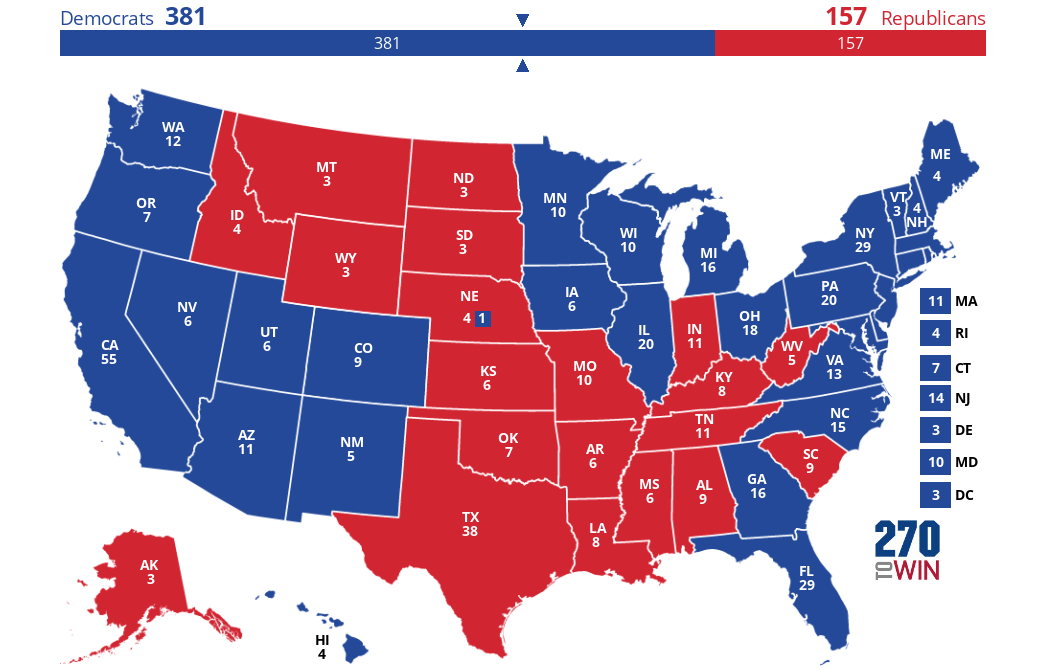
I will keep Texas - barely - on the Republican side, but if Latino
turnout rocks that house, it would be an epic GOP collapse.
I REALLY want Georgia to flip Blue...
Click the map to create your own at 270toWin.com


Okay, Republicans, deep breaths, stop panicking, oh c'mon for the love Flying Spaghetti Monster you SURVIVED Bill and Obama for decades, settle the hell down...

Anyway, previous prediction of post-election posing was that if Hillary wins but Republicans retain control of Congress, we'll likely be in the same obstructive gridlock the GOP has enforced on this nation since 2010 (and in a lesser form in 2009 when they abused Cloture rules in the Senate). Given the outright hatred the Republicans will have towards Hillary - and their belief that they have enough "criminal" charges on her - the possibility of constant Congressional investigations into every little move she makes is a near-lock.

On the bright side, the likely scenario is that the Republicans can lose the Senate - out of 34 seats open, the numbers suggest the Democrats can pull off a 52-54 seat majority - giving Democrats a chance to break the gridlock on Supreme Court nominations and other Judiciary/Executive vacancies that are in dire need of filling.

While the polling doesn't reflect any serious victory for Democrats in flipping the House, this is a "What If" scenario so let's go there: What if Trump's anger towards the GOP Establishment convinces his voting base to reject the down-ballot tickets to where Republicans lose a lot of seats? What if, thanks to a divided Republican party, the House goes from 234 Republicans over 201 Democrats and goes 220 D - 215 R?

It's not much, it'll be a slim hold on the House of Representatives, and there's always a chance some Democrats will vote against the party line - in this situation the backbenchers will have disproportionate control on some issues - but this version of the universe will give Hillary a Congress basically willing to grant her as much of her agenda as she'll want.

What does that actually mean?

Hillary's platform would be called a standard "liberal" agenda. She's on record supporting a Public Option fix to the ACA (Obamacare), a massive infrastructure budget to repair our aging highways and bridges, closing tax loopholes for the rich and for corporations, protecting Planned Parenthood, and boosting public education. Her biggest controversial issue is over gun safety laws that the NRA would never accept.

What we'd likely see in 2017 with Hillary and a Democratic Congress is a sweeping stimulus package covering massive construction projects - road, bridges, transit systems, schools, power grids - combined with moderate hikes in the tax rates for upper income earners (and possibly forcing the megacorps into bringing back all those tax dollars they're hiding overseas) to pay for it. While the Republicans will squeal in outrage over it and may try to block it in the Senate, there's every likelihood Hillary - using that Johnson-esque A-N worldview of hers - will get it pushed through.

The question will become "what impact will Hillary and the Democrats - no longer restrained by conservative austerity anti-spending efforts - have on the overall economy of the next four years?"

This is key, because economic performance is ALWAYS the best way for a sitting President to win a second term. As long as the economy works or improves, the incumbents are safe. Only during economic uncertainty - especially major downturns like a Recession similar to 2008's - will the sitting party get hit with electoral losses.

As long as Hillary can build on the slow rebuilding that Obama oversaw and lowers the unemployment down to a health 4 percent while seeing gains in wages and reductions in personal debts -THIS is what Hillary and the Democrats should focus on - then she's a lock to win a second term in 2020 (despite the fantasies of the GOP, more on that later).

So I would totally predict a Hillary administration is going to see a long, stretched-out battle against the banks by the Democrats to work on cutting back on debt-causing matters like college loans, mortgages, and the like.

There's also the likelihood of long, stretched-out battles against any Republican-controlled state government over state-level funding issues and economic cost-of-living issues surrounding city/county zoning laws (that last part might even involve a few Democratic states too).

In terms of domestic policy, the Pro-People agenda that Obama solidified in 2011-12 will made concrete. Gay Marriage and other Gay/Transgender rights under a full Democratic federal government will be made moreso, even against any Republican state-level obstruction like the "bathroom safety" and "gay cake" laws. Hillary is bound to fill more court vacancies - even Supreme Court ones - with Left-leaning progressive justices, adding to the Right-leaning (but not wingnut) judges already placing small-c conservative rulings on these issues. There's also increased odds of better pro-Women rulings on birth control, health care, child care and job protection/wage improvements. As well as the likelihood civil rights for Blacks, Latinos and minorities in general will be safe for the next decade (and one day permanent).

On foreign policy, Hillary will deal on fair terms with her allies without fear of a Republican Senate trying to knee-cap her. She is more aggressive on foreign issues which may mean an increase in direct interventions with land troops, but she may be tempered by a more Progressive Congress - especially in the House - that would seek to clamp down on any military misadventures.

Whether Hillary continues some of Obama's more questionable practices - especially drone "warfare" and the surveillance state - depends entirely on Congress. It is up to Congress to set the laws on these matters, and one hopes that a more Left-leaning legislature will set stricter guidelines and oversight. But let's be honest: every President - even Obama, and he's a good guy - cannot willingly give up such legally grey powers. It's going to be a fight if the Progressives push this issue.

While all this happens, you can guarantee the Far Right media will not roll over and play dead. Fox Not-News, Rush, Drudge, every wingnut with a video stream and a book deal is going to be at DefCon 1 claiming Hillary is destroying America. The other media outlets - CNN, MSNBC, ESPN - may find themselves at war with conservative talking heads trying to dominate for air time on the nightly roundtables, but if they have any sense or decency the major outlets need to ween themselves off that Far Right Noise and invite actual experts to their shows anymore. If we're lucky, a Democratic sweep this November might wipe out every favorite Congressional Republican guest - sorry, McCain - and force the networks to invite more elected Democrats for a change.

To anybody who thinks a Hillary win combined with a Democratic Congressional win is going to lead to the End Times: yeah, stop listening to the wingnuts. We've seen years of Democratic control - 2009 to 2010, 1993-1994 - and we never had A) massive arrests of all citizens, B) alien takeovers, C) the Rapture. Lighten the fuck up, wingnuts. Hillary may be talking about gun safety laws but that doesn't mean SHE'S COMIN TO TAKE OUR GUNZ. Hillary can't abolish the 2nd Amendment - that takes Congress, two-thirds of both houses, AS WELL AS two-thirds of the states - so take that fantasy off the list. At WORST you gun-nuts, Hillary is going to press for a re-interpretation of that amendment to recognize gun safety ("well-regulated") outweighs unlimited gun usage ("shall not be infringed"). What Hillary's gonna do is make it harder for the NRA to turn a profit on our kids getting shot.

The concerns about militia violence are legit, but we should recognize that a mass majority of Americans are not THAT violent. Losing the Presidential race may cause a lot of sound and fury, and of course losing Congress will make it worse, but it will only go so far. The wingnuts will talk about coups and secession and whatnot, but most of them will just go home and gripe about how bad it all is and wait for the next scandal to prove themselves right (note: there may be certain circumstances that might escalate that from talk to action...). That said, I hope the FBI and Homeland Security redouble their efforts on tracking and shutting down the homegrown terror militia groups already waging war on our nation.

So that's how it will kind of look once 2017 rolls onto the computer clocks.

It also depends on if that year's summer blockbuster lineup will be actually any fun. For that I will blame Obama, though.

Thursday, July 17, 2014

I FINALLY FOUND THAT ARTICLE I WAS LOOKING FOR

Apologies for the All-CAPS headline, but dammit I've been looking for a link to this thing for years.  I've really been trying to find it when I wrote my Presidential Character review of Bill Clinton last year.  As a librarian I revel in the success of finding a research item...

Lemme explain.  I wanted to make a point about Bill Clinton being an Active-Positive based on a character analysis on him talking about "future imperatives" and how America was a nation that looked forward by setting up goals that would benefit future generations and not the current one(s).  The article itself was really going into how the Baby Boomer generation - sans Clinton, who accepted the "future imperative" - was the horrific exception, the generation obsessed with its own needs and doing nothing to set up any "imperatives" for future kin.

Problem was I couldn't find the article, which I knew was at least archived somewhere: it was either an online article I saw in Salon or else in a magazine with political/current cultural focus like Rolling Stone or Esquire.  As a librarian who prides meself on finding anything, being unable to find this was frustrating.

This morning, doing some side work researching another matter, I decided to retry my search terms to focus more on the Baby Boomers and how they were destroying everything on the political landscape.  THAT'S when I got a search result to a New York Times 2012 op-ed called "The Entitled Generation".  And THAT referred to the article I was looking for!

The article by Paul Begala was in Esquire (I knew it was one of those) published April 2000 titled "The Worst Generation".  Finally.  At last.  I'll need to update that Clinton review now.

As for the reason I wasn't finding that article before: well, my bad, I mis-remembered the phrase.  It wasn't "future imperative" it was "future preference":

...It is my contention that the single greatest sin a generation can commit is the sin of selfishness. And it's from this standard that I draw my harsh conclusion. I'm not alone in this view, of course. The Boomer in Chief, my former boss, Bill Clinton, used to tell me about an influential professor he'd had at Georgetown. His name was Carroll Quigley, and he taught young Bill Clinton and hundreds of other Hoyas about something called the Future Preference.
I can still see Clinton doing his Quigley impression, eyes full of mischief, his voice an Arkansas version of a bad Boston accent, as we bounced around in a bus or flew through a thunderstorm on Air Elvis, our campaign plane back in 1992. "Mistah Begahhla," he'd intone as he looked at me through the bifocals perched on the end of his nose. "Why is America the greatest sociiiiiiety in human hist'ree? The Few-chah Pref'rence. At every critical junk-chaah, we have prefuhhed the few-chah to the present. That is why immigrants left the old waaahld for the new. That is why paahrents such as yours sacrifice to send their children to univehhsities like this wan. The American ideal is that the few-chah can be bettah than the paahst, and that each of us has a personal, moral obligation to make it so..."

Writing it when he did (2000) Begala was setting up his fears about the OTHER Baby Boomer threatening to become the next President, Bush the Lesser.  Whose administration did ignore the future in the obsessions of satisfying present needs (massive tax cuts even after being warned of the massive deficits that would happen, a bloated Medicare package left unfunded) and in the recklessness of starting fights (a war in Iraq) without a care (there was no Plan B) about how to resolve such fights so that our future (the poor kids sent in to fight that war) wouldn't have to fight it again...

So that's it.  That was the keyword I should have been looking for.  Future Preference.  It's something we should be looking for in our political leaders from now on.  I've added it to my Labels.  Hashtagging it on Twitter asap.

Thursday, December 12, 2013

Presidential Character: Week Forty-Two, I Survived The Clinton Years (UPDATE)

(UPDATE below)

SO SUCK IT, LIMBAUGH.  You fear-mongering Cubicle Commando.

Ahem.

I really wanted to refer to this article I read ten or twelve years ago about Baby Boomers (those born between 1945 to 1965) that a fellow boomer used to describe his own generation as selfish, destructive, and reactionary.  Except where he made note of THE Boomer President, Bill Clinton, as a notable exception to that destructive impulse because Clinton genuinely believed in "the future imperative".

Clinton was referring to something a college professor had taught him, that the Future Imperative - not the language construct, but a political viewpoint - was an American-based ideology where the players and motivators on the political stage in the Present focused on how their current actions would boost or help Future generations.  The article writer's implication was that, where the Boomers would focus on their own needs at the expense of past generations - their parents - and future generations - their children and grandchildren - the likes of Clinton would focus on taking care of needs so that future generations would have something to work with.

And damn me for a fool, even for five straight days of using my librarian skills to the fullest, I can't find the thing.  I've forgotten if I'd read it in Rolling Stone, Esquire, Vanity Fair, or someplace online like Salon.com.

'Cause that bit about "the future imperative" is what's stuck in my head when it comes to defining Clinton's Presidential Character.  Without Professor James David Barber as a lighthouse guiding me on the matter (I also tried looking for journal or magazine articles by Barber about Clinton, but it seems 1992 was his retirement), this is one of those cases I've got to make using my own evidence.

UPDATE (7/17/14): The article has been found!  The search term should have been "Future Preference", not Imperative.  My bad...

The actual quote about (and from) Bill Clinton provided by Paul Begala in his Esquire article "The Worst Generation":

...I can still see Clinton doing his Quigley impression, eyes full of mischief, his voice an Arkansas version of a bad Boston accent, as we bounced around in a bus or flew through a thunderstorm on Air Elvis, our campaign plane back in 1992. "Mistah Begahhla," he'd intone as he looked at me through the bifocals perched on the end of his nose. "Why is America the greatest sociiiiiiety in human hist'ree? The Few-chah Pref'rence. At every critical junk-chaah, we have prefuhhed the few-chah to the present. That is why immigrants left the old waaahld for the new. That is why paahrents such as yours sacrifice to send their children to univehhsities like this wan. The American ideal is that the few-chah can be bettah than the paahst, and that each of us has a personal, moral obligation to make it so."
So there it is.  Now, back to the original essay...

Doing research online, I've come across others referring to Barber's Character charts and applying the Passive-Positive label on Clinton, mostly due to his open desire to be liked and popular - the Congeniality trait - and because Clinton seemed to bend too much in dealing with a Republican Congress, being viewed as a weakness.

But that habit of dealing or working with Congress is a common Adaptive trait, if one noticed how Clinton, despite the expectations of his being a Liberal or Far Left leader, was able to deflect a rebellious GOP Congress from shredding more of the New Deal than they sought to destroy.

One of the big gripes I'd seen against Clinton was how he allowed the existing Welfare program to change from basic financial aid to families into an employment-related "workfare" program that satisfied most voters' concerns about a social aid program that appeared to allow the poor to endlessly live off the government (the reality may have been different, but the conservatives had succeeded in convincing the public that's what Welfare had become by the 1980s).  The thing is, the reform benefited by timely improvements to the economy itself - aided by job-boosting trade deals started under Bush the Elder and carried over by Clinton, and by a technology boom with computers and the Internet that few if any ever predicted - and from changes to the tax code and other social safety nets (food stamps) to cover any consequences of the workfare changes.

Rather than fear the dangers of changing welfare - as the Far Left worried that it would force more families into poverty, not less - Clinton and his administration was able to accept the bigger picture that the reform could work as long as other economic forces aided it.  In this regard, along with other points, I'd put Clinton in the Active-Positive category of Presidential behavior.

If Clinton did fail on some of the big Liberal ideas he was expected to pass/defend - failing to pass a healthcare reform that, let's admit it, was too complicated for its own good - it was because the nation itself was still not ready for most of those ideas (we as a nation are still not prepared for universal healthcare similar to every other major economic power on the globe, so how the f-ck can it be a commie socialist plot to destroy America if it works in England and Japan?).  For example, it had to take another decade of increasing health care costs for the nation to even tolerate a conservative, pro-business plan that became Obamacare.

Other signs of Clinton's A-P traits cover his self-deprecation, an honest desire to genuinely mingle and emotively relate to American voters (his "I feel your pain" was easily mocked, but it was sincere).  He was also able to re-position himself without ever crossing the line into flip-flopping, earning him a moniker "Slick Willie" (among other reasons, such as lying and using lawyer-speak to wriggle out of jams) but also making him adaptable to any political circumstance, including his fights with his opposite number Newt Gingrich, fellow Boomer and then-Speaker for most of Clinton's tenure.

For all of Gingrich's pro-conservative bluster, and for all of Gingrich's ambitions, Clinton could run rings around the guy.  And Bill was never that fast of a runner. /rimshot  Nearly every time Newt tried to confront Bill on a domestic issue - above all the budgets that were held up by Congress-fueled shutdowns - the President would get the nation to see his side of the argument and humble the Speaker and Congress down into accepting deals that may have benefited a conservative agenda but came across as Republican defeats.  Attempts to weaken Clinton during his first term of office with a legislative war didn't work: Clinton cruised to an easy re-election in another threeway race between himself, the Republican Bob Dole, and Ross Perot (whose impact, already meager, was diminished by 1996).

If anything weakened Clinton, it was himself: odd among most Active-Positives in that his personal and business dealings were very self-destructive (another reason some critics viewed him as a Passive-Positive like Harding, who did share those habits).  It could be argued that things like his Whitewater dealings, or his wife Hillary's law firm billing practices, were a mark of the post-Watergate era of unethical behavior by a lot of political figures.  But it left him vulnerable in ways that did limit his decision-making on the Presidential stage and had an adverse effect on his own staff.

Clinton's advantage during all of this was the colossal overreach of his political enemies.  All too eager to think the worst of a "hippie liar", hating on wife Hillary as a prominent feminist figure (the vitriol for her was worse than any bile aimed at him), the Far Right that came to dominate the Republican Party post-Reagan/Bush began an open campaign to discredit, humiliate, and delegitimize the Clinton administration.  Aided by a cable news channel led by a prominent conservative media whiz - Roger Ailes and his Fox News - and by radio blowhard Rush Limbaugh - whose career flourished the more he attacked Hillary - they talked up every potential scandal against Clinton they could find.  Whitewater became the new Watergate.  The firings of the White House travel office staff became headlines.  The suicide of a Clinton personal ally became the focus of three separate Congressional and grand jury investigations.

The overreach achieved peak crazy when it got out that Clinton had a sexual affair with a White House intern.  Immediately convinced she was the keystone to every Clinton scandal ever, the Lewinsky Affair dominated the news.  Long-standing media elites like Sam Donaldson openly predicted Clinton's resignation "within the week."  Clinton was forced under other investigations, including a civil suit by Paula Jones contending he sexually harassed her, to testify about having an affair with Lewinsky (and like any guy who thinks with his d-ck, Clinton did his best to weasel out of it).

But by this point a majority of Americans were jaded and burned out by the constant scandal-mongering by the Far Right.  What had started out as serious-sounding scandals - Corrupt land deals!  Dead lawyers!  A Trail of corruption across Arkansas! - turned up nothing but an intern with a stained dress.  What was promised as "worse than Watergate" ended up as "blowjobs".   Hillary was able to with a straight face go on national television and accuse their accusers of being part of "a vast Right Wing conspiracy".  And a lot of people agreed with her.

By the time the GOP Congress pushed to impeach Clinton for his perjury and obstruction before a grand jury (the BEST they could come up with), the Republicans were embarrassed by a poor 1998 midterms campaign that saw their seat numbers in both houses drop, although they retained majority control in both.  Feeling betrayed that they lost voters against Clinton's moral failings, the House turned against Gingrich as Speaker forcing him to drop the title (he would resign from the House less than a year later), and then coped with the embarrassment of their Speaker-designate Bob Livingston resigning when his sexual scandals came to light.  Meanwhile, with the Senate nowhere near the 2/3rd required to impeach the President, the vote wasn't even near that: the perjury charge went 55 votes against impeaching to 45 for, and the obstruction charge went dead even 50-50.

By 2000, Clinton left office with decent popularity numbers (although rightly hit for his poor honesty) while his opponents were sitting around thinking "what the hell happened?"  Rubbing salt into the wounds was the fact that during the impeachment and after, Clinton (A-P as always) was still able to get bills through Congress, nowhere near lame as most ending two-term Presidents tended to be.

--

It is hard to describe to the children and teens of today what it was like to be a survivor of both The Reagan Years and The Clinton Years.  Both different in terms of tenor and yet both similar in terms of economic booms presided over by highly charismatic and influential figures.

The take-away from the Clinton Era was a feeling of a missed opportunity, that Clinton could have been so much greater if he had reined in his personal appetites and unlocked his personal fears of political overreach.  If he had focused on a more comprehensive agenda that covered more needs rather than the several he prioritized above others.

To be fair, Clinton's Boomer impulses focused inward rather than outward onto his administration or the nation.  His one strength of political character - Adaptability while remaining tasked to a big picture - remains the saving grace of an otherwise bruised administration.

Next Up: If anyone's read this blog since the day I started it, You know how I feel about this one.  I may yet prove charitable regarding his Character...