Showing posts with label world war i. Show all posts

Monday, November 11, 2019

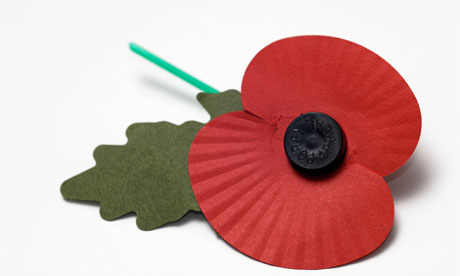
From the Battlefields of World War I, A Small Red Flower

From Flanders Field, this.


In Flanders fields the poppies blow
Between the crosses, row on row,
    That mark our place; and in the sky
    The larks, still bravely singing, fly
Scarce heard amid the guns below.

We are the Dead. Short days ago
We lived, felt dawn, saw sunset glow,
    Loved and were loved, and now we lie,
        In Flanders fields.

Take up our quarrel with the foe:
To you from failing hands we throw
    The torch; be yours to hold it high.
    If ye break faith with us who die
We shall not sleep, though poppies grow
        In Flanders fields.

poem "In Flanders Field" by John McCrae

Sunday, November 11, 2018

Veterans Day: It Rains On Our Soldiers All The Time (w/ Update)

It is, again, the Eleventh Month and the Eleventh Day coming up on the Eleventh Hour when the guns were ordered to stop across Europe one hundred years ago.

100th Anniversaries are a big deal. A full century has happened between the end of World War I to now. It made sense for the nations of the world to pause and gather at the memorials dotted across the battlefields where the fallen were laid to rest, and so many of the nations that fought on the Western Front - the allies of France, Great Britain, United States, the opponents that were Germany, Austria and Hungary - sent their leaders to stand for us in honor of those brave men who lost their lives.

Well, kinda. The United States tried to send our leader, but that just happens to be the Loser of the Popular Vote donald trump at the moment, and well...

President Donald Trump could not attend a commemoration in France for U.S. soldiers and marines killed during World War One on Saturday because rain made it impossible to arrange transport, the White House said.
The last minute cancellation prompted widespread criticism on social media and from some officials in Britain and the United States that Trump had “dishonored” U.S. servicemen.
The president was scheduled to pay tribute at a ceremony at the Aisne-Marne American Cemetery in Belleau, about 85 km (50 miles) east of Paris, with his wife Melania. But light steady rain and a low cloud ceiling prevented his helicopter from traveling to the site.

If that sounds like a bullshit excuse, because you'd think our Marine One helicopters ought to be able to handle bad weather, or because there's this wonderful option call CARS that could have been used to DRIVE across France - c'mon, the scenery this time of year can't be THAT bad - then you'd be right. The weather wasn't bad enough to stop trump from sending his own Chief of Staff John Kelly in his stead.

A lot of other people pointed out the stupidity of trump's move:

Ben Rhodes, who served as deputy national security adviser for strategic communications under President Barack Obama, said the excuse about the inclement weather did not stand up.
“I helped plan all of President Obama’s trips for 8 years,” he wrote on Twitter. “There is always a rain option. Always.”
Despite the light rain, French President Emmanuel Macron and German Chancellor Angela Merkel held a moving ceremony in Compiegne, northeast of Paris, to mark the 100th anniversary of the signing of the World War One armistice.
Canadian Prime Minister Justin Trudeau attended his own ceremony to pay tribute to Canadian troops killed at Vimy Ridge, on the battlefields of northeastern France.

Instead, trump pretty much stayed in his hotel room all day and sulked and tweeted his conspiracy nonsense about Democrats "STEALING ELECTIONS ZOMG". trump could have easily done all that from his own worthless country clubs and not wasted everyone else's time and money on this trip.

Gods, what a waste of oxygen trump has been.

Either trump was terrified of standing in the rain - the LEAST any elected official could do to honor our soldiers - or he's completely forgotten how umbrellas work.


Yeah I know, cheap shot. BUT TOTALLY DESERVED.

It's deserved because every other President takes it as an act of honor to stand in the rain:

Michael Beschloss' twitter
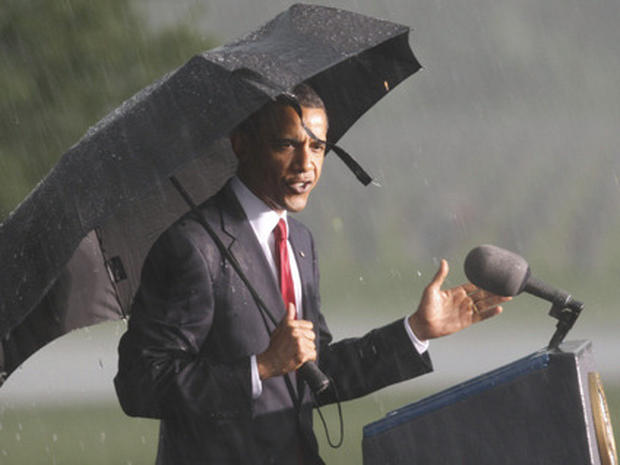
Obama never went hiding from the rain (and knew how umbrellas work):

President Obama's Memorial Day ceremony at the National Cemetery in Elwood, Ill., was stopped temporarily, and then canceled outright, while a severe thunderstorm passed through Northern Illinois.
As lighting cracked and thunder clapped, the President went to the podium to tell the thousands in the crowd to seek shelter.
Holding an umbrella in a massive rain storm, the President told the crowd, "Excuse me, everybody listen up. We are a little bit concerned about lightening. This may not be safe. So I know that all of you are here to commemorate the fallen and that's why we're here. What we'd like to do is, if possible, have people move back to their cars, and if this passes in the next 15-20 minutes, I will stick around and we'll come up and start up the ceremony again. But we don't want to endanger anyone, particularly children in the audience. So I'd ask everybody to very calmly, move back to your cars. I'm going to move back to mine. We will wait to make sure that the thunder has passed. A little bit of rain doesn't hurt anybody, but we don't want anybody being struck by lightning.
"God bless you everybody. We will be staying here and will make an announcement shortly," he said.
from AP Photo


THAT is what Presidents do.

trump doesn't even TRY.

Not even when we as a nation need to honor and respect those who TRULY served our nation, both our fallen and our living soldiers.

It rains on our soldiers all the time.

from NPR

But trump will never care. For him, it's NEVER been about respecting others.

(Update 11/12/18): And now the coward refuses to go to Monday's Veterans Day observance because of the weather reports claiming it will rain at Arlington National Cemetery.

Absolutely no true courage in him. Absolutely no respect for others at all.

Thursday, December 25, 2014

Anniversary: The Christmas Truce

This is, as noted before, the 100-year anniversary of the first year of World War I.

History is made of competing forces.  Between the Great Man and the Social Movements lie all the conflicts of both.  By 1914, these forces had congealed on the European continent through a combination of set nations - France, Germany, Russia, the UK, Italy, Austria-Hungarian Empire, and Ottoman Empire - and a burgeoning psycho-social ideology of Nationalism fighting over pride and global power.

It had been 100 years in the making by then.  In the aftermath of the Napoleonic empire and swath of republicanism, Europe suffered through a period of nation-building border wars - the Greek independence war, Italian reunification, Prussian unification of a greater Germany - that concluded with the Franco-Prussian War in 1870-71.

What had been viewed at the time as a likely win for France - larger armies, better organized - turned into a full rout in Prussia's favor in a war that barely lasted a year.  France was abjectly humiliated as a result (this is where the meme of France being terrible in wars started), Germany rose up to disrupt the standard balance of power - once it was England vs. France, no longer - in Western Europe, and the Victorian Era switched from being a period of scientific advancements to one big mechanized military arms race.

The problem was that the Victorian (and later Edwardian) Era became this period of an idealized, improved social condition.  Things like personal honor, stiff upper lip, gentlemanly codes became more fetishized.  A lot of it had to do with the literature of the time.  Some of it with the changes in economic and social fortunes creating a middle class striving for cultural norms of its own, to where the upper classes indulged in sharing the more romantic elements of their lifestyles.

By the time the fighting in World War I actually started, nearly everyone went into it with these grand notions of honor and soldiering.  That it was all parade marches and sacrificial charges into waiting hordes of bayonets and swords.  Nobody really thought about the improved rifles and automatic guns, or the advancements in artillery fire and targeting, or the armored tanks that were new to the battlefield, or the effectiveness of barbed wire and hand grenades and poison gasses.

By the end of the calendar year of 1914, Western Europe's battlefields were basically two extended mud trenches and two massive armies - Germany in one trench, UK and France in the other - staring at each other across a cold no-mans-land.  The Germans were the ones who made the efforts to decorate their trenches for the holidays, and via the honored soldiers' code of "Live and Let Live" (under which both sides agree to temporary cease-fires to recover wounded or personal belongings), the Germans sent messages to their British and French counterparts about holding a truce - THE Truce - during Christmas Day.

There aren't a lot of documents about it, mostly from a good number of diary entries and remembrances of those who were there that day, so a lot of the Christmas Truce has fallen into legend.  Above all the legend of a football (soccer to us Yanks) game being played between the two armies.  There's no evidence it happened, but the story is that Germany won 3-2.  It'd have been tied but that damn ref called Blackadder offsides.

Whatever history there is of this - the legends still tell us - the generals were not amused their soldiers weren't killing each other.  When the areas where the Truce were continuing on after Christmas had passed, the chain of command ordered artillery barrages and switched out the divisions stationed there with fresh troops to ensure the fighting started up again.  By 1915, the generals planned ahead and made sure they had artillery barrages scheduled for Christmas to prevent the troops from making another try at a truce.  By 1916, they didn't bother: the bloodshed between both sides - and the use of chemical gas weapons - ensured the troops were in no mood for cease-fires.

Looking back on the Christmas Truce, it reminds us that the war was fought by men looking not for glory - that madness was left to the generals - but because it was expected of them.  Where the soldiers in the trenches had more in common with each other than the officers in their headquarters five miles back.  The Truce was part of an era of that Victorian/Edwardian mindset of honor between soldiers regardless of which flag they fought for.

It was an era that was dead in the trenches by 1918.

And yet, we remember.  We remember the Truce as a good thing, a moment in human history at the edge of a terrible war where there was still hope and the potential of friendship past the hardship.  As a nice little Christmas candle shining in the darkness of the 20th Century.

Merry Christmas to ye, fallen soldiers of that and all other wars, before and after.  The Truce remains to us as a memory of what we all can achieve some day.

A chance of playing an honest game of football and not get shot at for it.

Tuesday, November 11, 2014

Though Poppies Grow

The poppy flower grows when the seeds are disturbed, and the ground is turned, when a war rages.

Today is Veterans Day.  Generally recognized as a day of remembrance for the soldiers who fought and for the ones who didn't make it back.  On this day, the poem In Flanders Fields is read, and the red poppy flower worn.
And as always, the final clip of Blackadder Goes Forth, one of the downest of Downer Endings a show ever had:


On the eleventh hour of the eleventh day of the eleventh month.  It meant an end to the fighting, but it didn't mean an end to all wars...

Saturday, June 28, 2014

Anniversary: The Fuse

(update: big hello to the Crooks and Liars audience, welcome back)
History teaches us that the War was inevitable.

There was this... understanding across the nations of Europe at the turn of the 20th Century.  The empires of the 19th Century had made treaties and agreements to protect their global power by dividing themselves into two armed camps.  Revolving around the animosities between France and newly-forged Germany, the other nations and empires - Great Britain, Austria-Hungarian Empire, Russia, newly-forged Italy - chose sides to back in case France and Germany decided to start a thing.

It all came from the belief in a Balance of Power working between the nations/empires of Europe: that no one nation would become stronger or more powerful than the others, requiring nations to gang up against the growing "threat" to ensure war wouldn't happen...  Except that, by the 20th Century, various powers wanted war in order to satisfy their needs or avenge some slight.

Or, as Captain Blackadder so rightly put it: "It was bollocks."

The splits had formed over slights and injuries spanning decades: France being humiliated by Prussia/Germany in 1871; Russia being slighted over Austria-Hungary's control over the Balkans; Great Britain threatened by Germany's growing Imperial Navy and open desire for empire-building in places the UK already controlled; Germany's desire to make themselves an economic powerhouse equal to a British Empire the Kaiser Wilhelm II - cousin to the British Royals - so wanted to emulate.  Underneath all of this was a budding sense of Nationalism - a tribal impulse of patriotism - merged with various elements of anarchism and economic malaise.

By the early 1900s, all of Europe was a literal powder-keg: each nation building up arsenals and weapons of increasing technological lethality that few of the generals and men in power even comprehended how dangerous war was becoming.  While the peace held, it was merely over the fact nobody wanted to be the idiot to start the whole thing blowing up.  Nobody wanted the blame once the dust settled...

Except for the ones who didn't care.

For all the politicians and men of power who knew to tread lightly, Europe was also filled with ethnic factions subsumed by the aging Empires affected by the same Nationalist pride.  Except that Nationalist pride drove them - especially the Serbians in the Austrian-held Balkans - towards a desire for self-determination, the right to form their own nation outside of imperial dominance.  They'd seen nations like Greece gain their independence from the Ottoman Empire - a Middle Eastern empire on the edge of the European boiling pot - and they'd seen Italy and Germany form themselves into true nations out of divided squabbling states.  So these smaller states, these ethnic groups, sought their own nations.

This brings us to Serbia.

Serbians had been suffering for centuries, a once proud eastern European culture taken over by the Ottomans in the late 1300s.  By the mid-19th Century they were able to fight back to gain some independence from the Ottomans only to suffer new rule under the Austria-Hungarians as part of a Russo-Turkish treaty.  While Serbia retained some independence as a nation it still had to answer to the Habsburgs in Vienna, and was blocked from expanding further influence in the Balkan region.

The resentments led to various factions in Serbia plotting for action against the Austrians.  Violence and riots were common throughout the region leading up into 1914.  When the Archduke Ferdinand of Austria decided on a visit to the region as part of his military duties to the Navy (Austria-Hungary had access to the Mediterranean through their hold of Bosnia), he also planned on visiting Sarajevo for a museum dedication on the date of his wedding anniversary with his beloved wife Sophie.

That was June 28.

Welcome to the anniversary date of the starting point of World War I: the assassination of the Archduke and his wife.

Done as a protest against Austria-Hungarian hegemony, for Serbian nationalism pushing for a Greater Serbia dominating all of the Balkans, it was the excuse the powers back in Vienna needed to stomp down on a Serbian nation they viewed as a threat.

Problem was, Russia had become allies of Serbia by then.  Russia's interests in eastern Europe had always been there ever since the birth of their own empire.  When Austria-Hungary mobilized for a war on Serbia by July 28, it triggered clauses in treaties Russia had with Serbia and with their Entente with France and UK to mobilize, which triggered Germany's mobilization, which triggered France's...

One trigger unleashed another.  At no point did any national leader "man up" and say "wait, this is stupid, this is a fight between Austria-Hungary and Serbia, it doesn't involve us!"  Germany didn't need to mobilize against Russia... France didn't need to mobilize versus Germany... Germany didn't need to invade Belgium to preemptively fight France, which gave Great Britain the excuse to jump in... except that there were enough people in power in each of those nations who argued that war was war, that it would be quick and easy with everybody's allies lining up to fight it, and now was the time to pitch in.

Like Blackadder said, bollocks.

Whatever ideals or hope there had been in the 19th Century that humanity as a whole was stepping towards a more evolved, artistic, sensible future died in the muddy trenches of the war fronts.  Once started, neither side had little incentive to end it fearing the consequences of national collapse and panic.  For four years, the European powers pummeled each other until they had placed serious strains on their manpower and resources.

None of it ended well.

Germany, trying to destroy Russia from within, unleashed a communist uprising in the heart of a frayed Russia that led to the rise of the Soviet Union and to the horrors of Stalin.  Austria-Hungary fell apart through a prolonged war that drained their resources.  Italy, jumping in late on the side of the French-UK-Russian Entente, found their fortunes ruined in disastrous military campaigns that collapsed their government, leading to the rise of the Fascists under Mussolini.  The Ottoman Empire fell apart through British intervention in the tribal uprisings across the Middle East.  Great Britain and France lost hundreds of thousands of men against the German lines.  Germany used up much of its resources and men as well.  Germany's desperation against the UK led to their attacking American shipping and trade interests, dragging the United States into the war.

When the fighting finally stopped on November 11 1918, it was due more to fatigue on all sides than due to any actual victory.  But Germany's government fell apart as a result of the armistice, and France and Great Britain wielded enough influence on the following peace process that its lopsided punishments on Germany convinced a good number of politicians and historians to note that the peace wouldn't last (and it was because some of them like General Foch believed the treaty was too lenient and would allow Germany to rebuild).  And we all know what that bloody Treaty of Versailles led to...

It didn't help that some of the underlying issues causing the war - the fervent tribalism that masqueraded as nationalism, for example - weren't properly resolved.  France and Great Britain still had their empires to maintain after all, and they exerted their influences into the Middle East by carving up the remnants of the Ottoman Empire into nations that forced the wrong ethnic groups in the region into the wrong states.  While the bloody history of the Middle East has existed long before the European map-makers made their mark in the region, the drawing up of Syria, Iraq, Iran, Saudi Arabia, Palestine (without an Israel at that time), Turkey and other regional nations with reckless disregard for ignored groups like the Kurds and ignorance of the divisions between Shia and Sunni faiths certainly exacerbated tensions to where we've got the bloody chaos the world endures to this day.

It was 100 years ago the modern world was born.  In fire and in blood and in death.  We've been dealing with the consequences ever since, more than any other historical event preceding it.

God help us all today.

Thursday, November 11, 2010

For Veterans Day: A Thought On Armistice

Oh to hell with it, here's the last scene of the BBC Comedy Blackadder Goes Forth:


Everything you need to know about war in 5 minutes.
That this was the closer of a comedy series remains heart-rending, only less so than the real-life madness that World War I really was.  England lost over 800,000 of their young men to that war: entire towns wiped out of a generation of sons and husbands.  In some ways, this war and not World War II - which in itself was a "Good" or necessary war and thus accepted with some cheer and satisfaction - is the more painfully remembered war in England.  Because of the insane loss of life over a war involving treaties and the lust for empire (Britain's to defend, Germany's to win).
As for this show... in England this episode was shown originally on Armistice Day... It's called Remembrance Day there (Veterans Day stateside).  They only had one complaint.  Everyone else was probably too busy crying as the poppies rise up from the debris of No-Man's Land...