Showing posts with label diplomacy. Show all posts

Sunday, January 05, 2020

Deteriorating Situation 2020 trump Style

Gods, this weekend has seen more collapses than an earthquake disaster movie.

This is what happened today Sunday January 5 (via Military Times).

Iraq’s Parliament called for the expulsion of U.S. troops from the country Sunday in reaction to the American drone attack that killed a top Iranian general.
Lawmakers approved a resolution asking the Iraqi government to end the agreement under which Washington sent forces to Iraq more than four years ago to help in the fight against the Islamic State group.
A pullout of the estimated 5,200 U.S. troops could cripple the fight against ISIS and allow its resurgence.
The majority of about 180 legislators present in Parliament voted in favor of the resolution. It was backed by most Shiite members of parliament, who hold a majority of seats. Many Sunni and Kurdish legislators did not show up for the session, apparently because they oppose abolishing the deal.
Officials from the Pentagon, U.S. Central Command and the Combined Joint Task Force Inherent Resolve did not immediately respond to requests by Military Times for comment.

The implications here, combined with the previous disastrous moves by trump allowing Turkey and Russia to purge Syrian Kurdish regions, will mean a resurgence of the Islamic State bastards who are so extremist they make the Taliban look like the Care Bears. This is going to lead to another round of internal bloodshed in Iraq that killed hundreds of innocent civilians and threatened a number of minority Persian/Arab groups that ISIL wants exterminated. Throw into this the further isolation of Iraqi Kurds and we've essentially abandoned the one ethnic group in the entire region the United States could trust. They sure as hell won't trust us ever again.

And here's Bombshell Number Two (via New York):

Iran announced on Sunday that it will no longer honor its commitments from the 2015 nuclear deal and said it has removed all limits on its uranium-enrichment program. The declaration came after the regime officials held an emergency meeting to reevaluate Iran’s nuclear program after President Trump ordered the assassination of the country’s top military leader, Qasem Soleimani, in a drone strike in Baghdad on Thursday. Iran also stressed in a statement that it was willing to resume honoring the deal and reopen access to the International Atomic Agency, but only after sanctions against the country were removed and it was sure its interests would be secure — i.e., that the U.S. would fulfill its commitment to the deal after President Trump unilaterally decided to abandon it.
In 2018, Trump withdrew from the deal and made the unsubstantiated claim that Iran had violated its terms. America’s JCPOA partners in Europe disagreed and tried, but ultimately failed, to preserve the agreement thanks to the numerous obstacles Trump and his Iran-hawk advisers erected as part of their maximum-pressure campaign against Tehran.

The JCPOA was working until trump sabotaged the deal. He and his neocon war-hawks despised Obama's efforts, believing it a betrayal of their War On Terror game plan. They'd rather have Iran dive head first into a nuclear armament program to justify attacking Iran for doing exactly that: A self-fulfilling disaster.

This is a failure of diplomacy all around. The war factions of trump's administration are getting what they want: More War, especially one designed to bring about their Rapture. trump is getting the two-fer of pissing on Obama's political legacy (negating a peace deal that could have led to an open and moderate Iran) and setting up a media spectacle designed to drown out (and in his mind shut down) the ongoing Impeachment process.

What we're going to get is further escalation as the situation in the Middle East deteriorates past the point of no return (if we haven't hit that already). We're getting the likelihood of the United States military being ordered to set attacks on Iranian Heritage Sites (civilian locations) which would by the way BE WAR CRIMES. We're getting an increase of terror and militia strikes against U.S. bases and personnel across the globe (We may already have in Kenya).

We're going to get more insanity and more chaos and more death because our government's system of checks and balances are failing to constrain a goddamn madman at the helm. Too many people in trump's Cabinet want this shit to happen, our military commanders unwilling to cross a line that could end their careers as acts of insubordination, and Congress too divided because of McConnell's obstructionist partisan bullshit to do anything to stop trump.


This is now officially out of control. And it's going to take more than luck to live through this.

Saturday, January 16, 2016

Who Knew Diplomacy Could Work With Iran? Oh, Right. Obama Did.

This had been an eventual week on the political stage, with Obama performing his last State of the Union, the Republican Presidential candidates going feral at each other at yet another horrific primary debate, and a series of international incidents involving the "rogue nation" of Iran.

The earlier incident involved two Navy patrol boats in the Persian Gulf performing maneuvers: somehow one of the boats suffered a failure and both boats ended up drifting into Iranian waters off Farsi Island. As the Washington Post reports:

...A senior defense official, speaking in Washington, said the sailors were not harmed but would undergo medical evaluation and a debriefing in the Persian Gulf nation of Qatar. Meanwhile, their vessels were taken by another American crew to Bahrain, their original destination and home to the U.S. Navy’s 5th Fleet.
The release appeared to end a potential flash point as Iran and world powers move toward the possible next steps in a landmark nuclear deal that limits Tehran’s atomic program in exchange for the easing of international economic sanctions.
The detention also added to tensions in the Persian Gulf region amid the worst diplomatic unraveling in decades between Shiite power Iran and Saudi Arabia and its Sunni allies. The feud — opened by Saudi Arabia’s execution of a prominent Shiite cleric earlier this month — has put Washington in the middle as it seeks to implement the nuclear deal while also backing its key regional partner, Saudi Arabia...
Secretary of State John F. Kerry, in a statement, expressed his “gratitude to Iranian authorities for their cooperation in quickly resolving this matter…. That this issue was resolved peacefully and efficiently is a testament to the critical role diplomacy plays in keeping our country safe, secure, and strong.”
The incident, meanwhile, offered a test of new high-level channels opened during the nuclear talks between the two nations. Diplomatic relations between Washington and Tehran soured after Iran’s 1979 Islamic revolution, and they were formally severed in April 1980, five months after militants seized the U.S. Embassy in Tehran and took Americans hostage.
For hours — even as President Obama gave his annual State of the Union address — messages passed directly between Iran and Washington instead of the intermediary nations used for decades. The exchanges included Kerry reaching out to Iranian Foreign Minister Mohammad Javad Zarif, who was Iran’s point man during the nuclear talks...

What's important to note that this is all happening in the background of a more pressing concern: the phased slowdown on Iran's attempts at a nuclear weapons program, along with promised lifting of international sanctions that forced Iran to negotiate. From the BBC news:

As part of the deal, Iran had to drastically reduce its number of centrifuges and dismantle a heavy-water reactor near the town of Arak, both of which could be used in creating nuclear weapons...
Iran has always maintained its nuclear programme is peaceful, but opponents of the deal - such as some US Republicans - say it does not do enough to ensure the country cannot develop a nuclear bomb.
The US Secretary of State John Kerry has ordered that US nuclear-related economic sanctions against Iran be lifted.
Speaking in Vienna where he had been holding talks with his Iranian counterpart, Mr Kerry said Iran had "undertaken significant steps" which many people "doubted would ever come to pass"...

And along with this, the United States secured the release - via prisoner exchange - of five of our citizens some of whom have been held in Iran since November.

This works a little bit better than labeling Iran part of an "Axis of Evil". Remember that? How three nations with absolutely nothing to do with each other - Saddam Hussein's Iraq, Ayatollah's Iran, and the Il Jong North Korea Crime Family - all got bunched together as a collective bogeyman Legion of Doom? All part of the Bush the Lesser administration's attempt to invoke an updated version of the World War II Axis of Germany, Italy and Japan.

Bush's people did that at a time we were starting to work with Iran especially with efforts against the Taliban in Afghanistan, with a reasonably moderate elected government. By 2003, the Iranians were miffed enough at the roughshod treatment that they voted the moderates out and by 2006 went their version of wingnut, which hurt our efforts to resolve the painful occupations of Afghanistan AND Iraq. It made it rougher in their own nation when the moderate-leaning populace tried going back to a responsible government only to have the hardline Ayatollah forces crackdown on them. Neither the U.S. nor Iran enjoyed the consequences of that diplomatic snafu.

But now with a President in Obama who takes foreign policy serious, as a collective effort between nations to resolve matters before they escalate and to fight back against the darker forces like ISIL, we have better results. We're getting Iran to deal with us, not against us. We're recognizing their ability to play as a Rational Actor on the global stage.

So of course the Republican Party and their 2016 headline candidates are throwing conniptions about it. Per the Washington Monthly:

...But yesterday, in the mere 24 hours surrounding the SOTU, we were able to see a situation unfold in a way that demonstrates how quick Republicans have been to jump on the anti-Obama bandwagon - no matter what that means - and just how wrong that leads them to be.
Of course I’m talking about the two naval vessels and 10 U.S. sailors that were taken into custody by Iran yesterday. As soon as the news broke, Republicans were ON IT. Here’s just a sample from twitter:

On several occasions recently President Obama has suggested that perhaps Republicans should aim before they shoot. This situation was a perfect example of why that might be a good idea. Because less than 24 hours after these boats and sailors were taken into custody by Iran, they were released...

The Republican debates were not much better. Even with the news that the sailors were already freed and the incident over, the candidates on-stage tried to use it to justify their calls to bomb Iran (via Vox):

...Rather, they fumed over the Iran incident as if it had been a particularly notable segment of reality TV, in which their favorite character had suffered a moment of awkward embarrassment at the hands of their least favorite. It was like watching a recap of MTV's Real World, in which everyone is fuming about how that Obama guy just won't pull his weight around the house, and did you see how he totally let that awful Ayatollah Khamenei jerk get away with dissing him?
If it sounds silly, that's because it is. But it's a kind of silliness with real and potentially dire consequences, as the candidates, one by one, promised militarism and an official policy of belligerence, speaking to a world that remembers the last time America tried that and earnestly fears the consequences should it happen again.
"I want to get to the substance of the question on jobs," Sen. Ted Cruz said in response to his very first question of the night. "But I want to start with something, today many of us picked up our newspapers to see the sight of 10 American sailors on their knees with their hands on their head. ... I will tell you, it was heartbreaking."

Just note that the question Cruz got was on jobs, and he STILL needed to go out of his way to bluster on this incident so he could get out there first before the other candidates. The others weren't any better.

Christie: We are not the world's policeman but we need to stand up and be ready. The problem, Maria, is the military is not ready either. We need to rebuild the military. This president let it diminish to a point where tin pot dictators like the mullahs in Iran are taking our Navy ships. It is disgraceful, and in a Christie administration, they would know much, much better than to do that.
Rubio: Barack Obama believes America is an arrogant global power that needs to be cut down to size... That is how you get a foreign policy where we cut deals with our enemies like Iran and we betray our allies like Israel and we gut our military and we go around the world like he has done on 10 separate occasions and apologized for America.

It's as though the candidates all wanted to pose as Badasses, as manly men able to enforce their American Exceptionalism upon a cowering planet. Little recognizing that for centuries and through 40-odd Presidencies, we have had to deal with other nations and not shell/invade/bomb all of them to get our way. As Max Fisher noted in his Vox article:

...As I have written previously about this worldview, which is also shared by a number of media figures, it is a world in which high-stakes geopolitical events do not matter for the actual content of those events or for their concrete consequences, but rather primarily for their quality as theater. Foreign policy is not the conduct of relations between states but rather a locker room competition of displays of toughness. The only appropriate posture is thus one of constant and maximal belligerence.
All the stuff about lives at stake, risks of war, and complex diplomatic issues are just window dressing for what really matters: the zero-sum competition for maintaining national pride or imposing national humiliation...
This isn't just campaign silliness. It has consequences. As the Washington Post's Dan Drezner shows, "toughness" as a foreign policy strategy isn't just ridiculous. It's dangerous:
All of these guys think that they’ll sound at least as tough as George W. Bush. The thing is, we already know how that movie played out. While Bush ostensibly demonstrated American resolve by invading and then surging in Iraq, North Korea developed a nuclear weapons capability, Iran accelerated its nuclear program, Russia invaded Georgia, China built up its soft power across the Pacific Rim, and Hugo Chavez expanded the Bolivarian bloc in Latin America. As a theory, the notion that any of these guys would deter Iran from doing what it did this week seems pretty laughable.
This is a movie we've seen before, and that the world has seen before. Even if Americans have short memories and are tempted back into a vision of reality TV–style foreign policy where it's all about imposing machismo and cost-benefit is for wimps, I have found, anecdotally but consistently, that no one outside of America has forgotten how it went last time. I don't know that they're going to have an easy time dismissing all this as empty campaign rhetoric, and I don't know that we should, either.

This is why fearmongering that the Republicans are selling us this year needs to get ignored by the voters. We are running the risk of voting into office someone who will treat international relations like a Game of Chicken. Using tanks instead of cars, using bombs instead of dueling pistols. It is the mindset of a Bully.

It is not the mindset of a professional adult, Something we need from the Someone who will sit in that Oval Office. It is not the mindset we've gotten out of President Obama the last seven years.

I worried before when Obama won the Nobel Peace Prize so early in his administration, that the world was merely honoring him because he wasn't Bush the Lesser. Now we see why. Where Dubya and his administration bullied, Obama led with outreach and dialogue and respect among our allies as well as opponents. This is how a President should act upon the global stage.

And of course the Republicans will blind themselves to that reality before they ever admit to it.

They're trying to blind the rest of us from that. Don't let them.

Tuesday, July 14, 2015

Iran And Peace In the Same Sentence, the Same Deal

Mentioned back in April that Iran agreed to a deal to reduce their efforts and step away from a nuclear weapons program.  Today, the final steps of that deal were put in place between Iran, the United States, and other major global players.  To the Atlantic on the deal:

One key feature of the deal is that it exchanges sanctions relief for Iran with limits to its fuel stockpile and nuclear-production capacities. Iran will have to remove two-thirds of its installed centrifuges and store them under international supervision. It will also have to reduce its stockpile of enriched uranium by 98 percent for 15 years.
Should Iran fail to hold up its end of the bargain, the agreement arranges for a panel involving all seven countries that participated in the nuclear talks to vote on whether to put sanctions on Iran back in place. A simple majority can approve them, which means that if Iran, China, and Russia vote against the so-called “snapback” of sanctions, they can be overruled.
Meanwhile, the agreement affirms that "under no circumstances will Iran ever seek, develop, or acquire any nuclear weapons." To make sure Iran complies, it also guarantees that the International Atomic Energy Agency will monitor Iran’s nuclear facilities for the next 25 years...
...As for the United Nations arms embargo against Iran, it will be lifted after five years and restrictions on Iran’s ballistic missiles will be eased after eight years. According to Colum Lynch and Dan de Luce at Foreign Policy, the American concession on this issue, which may alienate some of the president’s allies in Congress, is ultimately what led to Iran to give in on the limits to its nuclear program outlined in the accord. The issue of the arms embargo was initially left out of the April framework agreement.

Beinart's article about why the Republicans are having, will have a major hissy fit over this:

When critics focus incessantly on the gap between the present deal and a perfect one, what they’re really doing is blaming Obama for the fact that the United States is not omnipotent. This isn’t surprising given that American omnipotence is the guiding assumption behind contemporary Republican foreign policy. Ask any GOP presidential candidate except Rand Paul what they propose doing about any global hotspot and their answer is the same: be tougher. America must take a harder line against Iran’s nuclear program, against ISIS, against Bashar al-Assad, against Russian intervention in Ukraine and against Chinese ambitions in the South China Sea...
...Obama has certainly made mistakes in the Middle East. But behind his drive for an Iranian nuclear deal is the effort to make American foreign policy “solvent” again by bringing America’s ends into alignment with its means. That means recognizing that the United States cannot bludgeon Iran into total submission, either economically or militarily. The U.S. tried that in Iraq.
It is precisely this recognition that makes the Iran deal so infuriating to Obama’s critics. It codifies the limits of American power. And recognizing the limits of American power also means recognizing the limits of American exceptionalism. It means recognizing that no matter how deeply Americans believe in their country’s unique virtue, the United States is subject to the same restraints that have governed great powers in the past. For the Republican right, that’s a deeply unwelcome realization. For many other Americans, it’s a relief. It’s a sign that, finally, the Bush era in American foreign policy is over.

What is happening here is this: Obama's efforts at diplomacy throughout his two terms demonstrates that the neocon hardline "war is the answer" mindset is false.  Where the Republicans would insist on bombs and occupation at all times, Obama looks for alternatives, usually through talks and deals.  Granted, Obama still deploys troops and has increasingly relied on drone warfare across the Middle East, but he's trying to avoid the large-scale alienation that hampered U.S. interests overseas and weakened our position with allied nations.

Look at how Jeb Bush - whose father of all people was an expert diplomat himself, and who has to be cringing at his son's folly - was complaining about Obama's "poor" efforts at foreign policy, that "we" as a nation were "not leading".  His criticisms ring hollow and false now that Obama and his State Department led our allies into making a solid workable deal with an Iran once treated as hostile by Jeb's brother Dubya.  Jeb seems to ignore a key bit about foreign policy: if you go into a meeting and come out of it with more allies and trade partners than you did going in, it's a victory.  And more often than not, Obama's been winning those meetings.

To the hard-liners here in the U.S., the talk will likely be about how this deal hurts Israel (and Saudi Arabia), or appeases the theocratic Ayatollahs ruling Iran.  What they're ignoring is that if (yes, we do need that caveat) the deal pans out, Israel (and Saudi Arabia) will actually be SAFER with a nuke-free Iran in the region.  And this isn't a soft deal either: if Iran gets caught pulling anything sneaky - and the oversight/transparency efforts appear to be well-prepped - the whole deal's off, which is a strong incentive for Iran - which needs the sanctions lifted for economic stability - not to cheat.

And as for the Ayatollahs and their hard-liners in the Iranian government, the easing of sanctions will make the world a friendlier, more attractive visage to the Iranian people (who are more savvy about the world and eager for normalcy than the neocons would admit).

I still stand with the protesters from years ago who stood for a democratic change in their leadership.  I cheer on the fact that a later election cycle proved the Iranian people wanted that change despite the fear of their overlords, and elected people who became part of this peace process with the world at large.  I still hope that with this move, the hard-liners of their government can realize they don't need to rule by fear or suppress their people.

This is a great day for America, and a large step towards global peace.  Well, okay, there's still the rest of the Middle East to clean up, ISIL to stomp, a Syrian civil war to end, a Libyan government to stabilize, a...

Also, it's I Heart Pluto Day.  Let Pluto be the Planet it was BORN to be.

Friday, January 16, 2015

Take This Plane to Cuba

And from today onward you don't have to hijack said plane to do so.

While the travel rules aren't completely opened, you can meet one of twelve criteria to make a trip to Cuba.  As Ferdman writes in that article, the rules are flexible to where the American traveler "...will no longer have to obtain a special license from the government, which seems to pave the way for a future in which leisure travel is more common, if not completely legal. As part of the updated regulations, those hoping to travel to Havana will only need a general license, which they can declare as individuals. In practice, this will effectively mean that people can claim they are traveling under one of the dozen approved categories, and then book a flight..."

So for example I could claim I was traveling to Cuba to obtain research materials for a book on Caribbean history I've been writing since 1996, check off a box on the State Department paper claiming so, make a 10-minute visit to Cuban archives to photocopy some pages from Jamaica Today, and then spend about two more days on the coast without worrying I'm facing jail time or lawsuits when I get back to the U.S.

I hope.

In strictly legal sense, the 12 criteria covers a lot of professional and personal reasons to make the trip: the best part is allowing family trips, for members of the exiled community here in Florida and elsewhere in the U.S. to make the 90-mile journey across the waters to return "home" and visit those who stayed behind.

One of the expected impacts of this loosening of travel is how it will make it easier for U.S.-based Cubans to ship over money and resources to the more impoverished relatives back on the isle.  The other is that the interactions without repercussions can lead to a softening of the harsh divisions between the exiles and homeland.  While that heated opposition won't go away overnight, it could - and should - diminish to where reasonable solutions towards ending the 50-plus years of hostility between the sides can be reached.

Meanwhile, I'm now conflicted between either saving up money for a trip to Ireland or a trip to Cuba.  Should I flip a coin, seven blog readers?

Monday, December 22, 2014

Brief Thoughts On Cuba, Again

I'd written about Cuba before (back in 2008), noting how the 50-plus years of sanctions and embargoes had proven to be a colossal waste of time and resources:
...The big reason why there won't be any change is because of us, the United States. Our stance on Cuba has not changed in 49 years (then), and at some points have even worsened, simply because of ideology and stubbornness. While we have legitimate grievances against Castro's communist (and post-Soviet authortarian) regime, we've never attempted genuine diplomacy and dialog. Instead we've forced embargoes, sanctions, denials, covert ops, basically every hardliner stance we could think of. We'd also tried invasion once. We'd also tried exploding cigars and Nair assaults on Castro's beard (I'm not kidding!).
The problem is that all our efforts are wasted: other countries do not observe the sanctions and embargoes, so Cuba stays afloat (barely) financially. Castro and his buddies, meanwhile, use our bullying ways to act defiant and manly, and they get to look good while they do it. And what's worse, we know it's working for them, and not for us.
But we can't change, can we? Even with all the expert advise, all the obvious clues, we can't change our behavior towards Cuba because no one in D.C. wants to upset 200,000 plus Cuban exiles sitting in South Florida... even though a growing number of them think the sanctions and embargoes need to go...
This month, President Obama changed the rules: he's making open gestures to the Cuban government to work towards ending this half-century of hostility (via Jeffrey Goldberg):

...Critics of the Obama administration, and critics of the Castro regime, will say that today's decision to normalize relations between the two countries represents a victory for one-party rule. I think they are wrong; there is a very good chance that the U.S. comes out the winner in this new arrangement, and not only because Alan Gross is now home.
It is difficult for a Castro to agree to normalized relations with the United States; anti-Americanism is a pillar of the regime. But looking around Cuba earlier this year, it was apparent that there was an opening for the Obama administration to change direction and actually influence the course of events inside Cuba.
President Obama—and Benjamin Rhodes, the National Security Council aide who led the negotiations with Cuba—saw an opportunity to open up Cuba to American influence, and they took it. They will be criticized mercilessly—they already are—for giving too much ground to the Cuban regime. But Obama and his team knew something that many previous administrations before them also knew: U.S. policy toward Cuba was self-defeating. Five decades of an embargo, five decades of hostility, had not dislodged the Castro brothers, and had not brought even a suggestion of democracy to the island...
At first, my immediate response was to think - and claim elsewhere - that 50 years of sanctions had not worked.  But... kinda... in a way it did.  While the embargo and open hostility made the United States into an international bully picking on our neighbor state, and while it made Cuba under the Castro brothers into an intransigent one-party dictatorship with a horrible record of human rights violations, it also made Cuba into a very weak, economically unstable regime.

Goldberg's own article opens with him showing his kids around the backroads of Cuba, where poverty was constant and nearly everything rusted out and worn down.  Where most other Caribbean and Central/South American nations have at least kept up with economic growth and the Internet thanks to various trading deals with the U.S. as a major partner, Cuba's been stuck - literally - in 1959.

The only things keeping the Castro regime in power - after the fall of the Soviet Union in 1991 - were its ardent anti-American stance, and an alliance with Venezuela that kept it supplied with oil to keep up with energy needs.  And now with Venezuela facing dire bankruptcy problems of its own, Cuba is running out of trading partners - other nations don't respect the embargoes too much, but those sanctions have crimped how much they can do with Cuba - to keep it afloat.  In this regard - economics - the sanctions did have an effect.

Where the sanctions failed was forcing the Castros and their leadership partners into any kind of political reforms.  As long as the sanctions were in place and as long as the anti-Castro forces poised along the Florida coastline stoked with anger towards them, Fidel and his brother Raul were in no rush to do anything like open elections.

The current push for openness between Cuba and the United States is noticeably limited and still requiring a lot of negotiation.  This is where diplomacy - actual dialog, not gunboat - comes into play.  If the United States deals from a position of respect - not strength, which was how those sanctions have been viewed all these decades - with the Cuban leadership, they can craft a decent economic and cultural deal that can directly impact the nation towards a path of media and social openness in ways to affect the political.

Goldberg's follow-up article covers why diplomacy with Cuba compares a lot to the U.S. dealing with other one-party (formerly Communist) nations like China and Vietnam, with one notable exception where U.S. intervention might help:
There will be many ways to test whether the Obama administration, and those who support its decision to reestablish ties with Cuba after a half-century hiatus (including yours truly), are correct in arguing that broad exposure to America, to its people and to its businesses, will translate into greater openness and freedom for ordinary Cubans. One of the most important ways to measure this will be to watch levels of Internet connectivity—open, affordable, unfiltered connectivity. Many Cubans I've met have quite literally never been on the Internet. In two years, if rates of exposure to the Internet remain the same, then the great Obama experiment could be judged, provisionally, a failure.
Critics of Obama's overture to Cuba argue that close U.S. ties with Vietnam and China are proof that exposure to America does not translate into political freedom—it translates into greater access to Coca-Cola products, but not to the spread of American ideals of free speech and pluralism. These critics have a point, of course (though critics of these critics also have a point: If the U.S. can have normal diplomatic and commercial ties with China, a terrible violator of human rights, why should it not have normal diplomatic and commercial ties with Cuba, a country ruled by a government that is less malignant than China's?)...
Cuba, of course, is not China, and it is not Vietnam: China is large enough to create its own weather, and Vietnam is 8,000 miles away. The U.S. will have influence in Havana—a 45-minute flight from Miami—in profound and useful ways...
What Goldberg is getting at is how the United States' influence on Cuba will be overwhelming, not just economically but culturally. It's the closest Caribbean nation to us where tourism will become a major industry practically overnight (since all the others already have it): considering the curiosity factor alone, the first year of open travel would be huge.  Take the tourism numbers (and dollars) of places like Jamaica and Bahamas (two of the biggest destinations for Americans), and add them together to consider how many will travel to Cuba as a bucket-list thing to do.  Cuba's not part of the cruise line stopovers: once a deal's in place, every line will bid like mad for friendly ports (and a lot of construction at those ports for hotels, restaurants, amusement parks, shopping venues.  Infrastructure such as roads, water and sewage, communication networks will see a huge business boom).

And more than just the massive influx of tourism dollars, it will be the exposure to Americans and Cubans, person-to-person in ways we don't do enough with China and Vietnam (literally half the world away).  I'd like to think enough decent Americans visiting over there will meet enough decent Cubans to where Cubans will see American attitudes - and, let's be blunt, our bluntness - as our way of being open and honest with ourselves and with others.

And that's just the tourism bit.  One of the big benefits of ending the hostility will be the chance of families - the Cuban exile community - divided by decades of political bullheadedness having a chance to go home in peace, or at least visit regularly and rebuild lost legacies.

Again, a lot of this is going to have to involve delicate dealings with a lot of egos on both sides to soothe: the pro-Castro regime is not going to like any demands from the anti-Castro exiles and vice versa.  The sticking point will be settling reparations or restorations of properties/businesses from the 1960s.  The anti-Castro groups will most likely insist on criminal charges for human rights violations as well (as anyone fighting over the U.S. torture regime and our failure to indict any of those criminals will attest, it's a messy argument).

Thing is, let's face facts: the Cold War is over.  We won.  Yay capitalism.  Our ongoing hostility towards Cuba was really going nowhere in terms of our international standing.  Out of sheer spite - out of America's paternalistic political world-view of North America as our personal playground - we've been perpetuating an economic lockdown of a nation that could prove a solid trading ally and a force for regional good instead of evil.

It's been eleven Presidnets - Eisenhower, Kennedy, Johnson, Nixon, Ford, Carter, Reagan, Bush the Elder, Clinton, Bush the Lesser, Obama - since those sanctions were placed.  Ever since Bush the Elder's tenure, when the Soviet Union fell and Cuba lost its protector, we should have been making this effort to normalize relations and use peace to end the Castro regimes.

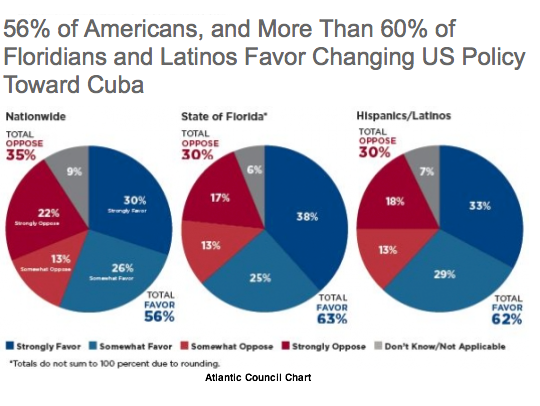
At least Obama is making the effort now.  While the Republicans and the Far Right (among them the exile hard-liners) will scream bloody murder about this, nearly every other player involved - our allies, local nations, a majority of Americans a lot of whom weren't even alive when the Cold War ended - will see this as a good thing.
via Huffington Post


And with luck, Disney will be smart enough to keep the 1950s Art Deco retro look when they turn all of Havana into an Epcot Center.

(caveat: I am writing this from Florida.  Any Floridian will tell you: Do Not F-CK with Disney.  They're like Hyman Roth, only with better PR.  If they wanna turn all of Havana into an Epcot, nothing's gonna stop them)

Monday, September 09, 2013

How To Cut a Gordian Knot

Ever hear of Lateral Thinking?  It's a problem-solving method of using non-conventional or unorthodox means to solve an otherwise intractable problem.  Where logic fails, you apply some illogical method that most people wouldn't see coming.

An example would be the legend of Alexander the Great confronting the problem of the Gordian Knot.  Where most everyone else tried to physically untie the knot, Alexander cut it with his sword.  It may seem like cheating, but it wasn't against the rules.  It symbolized how Alexander would conquer Persia/Middle East with the sword.

A modern-day Gordian Knot is the whole Middle East itself: war-ravaged, divided, tribalistic... if there's been a solution to stopping the ongoing violence that has plagued the region since, well, ever, no one's found it yet.

Part of the problem is that each region has its own internal issues that forces external politics to react disproportionately... and reverberates against every other problematic nation within shouting (or shooting) distance.  You've got 20 Gordian Knots adding up to one big Knot... and there's not a big enough sword to cut them all, not all at once.

For the United States, tied into the Middle East due to our alliances to various nations in the region (Israel, Saudi Arabia, Egypt, Libya) - and our opposition to other nations such as Iran and Syria - we're coping with the disastrous civil war in Syria by trying to enforce the unenforceable.  Syria is one of the nations with a sizable chemical weapons stockpile, and there's been recent usage of chemical weapons that's killing/wounding hundreds of civilians caught in the cross-fire of the civil war.  Obama tried earlier to push a "red line" stance on the use of chemicals... but now that they've been used, Obama's finding himself in almost no position to enforce it.

The standard response to what's happened in Syria is a "surgical" or tactical strike against key Syrian government targets, usually buildings that we plan to have as few people in them as possible when the missiles/bombs hit.  However, this most likely won't discourage Assad or his allies: it may actually make them react in the worst way.

Troubling Obama is the fact that this time the United States doesn't have many allies lining up to back any such strike.  The British Parliament voted against it.  NATO (outside of France, who will only provide political cover and not much else) is reportedly not in favor either.  There hasn't been an attempt to take this to the UN for a resolution, since the odds are Russia (Syria's biggest ally) and China will not play along.  It's gotten to where the only way Obama can get any political cover for striking Syria is by taking this to Congress to get a vote on a "limited military action", which he's kinda supposed to do under the War Powers Act but is something most Presidents haven't done in what seems like ages (or at least since the first Persian Gulf War in 1991).

Worst of all: most Americans do not want to get involved in Syria.  And it's not just the Far Right population opposing Obama's stance on Syria simply on principle (of hating Obama).  And even in the face of the growing humanitarian disaster that is the refugee crisis.  We've been burned out by 10-plus years of unending wars in Afghanistan and Iraq.  Getting lied to by Cheney and Bush the Lesser about Saddam's WMDs is affecting the national mood.  If Congress votes No on Syria - and after my earlier contention that Congress might go along, there's signs now that the Far Right might not give Obama this - Obama will have no political cover to push for a strike.  He could still order it - the War Powers has yet to be constitutionally upheld, and it's in a grey area at best - but Obama would be held responsible on both the national and international stage for ignoring the people he's supposed to represent... and would be violating national laws he's supposed to uphold.

This is where Obama would be looking for a third option... an alternative solution to cut the Gordian Knot he's just tied himself into.

Who would have thought it would be diplomacy and NOT the sword that might actually solve the problem?

Secretary of State Kerry seemingly threw out there during a meeting with the UK Foreign Office the possibility that if Russia could talk Syria into giving up control of their chemical weapon stockpiles to international observers (UN most likely), it might resolve the issue and make a military strike moot.

When the State Department tried to talk back Kerry's statements, making it look like an off-the-record "gaffe" (wink wink), Russia's Foreign Minister quickly responded with favorable language, and Syria's foreign minister joined in.  This is kinda how Hollywood works when movie blockbusters have to be ironed out between supersized egos, I've been told.

If it turns into something that can get worked out between the key parties, the whole matter of chemical warfare - one of the Big No-Nos of fighting - could be taken out of the equation.

It won't resolve the civil war itself: Assad is fighting for his life, with his minority ethnic clan struggling alongside him, against a nationwide uprising against his family's brutal decades-long rule.  It will, however, get Obama and the United States out of a nasty political nightmare and give the major powers involved - Russia, US, France, Britain, Turkey and Iran - some room to maneuver regarding the Syrian disaster.

And who knows?  This diplomacy thing might catch on across the rest of the Middle East.  Trick is, of course, to make sure the goddamn killing stops first...