Sunday, January 13, 2013

Presidential Character: Week Two, Always Second

Abigail Adams: I never asked for more. After all, I am Mrs. John Adams and that's quite enough for one lifetime.
John Adams: Is it, Abby?
Abigail: Well, think of it, John, to be married to the man who is always the first in line to be hanged!
 -- from the movie 1776.

In all other respects, John Adams - one of the major players in the ground-breaking uprising that formed the United States of America - was second in line for everything else.  To say that this made him a personally bitter man isn't entirely right: he was pretty grumpy and stubborn to begin with.

Adams was one of the major independence leaders in New England... except that he was overshadowed by his more passionate cousin Sam Adams (yeah, the beer guy).  He was one of the workers on the Declaration of Independence, the key document in American History and our nation's most sacred secular parchment... except that Thomas Jefferson was the major drafter and provided more of the literary flourish that makes the Declaration so memorable.  Adams was one of two major ambassadors to France trying to secure financial aid and military support from France... the other guy was Benjamin Freakin' Franklin, who wooed and wined his way into Frenchmen (and women's) hearts.

And of course, when it came time to vote for our nation's first executive under the Constitution... well, John Adams had to know in his heart that George Washington was the go-to guy there.  The only consolation Adams had to have was the knowledge that he'd qualify for President once Washington retired for good.

But by then the American political landscape had shifted: while the Founders attempted to create a non-partisan form of federal government, it couldn't last.  People naturally gravitated towards like-minded groups, and quickly two parties formed: The Federalists and the Republican-Democrats (aka the modern Democratic Party).  They formed along domestic, foreign, economic, and geographic lines.  And they formed around two natural leaders: Democrats (States' rights, France-leaning, agrarian anti-bank) swarmed to Thomas Jefferson; Federalists (Strong central government, British-leaning, business pro-bank) swarmed to... Alexander Hamilton.  Once again, Adams was second-place.  And while Adams got to be President, Hamilton was used to the idea of being the power-broker behind the scenes (his role during Washington's tenure).  This meant Adams and Hamilton - both ambitious men - were quickly at odds.

As a President - as a person - Adams is a textbook example of an Active-Negative.  The one word comparative is Compulsive: A-Ns are stubborn and uncompromising, ambitious, hard-working but derive no pleasure or feeling of success, suffers from low self-esteem, and a problem with anger management.

An Active-Negative could be a problem as President - especially on the uncompromising part - but you can agree that at least things get done.  A-Ns come in with an agenda or an ideology and gets right to work on it,  that quickly defines the administration and the nation.  It also creates a ton of political conflict, which shakes up the discourse for both good and ill (sad to say, usually "ill" due to hurt egos and unintended consequences).

Adams' administration was contentious where Washington's more... placid, stable.  It didn't help that Adams had decided - out of deference to his predecessor - to keep Washington's second term Cabinet intact.  It hampered Adams' abilities to get things done his way because the Cabinet were composed of men who preferred answering to Hamilton, who indulged in behind-the-scenes meddling to Adams' ever-growing ire.  And it didn't help that in that age, the Vice President was elected separate from the President: Veeps were the guys who won second place in the Presidential election, which at the time was Thomas Jefferson (this was one of two times in American history the President and Vice President were from different political parties, well three if you count that SOB Tyler).  Jefferson was nowhere near interested in helping his ex-friend (they broke their friendship over the French uprising) out against fellow rival Hamilton (the enemy of my enemy... in this case was still an enemy).

Of Adams' administration, there was one dominant matter: how America should respond to the European conflict between Revolutionary France and Great Britain (alongside other fearful monarchies).   By the time Adams entered office, the French Revolution had concluded its Reign of Terror and had reverted back to an uneven (and corrupt) Directory coping with wars and inflationary economics.  France was winning the ground war but was heating up their foreign adventures at sea, creating issues with the United States trying to ply trade across the Atlantic and Caribbean.

Adams sent diplomatic agents to France to discuss an amicable solution that didn't involve dragging the U.S. into a war it couldn't afford.  By 1798 Adams' agents replied back that they were approached by three French officials known only as X Y and Z and told to offer up a huge bribe just to even get one meeting with the French foreign minister Talleyrand.  The Americans refused, informed Adams what happened, and two of them returned home.  Adams then called on Congress to begin war preparations, but withheld the scandalous letters.  When the Democrats in Congress balked, Adams revealed the XYZ Affair to the public.  The cry was immediate: "Millions for defense, not one cent for tribute!"

Adams's Active nature kicked into gear.  He called on Washington to return and serve as Commander-in-Chief of any organized army Congress would muster (Washington was in no shape to lead: Adams begrudgingly allowed Washington to organize with Hamilton as second-in-command).  He formed a new Cabinet post for a Secretary of the Navy (separate from the Secretary of War (Army)) and ordered the first true U.S. naval fleet to be built (the famous ships of the Barbary Pirate Wars and the War of 1812). 

But there was also Adams' Negative nature.  He knew the United States was still too financially weak to endure a prolonged war against France.  He feared getting involved between Great Britain (resolved issues with the Jay Treaty, which was one reason France was angry at the United States) and France would stir up the populus into a civil war of sorts between Anglophile and Francophile.  His active nature combined with his negative fears to make another attempt at brokering a deal with France.  (Most A-Ns are reluctant to start wars, as they're usually smart enough to know wars don't end well and fearful enough of failing)  He re-sent diplomats to France who this time were received warmly by Talleyrand who publicly admitted he had sent the XYZ agents as a form of apology.  They were able to hammer out a deal that ended the Quasi-War efforts in the United States.

And this is where Adams' uncompromising A-N habits became his downfall: his resumption of peace talks while the public - especially the Federalists like Hamilton who fancied himself the next great American war hero - were stirred up into war passions caused a break among the Federalist party leaders.  They were eager for a war that Adams didn't want.  Losing his party leadership would hurt Adams' chances for re-election in 1800.

It didn't help that during the Quasi-War period that Congress passed with a Federalist majority the Alien and Sedition Acts.  The nation's first anti-foreigner law that gave government the power to expel unwanted immigrants or travelers to our shores: this was the Federalist response against French emigre agitators.  It was also the first censorship law that allowed government to arrest and jail anyone who spoke against the federal government: this was the Federalist response against the Republican-Democratic newspaper publishers railing against Federalist majority rule.

Adams may not have started those Acts but he did sign them into law, and he and the Federalists did profit from them.  This is the other big worry about A-N Presidents: they don't like criticism very much.  Their uncompromising, angry world-view (best described as "My way or the highway") make them the most likely among Presidents to subvert into dictatorial rule.  Other A-Ns during wartime or political strife show the same disregard for dissent (Wilson, Nixon, Cheney).

The Federalists didn't go completely overboard enforcing the Alien Sedition Acts: to be fair, compared to the Reign of Terror and other purges, this was the meekest with only 25 arrests and 10 convictions (Stalin would consider that a coffee break).  And there's no evidence that Adams personally oversaw or ordered any persecutions.  But like all repressive acts it backfired on Adams and his party: the Republican-Democrats were able to rally against the Acts and make huge wins in the 1800 election.  Combined with Adams' losing his party's support, he fell in his re-election bid to his rival Jefferson.  Worst of all, the Democratic reaction to the Alien and Sedition Acts were to lay the foundations to two ideas destructive to the concept of federalism: state nullification - when Jefferson and James Madison wrote the Kentucky and Virginia Resolutions - and secession.  Even though such arguments have been shot down - nullification in the Peters case, secession through the American Civil War and Texas v. White - we're stuck with the damn things even today...

From David and Robin Whitney's American Presidents (8th ed.), one of the sources I'm using, a final summary:
He tried to do what he believed was right for his country, rather than what was politically expedient.  His blunt frankness sometimes lost him friends, but he was respected for his honesty even by his political enemies... (p. 18)

Adams' legacy in the end wasn't much except in one regard and he does get a first: he presided over the first relative peaceful transition of the Presidency from one political party to another. And like some A-Ns, his administration's legacies got the benefit of hindsight showing where his caution about war proved the most sensible.

Friday, January 11, 2013

Here's a First: a Poll

It's probably a bit messy but we'll see how it works...

Update (1/13/13): Noooooo.  The Treasury, White House, and Federal Reserve spokespeople have all said they won't use the Platinum Coin to pay off the debt if Congress remains insane.  Defeats the whole purpose of a poll.  Sniff... I can't ever have the fun toys...

What image should be on the face of the $1 Trillion Platinum Coin?
Just remember kids, the rules on coinage is that it can't be a currently living President, so all those mock-ups with Obama's face on the front, you're doing it wrong kiddo...

Thursday, January 10, 2013

My Two Cents On The Platinum Coin (Yeah, I Went There)

With the Fiscal Cliff no longer an issue, the next scheduled disaster from our elected leaders is apparently yet another Debt Ceiling vote needed to ensure the Federal government can pay out those Medicare checks, military pay, and basically keeping the street lights on.

There's a good argument to be made that we don't even NEED a Debt Ceiling vote, the whole thing can be done through other budgetary bills and never be an issue: but sad to say the powers that be in Congress don't want to give up their ability to be bratty monsters to their fellow Americans, and also they've realized they can use this man-made disaster to wriggle out some twisted deals making the rest of us suffer in the process.

Considering how broken the system is, we've got a ton of people thinking outside of the box, using some lateral thinking.  And one idea that's come up - it actually started brewing last year when the government shutdown over the last Debt Ceiling vote happened - is the fact that under current law the Treasury Department can cast a platinum coin, give it any value they deem fit, and then use that coin as revenue to be spent however the government needs.  The actual value of platinum as a metal isn't at stake - this is called Seigniorage - all that matters is what value the Treasury Secretary can put on that coin.  As a result, the Secretary could stamp it as a One-Trillion-Dollar (that's 1,000,000,000,000.00 if you wanna count out the zeroes) Coin and that coin, probably no bigger than an Eisenhower Silver Dollar, will be worth that one trillion.

A law originally designed to allow the government to make and sell commemorative coins to a collectibles industry to turn a modest profit could be used to tell Congress to go screw itself over the Debt Ceiling nonsense:

As former Congressman and author of the original bill Mike Castle told Dylan Matthews of the Washington Post, the intent was to use the government's seigniorage power to very modestly reduce the deficit. Seigniorage is the delightfully literal concept of making money by making money. It's the difference between the cost of creating currency, and the value you assign to that currency -- in other words, the "profit" governments get from minting money. The trillion-dollar coin is seigniorage just like commemorative coins are seigniorage -- well, except that the trillion-dollar coin is a whole, whole lot more of it. Even if you don't find this terribly convincing, it doesn't really matter. The plain text of the law, not its intent, is what matters. And that means the trillion-dollar coin is almost certainly legal.
To be fair, our debt obligations aren't as high as one trillion: it's roughly about 52 billion.  A more modest plan would be to mint more than 52 platinum coins at One-Billion each and save the One-Trillion coinage for a more special occasion.

That persons among the Obama administration are talking seriously about this of course has the Far Right in an tizzy.  Most of them don't even realize the concept of seigniorage and are trying to mock the Platinum Coin proponents by thinking one trillion worth of platinum has to be cast for the world's largest coin.  The truth is much simpler: the coin can be the size of a DIME (our smallest coinage) and as long it's made out of platinum it can get valued however high it can, meaning it CAN be a One-Trillion Coin.

This may look on its face like a silly solution.  But the reason we're even thinking of this as a legitimate possibility is due to the fact that Congress is broken.  Full-on partisanship rules the floor, and the House Republicans have convinced themselves to never retreat on any issue that would give Obama a good day.  Especially if they can use their hostage-taking on the Debt Ceiling vote to force harsh social spending cuts on the Democrats.  There is no reason to believe that the House GOP will negotiate in good faith to resolve the matter, and we'll be facing yet another showdown just like in 2011 that crimped the nation's bond rating and caused enough financial chaos to choke a bull.

To consider Matthew O'Brien's thoughts:

As my colleague Derek Thompson explains, a world without a debt limit increase is a world where the government has to stop paying 40 percent of its bills overnight. Everything from food stamps to defense spending to maybe even Social Security benefits would go unpaid. Now, Congress would presumably relent after a few weeks of this, but if it didn't, the economic damage would be mind-blowing...
And that brings us to the trillion dollar coin. If you haven't heard, there's a law that technically lets the Treasury mint platinum, and only platinum, coins in whatever denomination it chooses. It's legal, it's doubtful anybody would have standing to challenge it in court, and it would let us keep paying our bills, without setting off massive inflation, if the debt ceiling isn't raised. But as Ross Douthat and Ezra Klein point out, the politics of it are toxic. It sounds crazy, and it would look like a crazy power grab, all of which would empower the very Republicans pushing us towards a possible default. Risking complete catastrophe is worth it if it will break the swamp fever according to this logic. That very well could be true if we were talking about a run-of-the-mill catastrophe, but it falls apart when we're talking about a debt default. The financial fallout and increase in our long-term borrowing costs are much too high a price to pay for discrediting the default caucus. Here's the way out. If Congress doesn't lift the debt ceiling in time, Treasury should prioritize payments while Obama and Republicans negotiate an increase. But if a day ever comes when incoming revenues won't meet interest payments, Treasury should mint a platinum coin to cover the difference. As Steve Waldman argued, use a billion dollar instead of a trillion dollar coin -- and only as a last resort to avoid irrevocable damage.
The full faith and credit is worth a platinum coin.
 
Personally, I kinda find this One-Trillion Coin idea amusing, a creative solution to a bankrupt problem.  But I'm kinda also with O'Brien here: I don't think we should be jumping straight at the platinum coin as the immediate solution.  The real problem is that we've got a Republican base pushing for a default (remember Grover Norquist, kids?  He wants to drown your government in his bathtub) no matter the hazards.  Going to the coin solution isn't going to solve the way Congress does business.  Congress needs serious fixing, especially considering how much of a sick joke the Debt Ceiling really is.
 
Get rid of the Debt Ceiling.  That's the real solution.  The pity of it is, that also takes real political courage right now, and NO ONE has that.

Saturday, January 05, 2013

Presidential Character: Week One, Guess Who

I threatened you all with pursuing a weekly write-up on Presidents regarding their Character traits as defined by David James Barber: the Active-Positive, the Active-Negative, the Passive-Positive, the Passive-Negative.

When one works a list of U.S. Presidents, one has to start (depending on the topic) with the first: George Washington.
Note: Okay, there were Presidents of the Congress before the Constitution was ratified, but dude they don't really count.  Sorry, John Hansen...

Washington's character has been classified as Passive-Negative: basically, the defining trait is Withdrawn, an oddly unambitious leader in an ambitious office who answers to a sense of duty/obligation, does not seek conflict or political gaming, and has an open aversion to politics.  This type only becomes President because it was expected of them, either from their friends or from the nation at large.  And it Washington's case, it was expected of him by practically everyone: the entire model of the Presidency as designed by the Constitution's founders was based entirely on his role as both military commander and as presiding officer of the Constitutional Convention.  If he had said "no" to being the first federal President, the whole deal would have collapsed, the young nation would have died on the vine, and he knew it.

It's not to say that P-Ns don't want to be leaders: Washington for example pursued a military career for both good and ill.  But that was about the limits of his ambition.  He loathed political deal-making, had to be pushed into making certain decisions.  His primary aide, Treasury Secretary Alexander Hamilton, had to talk Washington into a second term convincing his former general that the United States needed four more years of his leadership to stabilize.

Why did Washington succeed (he's routinely listed in the Top Three Ever) as a Passive-Negative?  Two reasons: he was above all a patriot who did what he thought best for the nation; and because oddly enough the nation needed him to be unambitious and self-limiting.

Washington is unique among Presidents because he came to power before partisan party formation.  The original intent of the founders was to create a party-free political environment (which they saw as hindering their electoral model, the British Parliament), but parties still formed around key issues - finance vs. farming, foreign intrigue especially France vs. England - and key political figures such as Hamilton (Federalist) and Thomas Jefferson (Republican Democrat, which evolved to just Democrat).  Washington's advantage was that - being above party - he thought first and foremost of the nation as a whole, and as such worked towards a recognized consensus between the growing factions and an awareness of how the nation was truly doing.

The best example of that was how Washington handled the European continental crisis of the French Revolution.  Due to France's bankrupting itself to finance the American Revolution, and due to the example of the American colonies rebelling against the British king, France devolved into its own revolution and an overthrow of their king Louis XVI.  Passions on the issue ran high.  When Republic France fell into war against Britain and Spain, France sent a minister (ambassador) Genet to the United States to drum up support.

Passions on the issue were running high in America: half the nation openly supported another republican uprising especially with it being our recent French allies.  But Washington took a good long review of the situation and noted the United States was still too young and unbalanced as a nation to get involved with an overseas conflict. The nation's finances were still a mess from the revolutionary era, the logistics of an overseas fight overwhelming, and the nation's best course at that moment was to get on good terms with as many European powers as possible, which actually meant getting on good terms with our recent opponents the Brits.  Despite the pressures to come to the side of the nation that backed us in independence, Washington had to think of his nation's needs first.  Washington issued a neutrality order, claiming the United States would not get involved in the war between Britain/Spain and France.

Genet ignored Washington's neutrality order and organized militias to attack Spanish-held Florida and privateer ships to raid British ships and Caribbean ports.  Washington didn't faze Genet in the least: after all, he found thousands of Americans eagerly signing up to help his cause.  But then Genet made the mistake of lying to Washington about the privateering when he met the President about getting the neutrality order revoked.  When caught in that lie, even Genet's ally Jefferson abandoned him, Washington openly issued a letter reprimanding Genet, and the French government was publicly embarrassed. It didn't help Genet much when the French republican leaders fell to the more radical Jacobians and the Reign of Terror started: when the Jacobians recalled Genet, he begged Washington for asylum... and received it.

The second thing that Washington did - being unambitious and self-limiting - is easier to see because a lot of what the Presidency is all about today is still based on the precedents Washington set.  The Constitution may spell out the specific things a President may do (Article II), but in practice no one really knew what a President COULD do... until Washington himself did them.

Article II may have a provision for "principal officers in executive departments" but no one knew what such a person could be.  Washington named his advisors as Secretary of particular offices - State, Treasury, War, and Attorney General - and defined the scope of each position's duties and authorities under the Executive office.  He made sure to make the appointments go through the Senate as established by the Advice and Consent clause in Article II.

One thing Washington did not do was impose himself much on the Congress: he fervently believed in the separation of powers between the Legislature and Executive.  He rarely exercised his veto power although he was still the first to use it, and used it in a way to get Congress to revise that bill to a more bipartisan form, setting that precedent of veto power.  He reportedly only tried once to impose himself on Congress when trying to get a treaty with a Native tribe passed, by showing up in person.  The Senators present felt intimidated, insisted on more time with the treaty, and Washington stormed out, his hatred of politicking fully confirmed.

This was where the benefits of being a Passive president by nature helped the nation.  A more Active president in office - say, John Adams or Thomas Jefferson, or even Alexander Hamilton (yes, he could have served if not for his scandalous behavior) - may have ignored many of the checks and separations of power in the Constitution, could have weakened the Legislature and/or Judiciary branches, and could have turned the Presidency into a Dictatorship.  Adams' and Jefferson's own Presidencies showed hints of that, if not for Washington's setting of precedence limiting their future roles.


Will a Cat Picture on Caturday Suffice?


Tuesday, January 01, 2013

A Follow-Up About Utopianism (Apparently That Is a Word Now)

I wrote awhile back about my disdain for libertarianism - and isms in general - due to my studies of utopian literature my freshman college year.

Now here I see in Salon.com that contributor Michael Lind shares the same disdain for utopian thought, and how he sees the current Far Right as unhinged as the Far Left of the 60s-70s were:


In that environment, what attracted me in my college years to conservatism was its hostility to utopianism, to the attempt to remake society according to some abstract theory. This was a theme shared by the older generation of “vital center” liberals like Arthur Schlesinger and Daniel Patrick Moynihan, as well as conservatives like Bill Buckley. Their distrust of doctrinaires using power to achieve utopia on earth was inspired not just by thinkers like Edmund Burke but even more by the examples of Hitler’s genocidal racist utopia and the mass murders and famines that accompanied Stalin’s and Mao’s attempts to use terror to remake society. The vital-center liberals (some of whom became early neoconservatives) disagreed with those further to the right, the “paleoconservatives,” over whether Franklin Roosevelt’s New Deal and Lyndon Johnson’s Great Society were examples of sensible reform to save the system, as the paleoliberals/ neoconservatives believed, or mild versions of collectivist utopian madness, the view of many traditional conservatives...
By the 1990s, the communist movement had collapsed as a global secular religion, even though a few relic communist tyrannies survived in China, Vietnam, North Korea and Cuba. The few remaining Marxist radicals in the Western world were mostly English professors hunting for classism and imperialism in the novels of Jane Austen. Nature abhors a vacuum, and as utopianism died out on the left, it found a new home to the right of center. The last generation in the U.S. has seen three forms of demented right-wing utopianism: religious, military and economic.
The religious utopianism was that of the Protestant religious right, which grew in influence in the 1980s and peaked in the 1990s... The religious right faded as a force by the early 21st century, largely because of the growing secularization of younger Americans. The next wave of utopianism was military. The older generation of neoconservatives had been New Deal liberals who had grown cautious and skeptical about the ability of public policy to remake American society. In contrast, the younger generation of neoconservatives — some of them literal heirs of the older generation, such as Irving Kristol’s son William Kristol — were wildly optimistic about the ability of the American military to remake foreign societies. Their utopian project of a “new American century” and a “global democratic revolution” exported by force of arms collided with reality in Iraq and Afghanistan in the first decade of the century... As the neoconservative utopia faded, it was followed in turn by the libertarian utopia... Ron Paul went from being a marginal figure to a folk hero for young people in search of gurus, and the works of mid-20th-century prophets of the free market like Ayn Rand and Friedrich von Hayek enjoyed a revival. The libertarian utopia peaked in 2010, around the same time as the Tea Party movement, which helped the Republicans to regain the House of Representatives. To judge by the elections of 2012, in which more Americans cast votes for Democrats for the gerrymandered House as well as in Senate and presidential elections, the public has turned against free market utopians like Paul Ryan...

It's rare for me to double-post in a day, but see Lind's article reminded me of what I wrote, and I enjoy the justification of a shared viewpoint.  ;-)

It's a New Year. I Need Resolutions.

I hereby resolve for this year of Common Era Two Thousand and Thirteen that I will do everything in my power to increase traffic to this blog site.

Shouldn't be too hard.  I've finally paid notice to the statistical trends on my blog and found out that my most popular entry has been the Iran Day Six article.  And that was because it had pictures that came up in search engines under "funny" "Iran" "pictures".

Shouldn't be too hard to do that, either.  I got a bunch of captioned photos already on my I Can Has account:
funny iran military pictures


also
funny pictures middle east
also wik
funny Iran pictures


Gonna have to make more of them by hand, though.  I Can Has website dumped their political funny caption maker.  Sigh...

Another way I can uptick the blog traffic is to do a regular series of articles.  I'm thinking of writing up entries on Presidential Character - the personality tracker developed by James David Barber - much like I did pointing out what Character a President Romney could have been.  It'll be tricky coming up with Character profiles for a lot of the One-Termers of the 19th Century... but I'm damn sure Millard Fillmore is gonna be a doozy when I get some research on him done!

Also, my other New Year's resolution: get some writing done and e-published!

See ya.

Monday, December 31, 2012

The Year In Review of Funny Pictures

I mess about on ICanHasCheezburger, okay?


These are the best ones I made for 2012.

Some were political.

Some were funny.

Some were inspired.

And of course, the best one I made all year:
Bwhahaha.

See you all in 2013!  I gots more planned then.


Thursday, December 27, 2012

What Romney Didn't Want: A View Into Presidential Character

I've wanted to write for a long time about the Presidential Character.  And the recent revelations about Mitt Romney's failed 2012 campaign is a good time to do it.

When I'm talking Presidential Character, I'm looking at the definitions created by political scientist James David Barber who developed the four types of Character based on Active/Passive and Positive/Negative traits: Active-Positive, Active-Negative, Passive-Positive, and Passive-Negative.

As a good example, look to the first four Presidents:
George Washington was, believe it or not, Passive-Negative.  P-Ns only become Presidents because of a sense of duty, not any desire for the office.  They're wary of executive power, and not thrilled with political negotiating.
John Adams was Active-Negative.  A-Ns are aggressive, uncompromising, unhappy both personally and professionally, but do relish a good amount of executive authority and do seek accomplishments to fulfill.
Thomas Jefferson was Active-Positive.  Optimistic, forward-thinking, capable of overreach, reveling in the ceremonial aspects of the Presidency, A-Ps are just as aggressive as A-Ns but more capable of compromise and reaching goals.
James Madison was Passive-Positive.  P-Ps are optimistic and friendly, but unfocused, more akin to being a caretaker letting the People's Business do its own thing.  Things can happen during their tenure but more often the Passive-Positive President is not leading the charge.

There is no bad precedent: Negative or Passive are not bad traits per se.  It all depends on the timing:  Washington was perfect as a Passive-Negative because as the first President under the Constitution it was up to him to define the limits and powers of the office.  By being that self-controlling, he stabilized government and gave it time to settle down.  An Active-Positive at that time could have led to chaos and constant in-fighting against the Congress: an Active-Negative could have made himself dictator out frustration.  On the other hand, Madison as Passive-Positive happened at a bad time: the War of 1812 happened under his watch, something an Active-Negative could have avoided, or an Active-Positive could have managed to greater success.  Passive-Positives could be successful during tenures of great upheaval: sometimes through luck, but most times because such passivity actually makes them flexible and capable of making sound deals with Congress or foreign nations. To that, look at Ronald Reagan: He campaigned as a radical anti-government conservative but in office his P-P nature made him amenable to government's effectiveness, which lead him to revoke his anti-tax stances and eventually pursue ground-breaking treaties with the Soviet Union.

That said, Active-Negatives tend to be very bad for the nation over the long haul: SEE Hoover, Herbert; Johnson, Lyndon B.; Nixon, Richard; Cheney, Dick (I would contend that Dubya himself was a Passive-Positive, allowing an Active-Negative like his Veep Cheney far too much power in his administration).

So what does this all have to do with Mitt Romney, the Man Who Will Never Be President?

Because his circle of insiders - his son Tagg, for example - are now claiming after his 2012 election debacle that Mitt Romney never wanted to be President anyway.

At first glance this looks, walks, and quacks like a case of Sour Grapes: he lost something of "value", so now they're claiming he never wanted it.  But the more you look at it, the more you see how this can fit into the Presidential Character grid that Barber devised.

I wanted to write about Romney's character - or lack of one - a few months back when I wanted to discuss this Presidential Character idea then.  I wanted to point out that Romney's constant flip-flopping on the issues made it impossible to determine just where on the charts he fit.  But then I realized he had a constant - his ever-fixed mark of the massive tax cut - and realized Mitt fit on the chart after all.

Mitt Romney, if he had won the Presidency, was going to be a Passive-Negative.

To refer back to Charles Pierce's Esquire article:

Willard Romney didn't want to be president. Willard Romney expected to be president, and that was his real undoing...
It has been years, probably, since Willard had to go to all the emotional fuss and bother of actually wanting something. If there was something that caught his eye -- a slow-moving company's fat pension fund, a nice house in La Jolla, the governor's office in Massachusetts -- there would be a deal to be struck and whatever it was that should be his would be his. This is not a man who tolerates disappointment well, not because he burns with ambition and avarice -- although he profited for years from very effective simulacrums of ambition and avarice --but, rather, because he rarely has experienced disappointment in his life. He does not want. He expects.

That fits the P-N psyche pretty well.  Passive-Negatives run out of a sense of duty or obligation.  For Romney, it has to do with the legacy of being George Romney's son: his father was an active political figure, running for all the right reasons (George Romney fit well to the Active-Positive if only he had bested Nixon in 1968).  It has to do with Romney being a major political figure within the Mormon church, an Americanized religious off-shoot of Christianity still looking for a President to validate the church's success.

The big difference keeping Mitt from qualifying for Active-Negative was all of Mitt's flip-flopping.  A-Ns, if anything, do have a core set of values outside of political ambitions: even Nixon for all his paranoia and loathing had his limits.  Romney's lack of core values - he honestly did not care one whit about abortion, or war, or poverty, or employment, or governance, or people in general - made him oh so very Passive in that regard.
 
(And at least Passive-Positives are well-liked.  Passive-Negatives?  Unless you're George Washington or Ike, who both earned respect enough to be liked, you're sh-t out of luck).

And what would that have meant?

Think George W. Bush's passive nature in office: he kow-towed to the "experts" in his administration, especially Cheney who quickly pushed his own secret agendas on the nation's energy policies, the nation's economic policies, and then the nation's war policies when 9/11 happened.  But at least against that, Dubya still had some semblance of leadership: he showed pragmatic concern for the GOP to pursue a moderate immigration policy (the Far Right refused), and he pushed for tolerance for Muslims and other faiths at a time the neocon's obsession with waging holy war in the Middle East led to a lot of bad feelings among the Far Right.  And at least during his first two years, before Cheney sunk his hooks further in, Dubya allowed more sensible figures in his Cabinet (Powell at State, O'Neill at Treasury) to craft policy.  Look to Powell's (and Condi Rice's) handling of the Spy Plane incident with China.

Mitt Romney would have filled his administration with the pushiest, meanest set of political hacks - hello, neocons - that dotted the edges of the Dubya administration.  He would have had to: the Far Right in the Republican Party would have insisted on their due, and Romney would accept it because Romney wouldn't have cared who was in charge at State or Defense or anywhere else in his Cabinet.

The Character of any President matters based on the times we as a nation are in.  We are still mired (2012) in a jobless recession requiring serious government intervention and jobs stimulus.  We are still mired in one ground war - Afghanistan - and still trying to clean up the messes of the other - Iraq - while at the same time juggling the political instability of the entire Middle East.  We're in the times where an Active-Positive President would be the most value.  Even an Active-Negative (as long as the Negativity was channeled elsewhere, say, resolving the professional hockey lockout) wouldn't be that damaging.  But a Passive-Negative?

Mitt Romney would have wrecked the United States.

In a way, it's a good thing Mitt really didn't want the Presidency.  He could have ended up being the first President to have been successfully impeached out of office (Nixon resigned, and both Andrew Johnson and Bill Clinton stayed in office).

P.S.  That said, how does Barack Obama rate on Presidential Character?

He fits the Active-Positive chart: the reason he lacks more success in an era that needs an A-P President is due to an obstructive Congress.

In the meantime, I seriously recommend James David Barber's text Presidental Character: Predicting Performance In the White House (4th Ed), 2008, ISBN 978-0205652594.
 

Tuesday, December 25, 2012

Io Saturnalia!

Tis the season to remember your Latin!  ...which means that I should write that as Satvrnalia: no U in the alphabet, and I am already substituting the I for J for the Jo part of Io Satvrnalia.  (label/tag will remain with the U because, well, modern Intertube traditions and all that).

This video is but a tourist-y Disney-fied version of Satvrnalia of course (the Romans were a bit more into the, ah, festive parts of festivities), but it's as best a representation of the holidays I can find.

So find a fellow Pagan and together tell Bill O'Reilly to STOP his War on Satvrnalia!  Io!  Io Satvrnalia!

Monday, December 24, 2012

How Went the Year 2012?

Well:

1) I'm still looking for full-time employment.  I have a contractual will-call job at least, which keeps me active and up-to-speed with the technological needs of my information-based profession.  I did get about six different libraries interviewing me - two of them with follow-up interviews! - which is a vast improvement to the number of interviews I had in 2011 (one) and 2010 (one).  And I still have an interview scheduled for this Friday, with one of the libraries that interviewed me with a follow-up, so I'm hopefully in good standing with them (fingers crossed for luck).

2) My guy got elected to President.  The Far Right's attempts to paint Obama as a "failure" and a "disaster" went nowhere.  And the one place at the federal level where the Far Right still holds any power - an unbalanced U.S. House - is one vote away from falling into chaos.

3) A lot of great genre movies - The Avengers, Dark Knight Rises, Wreck-It Ralph, Brave, Skyfall - this season.  I'd love to see all of them nominated like crazy for the Oscars this year... but noooooooo, it's all gonna be Lincoln and Zero Dark Thirty instead.  Sigh.

4) Too many shootings.  And even now, there's reports that someone shot at firefighters responding to a New York state neighborhood fire with two firemen dead and two others wounded.

5) The Mayans did not doom us.  Which is kinda okay, because the real Mayans never wanted the apocalypse anyway: it was some crank Eurowhite guy trying to sell his books.

6) Breitbart's legacy - a website smear machine - is going through some rather public splits right about now.  Schadenfreude, thou art pretty tasty during the holidays...

How was the year for you?

Friday, December 21, 2012

Apocalypse Why

It's just to note that today is WELL PLAYED MAYANS DAY we've been worried about since, oh, the Mayans forgot to make a follow-up long form calendar for the one expiring today.

Personally, I only found out about today back when I was a huge fan of The X-Files (aka a Philer, and a 'Shipper to boot), when the Mayan Calendar date was a plot point to the series finale.  But before that I've borne witness to such end-times embarrassments as Y2K, Harmonic Convergence, the Jupiter Effect, and the Tampa Bay Bucs winning a Super Bowl.  Not to mention a constant stream of predicted Raptures and Armageddons by various religious leaders screeching about War, Plague, Anti-Christs and hangers-on.

Just to note, before I go any further, I do not blame Mayans (and yes, they are still around) for the hype and hoopla.  This is all from some New-Age crank selling books.  But that comes later...

Look at that end-time embarrassments list regarding Dates Predicted for Apocalyptic Events on Wiki, this is something stretching back to even before Christianity was a gleam in Mother Mary's eye.  And it's not even including the mythology of various pantheons - such as the Norse and their Ragnarok - spelling massive catastrophe for not only humanity but the Gods as well.  This seems to be a hard-wired element of the human psyche: the expectation that at any moment, especially a moment that higher powers decided to create clues for announcing such doom, the world will end.

So, the eternal question: Why?

This is an even bigger question considering the age we live in.  We have enough human history now, enough recorded moments and documented failures of apocalypse - I've lived through (from 1970 to now) what I count to be more than 40 (I gave up around 2006)! - that I'm just sitting here asking "Why are people still buying this sh-t?"

Making it worse is noticing how the SAME NAMES keep cropping up on the list of predictors: David Berg, Harold Camping, Pat Robertson, Ronald Weinland, even a psychic debunker like The Amazing Criswell made an End-Times prediction for FSM's sake.  You would think after getting the FIRST and what was supposed to be ONLY prediction of THE END wrong, nobody would let them come back and make even MORE predictions ("Okay, so last Friday didn't work out, but I guarantee JEBUS is gonna show up at Mardi Gras like three years from now and order some Hurricanes!").

Insert head-desking here.

Why?  Why are these guys still out there?  Why are they still allowed to spew predictions they've already proven they're not good at making?

It's not that I blame the First Amendment, the right they have to say whatever they believe as long as it doesn't incite to riot.  After all, these End-Time predictors are global (Japan, China, Uganda, etc) in places that don't have as much free-speech rights.  And there are a ton of First Amendment users who abide by the common-sense principles of not saying anything stupid that can come back to haunt them later.

What I blame are the con artists who found in religion a near-perfect scam.  Look at how nearly all of these seers of prophecy are religious leaders or spiritualists of some form.  All they gotta do is whip up some frenzy, get the True Believers thinking they and only they are special enough to survive the Wrath of God, and get them involved with money work and more money to get a cozy little life-style going (NOTE: I am not a huge fan of wealthy priests claiming to serve God while owning four-car-garage mansions.  Living the good life while supposedly helping the impoverished reeks of hypocrisy).

Thing is, these "religious leaders" have to give these Believers something to fear: the expiration date.  You gotta give 'em an End Time to actually be worried.  And so they offer up a date, something that fits well into the numerology of faith (the number of years since the birth of the Messiah, the numbers of the Beast, the anniversary of a significant event).  And now, you've got the attention of the faithful who'll make sure to advertise everyone's doom, safe and satisfied that the Good Lord spares the True Believers (SEE Rapture, The; something that caught on in American Christian theology in the 1830s).

And then the day comes and goes, and for some Godforsaken reason none of the True Believers seem to get really p-ssed off.  Oh sure, the "outsiders" aka the People Who Didn't Buy It For One Second may laugh their asses off, but they're not in much of a position to sue for emotional damages or anything.  If anyone's got to be angry at the likes of Ronald Weinland - a "pastor" who predicted TWO different End-Times in 2011 AND 2012, and is still ballsy enough to "amend" his deadline to 2013 now that we're 10 days away from that year - it ought to be the people who bought his Rapture story and got suckered.

Could it be the embarrassment of admitting you got suckered?  Could it be the Belief is strong enough to ignore the doubt of the failed seer?  In a sane world, anyone having predicted an End-Time that does not come about ought to be removed from the stage, mocked for all time, made to refund any moneys made from selling doomsday materials - Books!  Recordings!  Beach towels! - and forced to repair broken-down casino slot machines on Indian reservations as a reminder that the odds are not ever in their favor.

For myself, I've seen enough, read enough to know that the End of the World on a global scale is more in the realm of science, not Faith.  End Times on a personal matter such as a death in the family or that of a friend, that IS Faith, and one that ought to be a guiding point in each of our lives but in our own ways.  My End of the World isn't going to match yours, I know that.

And the question of why that is doesn't bother me at all.  Because in my worldview, God is not going to end the likes of us.  We're too good an audience to God's everyday delights.

And thus endth the sermon.

Tuesday, December 18, 2012

Wrong Kind of Anniversary... Again

It is now four years to the day since I lost my full-time job as a librarian.

I've found some part-time jobs here and there, and I currently have a contractual job with an IT vendor needing desktop support... but it's not a full-time, 40 hours a week, with benefits type of job.

This year (2012) saw a lot more interviews by libraries than I've had since 2008 - six separate libraries interviewing, two of them interviewed me twice - and one can hope that the coming year will see more opportunities and with any luck an actual hire.

But in the meantime... still job-hunting... still trying to get around my writer's block to see about getting something published and marketed... still...

Monday, December 17, 2012

Top Ten Reasons Why The Mayans Are Not Dooming Us Friday 12/21/12

Here, straight from Xunantunich Belize near the center of all things Mayan, is your list of Top Ten Reasons the Mayans Are Not Dooming Us this Friday Dec. 21st, 2012!

10) The Mayans care not about ending the suffering of Detroit Lions/Cleveland Browns/L.A. Clippers/Toronto Maple Leafs/Houston Astros fans any time soon.

9) Mayans had nothing to do with Twinkies (tm) being no more.  Blame that on the corrupt CEOs at Hostess Inc who mismanaged the company into bankruptcy.
from memegenerator.net

8) Mayans are still around.  If they had any sense regarding any prediction of apocalypse, they'd have fled the planet long ago in their ancient rocket ships

7) Misinterpretation of the Mayan calendar.  It's really a recipe sheet for the MOST INCREDIBLE BANANA NUT MUFFINS YOU WILL EVER HAVE IN YOUR LIFE!  ...what?

6) The Mayan calendar's power source has run down, that's all.  We need to replace it with a Baghdad battery.

5) Didn't anyone read the Terms and Conditions agreement in the bottom left-hand corner?  This thing hasn't been valid since Cortes voided the warranty.

4) Planet-destroying Aliens do not go by the Mayan calendar, they go by Stardate.  Duh.

3) The so-called Calendar is really a promotional poster for an ancient Mayan drama about a weather priest forced to live the same sacrificial day over and over and over again.  It was called "Lowland Paca Day"

2) It's just a BLEEPING calendar!  We can get some astronomers and chronal measurement professionals together and make a BLEEPING PC/Mac app for a new Mayan calendar starting on this Saturday!  C'mon people get working on that app!

And the Number One Reason The Mayans Are Not Dooming Us this Friday Dec. 21st, 2012:

1) Disney is making a new Star Wars movie.  Disney will not allow some f-cking catastrophe to end the world before even pre-production is finished.  Even the Mayans know not to f-ck with Disney.  They go after day care centers for God's sake.

(had to write this, because the madness of the other major news story right now is too rage-fueling for me to cope)

Friday, December 14, 2012

What the Second Amendment Has Become: A Death Note On Everybody

Update Below

The Second Amendment has gone from being an 18th century constitutional concern for well-regulated militias to basically a license in the 20th-21st centuries for individuals to go on goddamned shooting sprees.

We had a shooting spree earlier this week in Oregon at a shopping mall, during the busiest time of the year Christmas season (here's your War on Christmas, Mr. O'Reilly), with a gunman using a military-level semiautomatic rifle that was once banned during the Clinton years but allowed back on the market during the Bush the Lesser years.

And just right now, as I'm writing this, we're getting reports of a shooting at an elementary school in Connecticut, with 20-27 deaths reported, most of them KIDS.  There's a whole school a whole COMMUNITY of survivors now, traumatized, friends they just spoke to minutes before now dead...  It's said that childhood ends when you learn what death is... and these kids just learned death in the most horrifying way...

This is after a mass shooting in Aurora Colorado at a movie theater.  This is after year upon year of yet even more shootings in public places and gatherings, where most law-abiding non-gun-owning Americans would like to gather without fear of GETTING SHOT AT.

Every year, we've got a body count of gun-related deaths in this country equivalent to a goddamn civil war in some Third World nation.  As of 2009 (for statistics, it takes awhile to tally up numbers), the United States had 15,000+ homicides with 9,000+ caused by guns/firearms.  That's roughly 60 percent of violent deaths due to guns.

People kill people, you say?  True.  But it's also true that GUNS MAKE IT TOO GODDAMNED EASY.

Dear National Rifle Association:

FUCK YOU.

We need gun control in this country.  We need laws restricting gun ownership, not making it easier.  We need to restrict ownership the same way we restrict car ownership, to make sure people are insured, licensed to use 'em, tested with exams to make sure there's no goddamn loose screws in their heads.  We need to restrict gun sales to ensure that gun sellers are NOT selling or passing on firearms to unqualified would-be buyers (Dear God, they're selling 'em online exactly BECAUSE online sales are unregulated.  NONE OF THEM CARE FOR SAFETY OF OTHERS, JUST THE GODDAMN SALE).

We need to establish ACCOUNTABILITY with guns much in the way we have accountability for car drivers, employees in high-risk industries, what have you.

We don't need civilian militias anymore.  The frontiers are closed.  The borders have guards now (even with the illegal immigrant issues, so shut up).  We have an organized permanent military (the Founders may have feared the threat of tyranny from such a thing, but for the most part the military traditions of answering to civilian rule have reduced that risk to nothing).  It doesn't take days to answer to a threat anymore, it takes minutes for law enforcement to respond.  The NEED to own guns has gone down as crime rates have gone down (violent crime in particular has dropped).  Just what the hell are you afraid of, gun nuts?  (answer: other gun nuts, usually)

It is time, it is WELL PAST TIME that we as a nation rewrite that Second Amendment, and make it damned clear that while gun ownership is possible it MUST BE REGULATED to ensure the safety and protection of ALL Americans, including the ones who DON'T OWN GUNS.

What's more important, National Rifle Association: an 8-year-old's life that could have become a doctor or a teacher or a parent or a President, or a goddamn lump of metal that has only one purpose - to kill?  Which do you worship more, you sons of bitches

Update: David Frum is angrier about it than I am:


A permissive gun regime is not the only reason that the United States suffers so many atrocities like the one in Connecticut. An inadequate mental health system is surely at least as important a part of the answer, as are half a dozen other factors arising from some of the deepest wellsprings of American culture.
Nor can anybody promise that more rational gun laws would prevent each and every mass murder in this country. Gun killings do occur even in countries that restrict guns with maximum severity.
But we can say that if the United States worked harder to keep guns out of the hands of dangerous people, there would be many, many fewer atrocities like the one in Connecticut.

And I'll say: I'll accept no lectures about "sensitivity" on days of tragedy like today from people who work the other 364 days of the year against any attempt to prevent such tragedies.
It's bad enough to have a gun lobby. It's the last straw when that lobby also sets up itself as the civility police. It may not be politically possible to do anything about the prevalence of weapons of mass murder. But it damn well ought to be possible to complain about them - and about the people who condone them.
Fuck you, NRA.  Fuck you.

Wednesday, December 12, 2012

The Saturnalia Wish List of 2012 That Even Mayans Would Like

Heya!  Once again, every reader from Japan, Russia and elsewhere linking to this site for the "funny Iran military" pictures on that Iran Day Six article, as part of our effort in the WAR ON BILL O'REILLY'S CHRISTMAS we here at this blog celebrate the life-affirming pagan holiday known as Saturnalia! The day where fully expect the Mayans to show up even though their calendar ends on 12/21.  Okay Mayans, you're bringing the homemade brew and you know it!

Anywho. As part of tradition, I'm posting my wishlist to The Roman Lord of Time (hi there!) in the mad hopes that the pagan gods will once again after thousands of years notice us tiny insignificant lifeforms, and smite our enemies and grant us boons.

So here's the wish list!

1) A freaking full-time job.

2) No, seriously, a full-time job.  It's been 4 years since I lost my job as a librarian, I've been looking for anything related to my skill sets, only just recently getting a part-time on-call job working desktop support, but it's been hard as hell to find anything thanks to a Congress that refuses to do any kind of Jobs Stimulus package to encourage more hiring and boosting of the economy.  It's not the deficits or the debt that's the problem, you Beltway morans, it's the LACK OF JOBS!  THE LACK OF WAGES TO PAY FOR SH-T LIKE COLLEGE LOANS AND MORTGAGES AND KIDS' SCHOOLING AND HEALTH CARE!  /rage

3) 50,000 people buying my ebooks!  If I can't have a job, at least a boost of income from ebook sales...

4) Grover Norquist forced to watch as dreaded TAXES GO UP, and the universe failing to implode, demonstrating once and for all THAT HE'S AN IDIOT.

5) A nice stocking stuffer would be this GravityLight thingee someone's trying to market.  For $5 a pop, you get a light source off of an LED light (the wave of the future) by using simple mechanics (pulley/gears) to charge up the light.  No batteries, no outlets, no burning of carbon fuels like oil or coal, just human energy lifting the weight up and viola!  We live in amazing times.

6) Yo, Obama!  If you need a reference librarian to shelve books in the West Wing, CALL ME...

7) That the civil war ends in Syria as soon as possible with as little loss of life than has already been lost; that Egyptian democracy endures on the streets as peaceful protests end the threat of dictatorship and Islamist extremism; that Iranian politics give way to moderate leadership more keen on economic and social well-being for their citizenry than on aggressive nuclear baiting against the U.S.,

8) That the traffic I got on this blog during October and November (2000 to 3000 views!) keeps up and I get some honest-to-Mithras comments for a change...

9) That voter suppression efforts that the GOP tried to inflict on people this election cycle get blocked, banned, and richly denied in order to ensure ALL voters have their rights protected for all time,

10) That the upcoming series of movies in 2013 - Star Trek Into Darkness, Man of Steel, Iron Man 3 - not suck.  Please o PLEASE SATURN LORD OF TIME, LET THESE MOVIES ROCK N ROLL...

There.  Oh, and again, make sure you forward any bills for your annual sacrificial bull get sent to Mr. O'Reilly care of Fox Not-News.  BWHAHAHAHAHA.

Enjoy the season!  ...and the countdown to the Mayan calendar continues...

Friday, December 07, 2012

Changing the Senate AND Changing the Veep

I mentioned earlier I had some ideas about fixing the Senate, especially when we consider how undemocratic that body of legislature is today.  What had been a balancing force between states and regional politics has altered into a logjam of political ideology, because the number of states have grown and the population difference between large states and small now unwieldy.

At the same time, I've had some issues regarding the Vice President, that it is for all intents an archaic office with only three functions: being the tie-breaking vote for the Senate (as President of the Senate), service as replacement/back-up to the sitting President, and of course protecting the space-time continuum.

So, like all mad scientists, I figure why not solve both problems with one solution?  (either that or create a giant monster, but for that I need a government grant)

First off, let's look at the office of the Veep: why does it exist, really?  Back in the beginning of the Constitution's formation, the Vice President was the second-place runner-up for the Presidency.  The Roman concept of co-consulships had appealed to the Founders, but they figured a true executive had to be in one person, so to the winner..  The consolation prize for getting second place was getting the President of the Senate, a body that was designed for even-number membership no matter what, meaning the need for a tie-breaker vote.  The Vice-Presidency was there to establish a chain of succession in case of emergency (which would get tested by 1841), and to grant the Senate body a slightly better rank of value over the House (and the Speaker of that body).

However, party formation f-cked that idea up by 1800.  The Founders didn't count on party factions trying to run on two-person tickets to secure both the Presidency and Vice-Presidency, creating a major constitutional crisis that had to be fixed with the Twelfth Amendment.  Now, the runner-up didn't get the Senate tie-breaker seat: the President got a loadstone around his neck in the form of a Veep who had no constitutional office within his own administration while the Senate got someone who answered more to the White House than the Capitol.

The thing is, a Vice President isn't really needed.  In terms of creating a succession chain, the Twenty-Fifth Amendment already establishes the means of determining who can replace the President if death, illness, impeachment and/or criminal prosecution happens.  And it can be tweaked as needed (for example, there is an ongoing push to revamp the succession among Cabinet members to have more national-security type offices - such as the newest one Homeland Security - get priority over other Secretaries such as Education or Housing/Urban Development).  What IS needed even if a VP is no longer part of the Executive branch is a tie-breaking vote for the Senate.

What's also needed for the Senate is a means to counter the unbalanced power that the smaller populated states - such as Wyoming or Montana or Delaware - have over the larger populated states - California and Texas and New York et al.  A handful of senators from enough small states can thwart the political will of senators from larger ones: in essence, a minority of the population can completely stymie the interests of the vast majority.  While the rights of the political minorities ought to be protected, that shouldn't come at the expense of the majority... EVERY... FREAKING... TIME.

More senators elected from the larger states might help counter that: it's been suggested before, so hello Professor Larry Sabato.  Another suggestion was to make ex-Presidents into permanent standing senators representing the whole nation: while it gives former Prezes something to do, it's not exactly a democratic answer (and having a Senator Dubya or Senator Jimmy Carter doesn't look too helpful, ya)... but the idea of nationally elected senators is more promising.

Nationally-elected senators would have the appeal and support of the nation's majority of voters (meaning those residing or sharing in the values of the larger states), providing a counterbalance to those senators from smaller (or more partisan-leaning) states.  Creating these new offices would also provide a start-point for those politicians tempted to run for higher national office (ahem, President) who may not be able to appeal at their residential state's level but at the national level (for example, a moderate Republican residing in Alabama able to run, or a centrist Democrat from Vermont).

Ergo, we can do this:
  • Drop the Vice President office.  Presidential campaigns are now free to pursue a life of political fulfillment without juggling the demands of party factions.
  • Create electable offices for the U.S. Senate for nationwide representation.  Make it an odd-then-even number of open offices to be filled for each of the Senate election cycles: three open seats for the first cycle, two (or four) open seats for the second, and then two (or four) open seats for the third.  You end up with seven (or eleven) National Senators.
  • Have it so that the incoming Senate body votes between the incoming National Senators (who will not vote, as they are the candidates) for the office of Senate President (what the VP is supposed to be).  This is where the odd total number works: the appointed Senate President does not sit on committees but presides over the body, enforces decorum, and casts any tie-breaking votes as needed.  This might also provide wacky hijinks if say the Senate body is mostly one party but the national senators from another: trying to see who gets picked as Senate leader would be fuuuuunnnny (or of course create another constitutional crisis, but then again every action has its own unplanned consequence).
  • Every new incoming Senate gets to vote on the Senate President.  It's possible for that person to just serve the two years: it all depends on that person's performance and/or the makeup of the new Senate.
  • Insert the Senate President into the chain of succession as part of the Twenty-fifth.  Placed below the President and above the Speaker of the House, where the VP currently has the spot.  This means whoever gets chosen by the Senate to serve as Senate President has to fulfill the office requirements (over 35, resident of the nation 14+ years, must be a natural-born citizen).
  • The remaining nationally elected Senators get to sit on committees and vote as regular members of the Senate.

Viola!  The National Senators replace the office of Vice President, and nothing gets lost.  The President no longer has to worry about a Vice President that could serve as a loose cannon or represent an inter-factional force against her (or his) own interests.  The Senate gets to choose their own Senate President who got elected on his/her own terms.  And the interests of the nation's majority has a better chance of getting heard and resolved.

Add this to the other proposal of increasing the number of senators elected from the ten or fifteen most-populated states (Sabato argues for 2 additional, but I feel 1 addition fits within the election cycle), and we reduce the damage that can be done by a small-population Senator even more.

This is a do-able amendment idea that can fix a lot of what's wrong with the U.S. Senate: the other fix - getting rid of Secrets Holds and weakening if not eliminating the filibuster altogether - has to be done by the Senators themselves.

To quote the wise man: What do you think, sirs?

Tuesday, December 04, 2012

We Need More Wallpapers for Saturnalia

On a whim, to see about spicing up my desktop screen with a Saturnalia wallpaper, I Googled (using the proper search engine to ensure trademark protection) "Saturnalia wallpaper" and got... not a lot of images I could use for a desktop.

I has a sad.

So, ergo and ipso and pre facto, I'm on a push to design a new Saturnalia wallpaper, once that's festive and colorful and fun.

So... what are the primary colors associated with Saturnalia...?

Lemme know please and thanks.

Oh, and IO SATURNALIA!

Monday, December 03, 2012

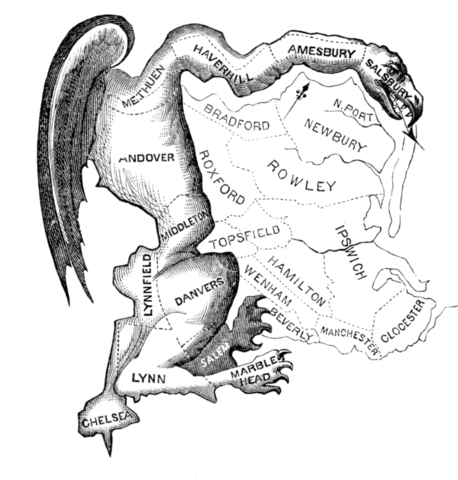
Killing The Gerrymander

Not a huge fan of the gerrymander.


Because it does these three things:
1) promotes one political party over the other by crafting "safe" congressional districts where registered voters are a majority/plurality over opposing parties, with such safe districts that incumbent officials can rarely be removed from office through honest vote;
2) distorts honest representation of communities by dividing them up and sharing them out to outlying, more sparsely populated areas that could now overwhelm that portion of a large community;
3) simple unfairness: a state could have one party with a larger registered voter base but - thanks to gerrymandering - the smaller party can retain control of local and congressional offices... and worse carve out supermajority control of state-level offices disproportionate to actual representation.  This could allow the more extreme positions of that minority party to pass legislation harmful (at least spiteful) to the actual majority of state residents who would oppose such laws.

Basically, gerrymanders create wasted votes.

First Problem is... the parties in power don't really want to see gerrymandering go away.  Let us be honest here: this IS one of the few times that claiming "both sides do it" is accurate (ask Florida Democrats, ask Illinois Republicans).

Second Problem is... how the hell can it be stopped?  The carving out of districts has to happen: democratic/republican government has to allow regions - cities, metropolises, counties - to provide local representation.  Each representative required to stand for a certain number of the populus, and done so at equal numbers so that one official does not represent a handful while another represents a vast number.  So districts have to get made.  But the people tasked to map them out are still people: biased and favored at best, corrupt at worst.

Some solutions are in place in various states, with hope that they can reduce if not end the threat of the gerrymander altogether.  Some states have non-partisan independent committees assigned the task of mapping out redesigned districts every Census count (10 years), and to do so without party consideration.  Other states - like here in Florida - passed state amendment laws forcing the state legislature (most state gov'ts control the process) to draw districts with strict limits - only by population density, must be reasonably shaped (rectangular as much as possible), etc. - to reduce the most blatant aspects of gerrymandering (the stretching out a district in bizarre shapes to provide the "safety" of that district).

But even these options have their limits and flaws: the Republican-held Florida legislature was still able to figure out how to carve out enough safe districts under the new rules to keep a solid GOP majority in both state houses, despite the fact there are more registered Democrats in this state.  So clearly, more needs to be done to kill the gerrymander.

Some ideas I've been mulling:

Increasing the number of representatives to Congress/state offices.  I've scoffed before at this idea of making more seats in the U.S. House to make Congress more responsive to the voters.  But now I think the guy who suggested this - professor Larry Sabato - might be right.  Not so much the need to drop the number of people represented from roughly 650,000 per district down to a more manageable 150,000... but because increasing the number of districts makes it harder to shape them into gerrymandered districts.
Look at it like this: Florida's got 27 Congressional districts right now.  Say we doubled that number to 54... and still requiring that districts have to be carved out based above all on population density as the state amendments require.  It makes it suddenly a lot easier for urban, densely populated areas to get more districts; and makes it a LOT harder to carve out those districts to share with the sparsely populated areas.  Ergo, fewer gerrymanders.

The cap on the number of representatives at 435 total isn't set in stone: it was capped back in 1929... back when the U.S. population was 123 million... we've nearly tripled that by now at 330 million for 2010.  An argument can be made that the cap set 100 years ago is no longer feasible and should go up.  Trick is, by how much?  There are only so many office spaces in D.C. to go around...

I would argue for a change in base representation, where the smallest populated states get one representative and that's it.  I'd suggest bumping that up to two representatives for the smallest states, just to give every state some diversity in representation.  Then I'd take that divided number of the fifth-least-populated state (currently South Dakota at 824 thousand or so) and use that (412,000 or so) as a basis for district drawing for all other states (dividing Wyoming as the least-populated would have given us district sizes at 284,000 which might be going too small).

Let's do the math for the most-populated state (California, 37,692,000 or so) with that 412,000: we get 92 representatives compared to the current 53.  It's not that huge a boost (close to double the current, yes, but not over).  For Texas (25,675,000) they get 62, over the 32 current.  By the way this is tracking out, it looks like a 42 percent increase of representatives per state.  Not sure how it will total up in the House, but I figure it's an extra 182 seats, minimum.  Can we afford/handle a 618-seat House?

Creating more districts does make sense as well at the state level... except in New Hampshire, they have 400 members for a state population of 1.3 million.  Florida's got 25 million residents, at least our house numbers (120) seem more sensible although a slight increase to say 150 reps is doable. 

Another option might be to create a Lottery system of randomly dividing up the registered voters per seat.  Get rid of districts for a state, change it over to just seating at Congress, and then allow for the technology to randomly assign a House seat per voter.  Your neighbor may end up voting for a candidate for Seat 12 while you get to vote on who gets Seat 24.  And your friend down the street gets Seat 5 while her neighbor gets Seat 7.  No-one gets to say who gets assigned to a Seat vote.  No favors.

This has the advantage of getting rid of "safe" districts altogether.  It also forces the two parties to run candidates for EVERY seat rather than selectively put their energies into those "safe" districts.  It also prevents parties from putting up candidates who might be extreme enough for that "safe" district - hi, Steve King of Iowa! - but who can end up being toxic for statewide voters as a whole (note the lack of super-crazy Senators: yes, most are partisan but even the most partisan of them aren't as wingnut as some of their House counterparts).  But the disadvantages are huge: this does have the effect of eliminating genuine community representation.  Local issues - trade vs. tourism, for example - will diminish as state issues dominate.  And there runs the ever higher risk of rigged lottery disbursement of voters.

Those are pretty much the two ideas I've got going.  If anyone else has sensible suggestions, please leave a comment here on this blog.  (again, if the Blogger system is NOT favorable to your login needs, let me know through other means such as my direct email, thanks) 

Also, if anyone else out there is coming to this blog via the Iran Day Six entry I wrote 3+ years ago... why are you still linking to that article?  Is it the pictures I have on that entry?  Is it the article itself?  I'm still getting steady traffic thanks to that one article, I'd like to know why...

Wednesday, November 28, 2012

The Middle East As The Center Of The Storm

There is, once again, little peace between Israel and Palestine as disparate peoples as much as nations.  There may be a ceasefire in place now with Gaza, but ceasefires can end without the resolution of both sides to stop the downward cycle of violence.

There is still an ongoing civil war in Syria, with tens of thousands dead, tens of thousands as refugees... and no honest solution in sight other than outright war that few other nations, including the bordering Turkey, have the stomach or budget to fight...

Iran has been living the horrors of occupation by their own leadership since the uprisings of 2009 (that an old blog entry from then is STILL getting hits on my little-viewed blog on a daily basis amazes me), combined with a global sanctions against the regime's nuclear program that's hurting the civilian economy but not the elites', leaving that a very unhappy place at the moment.

Egypt, coming off the high point of a relatively powerful yet low-on-body-counts uprising against their own dictatorship in 2011 and with a delicately well-managed crafting of that Israel/Gaza ceasefire, is now coping with an arrogant move by the newly elected President Morsi where he claimed sweeping extra-constitutional powers (basically making himself a new dictator replacing the old dictator), bringing the protestors back out into the same streets and gathering spots they've been at just one-and-a-half years ago.  Good Lord, can anybody catch a break here...?

And Libya's not entirely stabilized either after the overthrow of (misspelled name here).  The attack on the U.S. mission in Benghazi is but a smaller part of ongoing street violence between the militants and the more open, pro-democracy groups trying to rebuild after decades of brutal dictatorship.

And this doesn't even include the ongoing quagmire that is the U.S. Occupation of Afghanistan, nor the ongoing unrest in Pakistan.


I have no solutions.  I doubt anyone does, at least a solution that WON'T piss everyone off.  I have pity for any person going into foreign policy as a career, if you ever get signed in to do a job in that region.  Madness would be the only sane response the way things are going...

Monday, November 12, 2012

The Post-Election Scenario Now

Before the election results, there were five scenarios - two for Romney and three for Obama - for how the President / Congress dynamic would look.  With Obama's victory, we're on the fourth one, what is basically the status quo we've had since 2010: Democratic Senate, Republican House, and Obama Democratic Presidency.

What I said then:
The only problem then will be dealing with a Republican House standing as the "last bastion" against an Obama-dominated regime.  If it was a job herding cats before, this will be like working as an alligator teeth puller operating without pliers and standing waist-deep in a swamp.  The fight to get anything resembling a budget will be close to impossible without the wingnut faction in the House getting everything they want (which in a sane world won't happen).  Obama may yet want to finish out a second term where SOMETHING got done for job growth and economic stimulus, but the House will fight that every inch of the way.  And some legislation HAS to start in the House, not the Senate.  Meaning something approaching compromise has to be done... and Lord knows what Obama may have to give up in order to get a jobs bill passed...

Is pretty much how the post-election dynamic is lining up with the early positioning on the lame-duck Congressional session to finalize a budget deal.

It's the Fiscal Cliff scenario: a combination of deals and laws are intersecting this winter that would pack a one-two whammy on the U.S. economy if Congress refuses to act.  The Bush the Lesser tax cuts of 2001-03 are set to expire, which would raise everyone's tax rates not to historic highs but to Clinton-era (i.e., manageable) rates.  There's the Sequester deal made last year, where automatic spending cuts in ALL government programs - including defense/military, AND social programs - will kick in alongside more tax increases when 2013 calendar rolls up.  The sequestration isn't a bad deal overall: it's that the cuts will be akin to using a sledgehammer during surgery where a knife would be more apt.

Separately, either situation wouldn't be too harsh: together, the bump up in tax hikes and severe spending cuts can very well lead to another deep recession at a time where the U.S. economy is still crawling out of the last one.  It's a Double-Dip Recession we're facing, and it definitely has global economic consequences that wouldn't get resolved for another decade...

Thing is, a new bill out of Congress can kick both deadlines to the curb by overriding the sequestration and by re-working the Bush-era cuts into a more manageable tax hike.  So before December 31st rolls around, there are a good number of politicians in both the White House and Congress who want to get a deal done.

Problem is, on whose terms?

Obama wants to re-work the sequestration to reduce the amount of spending cuts to a more manageable level and combine it with returning the tax rates of the upper 2 percent of income to their Clinton-era levels.  The House Republicans would prefer keeping the spending cuts on all social programs, ignore cuts to defense spending, and keep the Bush-era cuts permanent if they could.

Worse of all, the Republican Party overall is reeling right now: their leadership AND voting base were so certain of a Romney victory - and some even thought they would gain control of the Senate - that their loss last Tuesday night really kicked their guts in.  All that hate and vitriol they spilled in Obama's direction, and still they lost.

The Republican Party hate-on for Obama is at unheard of levels: I remember the Republicans' disdain for Bill Clinton with all its conspiracy-laden what-the-hell alternate reality of America, and even THAT was mild compared to what they're hitting Obama with.  The closest historical I can think of is the hate-on the fiscal leaders of the GOP had towards FDR.

This is a party that has planned to obstruct Obama and his agenda - decried as socialist, un-American, anti-business - from Day One of his administration.  The use of Cloture and threat of filibuster has more than doubled.  Once the Republicans gained control of the House during the 2010 midterms based on paranoid-hate-fueled outrage, the House proceeded to ignore every Democratic attempt at a jobs stimulus bill and instead spent 31 useless votes on trying to overturn ObamaCare.  The Republicans have spent four years in an open attempt to make Obama a "failed" President akin to Jimmy Carter ("history's greatest monster!") and make Obama a One-Termer.  And they failed.

This does not mean the Republicans will give up the obstructionism.  They can well double-down on the obstruction.  They are still convinced that Obama is a failure: and they want history to reflect that belief.  They are NOT going to give Obama anything he wants.  I don't mean everything Obama wants: anything, at all.

That means if Obama comes calling with a deal on sequestration and ending the Bush-era tax cuts on just the upper 2 percent incomes, the House Republicans may well say NO in large unfriendly letters.  There may well be enough Republicans who will refuse to deal on anything and even allow the deadlines to pass, enacting that dreaded fiscal cliff.

Problem is what can happen: Obama can well live with Congress taking the country over the fiscal cliff.

Previous times negotiations had to happen to get budgets done, Obama was not in a position to negotiate much.  Facing re-election, he didn't want to overstep or fall into any traps the GOP may have laid out against him.  This time, however, Obama has little to lose: he's won re-election, he's got four more years to get something done with the economy and job woes.  And despite all protestations from the Far Right, Obama does have a mandate: the polling and the votes have shown that a solid majority of Americans back Obama on his plan to raise tax rates on the uber-rich.

It's the tax hikes that are the obvious sticking point for the Republicans.  They'll refuse to actively vote for any deal that raises them (the "no new taxes" pledge to Norquist overrides any obligation to the nation as a whole with these guys).  All Obama has to do, really, is let the Bush-era tax cuts expire, raising all taxes regardless.  And then the day after that, come back to Congress with deal to cut taxes back down close to Bush-era levels... with the exception of the upper 2 percenters.  This will catch the Republicans in a lose-lose situation: they'll be presented with a tax cut they CAN vote for which would be clearly for the middle-classes, but will give Obama a political victory they dare not allow... or they can vote against it on the excuse that the upper-classes need a tax cut as well, which is political poison in this economy and re-enforces the image of the Republicans as greedhead suck-ups to the billionaires.

As a result, there are some Republicans who see the benefit of getting a deal done now and make it look bipartisan in nature, giving them some of the credit... or they can obstruct some more, get caught with their pants around their ankles, and let all the credit go to Obama or all them blame to the House GOP.

It's all up the House Republicans right now: how they'll handle themselves this lame-duck session before 2013.  We'll see then if we'll have a working government or another round of Republican-led gridlock.  We'll see...