Friday, July 19, 2013

Death By A Thousand Cuts, Well Not a Death But a Serious Wound To Public Service

Normally I've got another blog to talk about librarianship.  But this topic is more about politics than libraries, and besides this is the blog where I use curse words more often and after hearing this I'm in dire need of dropping some F-bombs:

Miami-Dade County commission just voted to NOT raise the county millage rates in order to keep their county libraries and firefighter stations properly funded.  They'll be closing out 22 out of 49 branches as well as a small number of fire stations, and cutting 251 employees from the library system while cutting back on everyone else's hours.

The cuts are the result of a $15 million library budget shortfall. (The system had been using leftover funds to bridge the gap for the past two years.) Miami-Dade Mayor Carlos Gimenez recommended the budget which necessitates the cuts, as well as which cuts should be made, to the county commissioners, who approved his recommendation on July 16.Once the commissioners set the preliminary rate, it can be lowered but not raised. Throughout August, there will be six town hall meetings to explain the proposed budget to residents and receive feedback. On September 10 and September 16, there will be budget hearings. The commissioners will vote on the budget at the September 16 meeting, and it will take effect on October 1.But though the millage can’t be raised, Raymond Santiago, director of the Miami-Dade Public Library System and LJ’s 2003 Librarian of the Year, hasn’t given up on mitigating the worst of the impacts. He called the cuts presented to the commissioners and detailed above “a worst-case scenario,” and “probably the most drastic of all the options.”“Before the final budget vote in September,” Santiago continued, “the administration will continue to investigate options to reduce these negative impacts” through different adjustments to the library budget. “We’re looking at everything right now,” he said.

This county commission are pretty much the jokers who voted HOW MUCH in order to build a bullshit overpriced gaudy and unfilled baseball stadium for a morally bankrupt killer of baseball franchises - I dare you to say Loria's name in public anywhere in Canada, I dares ya - who as a businessman could have figured out a hundred other ways to raise his own goddamn money to build his own goddamn park.

The city/county mayor Gimenez is quoted in the article as saying "people have said that the age of the library is probably ending." I call bullshit on that, mayor (the Library Journal article I've linked to shows stats that library use has gone UP).  Which people?  'Cause there's a lot of people where I am - and where I've been at other public libraries as well - that come in to use libraries all the time.  People are still checking out books.  They're coming in to use library computers because libraries are now telecommunication hubs and workplaces.  I've got people coming in all the time needing help with logging into their unemployment benefits and online job hunts and typing up their resumes and downloading their medical records to get their HMOs to approve coverage.  Anybody who thinks libraries are ending hasn't been paying attention.

And speaking of all those people who come in to use libraries.  WHERE THE HELL DO THEY GO NOW?  There may be half of the county libraries still open, but they'll now be packed solid with people desperate to get onto computers - not everyone's got a laptop at home, Mister Mayor - and unable to find worktables to get any projects done.  I did the math of 49 branches to 2.5 million county residents, I got it roughly 52,000 people per branch.  With 22 branches closing, that 1.4 million residents suddenly put out without library access.  It will take them that much more effort to get to a library that's further away - not everyone's got a car, Mister Mayor, and buses get expensive too - and they'll be competing with that many more people to get onto a computer.

I worked in Broward County Libraries between 1994 to 2003.  We're right next door, county-wise, and we had a lot of traffic and usage of our resources, a lot of checkouts and a lot of people waiting their turn to use computers.  I can imagine Dade's libraries were just as busy.  I was there when we had a county referendum to vote for a bond issue in 1998, which involved a small tax increase.  We were expecting a close vote.  We got 72 percent approval, an unbelievable result, and it was because people in Broward liked their community libraries and wanted us to improve our services to them.

What the county commission did this week was unforgivable, unwarranted.  If they were having problems raising funds for libraries and fire stations, they should have done what Broward County did back in 1998: let the people vote on it.  Instead, they're cutting services rather than dare the ire of... lord, there's no sign of anyone even yelling at them to cut spending or even yelling about the taxes going up too high.  Why the hell did they do this?!

Here's a solution: sue Loria and Major League Baseball for that $500 million back for an unfilled baseball stadium.  Maybe when he's on the hook for it, Loria might actually spend his own money and field a fucking team in order to fill his goddamned empty seats.  That $500 million could easily pay for the county libraries, the county fire stations, the county police, and about twenty other social services a large metro like Miami have need for.  It's a far better solution than closing half of everything and forcing a ton of low-income families and retirees to suffer.

GOD.  Our political priorities are screwed, aren't they?  Our cities and counties and states and federal government are giving out millions to a handful of men who already have millions while the rest of us have to fight for table scraps.  At what point do we stop this bullshit?

In the meantime, call the Miami Dade County Commission's office (phone 305-375-4696).  Let them know that cutting back on library and firefighter services is a bad f-cking idea (don't say "fuck", but be very stern and concerned sounding) and if you're a county resident remind them that you can very easily vote them out like the idiots they are if they don't straighten up and do right by the citizenry.

Monday, July 15, 2013

What Happened To Trayvon Was Not a Flaw, It Was a Feature

Referring to what Mr. Coates had to say on the matter:

In trying to assess the killing of Trayvon Martin by George Zimmerman, two seemingly conflicting truths emerge for me. The first is that based on the case presented by the state, and based on Florida law, George Zimmerman should not have been convicted of second degree murder or manslaughter. The second is that the killing of Trayvon Martin is a profound injustice... The injustice inherent in the killing of Trayvon Martin by George Zimmerman was not authored by a jury given a weak case. The jury's performance may be the least disturbing aspect of this entire affair. The injustice was authored by a country which has taken as its policy, for the lionshare of its history, to erect a pariah class. The killing of Trayvon Martin by George Zimmerman is not an error in programming. It is the correct result of forces we set in motion years ago and have done very little to arrest.One need only look the criminalization of Martin across the country. Perhaps you have been lucky enough to not receive the above "portrait" of Trayvon Martin and its accompanying text. The portrait is actually of a 32-year old man. Perhaps you were lucky enough to not see the Trayvon Martin imagery used for target practice (by law enforcement, no less.) Perhaps you did not see the iPhone games. Or maybe you missed the theory presently being floated by Zimmerman's family that Martin was a gun-runner and drug-dealer in training, that texts and tweets he sent mark him as a criminal in waiting. Or the theory floated that the mere donning of a hoodie marks you a thug, leaving one wondering why this guy is a criminal and this one is not.We have spent much of this year outlining the ways in which American policy has placed black people outside of the law. We are now being told that after having pursued such policies for 200 years, after codifying violence in slavery, after a people conceived in mass rape, after permitting the disenfranchisement of black people through violence, after Draft riotsafter white-lines, white leagues, andred shirts, after terrorism, after standing aside for the better reduction ofRosewood and the improvement of Tulsa, after the coup d'etat in Wilmington, after Airport Homes and Cicero, after Ossian Sweet, after Arthur Lee McDuffie, after Anthony BaezAmadou Diallo and Eleanor Bumpers, after Kathryn Johnston and the Danziger Bridge, that there are no ill effects, that we are pure, that we are just, that we are clean. Our sense of self is incredible. We believe ourselves to have inherited all of Jefferson's love of freedom, but none of his affection for white supremacy...

An observer from Slate about the wackiness of Florida, and how the legal system in Florida isn't so much as wacky as it is screwed:

It doesn't help that the same prosecutor who lost the Zimmerman case recently won a conviction against Marissa Alexander, a black woman who fired a warning shot to chase off her abusive ex-husband, hurting no one. She was sentenced to 20 years in prison for aggravated assault with a deadly weapon. Twenty years for a warning shot against a known abuser versus no time at all for killing an unarmed teenager leaves you scratching your head and wondering if justice is not just blind but also insane...I spent four years covering criminal courts in Florida. I covered every kind of case, from misdemeanors to murder. One thing I learned is that you can never predict what a jury might do once it’s locked away to deliberate. I covered one trial where the defendant was accused of bigamy, and his defense was: Sorry, I forgot I was married already. He walked...
Prosecutors around the state boast of their high conviction rates, but those stellar records tend to be built primarily on successful plea deals, not trials. And frankly, some of their trial successes turn out to be the result of flimsy or faulty evidence—Florida leads the nation in the number of death row inmates who were subsequently exonerated...People who work in the court system can blame the legislature for the way our laws are worded. For instance, Florida's “Stand Your Ground” law was based on a distortion of a single anecdote, and it has subsequently allowed drug dealers to avoid murder charges and gang members to walk free... 
We've got a serious problem with our legal system.  We've had a serious problem for decades, and we're still not addressing the issues of fairness or justice.  And it's not just the racial animus of the legal system, it's the aggressiveness of a criminal defense system that can go out of its' way to "blame the victim" like the way Zimmerman's lawyers went after Trayvon - what else is "Stand Your Ground" but a calculated method of blaming the guy you killed "oh if only he didn't force me to pack a gun and blow his heart out his chest" - not just for murder cases but also rape cases - a lot of rape victims don't even pursue legal recourse out of fear they'll be slut-shamed at trial.

Balancing the right of a defendant to a fair trial ought to be balanced by the right of the victim to gain (or regain) some semblance of justice for the crime that took place.  

Sunday, July 14, 2013

This Is What Fear And a Gun Creates: Trayvon Martin Is Dead.

Trayvon Martin's intent: walk to a store and back for a bag of Skittles and a bottle of tea. George Zimmerman's intent: follow a black kid walking through a neighborhood while carrying his gun. Confrontation ensues. Zimmerman shoots Martin. 
Zimmerman gets acquitted because of "reasonable doubt". Trayvon Martin is dead.
Try to remember this: Trayvon Martin had a bag of Skittles and a bottle of tea. Martin was not committing any crime. He was walking home through his neighborhood. Zimmerman still chases after him. And Zimmerman shoots him dead.
As a teenager I spent a lot of time biking and walking through my neighborhood, but I never had some freaked-out adult chasing after me with a gun fearing for his life. Maybe because, gee I dunno, I was white. Who's to say? Certainly not Trayvon Martin. Because he's dead now.
It is now legal in Florida, and pretty much the rest of the nation, for terrified angry white guys to shoot young black kids walking through neighborhoods.
This is not justice.


Saturday, July 13, 2013

Great: the House GOP Is Now Sadistic As Well As Stupid

This is one of those moments where you wanna break out a camera and document the atrocity for the sake of preserving history.

The House Republicans just two days ago passed a version of the 5-year farm bill (it's consistent and important enough to have its own Wiki page) that doled out the billions of dollars as expected to the agribusiness industry... and didn't show one red cent for food stamps to poor families.

In our political system, a payout system of subsidies to farmers (in truth, to massive corporations) wouldn't survive on its own as its supporters would be few (mostly rural, mostly corporate forces in agribusiness) because those subsidies distort the market.  In our political system where any system of welfare to the poor (such as a food stamps program) is viewed by conservatives as Dreaded Socialism, food stamps wouldn't survive on its own either.  So for the sake of political comity of getting things done, subsidies and food stamps tended to get bound together into an omnibus farm bill in order to secure enough support from conservatives and liberals.

Problem is, our current political system is not a sane political system.  The Far Right are in control of the House, and the Far Right are so opposed to any financial aid to the poor that they couldn't even pass a farm bill with food stamps in it back in June, making the House look like it's being run by idiots.  It threatened to create a situation where milk prices would skyrocket, for one thing.  And it just looked bad: the Senate was able to pass their version of the farm bill with some bipartisan effort.

So, here we are in July one month later, the House still needing to pass any farm bill at all... and the House GOP decided to vote for a version that simply didn't fund any food stamps at all.  At least the June version was massive cuts to funding: this one full-out killed it.

Now the deal with legislation is that it has to pass both houses of Congress, which means the House of Representatives has to match the Senate: there's usually a committee process that hammers out a compromise version that both sides re-vote on for final signature.  Given the disparity of versions, the Senate has a say on the farm bill and there is absolute certainty the Democrat-led Senate will refuse to accept this from the House.  So there's little threat of food stamps being completely eliminated here.  The outrage by the public would be huge if the Senate caved on this: we would finally get some rioting in the streets to match up with Egypt and Turkey.

But what does it say to the public already about the House Republicans, that they would intentionally vote to starve out poor families like this?  And this IS about poor families across the whole nation.  The Far Right already has this disdain against the growing number of people on food stamps, ignoring the fact that we're in a goddamn recession so of course we've got more people in dire need to feed their kids.  But now this disdain is public and fully on-record: it's not just the punditry foaming at the mouth on the Sunday talk shows, the elected Republicans are voting into law bills that are against helping out the poor (and not just the poor minorities: enrollment for food stamps is 36 percent White families, compare 22 percent Black and 10 percent Latino (where the remaining percentages go, most likely into other ethnicities like Asian, Native American and Pacific Islander).

While the "liberal" punditry like Jonathan Chait is going ballistic about it:

...There’s some policy rationale for this. Some of the farm subsidies drive up the price of food, making it harder for poor people to buy the food and thus making it more necessary to subsidize them. But the main rationale for joining food stamps is political. It gets urban liberals to vote for farm subsidies that hurt their constituents, and it gets rural conservatives to tolerate food stamps that they’d otherwise oppose. And since advocates of both farm subsidies and food stamps fear losing their program more than anything else, they strongly endorse keeping them together.
The coalition between the two has come undone in recent weeks. Why? Because under President Obama, conservatives have gone from not caring much about food stamps to detesting food stamps as the emblem of Obama’s Chicago-style urban socialist welfare dependency administration. Food stamp spending has increased, not because Obama is handing them out like candy but because the number of poor, hungry people has dramatically increased since the Great Recession...
...Now, some House Republicans would like to spend less on farm subsidies, but they’re willing to maintain the status quo. They’re not willing to maintain the status quo on food stamps. Indeed, the incredible position of many conservatives is that the government should be handing out money to people because they run a farm, but should not hand out money to people who happen to be poor...
It’s no longer novel that conservative Republicans have positioned themselves to Obama’s left on domestic spending that benefits their own constituencies. We have seen three years of Republicans attacking Obama for robbing Grandma’s Medicare. But at least Medicare is a justifiable program. The existence of farm subsidies is insane, and the fact that a party that hates government so much it engages in a continuous guerrilla war of shutdowns, manufactured currency crises, and outright sabotage can’t eliminate it may be the most telling indicator of the GOP’s venality. They only hate necessary government spending. Totally unjustifiable spending is fine with them.
There's the established "conservative" punditry like Ross Douthat wondering just what the hell is going on:
...But without a vision of the common good, a party is basically just a faction, seeking only the interests of its constituents, with no sense of its responsibilities to the country as a whole. And the Obama-era Republican Party’s worst tendency has been toward just this sort of factionalism: Not an ideological extremism, exactly, but rather a vision of government that you might call “small government for thee, but not for me,” in which conservatism is just constituent services for the most reliable Republican groups and voters.
This is what produced the party’s unfortunate Mediscare tactics during the 2009 health care debate, and it’s what produced yesterday’s egregious farm bill vote. It should go without saying that America’s agriculture policy has always been a terrible, stupid, counterproductive exercise in self-dealing cronyism. But when House Republicans severed the traditional connection, arbitrary but politically effective, between farm subsidies and food stamps, it briefly seemed like they were looking for an opportunity to put libertarian populist principle into practice, by separating both outlays in order to trim or reform both separately. But no — instead they were just making it easier for the party’s congressmen to vote for a bloated, awful big government program that benefits mostly-Republican states and interest groups, knowing that they weren’t also voting for something that pays out to the (mostly-Democratic) poor as well.
This is egregious whatever you think of the food stamp program, and it’s indicative of why the endless, often-esoteric debates about the Republican future actually matter to our politics. Practically any conception of the common good, libertarian or communitarian or anywhere in between, would produce better policy than a factionally-driven approach of further subsidizing the rich while cutting programs for the poor. The compassionate-conservative G.O.P. of George W. Bush combined various forms of corporate welfare with expanded spending on social programs, which was obviously deeply problematic in various ways … but not as absurd and self-dealing as only doing welfare for the rich...
Reasonable people can disagree, in other words, about what kind of conservatism would best serve the common good. But everyone should agree that any alternative would be preferable to a Republican Party that doesn’t seem to think about the common good at all.

To me, this is just one more bit of evidence of the GOP House's utter incompetence: that they couldn't even pass a no-brainer bill like a farm bill without shooting themselves in the collective foot.  Their stance against food stamps may play well on the wingnut blogs but it's not going to play well over the kitchen tables at a lot of voters' homes.

Consider Machiavelli's question about whether it is better to be loved or feared... the real trick was to avoid being hated, and a political party or elected official intentionally going out of his/her way to inflict pain on a lot of people - on a lot of families - all at once is a very good way to become hated.

Public Puts the Blame On Where The Problem Is: Congress

If you're gonna blame the gridlock in our nation on someone, you better blame the right suspect(s).  The recent polling from Quinnipiac suggests that a slim majority of Americans are figuring it out:

According to the latest survey from Quinnipiac University, 51 percent of voters believe gridlock is mainly a result of the congressional GOP's determination to block any of Obama's initiatives. A mere 35 percent blamed gridlock on Obama's lack of "personal skills to convince leaders of Congress to work together." Obama has drawn blame from both Republicans and the press for purportedly being too isolated and unwilling to perform the type of cajoling necessary to making a deal in Washington...

I wouldn't say 35 percent is "mere", but at least 51 percent can tell where the gridlock is really happening.  After all, Congress is where the legislation is supposed to come from.

And this is happening despite the Republicans' best effort to lay the blame on Obama (or on Obamacare.  Or on libruls.  Or on zombie FDR.  Anyone but themselves).  The voters are starting to not buy the snake oil they're selling.

In this, I refer back to John Cole, who brought up current pundits' observations at how broken Congress has become, and how he noted even as far back as 2009 just how stupid and horrifying the GOP Obstruction gameplan was going to be:

I really don’t understand how bipartisanship is ever going to work when one of the parties is insane. Imagine trying to negotiate an agreement on dinner plans with your date, and you suggest Italian and she states her preference would be a meal of tire rims and anthrax. If you can figure out a way to split the difference there and find a meal you will both enjoy, you can probably figure out how bipartisanship is going to work the next few years.

This is why I've been saying "Don't Vote Republican" the last 6 years 10 years.  And it's only now that a decent majority of fellow Americans are waking up to how bad Teh Crazy really is.

I can only hope this growing outrage against Congressional incompetence and insanity leads to more voters tossing the Far Right wingnuts out of office this 2014.

Thursday, July 11, 2013

When You Meet A Better Wit Than Thou

You have to give props.  (with thanks to Digby for mentioning this earlier)

Rep. Mark Takano (D-CA) received a petition by House GOP members over the immigration reform issue.

Takano's background was working as an English high school teacher.

He used those teaching skills to grade that GOP petition an "F".  You have to click the link and see it to believe it.

My mom worked as a high school teacher, albeit in history but working with the same skill sets of grading essays and term papers.  When I saw Takano's red pen mark-ups on the GOP petition, I couldn't help but laugh.  He specifically ripped the petition writer(s) on failure to provide citations, relying on allegations, and overuse of hyperbole/exaggeration.

Well played, professor.  Well played.

Wednesday, July 10, 2013

Part Two of Today's Post: Why I Think the GOP Is Going Overboard to Pass Anti-Abortion Laws

Actually, there's a good number of reasons.  For starters, banning abortion has been a top ticket item for the Republicans ever since Roe V. Wade became a campaign issue.  It's just never been a Top 10 issue for voters overall (most voters have as their top issues Jobs, Jobs, Better Wages for Jobs, Better Education, Education That Leads to Jobs, and Not Having Anybody Pay For Anything Anymore).

The second reason there's been a recent surge in the anti-abortion legislation has been that Tea Party "revolution" the Far Right kicked up in response to Obama's 2008 win.  While the Tea Party supposedly formed over libertarian issues such as opposing government-controlled health care reform, in practice the Far Right that benefited from Tea Party support has been pushing a harsh socio-religious agenda and ignoring economic issues outside of massive tax cuts to corporations.

But what got me quizzical is "why now?"  Why are the Republicans - at least at the state level - going batshit crazy trying to get restrictive legislation that would essentially block any abortion, and doing so in such heavy-handed ways?

It's not that the courts are suddenly more pro-fetus than ever before.  Wisconsin's anti-abortion legislation just got held up by the courts already, and there's a certain guarantee that the Ohio, Texas, and North Carolina anti-abortion laws (North Carolina's lege hid their anti-abortion bill in a motorcycle safety bill!) will get blocked by the courts as well.

And, here's the thing that gets me, it's not like the Republicans ever really pushed this hard against abortion when they really had the opportunities to do so.  I mean, look at the states that had a Republican-controlled legislature for the last two or three decades.  Outside of the occasional attempt to restrict funding and access - and taking on partial-birth abortions as a method sure to turn off even pro-abortion supporters - I don't recall any of those states making a major push before 2011.  I live here in Florida, where the Republicans have basically been in control since Jeb Bush was governor in 1998 onward: I don't recall any major anti-abortion fights (and still haven't, probably because of other reasons I'll get into later).  Texas has been pretty much all-GOP since Dubya was governor in 1994... until this year, not a peep.

The thing I figured out, pretty much around 2006, was that while the Republican Party talked tough on the abortion issue, they really didn't want to vote it out of existence.  Partly because it would get rid of their most fanatical voting base: the pro-fetus voters are almost uniformly single-issue voters, and uniformly GOP.  Get rid of that as a rallying issue and you'll see the support wither.  But also because if the Republicans did make a major push against abortion, it would not only rile up and unite the Far Left voters (who've been for the most part disorganized compared to their Far Right numbers) but also alienate the more moderate voters who normally wouldn't care.

It's one of the paradoxes of being human: we're against something unless we gotta be for it.  Most Americans would consider themselves pro-life in that they don't want to see a fetus get aborted: most would never consider it, they'd want to raise the child or see it raised by an adoptive family.  However, most Americans also know that there are cases - rape especially, also the health of the mother - where abortion is an honest option.  (This is why the Far Right tries to dismiss rape as an issue nowadays, they're trying to degrade rape as an exception.)  If the GOP went after abortion access even in cases of rape, incest and saving the life of the mother, there would have been a huge cry from voters who'd otherwise not even think of abortion and those voters would have switched to more pro-choice candidates.

I'd thought this was the real reason why, when the Republicans had all three branches of the federal government - Dubya in the White House, control of the House and for the most part the Senate, 5-4 control of the Supreme Court - they barely ever looked at abortion as an issue.  They went after partial birth in 2003, but then... nada.  Cricket chirp noises.

But now, ever since 2010 when the Far Right used Tea Party outrage to retake the U.S. House and a good number of state governments, there's been a massive push.

Part of it is due to Reason Two I gave earlier: the Tea Party movement brought into power elected officials who were far more wingnut than previous officials, and more likely to push the agenda in spite of the electoral hazards.  But this doesn't explain all the normally standard-issue Republicans suddenly backing these pushes (and fear of getting primaried out isn't that high a reason: there's too many seats involved and even Norquist doesn't have that kind of reach).  This is where Reason Three comes into play: the underlying fear by the GOP at both the state and federal level that their party is running out of time.

Look again to Texas.  Like I noted earlier, Texas has been GOP for decades, they've been socially conservative on a lot of issues for far longer.  But the population has been trending further Hispanic, (and not even due to illegals, simple birth rates are what's happening) enough that even the massive gerrymandering efforts to hinder Hispanic voter responsiveness won't protect Republican incumbents.  And Hispanics, despite being conservative on some issues, tend to vote for Democrats because they agree with Dems on health care and education. (the shift in Hispanic population is one of the reasons California's gone Blue State).  The painful thing: Hispanics may be prominently pro-life, but they still vote Democrat because health care and education and immigration are bigger concerns.  Texas may not shift to Democratic control by 2014 (or even by 2016), but sooner rather than later the Democrats will have solid control of Texas at a national, state and maybe even local levels.  Texas has an even better chance of going Purple (like Florida and Pennsylvania) this 2014, which still hurts the wingnut agenda.

The other states like Ohio, Wisconsin and North Carolina are under threat of losing Republican control as well (I'd throw in Florida, but for some reason we're not pursuing a heavy pro-fetus agenda in this state.  I think the heavy Hispanic population is already a deterrent), less due to Hispanic voters and more due to the GOP voting base - angry elderly white guys - dying off and getting replaced by Millennial voters who are more left-leaning on a lot of issues than even previous generations at their age.  Those states are not as solidly pro-Republican as the party would admit: North Carolina in particular is showing major signs of buyers' remorse letting the wingnuts take control, and the next election cycle might see a major purge (unless the voter ID laws they're bound to push effectively cut off voter turnout).  Walker might skip running for Wisconsin governor for the excuse of focusing on 2016 and the White House (conveniently avoiding the embarrassment of likely losing re-election in 2014).

It's this reason - the Republican Party as it knows itself is doomed by basic demographics and the march of time - that I think the Far Right has gone overboard this year pushing their pro-fetus, kill-Planned-Parenthood, fuck-women's-health agendas.  They may not get another chance like this again.  Even though this may accelerate the Republicans' loss of control by alienating more voters than ever before, they'll do it.  They have the wingnut will to do it now: and they only have two more election cycles (2014 and 2016) to do anything about it before the population really does turn against them.

For what it's worth: just don't vote Republican, okay?  Please?  Thanks.

Part One Of Today's Post: Congress, Well Actually The Republican Party Sucks And Here's Why

I mentioned earlier about the immigration reform issue that's now a matter for the GOP-led House, and how even failing to get something out of committee would be a sign of how incompetent the Republican Party has become.

Well:

...The key moment came when Sen. Chuck Schumer (D-NY) — the leading Democratic author of the Senate’s immigration bill — laid things out for House Speaker John Boehner.“Without a path to citizenship, there is not going to be a bill,” he said. “There can’t be a bill.”Convening a conference committee with a House Republican bill that does not include a path to citizenship, he added, would amount to a “a path to a cul-de-sac, to no immigration bill.”In a Tuesday meeting with fellow Democrats, Schumer laid out Boehner’s five options, according to the New York Times.“(1)Doing nothing; (2)opting for a piecemeal approach of several separate but related immigration bills; (3)passing a comprehensive bill that does not include a path to citizenship; (4)passing a comprehensive bill that does include a path to citizenship that is different, and likely stricter, than the one offered in the Senate bill; (5)or taking up the legislation that has passed the Senate.”We still don’t know for sure what the House will do. But under Schumer’s terms, options one, two and three are deal breakers. Option four is extraordinarily unlikely under the constraints House Republicans have imposed on themselves (the Hastert rule, the preference for a pathway that’s “triggered” once the border is secure in some abstract sense). Boehner has ruled out option five.
So the question is whether House Republicans can get it together enough to do something like option four, in a way that wins support from at least half the conference, but that 
doesn't cop out on citizenship.
Here’s why I don’t think that’s possible: Even if the House GOP pulls off the unthinkable and puts a bill on the floor that includes a citizenship component — even one that’s “triggered” — conservatives will recognize it as a feint. They’ll be convinced, perhaps correctly, that the Senate position will win the day in conference, and that they’ll be faced with a take-it-or-leave-it proposition once the bill is really, truly finalized.So they’ll withhold support for that reason. And suddenly the bill will no longer be Hastert rule compliant.That’s why I think we’re in the defibrillation stage... They could drag this out for months before settling on terms of eventual citizenship. Democrats could fold on “triggering” the citizenship guarantee — or come to terms with the GOP on something that could be sold as both a “trigger” and a guarantee. Boehner could step up, break the Hastert rule, probably lose his job. But these are all pretty implausible scenarios. Particularly given how averse House Republicans and movement folks have become even to highly conservative legislation that they recognize as a potential vehicle for compromise.
The House won't even go with the "totally evil" route of coming up with an immigration bill that's so restrictive the Senate would balk, giving the House GOP the excuse of "blaming them libruls".  This is going to fall entirely on the House for the bill failing.  They'll still try to blame it on Obama - they always do - all the while refusing to admit in public something that's been pretty clear since Day One of Obama's tenure: the Far Right Republicans in control of the U.S. House simply do not want to pass legislation for Obama to sign, especially any legislation that Obama could hold up as an administration win.
So in the meantime nothing gets done.  Nothing gets passed.  We're stuck with a sequester budget that nobody really wanted because the Congressional Republicans refused to deal on tax hikes on the upper incomes.  We're stuck with a Congress that refuses to pass any meaningful jobs bill that could help relieve our stagnant economy.  We're stuck with a Congress that refuses to do anything about reducing the insane increase in college loan rates and the overall costs of going to college.  We're stuck with a GOP-led House that's about to vote for a repeal of Obamacare for the 38th time (what are they aiming for, 42?). 
We're stuck as a nation chugging along.  
As long as we've got a political party in the Republicans who refuse to do the actual hard work of compromising to get bills passed, as long as we've got party leadership that kow-tows to Rush Limbaugh and Fox Not-News and the National Review editors, as long as we've got a party that openly hates the poor and minorities and voters young AND elderly, we as a nation are screwed.
Please.  For the love of God, voters.  Stop voting Republican.  You don't have to vote Democrat if you don't want, you can always see if there's a Modern Whig ticket on your ballot or something, just PLEASE stop voting Republican.  It's not that they're too ideologically rigid, it's not that they're too Far Right.  It's that they're too damned incompetent.  It's because they as a party ARE DOING NOTHING AT ALL.

Monday, July 08, 2013

Anniversaries: On This Day In Zeta Reticula History

Google has an animation gracing their search engine page honoring the 66th anniversary of the Roswell UFO crash.

Yep, we're celebrating the fact that highly evolved lifeforms couldn't handle New Mexico traffic stops at night.

In seriousness, I grew up reading up the paranormal: I spent more time in the 133 shelves than the juvenile fiction.  Flying Saucers for me was a mind-blowing thing.  When The X-Files started I got hooked right off the bat.  Part of me understands the sheer improbability of space travel - damn you, laws of physics - but the child in me hopes we are not alone in the universe and that there are enough nice - the ones that won't eat our brains - sentient beings to co-exist with us.

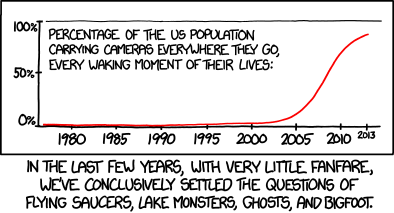
Of course, the guy at xkcd just has to point out something for the anniversary as well: with the spread of smartphones with cameras, trucks with dashboard cams, the immediacy of YouTube... the evidence of UFOs, Loch Ness Monster, Bigfoot and ghosts hasn't kept up.

Which is actually kind of heart-breaking...

Sunday, July 07, 2013

Presidential Character: Week Twenty-Three, I Got Nothing But a One-Termer Again

Another One-Term President to evaluate.  This shouldn't take too long...

The Republicans had enjoyed from Lincoln up to Arthur an extended period of White House control.  Grover Cleveland broke the cycle, bringing into office a reform-minded but-strict-as-hell Democrat that may have functioned but remained vulnerable to the whims of an electorate frustrated when Cleveland's administration failed to respond to their wants (not exactly their needs...).  They came into the 1888 election cycle with high hopes... and promptly ran into a deadlocked convention between two popular choices at the time.  Forced to find a compromise candidate, they settled on Benjamin Harrison, grandson of the late William Henry Harrison (yeah, they facepalmed about that back then too), scion of Ohio, officer of the Civil War (still a major campaign plus), occasionally elected to various offices... and pretty much one of the most bland unremarkable figures to get tabbed for the Boss job.

I exaggerate, I suppose.  Harrison had to have some qualities of value that made him an acceptable candidate.  Unfortunately, the biggest value he had was his malleability: the party bosses knew they could manage him.

Harrison's personality was one of reluctance.  He had to be talked into running for Governor of his state once (he lost a narrowly contested campaign).  Tabbed to serve as Senator (back then, a Senator was nominated by the controlling powers of the state legislature, not direct vote), he did so with little distinction preferring to vote along party interests and rarely making a name for himself.

And yet, Harrison doesn't entirely fit the Passive-Negative model of Presidential Character.  He shared a positive view of government's role in education and social improvement: he was the first President since Grant to make serious efforts to break the Jim Crow power in the south by pushing for federalizing the elections process and ensuring education funding for all.  Both didn't get far in a Congress where Republican allies traded away those issues for economic ones.

If I had to, I'd have to put Harrison right on the edge of the Passive-Negative line, but would make him a Passive-Positive.  Either way, he reacted to issues rather than acted, sought compromise, and worked with others to achieve their goals more than his own.

Next Week: Hey, didn't we meet this guy already...?

Saturday, July 06, 2013

Nobody's Winning Egypt

It's pretty harsh to say it, but so far this has been a no-win scenario for all parties concerned.

For Morsi and his Muslim Brotherhood party, it's a clear loss because he's been kicked out of office.  There were valid reasons for it: there were no check/balance mechanisms in place to make Morsi more responsive to the needs of the people; Morsi had done nothing to clean up the corruption that existed under Mubarak and in fact it was getting worse; the Muslim Brotherhood (MB) may have been better organized than any other coalition in the nation, but they simply weren't designed to make decisions and compromises that high office requires.  And consider the origins of the MB as a radical, occasionally violent opposition: by ousting them like this, they won't see any incentive in taking democracy seriously as a means to power.  They may well fall back into their old bad (and violent) habits, as demonstrated by the outbreak of violence between the pro-Morsi forces and the protesters last night.

The Army may look like the winners (again), but in truth this coup has hurt their position as well.  Rather than being unbiased players in the game, they've re-inserted themselves into the democratic process in a way that weakens said democratic process.

The foreign policy wonks pushing for democracy aren't happy: while Morsi was a terrible President he was democratically elected.  This coup discredits the validity of elected leadership across the Middle East, especially at a time when nations shrugging off decades of dictatorship - Algeria, Libya, Iraq - are struggling to forge new governments.  Tossing him out in a coup merely sets up the possibility of any future Egyptian President getting tossed out even if said President is actually doing his job.

The people protesting in the streets may have gained their primary objective - ousting Morsi - but there's no guarantee his replacement will fare any better.  Egypt's economy is in the tank alongside half the planet thanks to this global recession: tourism is also suffering, and being an unstable nation two steps away from open rioting doesn't market well at the AAA travel agency.  The corruption hurting Egypt's ability to provide even basic services like trash pick-up is deep rot: it will take years to flush it out even for a principled reformist.  The protesters may just be back out in the streets within another year.

The more liberal and moderate parties in Egypt may benefit from this, but there was a good reason why the MB won elections: the liberal and moderate groups in Egypt are not that well organized and in some cases unwelcome to a populace that may benefit from liberal reforms but in practice aren't fond of liberal ideas.  There's no sign of anyone in any position to step up and provide a moderate alternative.

There is a chance this could all still work out.  The Army has set up for emergency elections, and depending on the results a sensible moderate leader could be found.  But then the Army has to step back to let that President do his job.  There has to be serious reform efforts in both service and in the legal system (and in local law enforcement) to crack down on the corruption (and provide security against any violent reaction from the far right).  And whoever gets elected President has to make good-faith efforts to keep the Brotherhood engaged... and the Brotherhood has to make good-faith efforts to learn from this and change their methods to be more compromising and amenable to criticism.

It's a very thin needle eye to thread.

Thursday, July 04, 2013

Wednesday, July 03, 2013

Anniversaries: Gettysburg Day Three

The battle in most respects determined the fate of the war: the South suffered a decisive loss in the Eastern theater for the first time; Lee's army lost men it couldn't replace; and it failed to end the siege of Vicksburg the way Lee had hoped.


The war was fought for another two years (close enough) after this, because by this point only a total defeat of either side - especially the South, its leadership convinced in the righteousness of its cause - would have ended it.  But from this point on, all the advantages were to the Union: they had finally gotten a semblance of military leadership under Meade (and later Grant) to fight the Virginian theater, they had the numeric advantage of troops (the South intentionally fought with less manpower because they needed to keep enough white men back home to keep the slavery population in check), they had the economic and engineering might (the South had foolishly stuck to a cotton industry dominance and failed to create enough ironworks and grain farms to supply themselves).  This defeat combined with Lincoln's Emancipation Proclamation effectively kept Europe out of the war for good.

On an end note, a fellow Hordian Andy Hall runs the Dead Confederates blog (tracking southern and Texan history), and had his own take on the Second Day of Gettysburg from the memoirs of a Texan soldier caught in the thick of it.  He's got a great blog: link it.

Tuesday, July 02, 2013

Anniversaries: Gettysburg Day Two

This happened 150 years ago today:

That sound you hear is Joshua Lawrence Chamberlain of the 20th Maine codifying the Badass Bookworm trope for American history buffs.


Monday, July 01, 2013

July 1st, So Many Things To Say

I was going to just focus on the fact that today is the 150th anniversary of the First Day of the Battle of Gettysburg.

But there's a ton of stuff happening in the world, which I gotta mention:

In Texas, the people are up and protesting against the Far Right Republican push to restrict access to abortion - and basically making it impossible for women to have decent health care in the process - using another special session of their legislature to circumvent a good number of procedural rules normally part of the regular sessions.

In North Carolina, the people are up and protesting against the Far Right Republican push to, well, destroy everything that's not a corporate tax cut.  Not just the pro-fetus agenda, but that the state GOP has killed off unemployment benefits (RAAAAAAGGEEEE!) in order to push their austerity agenda.  And this is in face of the facts that this has been one of the worst employment markets ever, and the fact that the unemployment benefits help the unemployed look for a job... any job...

In Egypt, they don't have Far Right Republicans to protest against... they do have the Muslim Brotherhood and their self-serving President Morsi, who have basically mismanaged the nation in its first year of supposed democracy into bringing out protests LARGER than the ones that pushed out Mubarak.

In fact, it's been a really busy week in protests.

More on Gettysburg for Day Two.  That is the one with Little Round Top. (fanboy squeal)

Saturday, June 29, 2013

President Character: Week Twenty-Two, Gone To The White House

When we write of Grover Cleveland, we write of a man best-known to Americans as "The Guy Who Served Two Separate Terms".  A guy good for a punchline in the Simpsons/Futurama 'Verse.  There are other things he should be known for.

He should be known as one of the few Presidential candidates to win the popular vote three straight times (FDR is the other, and he's got the excuse of being a Four-Termer).  He didn't win the Presidency the second time because of the Electoral College.  Cleveland was also the first Democrat elected to the Presidency since 1860 (Johnson was not elected to it, Tilden should have won it but the corruption of the electoral system in 1876 blocked him), breaking the Republican monopoly on the office of 24 years.

He's also a candidate that had one of the biggest bombshells of a Presidential campaign ever: the revelation days after his nomination that he had fathered a child out of wedlock (he was enjoying the bachelor lifestyle up to that point).  It didn't help that he publicly acknowledged the child as his (although he and his supporters took pains to note he provided financial support).  Republicans gleefully took to the streets chanting "Ma! Ma! Where's My Pa!"  This was a huge load on Cleveland's election hopes, because outside of his personal lifestyle, Cleveland was arguably the most incorruptible political figure this nation ever saw: this was a guy with a reputation for vetoing bad bills, for gutting out corruption in local and state office, for going against Tammany Hall (the political machine of the 19th Century) and winning.  Cleveland was quoted as saying "Public Office is a Public Trust" and he damn well meant what he said.

His opponent was one of the Grant-era ethically-challenged congressmen, Blaine, who was reportedly pious in his personal life but up to his hips in corruption in his public job.  As a result, the debate became a question between voting for a man with questionable personal habits but clean policy record or for a man with questionable policy records and clean personal habits.

And it was a close race, the mudslinging involved one of the nastiest since Andrew Jackson's era and unrivaled until, well, Clinton and/or Obama's.  It took a last-minute PR faux pas of a Protestant preacher denouncing Irish voters in New York to switch the vote there to Cleveland's favor, in which he squeaked out  a win by 1,000 votes.

Democrats responded to the Republican rally cry by answering "Gone to the White House Ha! Ha! Ha!"

And what did Cleveland do once he reached the White House?

He vetoed more Congressional bills than any other President in history.  Granted, a lot of those bills were individually written to pension out war veterans rather than there being one over-arching congressional bill that would have covered them all.  But Cleveland wasn't the sort to let a single bill pass his inspection, and he didn't agree that Congress should override the veterans' Pension Office that had denied those pension petitions already.  But this was a sign of how Cleveland worked: he believed in limited government in the small-c conservative way, and every political stance - reducing the tariffs (taxes) because there was an ongoing surplus, supporting the gold standard over silver (which meant cheap money) - reflected that.

All in all, Cleveland demonstrated a lot of the traits - highly driven but unimaginative, reactive rather than active, Uncompromising above all - that are found in Active-Negative Presidents.  Granted: he never demonstrated obsessive self-interest and self-loathing most Negatives have, and had the love and faith in public office that an Active-Positive has, probably putting him more on the borderline between the two traits than most other Presidents.  But he was more A-N than A-P.

I'd say more, but there's still another blog entry I gotta write on the guy.  Non-consecutive blog entries, after all we got a schedule to maintain and Cleveland won't begrudge us that...

Next Week: Benjamin's just this guy, ya know?


Friday, June 28, 2013

The Republicans' Real Problem If They Can't Pass This Immigration Bill

It's not that the Republicans will lose favor even more with the growing Hispanic population - a voting bloc the GOP is convinced could lean conservative enough to their side - if they fail to pass the bill the Senate just signed off on.  It's not like there's a lot that would convince ethnic voters to side wholeheartedly with a party that just succeeded in shredding voting rights for said ethnic voters.  Like Conor notes over on The Atlantic:
It's true that there's a nativist element in the Republican Party that talks about illegal immigrants as if they are sub-human. There are, as well, other Republicans more restrained in their rhetoric, but who give off the impression that they aren't huge fans of Hispanic immigrants. This definitely alienates Hispanic voters, but it is unclear to me that the passage of immigration reform would win over these people -- whether a reform bill passes or not, that element will still exist in the Republican coalition. So long as the questionable rhetoric continues, so will the mistrust...

If the bill passes, there won't be a huge surge of Hispanic voters over the Republicans: the party would at least retain a sizable portion of that vote (a lot more than the 1-2 percent of Black voters still voting Republican... yeah the last polling showed close to ZERO percent but I'm pretty sure there had to have been a few Blacks who went Romney... why I don't know, but I digress) and have a more diverse base of voters for the next Presidential cycle.  But what would happen if the GOP House - with a sizable number of Far Right congresspersons who aren't huge fans of "illegals" and "freeloaders" - failed to take up the issue, to pass a similar bill that would get worked out in committee and sent to the President for a signature?

They'll still be in the same leaky boat in terms of Hispanic outreach, obviously, but the real damage will be to the Republicans' credibility as a functioning political party.  It's not just the Hispanics they'll be losing, it will be the good-sized middle-of-the-road voters, the moderates or non-ideologue voters.

Even with all the obstructionist efforts the GOP has pulled since retaking the House in the 2010 midterms, there was at least this perception that the Republicans were, well, doing things.  They'd at least tried to present some ideas in terms of budgeting and government oversight (albeit obsessed with tax cuts and deregulation as the CURE FOR EVERYTHING), they at least looked the part of a political party.  Perception means a lot in politics: looking competent is more valuable than actually being competent.

But this would be the break with that perception, a huge one.  There's been media buzz about the GOP fracturing ever since the earlier vote in the House for Hurricane Sandy relief that ended up passing without a majority of Republican votes.  The House is now presented with a bipartisan Senate bill (as close to bipartisan as possible: it passed a Cloture vote, which is damn near miraculous this day and age), and a bill on immigration reform that the media (and thus the nation) perceives as a must-pass for the Republicans.  If they can't even get this out of committee, the perception of party dysfunction would be overwhelming to everyone outside of the Tea-Party, anti-immigrant, anti-government crowd (and the Tea Party wingnut faction is not as big as the Fox Not-News commentators think it is).

There's not even a guarantee Speaker Boehner could pull off an attempted "poison pill" bill, something on immigration that would be so anathema to the Senate Democrats that the compromise committee that works on fixing disparate Senate-House bills would refuse to deal and thus give Boehner the excuse to blame the libruls.  The wingnut faction of the House is so opposed to immigration they may refuse to vote on anything close to reform... and if there's enough of them, Boehner won't be able to get a floor vote on it, even with that poison pill.  The blame will end up entirely on the GOP House. (if Boehner does get a bill passed with that poison pill, there's still no guarantee he'll be able to claim the Democrats killed it if the two houses can't agree).

The perception in politics will no longer be that "Congress is dysfunctional" because after all the Senate got something done.  The perception will be "The Republican Party is dysfunctional."  And while the Far Right won't be surprised or angry about it - after all, it's the kind of Party they want - whatever is left of the Center-Right and Moderate GOP voters (the RINOs that haven't fled yet) could well walk away.

The thing that always upsets me as an independent voter is that there's been enough middle-of-the-road, non-party-affiliated voters over the last 10 years who gave and still give the Republicans the benefit of the doubt.  Having been burned by the Norquists and Limbaughs and Breitbarts that have taken over the party, I just couldn't grok how any moderate voters, any non-wingnut voters, were still voting for the ( R ) bracket.  But one of the things about moderate voters isn't loyalty to a party, it's the desire to choose and vote for a candidate that creates and maintains an image of competency, of ability.  They'll vote for a Republican if that Republican looks capable of walking and chewing bubble gum at the same time.

But a Republican that's part of a House of Representatives that couldn't even pass a symbolically important immigration reform bill?  The perception of incompetence would be more destructive than the perception of that Republican being a hypocrite.

Despite the survival tactics that the Republicans use for midterm elections - the Congress-only, state Governor elections - that rely on low voter turnout and only the extremists voting, there's always the risk of playing it too close to the wire.  While the average (read: moderate) voters won't turn out for midterms, they could turn out in enough numbers to voice their discontent against the party with the most at stake (read: the ones running Congress).  During good years, the party in control tends to stay in control of Congress.  During bad years, during sessions where the majority party is viewed as incompetent, failing, broken... you get the turnover.  Look to 2006: the failure of leadership as the Iraq occupation turned sour was a major key to the Republicans losing to the Democrats in both houses.  Look to 2010: the session-long struggle to pass health-care reform made the Democrats look out-of-touch and unfocused (even if they still passed it: perception, remember, counts for a lot), letting the Republicans retake the House.

The Republicans may have an advantage with gerrymandered districts that favor them despite the larger vote totals for Democrats, but a good number of those gerrymandered districts are stretched thin and more vulnerable than they seem.  Get enough moderate Republicans and NPA voters disgruntled, get a Democratic candidate in one of those districts who can walk and chew gum, and you could well see a 51-48 victory for that Democrat.

The only things saving the Republicans at the moment are those gerrymandered districts and the possibility they can (and will) rewrite state voting laws to block all the voters they hate.  But fail at this vote, fail to maintain even a semblance of competency... the Republicans can suffer even with the voters they hope would be on their side, the ones they'll let past the vote-blocking.

Try to remember this about the moderate/centrist voters: they vote for competency, not ideology.  An incompetent Congress will lose those voters regardless of geography or gender or race.  And there's more of us moderate voters than the wingnuts will admit.  Count on it.

Wednesday, June 26, 2013

In This Case, the March Of History Goes Forward, Thank God

Yes, yesterday's SCOTUS ruling killing off voting rights was a huge bummer.

Today, the Supreme Court rulings - in separate decisions - that the federal DOMA and California's Prop 8 were unconstitutional turned into a major gain for civil rights.

In truth, the SCOTUS rulings are not a final say on the matter.  Overturning DOMA meant civil unions were possible and that states that passed same-sex marriage laws could uphold them, it didn't grant gay marriage rights across the nation.  And the Prop 8 decision was that the persons who brought suit to the Supreme Court - third-party groups that backed the referendum, not the state of California itself - did not have legal standing to do so.

Still. This is a great day to be Pro-People.  Play on, Don Coates:

I haven't read any of my fellow writers yet, but I did want to take a moment to say how important this moment is in the war against inequality. I was tempted to say "social inequality" but in America, there simply is no real way to separate the social, the political and the economic. When the larger country decided to stand aside as South Carolina went about the business of disenfranchising half its citizenry, the weapon was political, but the implications were economic and social. With no access to the franchise, black people lacked the means to protect their wealth. The poverty of wealth which befell them then reinforced their status as social pariahs, and their status as social pariahs reified (sp?) the racist justifications for their disenfranchisement and the inglorious cycle was complete...
It must never be forgotten that in America, the right to marry is the right to protect one's family. Certainly the pictures of same-sex couples embracing and hugging warm the heart and are a powerful weapon in country that prides itself on fairness...
The state repossessing a couple's wealth because it finds them icky, is wholly unjust. It recalls a particularly horrible aspect of slavery--the assault on the families of people deemed to be outside the law. There is a particular war here, which better people than me can speak to. But power is at the core of the long war which began sometime in the mid-17th century with the passage of the first slave codes. The prohibitions against same-sex marriage are not simply about witholding the right to be pretty in a dress or dashing in a tux (though I would deny no one their day.) It is about ensuring that only certain kinds of people, and certain kinds of families, are able to amass power, and with that power, influence over the direction of our society...
It is wrong to strip people of wealth because you are bigot. It is wrong to strip people of the right to name their caretakers because you are afraid. It is wrong to make war on people because you can not get over yourself. And though today we may say that we have advanced, through much of this country, the wrong continues unabated...

The fight's not over, I'll agree on that point.  But this is akin to winning Gettysburg: there may be another two years of war but the end - marriage equality - is in sight.  And as we advance on these rights, making them stronger and making our nation stronger, we can keep fighting for all the other rights - the right to vote, the right to earn a fair wage, the right to live healthy - that are self-evident (Yup, I'm enjoying that phrase).

So let the celebrating begin!
Yeah, that's right.  Even the heteros can gay-marry now.  Deal with it, Mr. Huckabee.


Tuesday, June 25, 2013

The March of History Isn't Supposed to Go Backwards

I was born in 1970.  Five years before, the nation passed a Voters Rights Act that ended a century of Jim Crow discrimination denying a sizable portion of our population from the God-given self-evident right to vote.

I didn't read up on history that much until high school, about 1984-85, around the 20-year anniversary.  They had it in the high school textbooks, which basically makes it ancient history to high schoolers.  For all I've known, the right to vote was meant to be as universal as possible regardless of race or gender (age being the only limiter with the 26th Amendment).

From all that I've studied on history - the slow, sometimes messy, march of ideas and ideologies towards an enlightened liberty and freedom of expression - I've rarely seen any situation where rights, once given, were later taken away.  The only times from what I saw was the Jim Crow era that took away the Black Man's right to vote for 100 years... and even then the VRA did away with that.  The rights came back, and it's been like that my whole life.

And now, I'm dreading that the rights are getting taken away again.  Something that shouldn't be happening.

The conservatives on the Supreme Court ruled in Shelby County v. Holder that a key provision of the VRA - Section 4, which provided metrics on what parts of the nation (Deep South states and key counties) had to get federal pre-clearance on any drastic changes to voting laws - was unconstitutional.  It basically neuters Section 5 (the authority of the Justice Department to act) until Congress ever decides to draw up a replacement metrics system that would pass Court's approval.  And considering the wingnut-controlled House and filibuster-stalled Senate, that will not happen.

My online friends among the Horde are mostly up in arms.  I'm upset as well.  Having witnessed just recently the Republican-controlled Florida government doing their damnedest in 2012 to deny people the right to vote - taking away early voting days, shutting down precincts, trying to pass a strict voter-photo ID bill, forcing county supervisors to purge voter rolls - I am well aware of how close we are to having one of our key rights - the right to vote, as sacred a right as free speech and right to assemble - taken away.  And not just the minorities like Blacks and Hispanics getting denied the right to vote through some complicated redistricting gerrymandering designed to hit ethnics, but poor people of every ethnicity (and a lot of women to boot) denied because they can't afford a photo ID, or college students denied because they tend to relocate often without a primary residence from which to vote.

For all the bad times I've seen our nation go through in my lifetime, I have never seen a moment where the march of history stepped backwards.  We're back to 1950 now, fighting the same damn fight to get people their self-evident right of equality before the law, their self-evident right to speak up and choose their representation, their self-evident right to be Americans.  And if it keeps going like this we'll be back to 1850 and what that all entails.

I hope to God this has the adverse reaction the goddamn Far Right Wingnuts expect: I hope to God this brings out the moderate voters in droves this midterms - the ones who usually don't show up when there's no President to choose - to vote the goddamn Republicans out of office and vote in people who will actually make government work and vote a new VRA into place.

That still hasn't been taken away: getting out the vote.  Not yet.  So there's work to be done.  Getting people registered right now no matter what.  GET IT DONE, PEOPLE.  Get EVERYONE registered right fucking now.  And get the goddamn vote out against the goddamn wingnuts.  Pardon my Swedish.

Sunday, June 23, 2013

Presidential Character: Week Twenty-One, The Effects of Office

It could be said that each President brings to the office a bit of himself, establishing a precedent, affecting a change in how the role is played.  It could also be said that the office affects the man, that the power could change them (the old phrase of power corrupts), although with Barber's research into Presidential Character there's been solid evidence that such changes are rare.  Once the man develops his traits, he carries them with him into the office, defining his tenure.

There are Presidents we've reviewed so far - John Quincy Adams, Franklin Pierce, Rutherford Hayes - who had certain traits but were thwarted in expressing their characters to due to external obstacles.  It still didn't change much of who they were (other than making them more embittered than they already were).  The 21st President, however, may be the first - may be the only President on the roster in fact - to genuinely evolve from an incoming Character trait into another: the first President who changed himself to fit the needs of the office at the moment of decision.

I speak, of course, of Chester A. Arthur.

...Yes, the trivia answer from the third Die Hard movie.  Please try to keep up...

That Arthur changed some of his positions - his political views on the Spoils system in particular - in office shouldn't be that much of a surprise: an assassin hoping to benefit from that Spoils system had killed Arthur's predecessor James Garfield, and even the simple optics of the PR nightmare that created would have made any Stalwart (pro-Spoils) change his label to Half-Breed (civil service reform).  The real surprise is how much of Arthur's previous habits - his laid-back ideology, his crony-ism, affability and desire to be loved - that made him a Passive-Positive character disappeared the second he took the oath to be President.  He went from being a Pass-Pos to an Active-Positive character.

Arthur's Pass-Pos traits could be noted through his aversion to actually running for office: Arthur had never before run for a job.  Every position he'd ever held in public service were through appointments and patronage, a system he wholly bought into as a means for a steady income.  Getting the job of Port Controller of New York (the key port of trade and major tax base) during the Grant administration was the highest office he'd yet held: he oversaw thousands of jobs, through which patronage was doled out to the loyal and politically useful.  There's little evidence that Arthur himself benefited from any massive graft or corruption in the Port office (he did profit from a "moiety" kickback of sorts), but he played his part as a machine politico, working behind the scenes with his good friend Roscoe Conkling.

Even then, reformers in their own party were getting into positions of authority to try and end the "political machines" and the corruption they entail.  By 1878 Hayes, needing to show he was serious about civil service reform, did what he could to remove Arthur - not the most corrupt political boss but the most public - from the Port Controller job.  It didn't work as Hayes had hoped: Conkling by that point was a Senator, and there were still too many Republicans favoring and favored by the Spoils system (Stalwarts) that they were strong enough to deadlock the 1880 Presidential convention against the reformists (Half-Breeds).  The Half-Breeds compromised on Garfield instead of Blaine, and the Stalwarts compromised on making Arthur the Vice-Presidential candidate to balance the ticket.

And as I've said before: ticket balancing never works the way the party hopes it will.  The ticket balancing Veep is usually someone who's NOT representing the majority of the party, merely a faction that has to be appeased.  In this case, it might have meant the Stalwarts through "their boy" Arthur reclaiming office to ensure their Spoils system of political machinery would remain intact.

Arthur defied that, because the moment of history was so blatantly against the Spoils system.  Much like the Civil War, the tides of history had flowed to this shore where corruption could no longer be tolerated or ignored.  In a previous moment just like this, a Pass-Pos like Franklin Pierce refused to rise to the moment: he refused to change himself.  Arthur realized he had to change himself in order to make the changes the nation needed to endure: he changed his Passive-Positive nature to an Active-Positive, pushing himself to the forefront of the civil service reform efforts, overseeing the legislation and vigorously enforcing the law as a President should.

This is why we as a nation think of Chester A. Arthur as a good President and why we barely think of Franklin Pierce at all.

Further signs of how the Presidency changed him: Arthur broke his friendship with Conkling to demonstrate his break with machine politics.  Although he nominated Stalwarts to most of the Cabinet vacancies - the Half-Breeds in Garfield's administration didn't want anything to do with him - Arthur did select men with reformist leanings and a willingness to root out corruption.

Arthur's other legacy involved the immigration issues that arose in the late 19th Century.  America had started as an immigrant's destination and so had cherished the the ideal of being open to any who chose to move here.  But by the 1880s the flow had turned into a flood, and there was a rising anti-immigrant sentiment.  It was worst in the Western states where a massive influx of Chinese was overwhelming the "established" Euro and Hispanic populations.  A series of harsh anti-Chinese bills were passed through Congress... and vetoed by Arthur, who viewed them as violating any foreign policy accords we had with China.  He vetoed other harsh anti-immigrant bills as well but Congress overruled those vetoes.

Arthur also presided over improvements in the U.S. Navy, and vetoed a massive spending bill for being too excessive and not fulfilling the requirements of promoting the defense and general welfare of the nation... even though the nation was dealing with an oversized surplus due to high wartime tariffs to protect Republican business interests.  The veto was popular with the nation but not so with Congress, which overruled Arthur on that (it did reduce the surplus, but caused further issues with corruption down the road).  If his tenure had any serious failures it was failing to break the power of the segregationists enforcing Jim Crow laws in the post-Reconstruction South.  And Arthur's hopes of helping Native American tribes with allotments (allowing individuals to buy up land instead of the tribes collectively) backfired when white speculators bought up the lands instead.

By 1884, Arthur had presided over a hectic and varying successful tenure in office... but because he still wasn't fully trusted by the reformists and was now reviled by his Stalwart friends, Arthur didn't have much chance at a re-election despite his hope for vindication.  It didn't help that health worries were rumored: Arthur was suffering from Bright's Disease and the physical toll was very visible.  He would leave the office in 1885 (and die a year later) but would leave with noticeable affection by a majority of Americans: a widower, Arthur was approached by four different women with marriage proposals on the day he left office.  And he left with Mark Twain - who once called him a "flathead" when Arthur ran the New York Port office - saying "it would be hard to better President Arthur's administration."

It's a pity few One-Termers retain enough of a foothold on our nation's history to be better remembered.  Arthur - willing to defy his personal character and evolve in the Presidency to become a better man - deserves a little more recognition.

Next Week: We'll also be talking about this guy two weeks later.  Yes, the non-consecutive jokes are due to... well, I'll tell you later.