Tuesday, October 22, 2013

Presidential Character: Week Thirty-Six, The Salesman Who Couldn't Convince Himself

There may never have been a better horse-trader in politics than Lyndon B. Johnson.

Politics itself, when done right, is all about deals.  Deals between parties, deals between pols, deals to get one pork barrel program in exchange for a key vote on a policy treaty.  Like it or not, there's a Quid Pro Quo nature to American governance, as long as the quids are as legal as the quos.  And as long as the deals happen, the government functions (SEE The Long October and the modern GOP obstructionism for how government collapses without compromises).

Johnson was a master at deal-making.  Stories abound about how he would work out a fellow congressman's position, figure out a proper arrangement to get his vote, and do the deal.  For the ones he couldn't convince, he'd find a way to get those elected officials out of town on "fact-finding missions" before he changed a vote's schedule to take advantage of the absence.  And for the ones he couldn't convince and yet needed to get a vote from, he would apply The Treatment, a form of psychological warfare under which friends and enemies alike would wilt:

...(It was) supplication, accusation, cajolery, exuberance, scorn, tears, complaint, the hint of threat. It was all these together. It ran the gamut of human emotions. Its velocity was breathtaking, and it was all in one direction. Interjections from the target were rare. Johnson anticipated them before they could be spoken. He moved in close, his face a scant millimeter from his target, his eyes widening and narrowing, his eyebrows rising and falling. From his pockets poured clippings, memos, statistics. Mimicry, humor, and the genius of analogy made The Treatment an almost hypnotic experience and rendered the target stunned and helpless... (Robert Dallek, PBS.org link)

The most famous moment of Johnson's method was when he met Alabama Governor George Wallace, an at-the-time fervent segregationist whose state was Ground Zero of the Civil Rights movement in 1965.  The brutal assault on protesters at Selma had just happened and LBJ wanted to send in federal troops to secure the peace (from that Brian Sweany's Texas Monthly article):

...the President directed Wallace to a soft couch. Nearly a foot shorter than Johnson, he promptly sank into its cushions. The president pulled up a rocking chair and leaned in close. The Johnson Treatment had begun...
Over the next three hours, LBJ pressed Wallace on the issue of race. Careful not to let the governor play the martyr for states' rights, he cajoled and flattered him. When the president asked him why he wouldn't integrate the schools and let black residents register to vote, Wallace said that he didn't have the power. Johnson thundered in response, "George, don't you shit me as to who runs Alabama." In the end Johnson questioned Wallace's place in history: "George, you and I shouldn't be thinking about 1965; we should be thinking about 1985... Now, you got a lot of poor people down there in Alabama... a lot of people who need jobs, a lot of people who need a future. You could do a lot for them. Now, in 1985, George, what do you want left behind? Do you want a great big marble monument that says 'George Wallace: He Built'? Or do you want a little piece of scrawny pine lying there along that harsh caliche soil that says 'George Wallace: He Hated'?"...
Shortly after the meeting, Wallace agreed to ask the president to send in federal troops. The governor, who just two years before had declared, "Segregation now, segregation tomorrow, segregation forever," would later say, "Hell, if I'd stayed in there much longer, he'd have had me coming out for civil rights." 

Within two days, Johnson would push for his signature 1965 Voting Rights Act that alongside the 1964 Civil Rights Act killed off Jim Crow Era in Southern (and national) politics.  Achievements not even the active civil rights Presidents like Truman, FDR, Teddy Roosevelt, or Grant could claim.

Johnson was obsessed with the idea of being the best: achievement above all others gnawed at him.  He chafed as Vice President under Kennedy, and when Kennedy was assassinated Johnson used the moment - and borrowed the legacy - to take over the Presidency on his terms and pass historic legislation on civil rights and voting rights that JFK never could.

And yet... and yet.  For all his efforts, for all his successes, he didn't last very long as President, and left the office hated more than loved or feared.  All because of one thing:

Lyndon B. Johnson could never really sell the idea of Lyndon B. Johnson as President to the people... and never could sell it to himself.

Oh, he could still make deals from the White House same as he could from the Senate backrooms.  He could cajole and brow-beat the Beltway media to his whim.  But there was something lacking.  All that ambition to get things done and yet almost no ability to dial back that intensity, no ability to inspire like Kennedy or FDR, no humility or ability to take the body blows of losing fights the way Active-Positive Presidents could.

At heart, Johnson was an Active-Negative, compelled to do things because "I Must" (much like Hoover before him) drove his deal-makings rather than "I Can" that could have allowed for compromise and adaptability.  As Professor Barber notes in his book Presidential Character, Johnson was obsessed with it being about him and what he had to do:

Lyndon Johnson took his tragedy personally.  His initial commitment to the war was made in personal terms: "I am not going to lose Vietnam.  I am not going to be the President who saw Southeast Asia go the way China went"... Not only did he talk that way, but he invested his energies as intensely as his words.  He had always been a fantastically active politician, driving himself well beyond what those around him could do... (p.42-3)

Like A-Ns before him, Johnson's Driven character could not allow him to see the objections of his opponents, which he came to view quickly as enemies:

...He had an answer to that question (of why bad things kept happening to his tenure): his miseries came from "knee-jerk liberals," "crackpots," and "trouble-makers"... the prime villain... became Robert F. Kennedy, the rival he had always called "Sonny Boy"... Even at the height of his success... Johnson complained bitterly asking "What do they want?  What do they really want?  I am giving them boom times and more good legislation than anybody else did, and what do they do - attack and sneer!  Could FDR do better? Could anybody do better? What do they want?" (p.44-6)  

And when confronted with enemies, the A-N's response to is to be Uncompromising, even in the face of facts:

In the course of his crusade, Johnson slowly whittled his advisors down to those ready to back his course.  George Ball had opposed the war from the early days, but Johnson had managed to plug him so firmly into the role of official dissenter that his views were listened to and then easily dismissed.  One by one his aides resigned... (p.45)

This self-inflicted damage was nowhere more apparent than LBJ's harshest failure: managing the Vietnam War.  What had been a small sideshow in the Cold War in 1963 - where Kennedy was hedging his bets between commitment and withdrawal - Johnson turned into a hotspot as he saw it as another domino in the Communist Takeover of Asia.  Maneuvering legislation and military backing for South Vietnam to create a favorable situation, Johnson took the Gulf of Tonkin incident as an excuse to deploy fully committed troops to defend the South against the North Viet Cong.

Johnson's main objective in committing to a war effort was to force the North Vietnamese to the negotiation table.  After all, deal-making was exactly LBJ's forte.  Problem was, the Viet Cong were not interested in any deals: the U.S. misread Vietnam as a Communist takeover when it was more a nationalistic effort to unify Vietnam into one.  The North Vietnamese quickly realized one thing: Johnson was not committed to open war, just holding patterns and bullying tactics.  And that they didn't have to beat the U.S. army on the battlelines: they had to beat Johnson.

Johnson's nature as a salesman betrayed him the longer the Vietnam effort strayed.  What was supposed to have been a quick mission turned into a quagmire.  Johnson obsessed over winning battles, which meant winning the body count statistics, which meant an overemphasis on numbers rather than qualitative results.  Above all, nothing was happening to get the other side to a negotiating table, and it drove Johnson to escalate.  Each troop draw-up exposed more of the lies his administration were claiming about "winning the war."  By 1968 he was losing home support, and the nation became more divided between pro-War and anti-War factions.

When the Tet Offensive - a massive blitz by the VC and their guerrilla forces throughout South Vietnam - occurred in late January 1968, it ruined Johnson's Presidency.  While in real terms the North Vietnamese lost far too much manpower to the attacks, it exposed Johnson as a liar about the "war ending any day now."  By March of 1968 Johnson pulled back on his war effort - and announced he would not seek a second term (the 25th Amendment did not apply to his brief tenure finishing JFK's) - as a show of faith to bring North Vietnam to the table at last.

That proved to be one of the nation's worst years: violent and tumultuous and unhappy.  It left a massive stain on LBJ's legacy, one that would have been remembered for its striking civil rights victories instead of the bloodshed at home and abroad.

And it left us with an Active-Negative more driven and self-destructive than LBJ ever was.

Next Up: I quoted from Lord Jim when this one died... and yes, after all he was one of us...

Monday, October 21, 2013

Pictures Of a New York Weekend

I'll have to ask the Horde first if it's alright to repost some pictures here.  In the meantime I can post the ones for myself:
 Coming in via the subway from JFK.

  The Flatiron building, also known as the operational HQ of Damage Control!

 I'm a librarian.  A visit to the New York Public Library is freaking mandatory.

 Selfie.  Witty and the Lions.

 En route to The Cloisters.  That's the Hudson.  The picture does not do the scenery any justice.

 One of the gardens at The Cloisters. It's a museum of classical Catholic architecture and artwork.

  I got lost on the second day.  How lost?  I was supposed to go to Brooklyn to The Commodore for dinner.  I ended up in southern Manhattan.  At least I got to see the new Tower...
More pictures forthcoming once I get some okays.

Just Flew Back From New Yawk City

...and boy are my arms tired.

Actually, it's my legs.  Damn but there's a ton of walking through Manhattan and Brooklyn.  To the people of New York City, two words: moving walkways permanently installed into the sidewalks.

"Look you moron," say 9 million New Yorkers, "that's seven words.  Damn tourists can't count..."

I'll answer that 1) I'm tired from all that walking and 2) I'm really tired from all that walking.

All I'm asking is a massive construction project across the whole city that will tie up everyone's ability to get around for the next 10-15 years before any usefulness becomes apparent., tied into open-air electronically-run equipment that's doomed to break down every three months for costly repairs.  In short, something that will keep the local unions busy and happy for decades.

I'll see about photos from the trip uploaded later today.  The Horde - wow, a lot of us showed up for this weekend, it was great seeing you all! - has already seen a few of them.

Also, sore throat.  Gotta go see a doctor this morning...

Friday, October 18, 2013

Flying to New Yawk City

(typed at Tampa International Airport around 9:45 am, but failed to post)
Been awhile since I've had a personal vacation.

Traveling to meet The Horde Of the Lost Battalion.

See you there.

(typed at Mid-Manhattan NYPL branch around 4:05 pm)
Damn, it takes forever to find a public workstation!

Pictures will be forthcoming.

Wednesday, October 16, 2013

The Long October And The Damage Done

Word is the deal is done in the Senate, and it's pretty much all over but the shouting (except for any last-minute disaster that may yet rear its head).

But the Shutdown caused by this reckless House GOP has left major damage across the board:


  • The sciences - which rely a lot on funding from the federal government as much as foundation support - have taken a huge hit.  The ongoing sequestration was cutting back heavily on projects, studies, new developments... the Shutdown piled on top of all that, disrupting a lot of work and forcing a good number of scientists to start over from scratch.  A lot of potential innovation and discovery is going to be devastated by all this.


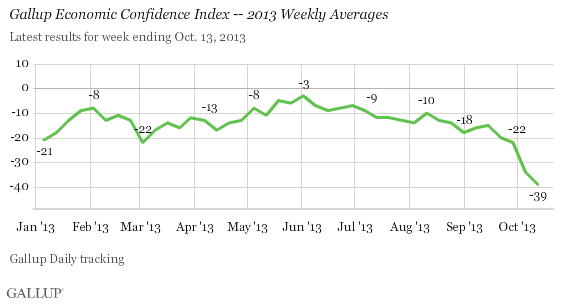
  • Economic confidence - one of the driving forces of a consumer-capitalist system is the willingness of people to spend money on stuff - has dropped as though we're in the middle of another recession.


  • Foreign investors - a serious way to get economic growth happening in our nation - have been scared off by the uncertainty of a political system that kills itself on the whim of a mere handful (32 Far Right Republicans in Congress) who under other circumstances would have no power like this anywhere else.


And there's little hope to be certain that this all won't happen again.  This current deal from the Senate, after all, only delays the fight another three months.  The debt ceiling will come up again as an issue.  The threat of a Shutdown can well happen again even though the Republican Party has been hit HARD by the public's revulsion of how this whole Shutdown came to be.  That's because the Far Right Tea Partier elements of the House GOP - and worse their media elite enablers like Limbaugh and Erickson - have not been fully chastened by their screw-up: some of them have even been emboldened by the publicity they think they've received, that they're still heroes to the Far Right Noise Fear-Making Machine.  As Tomasky says over on the Daily Beast:

Today, we have a clavern of sociopaths who know nothing of honor, and we have no easy way to stop them. Except at the ballot box. Except that they've rigged that, too, with their House districts. They've rigged the whole game so that they light the match and then point at President Obama and shout: “Look! Fire!”...
...This is the worst it’s ever been in modern America. But it is going to get worse. They aren't going to stop hating Obama and Obamacare. They aren't suddenly going to decide to make their peace with him or it. They sure aren't going to decide that gee, using default as leverage is naughty. A big chunk of them want the United States to default on Obama’s watch, so they can then blame him for what they themselves caused, say, “The black guy wrecked the economy. Couldn't you have predicted it?” New horrors await us that you and I, being normal people, can’t begin to dream up. But rest assured, they will...

This is why it is very important to stop voting Republican.  Just stop.  Don't vote for ANY Republican at any level.  They cannot be trusted with the jobs.  They cannot be trusted with government.

Please, for the LOVE OF GOD.  Stop voting Republican.  Get your voter identification switched from "Republican" to "No Party Affiliate" or hell even the "Libertarians" at this point (okay, maybe not). I don't know for how long.  Maybe when they're finally down to just three Representatives from one state and they're all thinking "gee, what's the Modern Whig Party got that we don't?"

Tuesday, October 15, 2013

The Long October: The Ambitious Damage of The Hollow Men

This is how the world ends...

As I'm typing this, the current news out of DC is that the House, scrambling over the last few days to get any kind of bill up to send to the Senate to end the shutdown, pretty much failed to get anything done.  The Senate is more amenable to getting a deal set up, but there still runs the risk of just one Senator - Cruz or Graham or Lee or another - gumming up the works by delaying the vote on it until the Thursday deadline on the debt ceiling passes.  And there's still no guarantee there will be enough votes in the House to accept the Senate version.

The sentiment right now is that pretty much the House GOP, the Tea Party types and their abettors in the Senate like Ted Cruz, are going to let the nation default on the debt.

Between the idea
And the reality
Between the motion
And the act
Falls the Shadow...

I've noted a couple of times that the current Republican Party psyche is geared towards letting the whole thing fail.  They WANT to see what happens if the nation goes into default, they've convinced themselves that it won't be as damaging as all the experts fear it could be.  We're talking about a political party that for the last 20 years or so have been influenced, bullied, led by the likes of Grover Norquist and Rush Limbaugh and a legion of purity agents obsessed with voting out RINOs and moderates who would dare compromise and govern.  A Republican Party where Norquist could openly pine for the chance to make government small enough - through massive tax-cuts and social spending cuts - to "drown in his bathtub."

Ask yourself this: which political party openly thinks that "government is bad" and which openly thinks that government can be managed and made effective and workable?  The Republicans have been the "Government Is Bad" ideologues ever since the Reagan Era, ever since Goldwater when you think about it.  So which one deserves the blame when government falls apart?  Especially when the branch of government where all the destruction is happening - the House - is the one being run by the Republican Party?

Those who have crossed
With direct eyes, to death’s other Kingdom
Remember us—if at all—not as lost
Violent souls, but only
As the hollow men...

The Far Right Republicans, the Tea Party faction, the wingnuts... they have expressed before their admiration of Ayn Rand, of Atlas Shrugged and the belief of enlightened selfishness.  They have each of them in their own way expressed the desire to be as brave and noble and correct as John Galt, self-made Hero of the Revolution of the Elite over the base hollow men that seek to bring the Genius and the Artist to heel.  They want to deregulate everything.  They want to privatize every function of public service to corporations that won't answer to laws or accountability.  They want to kill government to let their Utopia become reality.

But these wingnuts have all proved themselves hollow men, all so eager to tear down the world that other better Americans had formed over the last two centuries.  Uncaring, self-serving, scheming, petty.  Hollow to the core.

This is how the world ends
Not with a bang but a whimper
- TS Eliot, The Hollow Men

UPDATE: the deal's been done, the government's re-opened... but there's been damage done, and the Far Right are still seething. Hollow Men cannot be appeased until they're full of everything they want... and what the Far Right wants is to destroy the United States...

Sunday, October 13, 2013

Presidential Character: Week Thirty-Five, The Reflective Chrome Mask of the New Frontier

They sat on the stony ground/
And he took out a cigarette out/
And everyone else came down/
To listen./
He said "In winter 1963/
It felt like the world would freeze/
With John F. Kennedy/
And The Beatles..." - "Life In a Northern Town" Dream Academy

Let us sit upon the ground and tell sad stories of the death of kings. - William Shakespeare

I grew up in the shade of the John F. Kennedy administration.

Oh, I was born in 1970 but by the time I was in school and learning history JFK had been inserted into the textbooks, which makes it ancient history to me.  But it was still recent enough, much like the Eisenhower years, that I personally knew people - hi Dad, hi Mom! - who were living in that era and coping with the moments as they happened then.

And as I grew up, talking about history at the dinner table or watching the TV shows and the movies and the anniversary specials about Nov. 22nd, it got to be pretty clear that Dad was not a huge fan of JFK.  When I got older to be braver about asking Dad's opinions on JFK I did, and Dad gave a few points on Kennedy's dissembling and dishonesty which to be fair fit a good amount of the textbook materials I'd read to that point.

What did surprise me was when I got to University of Florida and ran into a college history professor who shared the same disdain for Kennedy.  Having gone in with the stereotypical view of professors as liberals, and informed by my Old School Republican Dad of how liberal JFK was, I was just a tad shocked.  And I found myself raising a hand and interjecting that while Kennedy's administrative goals were not as grandly achieved as the hagiographers would make it, I argued that Kennedy was an effective President as someone who inspired action in others, a form of leadership through oratory and forward thinking.

This was about the time I learned of James David Barber's Presidential Character textbook - it might have been the same class - but it was awhile before I read up on Barber's review of Kennedy's tenure to see if I could be right about Kennedy's inspirational qualities.

Was Kennedy a liberal, a conservative, or what?  His energy was apparent, its direction obscure.  He seemed detached, cool, reluctant to commit himself ideologically... Kennedy's priorities - the causes he would be willing to go to the wall for - were unclear... (p.342)
There was not a great deal of talk about "style" in politics before the Kennedys.  The campaign had an elan, a dash and flair... People saw in him what they wanted to: the Irish lad made good, the crisp Harvard mind, the battle-scarred veteran, the scion of unfathomable wealth, the handsome humble fellow destined for mysterious greatness.  Whatever it was, it added up to charisma... For all his apparent modesty - perhaps in part because of that - Jack left people feeling they could do better and enjoy it.  Even then, Kennedy and the Kennedys went around enspiriting people, calling forth their hope... (p.357)

Kennedy as the Inspiration figure: he had crafted for himself a mask of sorts upon which other people's beliefs could find reflection.  The mask itself projected the image of Kennedy being motivated towards accomplishments - fixing the economy, fighting the Russians over Berlin and Cuba, working on civil rights, pushing a space race program to reach the Moon by the end of the decade "not because these things were easy but because they are hard."  To that persona, Barber determined JFK to be an Active-Positive character, considering above all the Adaptive trait that such a veiled identity allowed Kennedy more flexibility in his decisions.

But that mask was also infuriating for people who had to deal with Kennedy, and for both his allies who expected so much more and his enemies who felt his youthful inexperience and weakened Presidential mandate: He barely won a close race against Richard Nixon in 1960, and was balanced by a Congress that was more conservative and demanding than an A-P President would like.

For all the efforts of presenting himself as an ardent defender of the growing Civil Rights movement under Martin Luther King, Kennedy moved about as fast as Eisenhower did during the first few years of his tenure: it wasn't until the lid blew off the cauldron with Birmingham in 1963 that Kennedy got more out in front on the issue.  For all his being a Cold Warrior fighting the Soviets, the Far Right types pushing for a hot war - especially JFK's own Joint Chiefs of the military - were frustrated that Kennedy wouldn't invade Cuba outright nor stop the Soviets from building the Berlin Wall.  And for all of Kennedy's inheritance of the New Deal from FDR and Truman, Kennedy's economic platform seemed more pro-business than even Ike's tenure.

What seemed - still seems - like ineffectiveness to observers was really Kennedy's Active-Positive traits of being Adaptive, Compromising, and less-discussed but more subtle trait of Game-Playing (read Barber's review of the Kennedy family traits that JFK grew up in, p.343 to 347 and elsewhere).  By Game-Playing I mean "being a chessmaster," someone who looked at the board, figured out how the pieces moved, better still figured out why those pieces move that way, and game out a situation (including deal-making compromises) that would lead to wins.  It's also known as "Playing the Long Game," and some of the more successful A-P Presidents are masters of it.

Where the generals wanted war, Kennedy saw the larger picture of global disaster (Mutually Assured Destruction) if the U.S. and U.S.S.R fought each other directly.  Kennedy wasn't too thrilled either to find he'd been lied to about the Bay of Pigs invasion of Cuba: the estimations of support were way off, and the organizers were really operating on the belief that once committed in part (the landing) the U.S. would commit in total (air support) if the invasion floundered.  When Kennedy didn't bite, they felt betrayed... even though they betrayed him first with unrealistic projections.

Like Truman, Kennedy was not keen on war as the ends of any engagement with our Cold War opponents.  When the Soviets began their Wall around Berlin to stop the out-flowing tide of refugees, it was another call to action for the hardliners... but Kennedy held it in check, showing action through calling up more troops to show Khrushchev he was serious, but letting the Soviets finish their wall because it ultimately kept the peace (if more people kept fleeing Eastern Europe it would well have been war).

The biggest test was of course the Cuban Missile Crisis: for all intents the closest the entire planet got to nuclear war.  The United States was still backing exile Cubans to overthrow Castro even with the fiasco of the Bay of Pigs on everyone's mind: the Soviets also weren't thrilled with a set of nuclear warheads placed within Turkey figuratively a stone's throw away from Moscow.  In response, the Soviets sent missiles into Cuba, a figurative stone's throw from Washington DC.  Literally a stone's throw away from Florida.

When the U.S. found out... when the spy plane came back with photographic proof... we entered the 13 most panicked days in American (and global) history.  The generals - Air Force General LeMay in particular - wanted to invade Cuba and hit the missile strikes with air and land assaults before they felt the missiles could be deployed (they didn't know or didn't care to know that some of the missiles were ready to go).  Taking the diplomatic route without a show of strength would have taken too long, given the Soviets and Cubans more time to obstruct and hide their efforts.

Kennedy took the third option (A-Ps usually do): he formed a naval blockade instead, daring the Soviets to cross it in such a way that the burden would be on them.  It wasn't full war, but it was hardline enough to convince Khrushchev and the rest of the Soviets that Kennedy had strength to follow through.  And even as that played across the TV sets, the White House kept communications open with the Soviets, and then jumped on an opportune moment when two different proposals had been floated to take the earlier better deal.  When the crisis ended with a public agreement that the Soviets will remove the missiles and that the U.S. would not invade Castro's Cuba (and a secret arrangement to remove those ICBMs from Turkey), everyone - except the war hawks who wanted to fight the dirty Commies - breathed a sigh of relief.

In all other matters, Kennedy kept playing the long game, stringing out decisions ranging from Vietnam - neither fully committing to efforts there, nor pulling completely out - to the Civil Rights movement.  While not as Confident as Truman had been to make the Big Decision, JFK was more content to work behind the scenes and wait for the right moments.  Even though such moments were running out for him.

As for Kennedy's assassination... well, now is not really the time to discuss it.  A more appropriate moment will be the 50th anniversary - yes it has been that long - coming up this November 22nd.  I'll talk more about it then... and discuss my arguments for one of the conspiracy theories - yes I am a conspiracy nut, I hope I am honest enough to admit to that...

The thing about Kennedy in the final analysis is that he's a mirror to us, to the nation, to our psyche.  We see of him what we want to see: the hopes or fears he generated, the weakness or strength he conveyed, the nobility or the crassness his fans admired and his haters despised.  We apply our theories and our conspiracies on him and his administration, which ended all in "What Ifs" and "Never Weres".  The best we can say is that Kennedy's New Frontier - a dazzling dream of ongoing progress into a shiny chrome future - died with him that day in Dallas: neither of Kennedy's immediate successors had the vision or the skill to pull it off the way Kennedy could (even LBJ, who tried but had his own personality flaws trip him up, but that comes later).  A practical review of the Kennedy years would be doable, but no one would notice because they'll still insist on seeing the ghosts of their beliefs.

We may not get a clear-sighted view of JFK's tenure for another 50 years.

Next Up: The Best Horse-Trading Brow-Beater You'd Ever Meet Who Could Sell You Anything... Just Not The Idea Of Him As President

Saturday, October 12, 2013

The Long October: When The Republicans Had To Notice Their Hostage-Taking Suicide Mission Was Failing

...was pretty much the point when the mainstream media noticed that Nickelback was more popular than Congress.  To which I can only beg: can we please stop picking on Nickelback?  I'm not a fan or anything - I liked them back when they were Foreigner -  but even they didn't do anything to deserve getting compared to Congress...

Actually, the Nickelback thing relates to a poll taken back in January, or maybe February, of this year.  Public Policy Polling held a more recent poll (Oct. 4 to 6) and found out these things were more popular than Congress:
  • Dog poop
  • Toenail fungus
  • Hemorrhoids
  • Cockroaches
  • The IRS (the tax collectors, not the college-radio record label, although I'm pretty sure the record label will poll popular as well)
  • The DMV
  • The Mother-in-Law
  • Public Radio fundraising drives
  • Potholes
  • Zombies (Must be a Walking Dead fanboi thing)
Sadly enough, neither Miley Cyrus nor Lindsey Lohan proved more popular than Congress, which is sad because both those young ladies are still more coherent and (dammit Miley stick that tongue back in!) reasonable than Congress really is. P.S. can we also stop picking on Lindsey Lohan.  Even she doesn't deserve getting compared to Congress...

On a more serious note, that poll showed only 8 percent approved of Congress' job, with a staggering 86 percent disapproving.  Harry Truman never polled lower than 22 percent.  Bush the Lesser never polled lower than 26 percent.  At a Presidential level, their parties suffered with that unpopularity.  Congress ought to see the same negative result: When you poll that low, no matter how you've got your congressional district gerrymandered to your favor, you are losing voters at an exponential rate.

When voters hate you... you tend not to get those voters back to your side.  No matter how short-term their memories are.  Remember Machiavelli's warning: while being loved or being feared helps, being hated is the worst thing a Prince or any person of power can become.

And making it worse for Congress is that this is a lousy time to be dropping your favorables.  The 2014 midterms are not going to be about Obama the way the 2010 midterms were: the President is not going to be up for re-election again, he can live with having his popularity numbers tank as low as Congress' numbers are tanking right now...  except for the fact that Obama's numbers AREN'T tanking, he's actually going up (he's back over 50 percent in one poll) while the Republicans are going down.  The 2014 midterms are going to be about Congress - much in the way the 2006 midterms were, much in the way the 1998 midterms were - and right now every American voter is seeing how messed up the GOP-led House has been behaving.

Even Obama's signature law the healthcare reform AKA Obamacare - the thing the Far Right Republicans were attacking in the first place as an excuse for the shutdown - is growing popular even though A) people still are confused about what it does and B) the rollout of the Obamacare website was an unforced error and still glitchy.

And the polling is showing a majority of those polled hold the Republicans accountable for the very unpopular shutdown mess.

If the Republicans were doing this whole shutdown / debt ceiling fight to embarrass or weaken Obama, they've done a piss-poor job of it.  I can see how the Republicans would think that if they screwed government up enough, make an incompetent mess of it, they could drag everyone's popularity - not just theirs, but also Obama's - down with them.  A kind of kamikaze "taking-you-with-me" scheme.  The Republicans could normally believe in that, considering that their modern ideology revolves around the belief that government is bad for you anyway.

However, committing suicide thinking your hated enemy is going to fall with you isn't the wisest course of action to take.  All it does for you - for your political party - is bring out the hate from the people who would have normally backed your move... all it's doing is pissing off the people who are/were Republicans suddenly inconvenienced by the shutdown you've caused... and not at all happy with the lies they've been told that "Obama is weak and gonna cave to our demands."

Obama didn't cave.  The Democratic Senate didn't cave.  The current status of the shutdown is that the House GOP is trying to negotiate a short-term extension on the debt ceiling - the big threat looming less than a week away - even though Obama and the Senate Democrats are insisting rightly on resolving the debt ceiling for a longer period along with passing a "clean" Continuing Resolution to get government open again.

We're at the point where it doesn't matter who the "winners and losers" are over this crisis: it's pretty clear the Far Right Republicans took a high-risk gamble and lost.  The smart move for the GOP is to make the deal Obama wants, take the hit from their wingnut voters, assure their financial backers to not support any primary challengers for their gerrymandered districts, and work hard to make voters forget this Long October.

Then again, that plan of action is based on there being enough sane and competent Republicans left in government able to do any of that.

/headdesk

Here's hoping the Nickelback/Miley Cyrus/Lindsey Lohan "Suck On This Congress" nationwide tour generates a lot of ticket and t-shirt sales...

Friday, October 11, 2013

Personal Note: My Desktop Monitor is DEAD

My home computer cannot connect to any monitor or digital TV I try to plug in.

The Graphics Card may have quit in protest.

I have no choice now but to work from my laptop until further notice.

This also means I need to generate more money to pay for any repairs to the desktop.

Consider this my BUY MY EBOOKS post for the week.

Hero Cleanup Protocol - via Smashwords.com, although Nook and iBooks readers can access them through the regular retailer websites.

My author's page at Amazon.com - links to my personal anthology Last of the Grapefruit Wars and to the humor-horror anthology Strangely Funny (please also leave reviews if you purchase the titles, thanks)!

I'm working on finishing up a story or two before NaNoWriMo kicks in this November.

Thursday, October 10, 2013

Fantasy-Hoping Tea Partier Ted Yoho Vs. Fact-Based Experts

As part of the ongoing efforts to drive the United States federal government as well as the whole nation over that cliff, there is a discernible faction within the Republican Party known as "default denialists" proclaiming that the debt ceiling isn't that big of a deal and that, hey, defaulting wouldn't be that bad.

One of these idiots is from my state, and worse he's from my alma mater of University of Florida.  Rep. Ted Yoho (Tea Party) is on record saying he won't raise the debt ceiling, and that the United States ought to go broke as a wake-up call of sorts.

His one-liner: "I think, personally, it would bring stability to the world markets."

Yoho's degrees, by the by, are in Agriculture and Veterinary Medicine.  Not in business or finance (both of which ARE taught at UF).  Any financial experience he has mostly relates to running his vet office.

In the meantime, there's a slew of people who actually HAVE college degrees in business and finance, and at least a sizable amount of working in the fields of business and finance, who are absolutely freaking out over the possibility that the U.S. will default.

“We can’t even imagine all the things that might happen, just like Henry Paulson couldn’t imagine all the bad things that might happen if he let Lehman go down,” said Bill Isaac, chairman of Cincinnati-based Fifth Third Bancorp and a former chairman of the Federal Deposit Insurance Corp., referring to the former U.S. Treasury secretary. “It would create chaos in financial markets...”
The market shocks would be enough to tip the U.S. back into recession and drag the world economy down, according to Desmond Lachman, a fellow at the Washington-based American Enterprise Institute. The event could prove to be the trigger that reverses a weak and fragile recovery, said William Cunningham, head of credit portfolios for the investment arm of Columbus, Ohio-based Nationwide Mutual Insurance Co. Lehman’s collapse was a similar spark, he said.
“Is this the straw among other things that tips an economy without drivers of growth back down into a negative spiral?” Cunningham said...
Labeled technical or not, a default is still a default, said Jim Grant, founder of Grant’s Interest Rate Observer.
“People have typically turned to Treasuries as a safe haven, but what will happen when they realize it’s not safe anymore,” said Grant, who has followed interest rates since the 1970s. “Financial markets are all confidence-based. If that confidence is shaken, you have disaster.

You'll notice a lot of the financial sector experts quoted in those paragraphs kept referring back to the Lehman Brothers collapse, which is regarded as one of the prime elements of the 2007-08 Financial Crisis that led to the Great Recession.  They are pointing to a track record, a historical moment well-documented of where a global economic collapse occurred due to a large-scale default that went into the billions of dollars.  (and the Lehman Brothers collapse occurred because the federal government refused to help)  The United States default we're facing due to the impending debt ceiling cap?  That will be in the trillions of dollars.

Failure by the world’s largest borrower to pay its debt -- unprecedented in modern history -- will devastate stock markets from Brazil to Zurich, halt a $5 trillion lending mechanism for investors who rely on Treasuries, blow up borrowing costs for billions of people and companies, ravage the dollar and throw the U.S. and world economies into a recession that probably would become a depression. Among the dozens of money managers, economists, bankers, traders and former government officials interviewed for this story, few view a U.S. default as anything but a financial apocalypse.

Just for the record, my degree from University of Florida is in Journalism, which gives me some expertise writing this blog.  I've got a Masters in Library Information Sciences from University of South Florida, which gives me some expertise in research, finding relevant resources, and sharing of information.  I may not have a degree in finance, but I know where I can find the ones who do and I can ask them.  And what they're saying carries more weight than a Teabagging whack job who's ruining one of my university's reputation by talking like a self-serving idiot.

It's like Yoho wants to drive this car over the cliff just to prove something.

Dear University of Florida: can you revoke Ted Yoho's degrees?

Wednesday, October 09, 2013

The Long October: How It Came To This, a Followup Post

Following on a previous thought about how we as a nation got to this shutdown debacle, and how this all echoes back to the obstruction / nullification follies of the 1860 Southern Democrats as well as the shifting of conservative ideology whole-heartedly into the modern Republicans due to the Southern Strategy, I'd want to add a few more thoughts on this, and at best from another person who's been thinking about the same problems and doing a better job of discussing it.

Zack Beauchamp over on ThinkProgress had a great article today on the whole thing: How Racism Caused The Shutdown...
...A lot of people think the only way that racism “causes” anything is when one person intentionally discriminates against another because of their color of their skin. But that’s wrong. And understanding the history of the forces that produced the current crisis will lay plain the more subtle, but fundamental, ways in which race and racism formed the scaffolding that structures American politics — even as explicit battles over race receded from our daily politics.
The roots of the current crisis began with the New Deal — but not in the way you might think. They grew gradually, with two big bursts in the 1960s and the 1980s reflecting decades of more graduated change. And the tree that grew out of them, the Tea Party and a radically polarized Republican Party, bore the shutdown as its fruits...
But the Depression-caused backlash against Republican incumbents that swept New Yorker Franklin Roosevelt into the White House and a vast Democratic majority into Congress also made Southerners a minority in the party for the first time in its history... Yet, Reed notes, the New Deal not only benefited blacks, but brought them to a position of power in the Democratic Party. “The Social Security exclusions were overturned, and black people did participate in the WPA, Federal Writers’ Project, CCC and other classic New Deal initiatives, as well as federal income relief,” he reminds us. “Black Americans’ emergence as a significant constituency in the Democratic electoral coalition helped to alter the party’s center of gravity and was one of the factors–as was black presence in the union movement–contributing to the success of the postwar civil rights insurgency.”
...UC-Berkeley’s Eric Schickler and coauthor Brian Feinstein built a database of state party platforms from 1920-1968 and examined their positions on African-American rights. They found that “the vast majority of nonsouthern state Democratic parties were clearly to the left of their GOP counterparts on civil rights policy by the mid-1940s to early 1950s.” African-Americans and other sympathetic New Deal Coalition constituencies, like Jews and union leaders, deserve the bulk of the credit — these new Northern Democrats made supporting civil rights a litmus test for elected Democratic officials. That explains why, from the Early New Deal forward, congressional Northern Democrats voted more like Northern Republicans than their Southern brethren on civil rights...

That last bit kinda helps explain the hostility Southern states still have (the "Right to Work" laws that are nothing but) towards unions... but I digress.  Continuing on:

...Hence the famous Dixiecrat revolt of 1948, when Strom Thurmond and like-minded Southerners temporarily seceded from the Democratic Party over Harry Truman and the Democratic platform’s support for civil rights. The tacit bargain that Katznelson documents during the Roosevelt Administration, in which the Northern Democrats would get their New Deal if the Southern Democrats got their white supremacy, became untenable.
But the Dixiecrats weren’t ready to migrate en masse to Party of Lincoln just yet. Something needed to happen to make the Republican Party shed its commitment to leading on civil rights wholesale. That “something” was the rise of the modern conservative movement...
...By the Johnson-Goldwater election, it had become clear that overt racism and segregationism was politically doomed. Brown v. Board of Education and LBJ’s support for the 1964 Civil Rights Act saw to that. As this scary recognition dawned on Southern whites, they began searching for a new vehicle through which to shield themselves and their communities from the consequences of integration. The young conservative movement’s ringing endorsement of a minimalist federal government did the trick — it provided an on-face racially neutral language by which Southerners could argue against federal action aimed at integrating lily-white schools and neighborhoods...
...The Reagan realignment of the 1980s dramatically expanded the number of Republicans and conservative independents in the region’s electorate.” The Blacks attribute this to a combination of Reagan’s winning political personality and (more persuasively) the relative prosperity of the 1980s. Not only were white conservatives ideologically inclined to support Reagan’s Republican Party, but they became wealthier on his watch...
...The South’s conversion to movement conservatism led to local and Congressional Republican victories throughout Dixie. These culminated in the Gingrich Revolution in 1994, when hard-line Southern conservatives took charge of the Republican Congressional delegation, seemingly for good...
We all know what happens next. The Southern conservative takeover of the Republican Party pushes out moderates, cementing the party’s conservative spiral. This trend produces the Tea Party, whose leading contemporary avatar — Ted Cruz — engineers the 2013 shutdown and risk of catastrophic default...

It's all there. The obsession with Southern politicians to dismantle everything New Deal, which was the breaking point of the Jim Crow era. The merging of conservative ideologies that were previously unwedded - race, economics, religion - into a broad movement.

From this point, Beauchamp draws his conclusions:

...First, that the shutdown crisis isn’t the product of passing Republican insanity or, as President Obama put it, a “fever” that needs to be broken. Rather, the sharp conservative turn of the Republican Party is the product of deep, long-running structural forces in American history. The Republican Party is the way that it is because of the base that it has evolved, and it would take a tectonic political shift — on the level of the Democrats becoming the party of civil rights — to change the party’s internal coalition. Radicalized conservatism will outlive the shutdown/debt ceiling fight.
Second, and more importantly, the battle over civil rights produced a rigidly homogeneous and disproportionately Southern Republican party, fertile grounds for the sort of purity contest you see consuming the South today. There’s no zealot like a new convert, the saying goes, and the South’s new faith in across-the-board conservatism — kicked off by the alignment of economic libertarianism with segregationism — is one of the most significant causes of the ideological inflexibility that’s caused the shutdown. That’s not to dismiss the continued relevance of race in the Southern psyche. There’s no chance that, when 52 percent of voting Americans are over 45, the country has just gotten over its deep racial hang-ups. Read Ta-Nehisi Coates’ masterful “Fear of a Black President” if you don’t believe me...
As the Southern faction became the face of the GOP in the mid-90s, the GOP’s electorate became a lot more conservative nationally. Panel data reviewed by Alan Abramowitz and Kyle Saunders found that, from 1992-1996, ideological conservatives joined the Republican Party in droves. That’s because Southern elites played a key “signalling” role; their prominent national conservatism signaled to conservatives around the country that the Republican Party was theirs.
Penn’s Matthew Levendusky, who literally wrote the book on conservatives “sorting” themselves into the Republican Party, says that “even when the data are consistent with a nationalization hypothesis, the South still played a crucial role in the sorting process because of the key role of Southern elites.” As conservative Southern elites took over the Republican Party, hyper-conservative Americans followed, becoming the GOP primary voters we know and love today...

Given the evidence that Beauchamp puts together, he paints a situation where a very lopsided Far Right national political party - the modern GOP - has set itself up with an ideology driven by Southern factional needs.  While it's not as overtly racist as it once was, the attitude is still there: the hatred of any kind of social service that could benefit minorities even though whites benefit as well; open contempt for voting rights by way of pursuing voter purges that disproportionately affect minorities; the desire to shut down a federal system that upholds such things as due process and citizenship rights.

The biggest reason this Long October is going to be long: The modern Republican Party is still fighting the Civil War... and the Reconstruction... and the New Deal... and the 1960s... as well as Obamacare and Obama himself.  It's been a long war already, and it's not over yet...

Tuesday, October 08, 2013

The Long October: Pretty Good Idea About WHY the Far Right Is Pushing For Default

Well, other than the fact that the Far Right in the House GOP are convinced that Obama is to blame for everything and must be defeated at all hazards, there's this little tidbit - "Crisis? What Crisis?" - coming out of the Capitol Building (via David Weigel over at Slate):
That’s how plenty of House Republicans, who remain the prime movers in the shutdown crisis, are looking at the terrain. They were told for years that a shutdown would be a disaster for the economy and their party. They were told the same thing about sequestration. Neither crisis has really lived up to the end-of-times hype, especially not in their districts. The worst effects, the ones constituents ask about, appear to them to be engineered by a vindictive Obama administration. And they expect the same if they fail to raise the debt limit—a crisis manufactured by Obama, not by them.

To be fair, the wingnuts have a valid point: nobody is really certain what will happen if the debt ceiling gets capped and the nation defaults.

This is despite the fact that there's a lot of financial experts - bank CEOs, Wall Street institutions, foreign investors - are freaking out that if the United States defaults due to the debt ceiling, the global reactions would be on the scale of the 2007-08 banking collapse.

To the Far Right Congresscritters driving this crisis, it's STILL all a bluff on Obama's part.

This is due to the fact that the Far Right are neither true conservatives - who by nature would be cautious and alert to potential hazards - nor real thinkers - they cannot perceive the potential of future effects, they can't ask the "what ifs".  To these people, the only thing that matters is the immediate recognizable past and the immediate NOW, things that can be perceived and understood.  And for what they know, the last time this was a crisis - in 2011 - the worst thing that happened was a slip in the Credit Rating from AAA to AA.  The nation and the planet kept chugging along.  And before that, the major disaster was the banks failing in 2007, which the Far Right still believes was a problem with housing markets and a corrupt Fannie Mae/Freddy Mac system (which is wrong in different ways).

The Far Right can only experience and understand the NOW, what happens in the moment and no further.  And to them, there's really no sign that a default or refusal on the debt ceiling would really cause any serious, long-term, or even permanent harm.

This is akin to a car driver speeding along a narrow cliff-side highway overlooking the Pacific Ocean.  They've been told in driver's ed class of the danger going off the road, and they've had gravity explained to them in physics and astronomy, but that driver really doesn't know what it's like to drive that car off that cliff.  And it's not even a suicidal impulse on the part of the driver: he just honestly doesn't know what will happen once the tires leave the road and the car goes spinning off into the blue.

For all the Far Right driver knows, the car won't even get dinged up all that bad, that the impact into the water won't be that harsh, that there aren't rocks hiding in those waves, and that after all the car is designed to survive impacts or at least protect the passengers from serious injury.  The Far Right driver can expect a thrilling rush, the taste of danger, and then let the airbags deploy and the driver can swim away and let the insurance company buy a replacement car.

And if that all doesn't work out, that Far Right driver can always ALWAYS fall back on the excuse that the car going over the cliff was Obama's fault.  Even though Obama was in the back seat the whole time since the Constitution doesn't allow him to set the budget, uh drive the car, and Obama was the one screaming the whole time at the driver to fucking stop before that car went over the cliff.  "Gee, if Obama didn't make all that screechy noise when the car punched over the guard rail..."

THIS now makes a whole lot more sense.  The Far Right have no qualms about driving the entire government AND the entire financial sector over that cliff... simply because they really don't know, and they really don't CARE to know, what might actually happen if they do.  The wingnuts seem to genuinely think the whole thing's a bluff to make them "surrender" to Obama.

Despite the fact that gravity is real.  Despite the fact that defaults are real.

Welcome to The Long October.

Monday, October 07, 2013

Ongoing Reports From The Long October

I'm trying to come up with some poetic-sounding names for the Shutdown Showdown of 2013, and right now "The Long October" is about as good as I can think of a name.

Because for the most part we're now expecting the current Shutdown to merge into the scheduled Debt Ceiling crisis set for October 17th, simply because the House Republicans are driving the nation off the cliff (via Jonathan Chait at the New York):

...Last Tuesday, House Republicans shut down the federal government, demanding that Obama abolish his health-care reform in a tactically reckless gamble that most of the party feared but could not prevent. More surreal, perhaps, were the conditions they issued in exchange for lifting the debt ceiling later this month. Lifting the debt ceiling, a vestigial ritual in which Congress votes to approve payment of the debts it has already incurred, is almost a symbolic event, except that not doing it would wreak unpredictable and possibly enormous worldwide economic havoc. (Obama’s Treasury Department has compared the impact of a debt breach to the failure of Lehman Brothers.) The hostage letter House Republicans released brimmed with megalomaniacal ambition. If he wanted to avoid economic ruin, Republicans said, Obama would submit to a delay of health-care reform, plus tax-rate cuts, enactment of offshore drilling, approval of the Keystone pipeline, deregulation of Wall Street, and Medicare cuts, to name but a few demands. Republicans hardly pretended to believe Obama would accede to the entire list (a set of demands that amounted to the retroactive election of Mitt Romney), but the hubris was startling in and of itself.
The debt ceiling turns out to be unexploded ordnance lying around the American form of government. Only custom or moral compunction stops the opposition party from using it to nullify the president’s powers, or, for that matter, the president from using it to nullify Congress’s. (Obama could, theoretically, threaten to veto a debt ceiling hike unless Congress attaches it to the creation of single-payer health insurance.) To weaponize the debt ceiling, you must be willing to inflict harm on millions of innocent people. It is a shockingly powerful self-destruct button built into our very system of government, but only useful for the most ideologically hardened or borderline sociopathic. But it turns out to be the perfect tool for the contemporary GOP: a party large enough to control a chamber of Congress yet too small to win the presidency, and infused with a dangerous, millenarian combination of overheated Randian paranoia and fully justified fear of adverse demographic trends...

We're basically unable to do anything about the current Shutdown: the Democrats are attempting to force a vote on the House floor for a "clean Continuing Resolution" using an obscure mechanism called a "discharge petition", but to pull it off they seemingly need more than 17 Republicans to commit publicly to vote for it.  And while there's a solid number of anonymous House Republicans complaining about the Far Right taking their own party hostage during these "negotiations", only two of them have been brave up to stand up... because if anyone else did so they'd be primaried within a heartbeat.

Molly Ball at The Atlantic makes the observation that Republicans are the one voting bloc that refuses to compromise (the poll is linked from her article):


Republicans, it seems, are different: They value compromise far less and principle far more than other Americans. In refusing to give ground, then, Republican politicians are reflecting their base's priorities.
This result helps explain more than just GOP intransigence, it seems to me. It also helps explain the parties' mutual incomprehension. Since Democrats value compromise by such an overwhelming margin, they assume their opponents do too. But Republicans, it turns out, are wired a bit differently.

Andrew Sullivan makes the observation that the Republicans aren't so much refusing to compromise, it's that they can't accept the reality of the situation and are grasping at anything:

They say they want to reverse what they see as the end of American freedom because of the dawn of public subsidies for private insurance policies, based on a Heritage Foundation idea and implemented by their last presidential nominee in his home state. Okay, so how about running a campaign for Congress and presidency that explicitly promises to repeal Obamacare entirely? Oh, yes, they already did that and lost. How about upping the ante and making it explicit in the campaign that this is the very last chance to end Obamacare and save America? Oh, yeah, I forgot. They did that too. So what do they want? I’m not sure they even know.

Even though there's another poll, this time on approval ratings for the parties involved - Obama, Democrats in Congress, and Republicans in Congress - and showing why this is still a serious problem for Republicans continuing this path to self-destruction:


Problem with that poll is while the numbers show the Republicans in trouble with Americans overall (at 70 percent disapproval), the House GOP are only worried about the Americans (Tea Partiers) in their gerrymandered districts (and yes, the gerrymander is one of the things at fault here), and most of them are in the 24 percent bracket still approving of their hostage-taking BS.

This is going to be a Long October after all.

I only hope this won't interfere with trick-or-treating... 'cause if our kids can't trick-or-treat due to an economic collapse then we are going to see some SERIOUS street riots led by kids dressed up in superhero costumes and wielding plastic pirate swords.  CANDY OR DEATH!  CANDY OR DEATH...!

Saturday, October 05, 2013

Presidential Character: Week Thirty-Four, Why DID Everyone Like Ike?

So, Professor Barber, why DID everyone like Ike, uh Dwight D. Eisenhower?
...Furthermore, Eisenhower often displayed optimism; he was certainly no gloomy Gus in the White House, though he was often irritable and depressed... (Presidential Character, p. 179)
...Eisenhower did not feel a duty to save the world or to become a great hero, but simply to contribute what he could the best he was able... Yet Eisenhower very much wanted to make a contribution.  Once while laboring over a speech he said, "You know, it is so difficult.  You come up to face these terrible issues, and you know that what is in almost everyone's heart is a wish for peace, and you want so much to do something..." (p.182)

To this, even with Barber's assertion Eisenhower was a Passive-Negative Character:
The key orientation is toward performing duty with modesty, and the political adaptation is characterized by protective retreats to principle, ritual and personal virtue.  The political strength of this character is its legitimacy.  It inspires trust in the incorruptibility and the good intentions of the man... (p.182)

Eisenhower came to the Presidency as the commanding general of European forces during the Second World War, one of a select group of non-political generals - Washington and Taylor - to do so (other generals like Grant, Hayes and Garfield - mostly from the Civil War - had been converted into true Republicans as part of their response to the war and Reconstruction politics).  How he came to be the general-in-chief of a major theater of war speaks to his basic character traits of Modesty and (for the Passive-Negative) Duty.

Eisenhower was not the best-known candidate for the job of representing the U.S. among the Allied forces against Hitler's Axis.  He'd been a middle-of-the-pack officer pretty much from West Point onward, and while he'd worked hard to earn his promotions up to colonel by 1940 he still lacked a few things such as battlefield experience.  But he knew tanks and how to deploy them, impressed during the training exercises before the U.S. entered the war (by 1940 FDR's administration and the Army both knew war was coming), and got promoted up to brigadier general on the eve of conflict.

One joke floating around was that General George Marshall, the head of the whole Army at the time, promoted Eisenhower to head up Allied efforts in Europe because Eisenhower had served as an aide to General MacArthur, and that the experience of massaging that huge ego made Ike the best expert to keep the British and French allied generals in line.  But the truth of it was Marshall saw in Eisenhower the organizational skills needed to manage such a massive endeavor, and the sense of Duty to the cause to make it work.

Marshall must have seen something else, the unique trait Eisenhower had that no other P-N character showed: Ike was unusually optimistic and forward-thinking.  He didn't see disasters as such, he saw them as opportunities.

During the beginning stages of the Battle of the Bulge in December 1944, Eisenhower met with his subordinate generals about counter-offensives.  Rather than take the gloomy approach that the unexpected German offensive could divide the Allied front and prolong the war, Eisenhower saw it as a chance to finally get the Germans out in the open and finished off rather than slogging through a potentially massive defensive effort.  He's on record saying "The present situation is to be regarded as one of opportunity for us and not a disaster.  There will be only cheerful faces at this table."  He then turned to General Patton - his blood knight - and asked how quickly they could relieve the American paratroopers at Bastogne.  Patton said 48 hours, and pulled it off.

Making the call on D-Day.  The weather for early June 1944 was wet, rainy, windy, terrible for beach landings and paratrooper drops.  The Germans, having developed excellent profiles on opposing generals, figured Eisenhower's overly cautious nature would never give the order to go in bad weather.  And in most cases for a P-N character they'd be right.  But there was that optimism: the Allied meteorologists told Ike there was a chance the morning of June 6th would have a slight window before dawn to work out.  Knowing that June was the last best chance to get into Europe before summer turned into winter, and that he needed to go sooner or later, Eisenhower went against his nature (ironically, his sense of Duty to get the landings over with made him do it) and made the call.  Even then, he knew it was a giant risk.  He wrote one letter praising the troops and cheering them onto victory.  He wrote a second letter in case the landings failed, and insisted that any blame be put on him ("It is mine alone.").

It was not only Eisenhower's judgment... it was not only Eisenhower's organizational skills... it was Eisenhower's Modesty, his acceptance of Duty, his non-Negative sense of Optimism in others that made him so likable.

And that likability made him the hot political ticket once World War II ended.  Like his predecessor Taylor, Eisenhower had made it a point to not even vote in elections up until 1948 or so (both Democratic Party leaders and Republicans sent out feelers).  He preferred at the time to retire out as Chief of Staff (having reorganized the entire military into the Department of Defense) and serve as school President at Columbia U.  By 1950 he accepted the call back to duty by becoming the commander of NATO forces and used his organizational skills to make that nascent military alliance work.  By 1952, with the nation deeply mired in Korea, and pressed ever more by the people around him, Ike acceded to the demand he run for office.

And he won in massive landslides (1952 and re-election 1956).  "I Like Ike" being one of the most successful - and obvious - campaign slogans of all time.

But Eisenhower didn't enter the White House at an easy time.  Solving Korea - with an armistice that has yet been resolved to this day - was one thing but the Cold War - an ongoing chess match with the Soviet Union over Europe, Asia and the Middle East - was something else.  The Cold War affected domestic issues in the form of political witch hunts (the Red Scare) led by a glory-hogging Joseph McCarthy.  And other domestic issues involved the growing Civil Rights movement that started with Truman's desegregation of the military and was moving on towards public services and education.

Eisenhower's Passive-Negative traits did not put him in with the Far Right forces of the Republican Party, obsessed as they were with hunting down suspected Communists throughout society.  But it made it difficult for him to openly confront the likes of McCarthy.  To Ike's credit, McCarthy self-destructed by going after too many targets that wanted to fight back, especially Ike's beloved Army, and he used that distance to let McCarthy bury himself which pretty much quieted down the anti-Communist fervor for the rest of the Fifties to a low boil.

As Barber noted, Eisenhower may have fit for the most part into the P-N category but as President Eisenhower defied certain traits through both his habits and his optimism.  By habits I mean his organization: the West Wing as we know it - with a Chief of Staff, organized departments handling communications, interdepartmental issues, and policy essentials - came entirely from Eisenhower.  By his optimism I point to how Eisenhower not only kept New Deal era economic policies that worked (where the Republicans would have considered them no longer essential once the economy was chugging along and the War Effort was over), but pushed his own national agendas such as the Interstate Highway system.

If Ike had weaknesses it was a maddening level of complacency, his hands-off approach to how the various departments in the Executive branch handled themselves as well as a hands-off approach with dealing with Congress.  On one hand Eisenhower's two-term administration was relatively free of scandal - the worst was that his Chief of Staff was caught lying about an oriental rug and fur coat his wife had received as gifts - but on the other the administration allowed some branches - especially the CIA with their activities in Iran and Central America - a wide scope of questionable activity.

And while Eisenhower continued Truman's work on Civil Rights - Ike declared discrimination a "National Security issue" because Communists used it as an argument against American democratic ideals - he didn't pursue it as aggressively as Truman had.  He worked with Congress to pass legislation to create offices for civil rights investigations in the Justice Department but left them ill-defined and underfunded.  In the best respect Eisenhower's greatest achievement was calling out the National Guard and 101st Airborne to Little Rock Arkansas to enforce the court rulings to desegregate schools.  But past that Eisenhower's administration did not aggressively pursue methods to end segregation in businesses and communities: Ike would only go so far in the use of executive authority.  Passive-Negatives do not like using the full weight of the Executive branch the way an Active-Positive or Active-Negative would.

Eisenhower's legacy as President was mixed when he left office and it wasn't until well into Clinton's tenure that a better understanding of Ike's performance as leader could be seen.  The argument against him was that Eisenhower didn't "do anything," (my own father, Old School Republican that he is, said this today as I was writing portions of this article over at the parental units' home, they needed help updating their computer stuff, anyways I digress) especially in the face of McCarthyism and the growing Civil Rights fight.  But in other ways Ike did in office what was expected of him: the mentor figure, the retired general / father figure neither passionate nor angry, reserved in judgment and basically right on all matters.  He focused on the job at hand and oversaw a relatively stable period of post-war growth and adjustment.  His pursuit of the Interstate Highway construction proved one of the biggest job creating government programs in history - bigger than any New Deal project - and had a major impact on interstate commerce, population growth and dispersal, and development of cultural trends (car culture, travel, etc).

Above all, much like his Passive-Negative model of old - George Washington - Eisenhower may well have been the last true non-partisan figure in American 20th Century politics.  Republican more by necessity than ideology, Eisenhower was a self-described moderate who sought to balance out the Far Right McCarthyist elements of the party through his personal example and calls for common sense solutions.  Conservative only in action rather than thought, Eisenhower today is the go-to figure of moderates (whoever may be left) within the modern GOP.

Next up: The key word is survival on the New Frontier (sorry, I keep thinking of that Donald Fagan song)

Wednesday, October 02, 2013

The Cooper Union Speech Shows Us the War Is Not Really Over

(NOTE: Had to edit for an accidental grammar error)
As the Shutdown Showdown of 2013 continues unabated - and in fact may get worse - more and more critics of the modern GOP's hardline stance find themselves referring to Abraham Lincoln and the Cooper Union speech he gave before the November 1860 elections (before he even won the nomination for the Republican Party of that age).

Here's a link to the Cooper Union speech as provided by the National Parks Service:


Oops.

Here's another link that might still be up.  Most of the first half of the speech is Lincoln setting up his lawyer's argument about how the Constitution came to be, how the Founders themselves spelled out their opposition to slavery's extension, and how the Republicans of 1860 were adhering to that argument - stopping slavery's spread not slavery itself - against the wild accusations and demands of the Southern Democrats.  The Southern states even by that date were threatening open secession unless they got their way.  Lincoln eventually gets to the meat of the speech to argue against that, the part of the speech everyone's quoting:

But you will break up the Union rather than submit to a denial of your Constitutional rights.
That has a somewhat reckless sound; but it would be palliated, if not fully justified, were we proposing, by the mere force of numbers, to deprive you of some right, plainly written down in the Constitution. But we are proposing no such thing.
When you make these declarations, you have a specific and well-understood allusion to an assumed Constitutional right of yours, to take slaves into the federal territories, and to hold them there as property. But no such right is specifically written in the Constitution. That instrument is literally silent about any such right. We, on the contrary, deny that such a right has any existence in the Constitution, even by implication.
Your purpose, then, plainly stated, is that you will destroy the Government, unless you be allowed to construe and enforce the Constitution as you please, on all points in dispute between you and us. You will rule or ruin in all events.

If the arguments, nay demands, of the 1860 Southern Democrats sound a lot like the rhetoric of the 2013 House Republicans and their Far Right spokespeople in the media, don't be surprised.  A lot of this has to do with the Southern Strategy of the Republican Party under Nixon back in the 1970s.

The South as a voting bloc had been virulently pro-slavery since the 1820s (perhaps even earlier), and when slavery bit the dust post-Civil War and post-13th Amendment the South went virulently anti-Black.  That region of the nation was basically allowed to act that way for roughly 100 years because the North got tired of trying to fix that shit and collectively gave up.  The only reason the United States took the Civil Rights efforts of Black Americans seriously by the 1960s was because of public relations: as a global power pushing for liberty against the wave of Soviet oppression, it was hypocritical of us to deny our own citizens their own freedom and rights under the law.

As the Democratic coalition fractured by 1968 with the Dixiecrats falling in power within their own ranks, the Republicans behind Goldwater and Nixon took notice and realized the South as a voting bloc was surprisingly tight (and growing as business markets shifted southward into Texas and Florida) and could be merged to the economic and religious conservatism of the GOP.  By the time of Reagan in 1980, he was able to put together a cultural/economic/religious voting bloc that led to a dynamic pro-Republican shift in the electoral system.

But now we're seeing the problem of going with the Southern Strategy.  By allowing a platform for the basically racist elements of the southern conservatives, the Republicans unwittingly (or even worse, willingly) allowed that strain of hate to spread to the other conservative elements of the party.  Why we're seeing Republicans from non-Southern places like Iowa and Ohio and California railing against social welfare services like food stamps is from the underlying belief that the primary recipients of social aid are Blacks and other minorities.

Joan Walsh in her Salon article:

Today, the entire government has been taken hostage by leaders elected by this crazed minority, who see in the face of Barack Obama everything they've been taught to fear for 50 years. Start with miscegenation: He’s not just black, he’s the product of a black father and a white mother. (That helps explain an unconscious motive for Birtherism: They can’t get their minds off the circumstances of his conception and birth.) With his Ivy League degrees, they are sure he must be the elitist beneficiary of affirmative action. Steeped in Chicago politics, he’s the representative of corrupt urban machines controlled by Democrats – machines that ironically originated with the Irish and once kept African-Americans down, but which are now synonymous with corrupt black power...

Obama's brought all this hatred out in a big way.  Part of the open hatred the GOP and the Far Right have towards Obama is that he's a Democrat interrupting the Glorious Pax Reaganicus Era of tax cuts, deregulation, and Commie-bashing (even though tax cuts didn't work, deregulation is why we're in our current mess, and Commie-bashing went out when Communism did).  But a lot of that hate is because of who Obama is as a person: they flat out can't accept him as an American at all, which is where the Birther obsession and the Kenyan Socialist obsession and Secret Muslim bomb-thrower obsession all come from.  That's not because he's a Democrat: Clinton never got this level of outrage, at worst he was a philandering pot-smoking hippie to them.

But racism is only part of the problem here.  The Southern Conservative mindset is obsessed with "their" rights above the rights of everyone else.  To them, they've got a right to abide their own laws, they've got a right to ignore laws they don't like.  The old strain of Nullification, the belief in State Rights that under the 10th Amendment they can do anything at the state level and to hell with anything federal law or Supreme Court interpretations of federalism - say, the court's approval of the Health Care Reform law (aka Obamacare) - have to say about it.

The Southern Conservative - the template of the modern Far Right wingnut - has no true love for the Federal Government, especially not a Federal government that insists on civil rights or regulatory practices.  The Republican outrage towards a 14th Amendment that both applies due process to all states and recognizes equal citizenship to all Americans is as much a target of their anger as Obama himself.

And all that anger, all that frustration has led them to this shore.  To a point where they don't mind - hell, they WANT to do this - shutting down the federal government the Far Right wingnuts view as The Enemy.

The Civil War is not over.  Not as long as there are wingnuts out there convinced of their radicalism - as Sully notes, this hasn't been true conservatism in ages - against the very concept of a United States of America.  No matter how much they try to wrap themselves up in the Stars And Stripes, they've made it abundantly clear they are the banner carriers of the Stars And Bars.  The Far Right Wingnuts want to Nullify laws they don't like.  They want to punish - if not banish - political leaders they don't like.

The Far Right Wingnuts want to rule or ruin.  We've seen them rule and it wasn't pretty.  Now they want to ruin.  At all costs.  And the way the situation is now, they're ruining us no matter what the rest of the nation wants.

For the LOVE OF GOD, stop voting Republican.


A Thing Or Two About Anonymous Comments

Just to let you know, there is a practical reason for NOT posting as Anonymous to this blogger.com hosted site:

Anonymous comments can end up in the SPAM folder.

I'd also like to add another thing about Anonymous comments:

I'm not a huge fan of them.

So far, my experience with Anonymous posters have been bleak and rude and very unhelpful.  I've found that the Anonymous people accuse me of being things I'm not, relishing the fact that since I can't tell who they are I can't return the favor other than pointing out their folly (which they'll ignore anyway).  I've found that the Anonymous person to be something of a coward, refusing to put their name to a political position, preferring to hide in the shadow and think themselves clever for hiding so well.

If I ever post an Anonymous Trolling Comment of Little Worth, it's because I want to make a point of how foolish that troll's comment really is.  Most of the rest of them I leave in the SPAM folder.

If you want to leave a comment, do so.  But have the decency to put your name to it, especially if you're going out of your way to insult somebody.  If you're insulting me, heh, I can laugh it off.  I've survived middle school: I've heard worse.  Insult someone else, you'll get called on it.  But own up to what you write: you owe yourself that much.  If you can't respect yourself to put your name to your opinion, how the hell should you expect us to respect you for it?