Saturday, October 12, 2013

The Long October: When The Republicans Had To Notice Their Hostage-Taking Suicide Mission Was Failing

...was pretty much the point when the mainstream media noticed that Nickelback was more popular than Congress.  To which I can only beg: can we please stop picking on Nickelback?  I'm not a fan or anything - I liked them back when they were Foreigner -  but even they didn't do anything to deserve getting compared to Congress...

Actually, the Nickelback thing relates to a poll taken back in January, or maybe February, of this year.  Public Policy Polling held a more recent poll (Oct. 4 to 6) and found out these things were more popular than Congress:
  • Dog poop
  • Toenail fungus
  • Hemorrhoids
  • Cockroaches
  • The IRS (the tax collectors, not the college-radio record label, although I'm pretty sure the record label will poll popular as well)
  • The DMV
  • The Mother-in-Law
  • Public Radio fundraising drives
  • Potholes
  • Zombies (Must be a Walking Dead fanboi thing)
Sadly enough, neither Miley Cyrus nor Lindsey Lohan proved more popular than Congress, which is sad because both those young ladies are still more coherent and (dammit Miley stick that tongue back in!) reasonable than Congress really is. P.S. can we also stop picking on Lindsey Lohan.  Even she doesn't deserve getting compared to Congress...

On a more serious note, that poll showed only 8 percent approved of Congress' job, with a staggering 86 percent disapproving.  Harry Truman never polled lower than 22 percent.  Bush the Lesser never polled lower than 26 percent.  At a Presidential level, their parties suffered with that unpopularity.  Congress ought to see the same negative result: When you poll that low, no matter how you've got your congressional district gerrymandered to your favor, you are losing voters at an exponential rate.

When voters hate you... you tend not to get those voters back to your side.  No matter how short-term their memories are.  Remember Machiavelli's warning: while being loved or being feared helps, being hated is the worst thing a Prince or any person of power can become.

And making it worse for Congress is that this is a lousy time to be dropping your favorables.  The 2014 midterms are not going to be about Obama the way the 2010 midterms were: the President is not going to be up for re-election again, he can live with having his popularity numbers tank as low as Congress' numbers are tanking right now...  except for the fact that Obama's numbers AREN'T tanking, he's actually going up (he's back over 50 percent in one poll) while the Republicans are going down.  The 2014 midterms are going to be about Congress - much in the way the 2006 midterms were, much in the way the 1998 midterms were - and right now every American voter is seeing how messed up the GOP-led House has been behaving.

Even Obama's signature law the healthcare reform AKA Obamacare - the thing the Far Right Republicans were attacking in the first place as an excuse for the shutdown - is growing popular even though A) people still are confused about what it does and B) the rollout of the Obamacare website was an unforced error and still glitchy.

And the polling is showing a majority of those polled hold the Republicans accountable for the very unpopular shutdown mess.

If the Republicans were doing this whole shutdown / debt ceiling fight to embarrass or weaken Obama, they've done a piss-poor job of it.  I can see how the Republicans would think that if they screwed government up enough, make an incompetent mess of it, they could drag everyone's popularity - not just theirs, but also Obama's - down with them.  A kind of kamikaze "taking-you-with-me" scheme.  The Republicans could normally believe in that, considering that their modern ideology revolves around the belief that government is bad for you anyway.

However, committing suicide thinking your hated enemy is going to fall with you isn't the wisest course of action to take.  All it does for you - for your political party - is bring out the hate from the people who would have normally backed your move... all it's doing is pissing off the people who are/were Republicans suddenly inconvenienced by the shutdown you've caused... and not at all happy with the lies they've been told that "Obama is weak and gonna cave to our demands."

Obama didn't cave.  The Democratic Senate didn't cave.  The current status of the shutdown is that the House GOP is trying to negotiate a short-term extension on the debt ceiling - the big threat looming less than a week away - even though Obama and the Senate Democrats are insisting rightly on resolving the debt ceiling for a longer period along with passing a "clean" Continuing Resolution to get government open again.

We're at the point where it doesn't matter who the "winners and losers" are over this crisis: it's pretty clear the Far Right Republicans took a high-risk gamble and lost.  The smart move for the GOP is to make the deal Obama wants, take the hit from their wingnut voters, assure their financial backers to not support any primary challengers for their gerrymandered districts, and work hard to make voters forget this Long October.

Then again, that plan of action is based on there being enough sane and competent Republicans left in government able to do any of that.

/headdesk

Here's hoping the Nickelback/Miley Cyrus/Lindsey Lohan "Suck On This Congress" nationwide tour generates a lot of ticket and t-shirt sales...

Friday, October 11, 2013

Personal Note: My Desktop Monitor is DEAD

My home computer cannot connect to any monitor or digital TV I try to plug in.

The Graphics Card may have quit in protest.

I have no choice now but to work from my laptop until further notice.

This also means I need to generate more money to pay for any repairs to the desktop.

Consider this my BUY MY EBOOKS post for the week.

Hero Cleanup Protocol - via Smashwords.com, although Nook and iBooks readers can access them through the regular retailer websites.

My author's page at Amazon.com - links to my personal anthology Last of the Grapefruit Wars and to the humor-horror anthology Strangely Funny (please also leave reviews if you purchase the titles, thanks)!

I'm working on finishing up a story or two before NaNoWriMo kicks in this November.

Thursday, October 10, 2013

Fantasy-Hoping Tea Partier Ted Yoho Vs. Fact-Based Experts

As part of the ongoing efforts to drive the United States federal government as well as the whole nation over that cliff, there is a discernible faction within the Republican Party known as "default denialists" proclaiming that the debt ceiling isn't that big of a deal and that, hey, defaulting wouldn't be that bad.

One of these idiots is from my state, and worse he's from my alma mater of University of Florida.  Rep. Ted Yoho (Tea Party) is on record saying he won't raise the debt ceiling, and that the United States ought to go broke as a wake-up call of sorts.

His one-liner: "I think, personally, it would bring stability to the world markets."

Yoho's degrees, by the by, are in Agriculture and Veterinary Medicine.  Not in business or finance (both of which ARE taught at UF).  Any financial experience he has mostly relates to running his vet office.

In the meantime, there's a slew of people who actually HAVE college degrees in business and finance, and at least a sizable amount of working in the fields of business and finance, who are absolutely freaking out over the possibility that the U.S. will default.

“We can’t even imagine all the things that might happen, just like Henry Paulson couldn’t imagine all the bad things that might happen if he let Lehman go down,” said Bill Isaac, chairman of Cincinnati-based Fifth Third Bancorp and a former chairman of the Federal Deposit Insurance Corp., referring to the former U.S. Treasury secretary. “It would create chaos in financial markets...”
The market shocks would be enough to tip the U.S. back into recession and drag the world economy down, according to Desmond Lachman, a fellow at the Washington-based American Enterprise Institute. The event could prove to be the trigger that reverses a weak and fragile recovery, said William Cunningham, head of credit portfolios for the investment arm of Columbus, Ohio-based Nationwide Mutual Insurance Co. Lehman’s collapse was a similar spark, he said.
“Is this the straw among other things that tips an economy without drivers of growth back down into a negative spiral?” Cunningham said...
Labeled technical or not, a default is still a default, said Jim Grant, founder of Grant’s Interest Rate Observer.
“People have typically turned to Treasuries as a safe haven, but what will happen when they realize it’s not safe anymore,” said Grant, who has followed interest rates since the 1970s. “Financial markets are all confidence-based. If that confidence is shaken, you have disaster.”

You'll notice a lot of the financial sector experts quoted in those paragraphs kept referring back to the Lehman Brothers collapse, which is regarded as one of the prime elements of the 2007-08 Financial Crisis that led to the Great Recession.  They are pointing to a track record, a historical moment well-documented of where a global economic collapse occurred due to a large-scale default that went into the billions of dollars.  (and the Lehman Brothers collapse occurred because the federal government refused to help)  The United States default we're facing due to the impending debt ceiling cap?  That will be in the trillions of dollars.

Failure by the world’s largest borrower to pay its debt -- unprecedented in modern history -- will devastate stock markets from Brazil to Zurich, halt a $5 trillion lending mechanism for investors who rely on Treasuries, blow up borrowing costs for billions of people and companies, ravage the dollar and throw the U.S. and world economies into a recession that probably would become a depression. Among the dozens of money managers, economists, bankers, traders and former government officials interviewed for this story, few view a U.S. default as anything but a financial apocalypse.

Just for the record, my degree from University of Florida is in Journalism, which gives me some expertise writing this blog.  I've got a Masters in Library Information Sciences from University of South Florida, which gives me some expertise in research, finding relevant resources, and sharing of information.  I may not have a degree in finance, but I know where I can find the ones who do and I can ask them.  And what they're saying carries more weight than a Teabagging whack job who's ruining one of my university's reputation by talking like a self-serving idiot.

It's like Yoho wants to drive this car over the cliff just to prove something.

Dear University of Florida: can you revoke Ted Yoho's degrees?

Wednesday, October 09, 2013

The Long October: How It Came To This, a Followup Post

Following on a previous thought about how we as a nation got to this shutdown debacle, and how this all echoes back to the obstruction / nullification follies of the 1860 Southern Democrats as well as the shifting of conservative ideology whole-heartedly into the modern Republicans due to the Southern Strategy, I'd want to add a few more thoughts on this, and at best from another person who's been thinking about the same problems and doing a better job of discussing it.

Zack Beauchamp over on ThinkProgress had a great article today on the whole thing: How Racism Caused The Shutdown...
...A lot of people think the only way that racism “causes” anything is when one person intentionally discriminates against another because of their color of their skin. But that’s wrong. And understanding the history of the forces that produced the current crisis will lay plain the more subtle, but fundamental, ways in which race and racism formed the scaffolding that structures American politics — even as explicit battles over race receded from our daily politics.
The roots of the current crisis began with the New Deal — but not in the way you might think. They grew gradually, with two big bursts in the 1960s and the 1980s reflecting decades of more graduated change. And the tree that grew out of them, the Tea Party and a radically polarized Republican Party, bore the shutdown as its fruits...
But the Depression-caused backlash against Republican incumbents that swept New Yorker Franklin Roosevelt into the White House and a vast Democratic majority into Congress also made Southerners a minority in the party for the first time in its history... Yet, Reed notes, the New Deal not only benefited blacks, but brought them to a position of power in the Democratic Party. “The Social Security exclusions were overturned, and black people did participate in the WPA, Federal Writers’ Project, CCC and other classic New Deal initiatives, as well as federal income relief,” he reminds us. “Black Americans’ emergence as a significant constituency in the Democratic electoral coalition helped to alter the party’s center of gravity and was one of the factors–as was black presence in the union movement–contributing to the success of the postwar civil rights insurgency.”
...UC-Berkeley’s Eric Schickler and coauthor Brian Feinstein built a database of state party platforms from 1920-1968 and examined their positions on African-American rights. They found that “the vast majority of nonsouthern state Democratic parties were clearly to the left of their GOP counterparts on civil rights policy by the mid-1940s to early 1950s.” African-Americans and other sympathetic New Deal Coalition constituencies, like Jews and union leaders, deserve the bulk of the credit — these new Northern Democrats made supporting civil rights a litmus test for elected Democratic officials. That explains why, from the Early New Deal forward, congressional Northern Democrats voted more like Northern Republicans than their Southern brethren on civil rights...

That last bit kinda helps explain the hostility Southern states still have (the "Right to Work" laws that are nothing but) towards unions... but I digress.  Continuing on:

...Hence the famous Dixiecrat revolt of 1948, when Strom Thurmond and like-minded Southerners temporarily seceded from the Democratic Party over Harry Truman and the Democratic platform’s support for civil rights. The tacit bargain that Katznelson documents during the Roosevelt Administration, in which the Northern Democrats would get their New Deal if the Southern Democrats got their white supremacy, became untenable.
But the Dixiecrats weren’t ready to migrate en masse to Party of Lincoln just yet. Something needed to happen to make the Republican Party shed its commitment to leading on civil rights wholesale. That “something” was the rise of the modern conservative movement...
...By the Johnson-Goldwater election, it had become clear that overt racism and segregationism was politically doomed. Brown v. Board of Education and LBJ’s support for the 1964 Civil Rights Act saw to that. As this scary recognition dawned on Southern whites, they began searching for a new vehicle through which to shield themselves and their communities from the consequences of integration. The young conservative movement’s ringing endorsement of a minimalist federal government did the trick — it provided an on-face racially neutral language by which Southerners could argue against federal action aimed at integrating lily-white schools and neighborhoods...
...The Reagan realignment of the 1980s dramatically expanded the number of Republicans and conservative independents in the region’s electorate.” The Blacks attribute this to a combination of Reagan’s winning political personality and (more persuasively) the relative prosperity of the 1980s. Not only were white conservatives ideologically inclined to support Reagan’s Republican Party, but they became wealthier on his watch...
...The South’s conversion to movement conservatism led to local and Congressional Republican victories throughout Dixie. These culminated in the Gingrich Revolution in 1994, when hard-line Southern conservatives took charge of the Republican Congressional delegation, seemingly for good...
We all know what happens next. The Southern conservative takeover of the Republican Party pushes out moderates, cementing the party’s conservative spiral. This trend produces the Tea Party, whose leading contemporary avatar — Ted Cruz — engineers the 2013 shutdown and risk of catastrophic default...

It's all there. The obsession with Southern politicians to dismantle everything New Deal, which was the breaking point of the Jim Crow era. The merging of conservative ideologies that were previously unwedded - race, economics, religion - into a broad movement.

From this point, Beauchamp draws his conclusions:

...First, that the shutdown crisis isn’t the product of passing Republican insanity or, as President Obama put it, a “fever” that needs to be broken. Rather, the sharp conservative turn of the Republican Party is the product of deep, long-running structural forces in American history. The Republican Party is the way that it is because of the base that it has evolved, and it would take a tectonic political shift — on the level of the Democrats becoming the party of civil rights — to change the party’s internal coalition. Radicalized conservatism will outlive the shutdown/debt ceiling fight.
Second, and more importantly, the battle over civil rights produced a rigidly homogeneous and disproportionately Southern Republican party, fertile grounds for the sort of purity contest you see consuming the South today. There’s no zealot like a new convert, the saying goes, and the South’s new faith in across-the-board conservatism — kicked off by the alignment of economic libertarianism with segregationism — is one of the most significant causes of the ideological inflexibility that’s caused the shutdown. That’s not to dismiss the continued relevance of race in the Southern psyche. There’s no chance that, when 52 percent of voting Americans are over 45, the country has just gotten over its deep racial hang-ups. Read Ta-Nehisi Coates’ masterful “Fear of a Black President” if you don’t believe me...
As the Southern faction became the face of the GOP in the mid-90s, the GOP’s electorate became a lot more conservative nationally. Panel data reviewed by Alan Abramowitz and Kyle Saunders found that, from 1992-1996, ideological conservatives joined the Republican Party in droves. That’s because Southern elites played a key “signalling” role; their prominent national conservatism signaled to conservatives around the country that the Republican Party was theirs.
Penn’s Matthew Levendusky, who literally wrote the book on conservatives “sorting” themselves into the Republican Party, says that “even when the data are consistent with a nationalization hypothesis, the South still played a crucial role in the sorting process because of the key role of Southern elites.” As conservative Southern elites took over the Republican Party, hyper-conservative Americans followed, becoming the GOP primary voters we know and love today...

Given the evidence that Beauchamp puts together, he paints a situation where a very lopsided Far Right national political party - the modern GOP - has set itself up with an ideology driven by Southern factional needs.  While it's not as overtly racist as it once was, the attitude is still there: the hatred of any kind of social service that could benefit minorities even though whites benefit as well; open contempt for voting rights by way of pursuing voter purges that disproportionately affect minorities; the desire to shut down a federal system that upholds such things as due process and citizenship rights.

The biggest reason this Long October is going to be long: The modern Republican Party is still fighting the Civil War... and the Reconstruction... and the New Deal... and the 1960s... as well as Obamacare and Obama himself.  It's been a long war already, and it's not over yet...

Tuesday, October 08, 2013

The Long October: Pretty Good Idea About WHY the Far Right Is Pushing For Default

Well, other than the fact that the Far Right in the House GOP are convinced that Obama is to blame for everything and must be defeated at all hazards, there's this little tidbit - "Crisis? What Crisis?" - coming out of the Capitol Building (via David Weigel over at Slate):
That’s how plenty of House Republicans, who remain the prime movers in the shutdown crisis, are looking at the terrain. They were told for years that a shutdown would be a disaster for the economy and their party. They were told the same thing about sequestration. Neither crisis has really lived up to the end-of-times hype, especially not in their districts. The worst effects, the ones constituents ask about, appear to them to be engineered by a vindictive Obama administration. And they expect the same if they fail to raise the debt limit—a crisis manufactured by Obama, not by them.

To be fair, the wingnuts have a valid point: nobody is really certain what will happen if the debt ceiling gets capped and the nation defaults.

This is despite the fact that there's a lot of financial experts - bank CEOs, Wall Street institutions, foreign investors - are freaking out that if the United States defaults due to the debt ceiling, the global reactions would be on the scale of the 2007-08 banking collapse.

To the Far Right Congresscritters driving this crisis, it's STILL all a bluff on Obama's part.

This is due to the fact that the Far Right are neither true conservatives - who by nature would be cautious and alert to potential hazards - nor real thinkers - they cannot perceive the potential of future effects, they can't ask the "what ifs".  To these people, the only thing that matters is the immediate recognizable past and the immediate NOW, things that can be perceived and understood.  And for what they know, the last time this was a crisis - in 2011 - the worst thing that happened was a slip in the Credit Rating from AAA to AA.  The nation and the planet kept chugging along.  And before that, the major disaster was the banks failing in 2007, which the Far Right still believes was a problem with housing markets and a corrupt Fannie Mae/Freddy Mac system (which is wrong in different ways).

The Far Right can only experience and understand the NOW, what happens in the moment and no further.  And to them, there's really no sign that a default or refusal on the debt ceiling would really cause any serious, long-term, or even permanent harm.

This is akin to a car driver speeding along a narrow cliff-side highway overlooking the Pacific Ocean.  They've been told in driver's ed class of the danger going off the road, and they've had gravity explained to them in physics and astronomy, but that driver really doesn't know what it's like to drive that car off that cliff.  And it's not even a suicidal impulse on the part of the driver: he just honestly doesn't know what will happen once the tires leave the road and the car goes spinning off into the blue.

For all the Far Right driver knows, the car won't even get dinged up all that bad, that the impact into the water won't be that harsh, that there aren't rocks hiding in those waves, and that after all the car is designed to survive impacts or at least protect the passengers from serious injury.  The Far Right driver can expect a thrilling rush, the taste of danger, and then let the airbags deploy and the driver can swim away and let the insurance company buy a replacement car.

And if that all doesn't work out, that Far Right driver can always ALWAYS fall back on the excuse that the car going over the cliff was Obama's fault.  Even though Obama was in the back seat the whole time since the Constitution doesn't allow him to set the budget, uh drive the car, and Obama was the one screaming the whole time at the driver to fucking stop before that car went over the cliff.  "Gee, if Obama didn't make all that screechy noise when the car punched over the guard rail..."

THIS now makes a whole lot more sense.  The Far Right have no qualms about driving the entire government AND the entire financial sector over that cliff... simply because they really don't know, and they really don't CARE to know, what might actually happen if they do.  The wingnuts seem to genuinely think the whole thing's a bluff to make them "surrender" to Obama.

Despite the fact that gravity is real.  Despite the fact that defaults are real.

Welcome to The Long October.

Monday, October 07, 2013

Ongoing Reports From The Long October

I'm trying to come up with some poetic-sounding names for the Shutdown Showdown of 2013, and right now "The Long October" is about as good as I can think of a name.

Because for the most part we're now expecting the current Shutdown to merge into the scheduled Debt Ceiling crisis set for October 17th, simply because the House Republicans are driving the nation off the cliff (via Jonathan Chait at the New York):

...Last Tuesday, House Republicans shut down the federal government, demanding that Obama abolish his health-care reform in a tactically reckless gamble that most of the party feared but could not prevent. More surreal, perhaps, were the conditions they issued in exchange for lifting the debt ceiling later this month. Lifting the debt ceiling, a vestigial ritual in which Congress votes to approve payment of the debts it has already incurred, is almost a symbolic event, except that not doing it would wreak unpredictable and possibly enormous worldwide economic havoc. (Obama’s Treasury Department has compared the impact of a debt breach to the failure of Lehman Brothers.) The hostage letter House Republicans released brimmed with megalomaniacal ambition. If he wanted to avoid economic ruin, Republicans said, Obama would submit to a delay of health-care reform, plus tax-rate cuts, enactment of offshore drilling, approval of the Keystone pipeline, deregulation of Wall Street, and Medicare cuts, to name but a few demands. Republicans hardly pretended to believe Obama would accede to the entire list (a set of demands that amounted to the retroactive election of Mitt Romney), but the hubris was startling in and of itself.
The debt ceiling turns out to be unexploded ordnance lying around the American form of government. Only custom or moral compunction stops the opposition party from using it to nullify the president’s powers, or, for that matter, the president from using it to nullify Congress’s. (Obama could, theoretically, threaten to veto a debt ceiling hike unless Congress attaches it to the creation of single-payer health insurance.) To weaponize the debt ceiling, you must be willing to inflict harm on millions of innocent people. It is a shockingly powerful self-destruct button built into our very system of government, but only useful for the most ideologically hardened or borderline sociopathic. But it turns out to be the perfect tool for the contemporary GOP: a party large enough to control a chamber of Congress yet too small to win the presidency, and infused with a dangerous, millenarian combination of overheated Randian paranoia and fully justified fear of adverse demographic trends...

We're basically unable to do anything about the current Shutdown: the Democrats are attempting to force a vote on the House floor for a "clean Continuing Resolution" using an obscure mechanism called a "discharge petition", but to pull it off they seemingly need more than 17 Republicans to commit publicly to vote for it.  And while there's a solid number of anonymous House Republicans complaining about the Far Right taking their own party hostage during these "negotiations", only two of them have been brave up to stand up... because if anyone else did so they'd be primaried within a heartbeat.

Molly Ball at The Atlantic makes the observation that Republicans are the one voting bloc that refuses to compromise (the poll is linked from her article):


Republicans, it seems, are different: They value compromise far less and principle far more than other Americans. In refusing to give ground, then, Republican politicians are reflecting their base's priorities.
This result helps explain more than just GOP intransigence, it seems to me. It also helps explain the parties' mutual incomprehension. Since Democrats value compromise by such an overwhelming margin, they assume their opponents do too. But Republicans, it turns out, are wired a bit differently.

Andrew Sullivan makes the observation that the Republicans aren't so much refusing to compromise, it's that they can't accept the reality of the situation and are grasping at anything:

They say they want to reverse what they see as the end of American freedom because of the dawn of public subsidies for private insurance policies, based on a Heritage Foundation idea and implemented by their last presidential nominee in his home state. Okay, so how about running a campaign for Congress and presidency that explicitly promises to repeal Obamacare entirely? Oh, yes, they already did that and lost. How about upping the ante and making it explicit in the campaign that this is the very last chance to end Obamacare and save America? Oh, yeah, I forgot. They did that too. So what do they want? I’m not sure they even know.

Even though there's another poll, this time on approval ratings for the parties involved - Obama, Democrats in Congress, and Republicans in Congress - and showing why this is still a serious problem for Republicans continuing this path to self-destruction:


Problem with that poll is while the numbers show the Republicans in trouble with Americans overall (at 70 percent disapproval), the House GOP are only worried about the Americans (Tea Partiers) in their gerrymandered districts (and yes, the gerrymander is one of the things at fault here), and most of them are in the 24 percent bracket still approving of their hostage-taking BS.

This is going to be a Long October after all.

I only hope this won't interfere with trick-or-treating... 'cause if our kids can't trick-or-treat due to an economic collapse then we are going to see some SERIOUS street riots led by kids dressed up in superhero costumes and wielding plastic pirate swords.  CANDY OR DEATH!  CANDY OR DEATH...!

Saturday, October 05, 2013

Presidential Character: Week Thirty-Four, Why DID Everyone Like Ike?

So, Professor Barber, why DID everyone like Ike, uh Dwight D. Eisenhower?
...Furthermore, Eisenhower often displayed optimism; he was certainly no gloomy Gus in the White House, though he was often irritable and depressed... (Presidential Character, p. 179)
...Eisenhower did not feel a duty to save the world or to become a great hero, but simply to contribute what he could the best he was able... Yet Eisenhower very much wanted to make a contribution.  Once while laboring over a speech he said, "You know, it is so difficult.  You come up to face these terrible issues, and you know that what is in almost everyone's heart is a wish for peace, and you want so much to do something..." (p.182)

To this, even with Barber's assertion Eisenhower was a Passive-Negative Character:
The key orientation is toward performing duty with modesty, and the political adaptation is characterized by protective retreats to principle, ritual and personal virtue.  The political strength of this character is its legitimacy.  It inspires trust in the incorruptibility and the good intentions of the man... (p.182)

Eisenhower came to the Presidency as the commanding general of European forces during the Second World War, one of a select group of non-political generals - Washington and Taylor - to do so (other generals like Grant, Hayes and Garfield - mostly from the Civil War - had been converted into true Republicans as part of their response to the war and Reconstruction politics).  How he came to be the general-in-chief of a major theater of war speaks to his basic character traits of Modesty and (for the Passive-Negative) Duty.

Eisenhower was not the best-known candidate for the job of representing the U.S. among the Allied forces against Hitler's Axis.  He'd been a middle-of-the-pack officer pretty much from West Point onward, and while he'd worked hard to earn his promotions up to colonel by 1940 he still lacked a few things such as battlefield experience.  But he knew tanks and how to deploy them, impressed during the training exercises before the U.S. entered the war (by 1940 FDR's administration and the Army both knew war was coming), and got promoted up to brigadier general on the eve of conflict.

One joke floating around was that General George Marshall, the head of the whole Army at the time, promoted Eisenhower to head up Allied efforts in Europe because Eisenhower had served as an aide to General MacArthur, and that the experience of massaging that huge ego made Ike the best expert to keep the British and French allied generals in line.  But the truth of it was Marshall saw in Eisenhower the organizational skills needed to manage such a massive endeavor, and the sense of Duty to the cause to make it work.

Marshall must have seen something else, the unique trait Eisenhower had that no other P-N character showed: Ike was unusually optimistic and forward-thinking.  He didn't see disasters as such, he saw them as opportunities.

During the beginning stages of the Battle of the Bulge in December 1944, Eisenhower met with his subordinate generals about counter-offensives.  Rather than take the gloomy approach that the unexpected German offensive could divide the Allied front and prolong the war, Eisenhower saw it as a chance to finally get the Germans out in the open and finished off rather than slogging through a potentially massive defensive effort.  He's on record saying "The present situation is to be regarded as one of opportunity for us and not a disaster.  There will be only cheerful faces at this table."  He then turned to General Patton - his blood knight - and asked how quickly they could relieve the American paratroopers at Bastogne.  Patton said 48 hours, and pulled it off.

Making the call on D-Day.  The weather for early June 1944 was wet, rainy, windy, terrible for beach landings and paratrooper drops.  The Germans, having developed excellent profiles on opposing generals, figured Eisenhower's overly cautious nature would never give the order to go in bad weather.  And in most cases for a P-N character they'd be right.  But there was that optimism: the Allied meteorologists told Ike there was a chance the morning of June 6th would have a slight window before dawn to work out.  Knowing that June was the last best chance to get into Europe before summer turned into winter, and that he needed to go sooner or later, Eisenhower went against his nature (ironically, his sense of Duty to get the landings over with made him do it) and made the call.  Even then, he knew it was a giant risk.  He wrote one letter praising the troops and cheering them onto victory.  He wrote a second letter in case the landings failed, and insisted that any blame be put on him ("It is mine alone.").

It was not only Eisenhower's judgment... it was not only Eisenhower's organizational skills... it was Eisenhower's Modesty, his acceptance of Duty, his non-Negative sense of Optimism in others that made him so likable.

And that likability made him the hot political ticket once World War II ended.  Like his predecessor Taylor, Eisenhower had made it a point to not even vote in elections up until 1948 or so (both Democratic Party leaders and Republicans sent out feelers).  He preferred at the time to retire out as Chief of Staff (having reorganized the entire military into the Department of Defense) and serve as school President at Columbia U.  By 1950 he accepted the call back to duty by becoming the commander of NATO forces and used his organizational skills to make that nascent military alliance work.  By 1952, with the nation deeply mired in Korea, and pressed ever more by the people around him, Ike acceded to the demand he run for office.

And he won in massive landslides (1952 and re-election 1956).  "I Like Ike" being one of the most successful - and obvious - campaign slogans of all time.

But Eisenhower didn't enter the White House at an easy time.  Solving Korea - with an armistice that has yet been resolved to this day - was one thing but the Cold War - an ongoing chess match with the Soviet Union over Europe, Asia and the Middle East - was something else.  The Cold War affected domestic issues in the form of political witch hunts (the Red Scare) led by a glory-hogging Joseph McCarthy.  And other domestic issues involved the growing Civil Rights movement that started with Truman's desegregation of the military and was moving on towards public services and education.

Eisenhower's Passive-Negative traits did not put him in with the Far Right forces of the Republican Party, obsessed as they were with hunting down suspected Communists throughout society.  But it made it difficult for him to openly confront the likes of McCarthy.  To Ike's credit, McCarthy self-destructed by going after too many targets that wanted to fight back, especially Ike's beloved Army, and he used that distance to let McCarthy bury himself which pretty much quieted down the anti-Communist fervor for the rest of the Fifties to a low boil.

As Barber noted, Eisenhower may have fit for the most part into the P-N category but as President Eisenhower defied certain traits through both his habits and his optimism.  By habits I mean his organization: the West Wing as we know it - with a Chief of Staff, organized departments handling communications, interdepartmental issues, and policy essentials - came entirely from Eisenhower.  By his optimism I point to how Eisenhower not only kept New Deal era economic policies that worked (where the Republicans would have considered them no longer essential once the economy was chugging along and the War Effort was over), but pushed his own national agendas such as the Interstate Highway system.

If Ike had weaknesses it was a maddening level of complacency, his hands-off approach to how the various departments in the Executive branch handled themselves as well as a hands-off approach with dealing with Congress.  On one hand Eisenhower's two-term administration was relatively free of scandal - the worst was that his Chief of Staff was caught lying about an oriental rug and fur coat his wife had received as gifts - but on the other the administration allowed some branches - especially the CIA with their activities in Iran and Central America - a wide scope of questionable activity.

And while Eisenhower continued Truman's work on Civil Rights - Ike declared discrimination a "National Security issue" because Communists used it as an argument against American democratic ideals - he didn't pursue it as aggressively as Truman had.  He worked with Congress to pass legislation to create offices for civil rights investigations in the Justice Department but left them ill-defined and underfunded.  In the best respect Eisenhower's greatest achievement was calling out the National Guard and 101st Airborne to Little Rock Arkansas to enforce the court rulings to desegregate schools.  But past that Eisenhower's administration did not aggressively pursue methods to end segregation in businesses and communities: Ike would only go so far in the use of executive authority.  Passive-Negatives do not like using the full weight of the Executive branch the way an Active-Positive or Active-Negative would.

Eisenhower's legacy as President was mixed when he left office and it wasn't until well into Clinton's tenure that a better understanding of Ike's performance as leader could be seen.  The argument against him was that Eisenhower didn't "do anything," (my own father, Old School Republican that he is, said this today as I was writing portions of this article over at the parental units' home, they needed help updating their computer stuff, anyways I digress) especially in the face of McCarthyism and the growing Civil Rights fight.  But in other ways Ike did in office what was expected of him: the mentor figure, the retired general / father figure neither passionate nor angry, reserved in judgment and basically right on all matters.  He focused on the job at hand and oversaw a relatively stable period of post-war growth and adjustment.  His pursuit of the Interstate Highway construction proved one of the biggest job creating government programs in history - bigger than any New Deal project - and had a major impact on interstate commerce, population growth and dispersal, and development of cultural trends (car culture, travel, etc).

Above all, much like his Passive-Negative model of old - George Washington - Eisenhower may well have been the last true non-partisan figure in American 20th Century politics.  Republican more by necessity than ideology, Eisenhower was a self-described moderate who sought to balance out the Far Right McCarthyist elements of the party through his personal example and calls for common sense solutions.  Conservative only in action rather than thought, Eisenhower today is the go-to figure of moderates (whoever may be left) within the modern GOP.

Next up: The key word is survival on the New Frontier (sorry, I keep thinking of that Donald Fagan song)

Wednesday, October 02, 2013

The Cooper Union Speech Shows Us the War Is Not Really Over

(NOTE: Had to edit for an accidental grammar error)
As the Shutdown Showdown of 2013 continues unabated - and in fact may get worse - more and more critics of the modern GOP's hardline stance find themselves referring to Abraham Lincoln and the Cooper Union speech he gave before the November 1860 elections (before he even won the nomination for the Republican Party of that age).

Here's a link to the Cooper Union speech as provided by the National Parks Service:


Oops.

Here's another link that might still be up.  Most of the first half of the speech is Lincoln setting up his lawyer's argument about how the Constitution came to be, how the Founders themselves spelled out their opposition to slavery's extension, and how the Republicans of 1860 were adhering to that argument - stopping slavery's spread not slavery itself - against the wild accusations and demands of the Southern Democrats.  The Southern states even by that date were threatening open secession unless they got their way.  Lincoln eventually gets to the meat of the speech to argue against that, the part of the speech everyone's quoting:

But you will break up the Union rather than submit to a denial of your Constitutional rights.
That has a somewhat reckless sound; but it would be palliated, if not fully justified, were we proposing, by the mere force of numbers, to deprive you of some right, plainly written down in the Constitution. But we are proposing no such thing.
When you make these declarations, you have a specific and well-understood allusion to an assumed Constitutional right of yours, to take slaves into the federal territories, and to hold them there as property. But no such right is specifically written in the Constitution. That instrument is literally silent about any such right. We, on the contrary, deny that such a right has any existence in the Constitution, even by implication.
Your purpose, then, plainly stated, is that you will destroy the Government, unless you be allowed to construe and enforce the Constitution as you please, on all points in dispute between you and us. You will rule or ruin in all events.

If the arguments, nay demands, of the 1860 Southern Democrats sound a lot like the rhetoric of the 2013 House Republicans and their Far Right spokespeople in the media, don't be surprised.  A lot of this has to do with the Southern Strategy of the Republican Party under Nixon back in the 1970s.

The South as a voting bloc had been virulently pro-slavery since the 1820s (perhaps even earlier), and when slavery bit the dust post-Civil War and post-13th Amendment the South went virulently anti-Black.  That region of the nation was basically allowed to act that way for roughly 100 years because the North got tired of trying to fix that shit and collectively gave up.  The only reason the United States took the Civil Rights efforts of Black Americans seriously by the 1960s was because of public relations: as a global power pushing for liberty against the wave of Soviet oppression, it was hypocritical of us to deny our own citizens their own freedom and rights under the law.

As the Democratic coalition fractured by 1968 with the Dixiecrats falling in power within their own ranks, the Republicans behind Goldwater and Nixon took notice and realized the South as a voting bloc was surprisingly tight (and growing as business markets shifted southward into Texas and Florida) and could be merged to the economic and religious conservatism of the GOP.  By the time of Reagan in 1980, he was able to put together a cultural/economic/religious voting bloc that led to a dynamic pro-Republican shift in the electoral system.

But now we're seeing the problem of going with the Southern Strategy.  By allowing a platform for the basically racist elements of the southern conservatives, the Republicans unwittingly (or even worse, willingly) allowed that strain of hate to spread to the other conservative elements of the party.  Why we're seeing Republicans from non-Southern places like Iowa and Ohio and California railing against social welfare services like food stamps is from the underlying belief that the primary recipients of social aid are Blacks and other minorities.

Joan Walsh in her Salon article:

Today, the entire government has been taken hostage by leaders elected by this crazed minority, who see in the face of Barack Obama everything they've been taught to fear for 50 years. Start with miscegenation: He’s not just black, he’s the product of a black father and a white mother. (That helps explain an unconscious motive for Birtherism: They can’t get their minds off the circumstances of his conception and birth.) With his Ivy League degrees, they are sure he must be the elitist beneficiary of affirmative action. Steeped in Chicago politics, he’s the representative of corrupt urban machines controlled by Democrats – machines that ironically originated with the Irish and once kept African-Americans down, but which are now synonymous with corrupt black power...

Obama's brought all this hatred out in a big way.  Part of the open hatred the GOP and the Far Right have towards Obama is that he's a Democrat interrupting the Glorious Pax Reaganicus Era of tax cuts, deregulation, and Commie-bashing (even though tax cuts didn't work, deregulation is why we're in our current mess, and Commie-bashing went out when Communism did).  But a lot of that hate is because of who Obama is as a person: they flat out can't accept him as an American at all, which is where the Birther obsession and the Kenyan Socialist obsession and Secret Muslim bomb-thrower obsession all come from.  That's not because he's a Democrat: Clinton never got this level of outrage, at worst he was a philandering pot-smoking hippie to them.

But racism is only part of the problem here.  The Southern Conservative mindset is obsessed with "their" rights above the rights of everyone else.  To them, they've got a right to abide their own laws, they've got a right to ignore laws they don't like.  The old strain of Nullification, the belief in State Rights that under the 10th Amendment they can do anything at the state level and to hell with anything federal law or Supreme Court interpretations of federalism - say, the court's approval of the Health Care Reform law (aka Obamacare) - have to say about it.

The Southern Conservative - the template of the modern Far Right wingnut - has no true love for the Federal Government, especially not a Federal government that insists on civil rights or regulatory practices.  The Republican outrage towards a 14th Amendment that both applies due process to all states and recognizes equal citizenship to all Americans is as much a target of their anger as Obama himself.

And all that anger, all that frustration has led them to this shore.  To a point where they don't mind - hell, they WANT to do this - shutting down the federal government the Far Right wingnuts view as The Enemy.

The Civil War is not over.  Not as long as there are wingnuts out there convinced of their radicalism - as Sully notes, this hasn't been true conservatism in ages - against the very concept of a United States of America.  No matter how much they try to wrap themselves up in the Stars And Stripes, they've made it abundantly clear they are the banner carriers of the Stars And Bars.  The Far Right Wingnuts want to Nullify laws they don't like.  They want to punish - if not banish - political leaders they don't like.

The Far Right Wingnuts want to rule or ruin.  We've seen them rule and it wasn't pretty.  Now they want to ruin.  At all costs.  And the way the situation is now, they're ruining us no matter what the rest of the nation wants.

For the LOVE OF GOD, stop voting Republican.


A Thing Or Two About Anonymous Comments

Just to let you know, there is a practical reason for NOT posting as Anonymous to this blogger.com hosted site:

Anonymous comments can end up in the SPAM folder.

I'd also like to add another thing about Anonymous comments:

I'm not a huge fan of them.

So far, my experience with Anonymous posters have been bleak and rude and very unhelpful.  I've found that the Anonymous people accuse me of being things I'm not, relishing the fact that since I can't tell who they are I can't return the favor other than pointing out their folly (which they'll ignore anyway).  I've found that the Anonymous person to be something of a coward, refusing to put their name to a political position, preferring to hide in the shadow and think themselves clever for hiding so well.

If I ever post an Anonymous Trolling Comment of Little Worth, it's because I want to make a point of how foolish that troll's comment really is.  Most of the rest of them I leave in the SPAM folder.

If you want to leave a comment, do so.  But have the decency to put your name to it, especially if you're going out of your way to insult somebody.  If you're insulting me, heh, I can laugh it off.  I've survived middle school: I've heard worse.  Insult someone else, you'll get called on it.  But own up to what you write: you owe yourself that much.  If you can't respect yourself to put your name to your opinion, how the hell should you expect us to respect you for it?

Tuesday, October 01, 2013

I Miss Shardtober and City of Heroes

Anybody else here from Champion Server?  Remember when I would host Shardtober task force runs every October weekend?

Sigh.


I miss playing hero.

Dear NCSoft: I hope your stock sinks to pennies on the dollar so we gamers can buy it up and bring City of Heroes back.


cross-posting with my other blog

Monday, September 30, 2013

How To Survive The Impending Shutdown In Three Easy Steps

Considering we're facing the last day before October 1st when a new budget has to kick in - either with a Continuing Resolution or an actual budget - and that the odds are very high that the Republicans' demands will be rejected by the Democrats... we're pretty much facing a government shutdown.

Having survived the Shutdowns of 1995 and 1996, I would like to offer up my expertise on the matter and provide some emotional and spiritual support in these trying times.  So here now is a simple, three-step guide to surviving the Shutdown Showdown of 2013:

1. Don't panic.  The ones inflicting the shutdown - the Far Right - are in fact counting on a lot of people freaking out and calling their elected officials to scream about getting something done.  While the House GOP will get those calls same as the Democrats, the Far Right are so out-of-touch with voters... so willingly out of touch with voters... that they will easily ignore the shouting in their own ears.  They are sociopathic enough to know that while they can endure the screaming, their Democratic opponents - who actually want government to work - may well buckle under the pressure and give in to a handful of demands... at which point the Far Right knows that hostage-taking works and will continue to play this game of destruction.

Now, there will be a lot of people inconvenienced by the shutdown.  That's the whole point of it.  The thing not to do is give the ones pushing the shutdown any satisfaction.  You're just going to have to endure this and wait for the financial sector power leaders to dopeslap enough Republicans for them to pass a clean CR bill.

Voters need to realize something: Washington doesn't really listen to protests anymore unless it's a protest they themselves organized.  When hundreds of thousands marched in the streets against the Iraqi invasion in 2002-03, the media ignored it or dismissed it and the elected officials didn't give a rat's ass.  When hundreds of thousands marched in the streets in favor of immigration reform in 2005-06... take a look, we're still stuck with a broken immigration system.

The only thing our elected officials even pay attention to anymore are election results.  They only care about who wins and who doesn't.  The reason the Far Right Republicans pay no mind to protests is because they've insulated themselves into gerrymandered districts where they can always get re-elected by pandering to the base, not the masses.  Which brings us to...

2. Change your voter ID information.  This will take some time on your part.  You can go online or to a location that will carry voter registration forms - while the federal government agencies are closing down for the shutdown, the county and state offices ought to stay open - and fill out a change of voter identification form.

This step is very important: change your voter ID from whatever party affiliation you've got - Republican or Democrat - to No Party Affiliate or Independent.  Also, change your Ethnic identification - if it asks for one - to Other.  That's all.  This is important because this will eventually screw up the political parties in a variety of ways.  And while it won't do much good right now, hopefully if enough voters change their identities over to NPA as well as hide their ethnic identity on the records, it will screw up the parties' ability to craft out gerrymandered districts.

Now, the deal is the states are not supposed to be creating districts for partisan gain.  But the law is one thing: the practice is another.  Parties dominating in a state use specially designed software programs to calculate out the best ways to carve out districts by ethnicity - some states by law have to carve out minority-majority districts - and by party affiliation (they're not supposed to, but they know the loopholes to mask what they're doing).  This is why here in Florida even though there's a 800,000 voter advantage to Democrats over Republicans, the Republican-controlled legislature still figures out how to create more Republican districts than Democrat.

Ah, but what if a massive majority of registered voters were suddenly No Party Affiliate?  There's a good 2 million now out of 11 million registered in Florida... what if it's suddenly 6 million, more than the Dems and more than the GOP put together?  The state lege could still figure out a few things by ethnicity - Black-majority communities by census are bound to be Democratic by default when 98 percent of Blacks vote that way - but now they can't tell exactly where to make their cuts into urban and suburban areas to ensure GOP-friendly districts.  No more safe districts in Florida for Republicans.  If they gerrymander the wrong way they could make it more Democratic-leaning than if they just did it by population density like they're supposed to.

It's also pretty liberating to not be tied down to one party.  You'll still get their junk mail begging for donations, but you're no longer under any kind of peer pressure to subsume your political beliefs to a group that will just ignore 'em.

Meanwhile...

3. When the time comes, FOR THE LOVE OF GOD DO NOT VOTE REPUBLICAN.

Don't listen to the "both sides do it" bullshit.  The Republicans are totally on board with crashing the government and ruining the nation's credit rating.  Yes, the Democrats have voted before against the debt ceiling and they rail against the Continuing Resolutions that make do for budgets when they're in the minority.  But the Democrats don't schedule an entire government shutdown around it.  My God, some of the Republicans came out of their Saturday pep rally openly cheering what they were planning to do.

The Democrats never held up an entire government like this to pass basically an entire Presidential platform (Romney/Ryan's 2012) that got rejected by a solid majority of American voters.

And the Democrats never pushed an agenda like this that was so sociopathic, where the Republicans want to kill off a health care reform package designed to help more people, not less.  We're talking about a Republican Party so obsessed with punishing poor people they are willing to cut food stamp aid by $39 billion under the argument that "the poor just gotta suck it up".

And we're talking about a political party in the modern Republicans who refuse to negotiate on good faith, issuing demands so far to the right there is no room for Obama or anyone on the left to see a point on which to compromise.  A Republican Party that keeps thinking it won everything in 2012 and so ought to get all the pretty prizes it wants.

The Republican Party is going to keep taking hostages and ruin our nation's credit and credibility until they get voted out of power for good.  And even then they may not accept the reality - mostly because the real party leadership (hi Fox Not-News!) aren't elected officials, meaning they won't get burned if the GOP no longer has legislative or executive powers - but at least they won't be in any position to ruin our lives for a good long while.

So there you have it.  Just follow those three easy steps and you'll get through this showdown crisis just fine.

Also, stock up on a lot of bottled water, portable battery extensions for your tablet devices, and food for yourselves and your pets.  ...You know, just in case.

Sunday, September 29, 2013

You Know, I Thought This Redshirts Guy Was Familiar...

There was this article I read a few years back - I think TBogg over on Firedoglake website highlighted it or something, or maybe on Balloon Juice - about the three primary types of political ideology in the United States.  Liberal, Conservative, and Libertarian.  And how the blog writer despised all three.

It was titled "I Hate Your Politics."

It was hilarious.  It oversimplified the political traits of all three, true, but sarcasm or satire work best when it's correct on the details.  I could copy/paste some of the article quotes from there to here, but that wouldn't be fair to you.  You HAVE TO READ THE WHOLE THING.  Click that link above.  Read it.  Learn it.  Live it.  You'll laugh, you'll cry, it'll become a part of you.  Then come back here because I crave your attention and still have a few more things to say.

(insert chamber music here).

Okay, you back?  ...oh okay... quick bathroom break, see you in three minutes...

(awkward wait)

Anyway, so here I was about a month ago reading up on the Hugo Award winners - as both a librarian and a sci-fi / comic book geek, I have an interest - and I see the winning novel this year was Redshirts, a meta-fictional delving into the lives of the ill-fated crew members who tend to die on science fiction space opera shows.  And the author's name is John Scalzi.

And I think to myself Wait, I know this guy.

I admit I don't read as much science fiction lit as I should in order to keep my geek cred fresh - partly because my collection management duties focus more on non-fiction - so I hadn't really noticed that Scalzi has been penning a few good novels here and there (I'd been reading more Iain M. Banks and Terry Pratchett lately, so that's my excuse).  I merely recognized the name as someone who'd written a blog entry about politics that I recalled was twisted and funny.

So, yeah, I go diving back in and find that I've got the Whatever article still saved as a bookmark on my browser.  And yeah, it's him.

And so now, a lot of things about what Scalzi wrote about libertarians makes a whole shitload of sense.

Here, I will copy and paste this part:

Never got over the fact they weren't the illegitimate children of Robert Heinlein and Ayn Rand; currently punishing the rest of us for it. Unusually smug for a political philosophy that’s never gotten anyone elected for anything above the local water board...  Blissfully clueless that Libertarianism is just great as long as it doesn't actually involve real live humans... Libertarians blog with a frequency that makes one wonder if they’re actually employed somewhere or if they have loved ones who miss them... Socially slow — will assume other people actually want to talk about legalizing hemp and the benefits of a polyamorous ethos when all these other folks really want is to drink beer and play Grand Theft Auto 3. Libertarianism the official political system of science fiction authors, which explains why science fiction is in such a rut these days... 
Back when I first read it (about 2007, maybe earlier), I wasn't entirely sure why Scalzi was chewing out libertarians for screwing up modern sci-fi literature (unless he was tuned out by John Ringo's stuff).  I hadn't noticed Scalzi was getting his works being published when I first read this (he's updated / upgraded the blog site since last I visited, back then I didn't see the About The Writer or a link to his books).  But now I'm looking at his career and I see why he's pissed.

Scalzi's been involved in publishing and editing for more than a decade, some of it in traditional markets and a few years working with science fiction pubs.  As such, he's probably been exposed to more horrifically bad science fiction story submissions than the average Human,Vulcan, Klingon, Minbari, Silurian, or small furry creature from Alpha Centauri.

This is part of the Sturgeon's Law: that 90 percent of everything is shit.  Since Sturgeon was an acclaimed sci-fi writer, he came up with what he called the revelation when he got tired of defending science fiction as a genre when the critics kept using the worst of sci-fi - the bad aliens, the bland ideologies, the squicky sex - to belittle it.  And in a way, Sturgeon is right about 90 percent of the stuff out there is bad, regardless of genre or format: 90 percent movies, 90 percent music, 90 percent art, 90 percent fashion, some of that shit is bad shit.  It's just that the worst of that 90 percent, well it rankles on you if you're a fervent lover of that music/fashion/art/film/literature genre.  You live for the 10 percent that wows and enjoys and delights, but if you get nothing but shit most of the time it's gonna make you jaded at best.

So in a way I see where Scalzi's coming from when he dumped on libertarianism like that in his article.  He's probably seen one too many sci-fi fantasy stories of a Randian-inspired utopia filled with bland archetypes and bad sex.  And he's pretty much right about it dominating and ruining a lot of current sci-fi: a lot of libertarians love to write speculative fiction / alternate world stories where their ideology can flourish (since, as I've noted meself, utopias don't flourish in the real world), which gets it shoved into the science fiction shelves at your local ebook retailer.

I hope this means I grok Scalzi's political stance.  Probably not, there may be nuances to his ideology that drives his world-view.  But I'm damn certain I know why he hates libertarians: it's all that self-indulgent terrible writing (and it's getting worse now that there's cheap self-publishing and no editorial control).  Damn you, libertarians: why can't you write more Harlequin romance novels and leave us geeks alone...

Saturday, September 28, 2013

Presidential Character: Week Thirty-Three, Serving Crow Since 1948

A statesman is a politician who's been dead for ten years. - Harry S. Truman

To flashback to earlier Presidential Character reviews, I've often lamented the failings of how the party candidates screw up their selecting Vice Presidents to balance out an election ticket.  Ever since the ticket system was designed - 1800 election with Jefferson / Burr - it's been more headache than solution.

Part of the problem has been - remains - the need to literally balance the ticket between the winning Presidential candidate representing the party with someone who represents one of the losing factions that needed placating.  As a result you'd get a Veep who would not only be philosophically opposed to the President but most likely psychologically opposed as well.  You'd start off with an administration behaving in one way following the President's Active/Passive - Positive/Negative habits... and then if something bad happened to that President you'd get an administration suddenly following different traits, sometimes for the worse.

More often than not - Harrison to Tyler, Taylor to Fillmore, Lincoln to Johnson, Harding to Coolidge - you'd get a radical shift of personalities that ruined the political dynamics of the era.  There's been a few transitions where the incoming Vice President - Chester A. Arthur, Theodore Roosevelt - proved to be a boon rather than a bust, but when it comes down to it the parties ought to do a better job of selecting their Vice President candidates with an eye towards a risky future.

The first time - in some respects the only time - a serious effort to line up a candidate for the Vice Presidency was in 1944 for Franklin D. Roosevelt's fourth campaign.  It was pretty much a given that FDR was going to win: the nation was full into World War II, things were going well on the home front and the front lines, and FDR had remained popular with voters.  There was no need to "change horse in midstream," the standard argument against voting out an incumbent during wartime.

However, everyone within FDR's circle knew Roosevelt was dying (himself included).  In 1940 Roosevelt had campaigned with an extreme liberal Henry Wallace to shore up the far left faction of the Democrats on the eve of World War II, but Wallace's soft stance on Communism (the Soviet kind) made the party worry by 1944: while the Allies had teamed up with Josef Stalin and the Soviet Union to defeat the common enemy of Hitler's Axis, Stalin was still a devil and having someone like Wallace eagerly dealing with him as President was a horrifying thought.

The party leadership - the backroom dealers and FDR's inner circle - began searching for a suitable replacement.  One name kept coming up: Harry S. Truman, Senator out of Missouri.

Truman wasn't the first choice, though: James Byrnes out of South Carolina was.  Byrnes had served in a variety of state and federal offices, and was one of FDR's closest advisors.  But where Wallace was too liberal, Byrnes was too conservative, and Truman quickly became the kind of compromise candidate a party chooses for the top half of the ticket.

It wasn't hard to see why Truman's name raced to the top of the list.  He'd been a solid and loyal party member since before World War I, someone who may have come from a corrupt political machine but was himself honest and incorruptible, and a major Senatorial player supporting the New Deal from the get-go.  Truman served in the first world war, earning the rank of captain and showing his stripes as a battlefield leader.  Really making his reputation was his stellar work on an oversight committee during the first years of the War Effort that clamped down on waste and war profiteering (on a budget of $360,000 Truman saved the nation around $15 billion from waste and fraud).

But there had to have been another factor at play here, and James David Barber makes note of it during his review of Truman's style:

Truman's style in decision making had two large elements. One was the close attention to detail, the studious homework he drew out of his early reading, his experience in detailed jobs, and his successful canteen management and personal reconnaissance in the Army.  Truman as President could and did study hard... The other element was the decisiveness - the habit of nearly impulsive assertion of definite answers - that was the bring him such difficulties as he "shot from the hip"...  In a world of uncertain people, Harry's style of deciding - yes or no, on the spot, right now - could be impressive, could bring him a reputation for leadership. (p.313)

Barber had Truman in the Active-Positive category, partly because of that decision-making (pure Active) but also because Truman was a hard political campaigner: working in the rough world of state-level politics - especially southern politics with its racial issues and populist anger - taught Truman to fight hard for the offices he campaigned for.  While not a practiced or well-known orator, Truman was a font of quips and one-liners, a Deadpan Snarker who disdained puffery and went after what he saw was the truth (and because of that attention to detail Barber noted, it was truth based on researched fact).  A-Ps in Barber's evaluation were tireless campaigners, enjoying not so much the fight but the chance to get in front of the issues, make a case, confront a problem.

Roosevelt himself was an Active-Positive, and one thing A-Ps love are fellow A-Ps (the other Roosevelt thought he found a fellow Active-Positive in Taft which was why Taft got tabbed as his successor... when Taft proved Passive-Positive Teddy came to regret that move).  Roosevelt saw in Truman a dedicated New Dealer, someone who would carry the banner of the cause on his own terms but still one that FDR would recognize; a tireless worker whose fraud-busting efforts showed a commitment to honest government.

Ironically, Truman didn't want the Vice Presidency - he was convinced Byrnes would be the choice, and even kept a nominating speech for Byrnes with him during the early stages of the convention - and had to be pressed into taking the nomination during a staged phone call between FDR and a room full of party leaders.  Truman knew to some extent of FDR's frail health, but wasn't entirely in the know, and so in most respects he was genuinely stunned when 82 days into the fourth term FDR died and Truman became President.

While Truman didn't want the job, the A-P trait of being Self-Confident became the defining trait of his administration.  Truman's Presidency desk famously displayed a message: The Buck Stops Here.  And Truman meant it: when he made a decision he followed through, owned up to it, made his arguments, did his best to accept the criticisms of his allies and did even better shooting down the criticisms of his enemies.

The clearest example of Truman's decision-making was his earliest decision: making the call on using atomic weapons on key Japanese targets.  Having only been told of the Manhattan Project right after ascending to the Oval Office, and facing in mid-summer the sobering possibility of a massive invasion of a fortified Japan.  Confronted with the projected losses following the fierce and bloody Battle of Okinawa - both military and civilian lives lost on the Japanese mainland into the hundreds of thousands - and also confronted with weapons that could fell a single city with a single bomb, Truman made the decision to use the bombs our nation had to press Japan into surrender before a mass invasion was needed.

The decision has been debated since the moment it was made.  Proponents siding with Truman noting that Japan's martial culture would have guaranteed a massive and bloody defense against any landings; opponents arguing that the use of such weapons - more lethal to civilians than military targets - were tantamount to war crimes.  In hindsight an argument could have been made that diplomacy could have worked: but it would have taken months or years with no guarantee of peaceful resolution, and the Japanese Army was adamantly against any surrender.

If the estimated casualties of Operation Downfall were correct even at the most conservative - about 23,000 during the first 90 days - it would have been bloody but far less than the total death count of Hiroshima and Nagasaki (150,000).  If the larger calculations throwing in a civilian uprising were right, it would have gotten into 1.7 million American casualties and 5 million Japanese, and those death tolls for the atomic bombs would have been a more acceptable - but still painful - alternative.

Truman owned up to the decision of dropping the bombs - he insisted on military targets only - but wasn't aware at the time of how destructive such a weapon could be.  When it came out how the devastation wiped out civilians as much as military bases, Truman had to have learned from that... because the next time the use of atomic weapons came up - the Korean War, and China's intervention into it - he flat-out opposed it.

Past that, Truman's Active-Positive traits carried him through his first term.  He carried on the War Effort towards victory in Europe and in Japan.  He presided over the formation of a United Nations, an attempt to improve on the failed League of Nations, this time with an active United States backing it up.  Remembering his own experiences of post-war economic downturn after World War I, Truman did what he could to keep the post-war economy churning through price controls.  When unions struck, Truman used the power of the office to "draft" the unions and nationalize the affected industries to keep them working.

When Stalin openly reneged on his promises and seized control of Soviet-held nations in 1947, Truman issued his Doctrine of supporting "all free peoples who are resisting subjugation."  This went towards keeping Greece and Turkey from falling under Soviet domination (albeit at the cost of rather messy civil wars).  This was followed up with the Marshall Plan, an ambitious foreign aid program to rebuild war-torn Western Europe before the Stalin-backed Communist factions could use the economic malaise to their advantage.  And part of all this was the Berlin Airlift, Truman's solution to a Soviet blockade of West Berlin (Germany and Berlin had been divided up into allied-controlled sections, with West Berlin a sore point in Stalin's control of East Germany).  Rather than press a military confrontation on the ground, Truman coordinated flights into West Berlin daring Stalin to shoot down the planes performing publicly recognized humanitarian supply efforts.  Pretty much the best display of Truman's Adaptive skill, it worked: Stalin wouldn't cross that line and the blockade was lifted.

All of these were actions an Active-Positive President would preside over: the use of government power not for the personal gain but for the gains of others.  He didn't display the A-P trait of Adaptive, but instead showed the willingness to be Confident in the use of executive power to get done what needed doing.  But wait, there's more.

Harry S. Truman was the first President since Reconstruction to make serious gains in ensuring civil rights for Blacks.  He had followed the struggles of Black soldiers during efforts at integration during World War II and had been sickened by the reports of lynchings that occurred during and after the war.  By 1948 he issued an executive order desegregating the armed forces, the first major blow for civil rights since the 15th Amendment.

Truman also became the first global leader in 1948 to recognize Israel's right to exist as a nation.  Warned it would upset Arab nations and cut off American access to much-needed oil, Truman couldn't ignore the fact that the Nazis had just attempted a Final Solution to wipe out Jews altogether, and that the Jewish people required a homeland to ensure their survival.

In these, Truman was using the A-P initiative of getting ahead on civil rights issues and sticking to it.  He pursued these points even in the face of political opposition, especially as 1948 was an election year.

By 1948 Truman and the Democratic Party was facing long odds indeed.  Despite the successful conclusion to the war, there was the struggle to rebuild Europe and Asia and the home front, there had come a kind of political fatigue to the whole thing.  Democrats had been in charge of things since 1933, a full decade had passed and then some, and the strain of a prolonged rule was showing.  The failures of the Republicans leading up to the Great Depression had almost been forgotten.  Truman's popularity wasn't all that great, and the Democratic Party had developed serious internal factions during FDR's prolonged tenure.

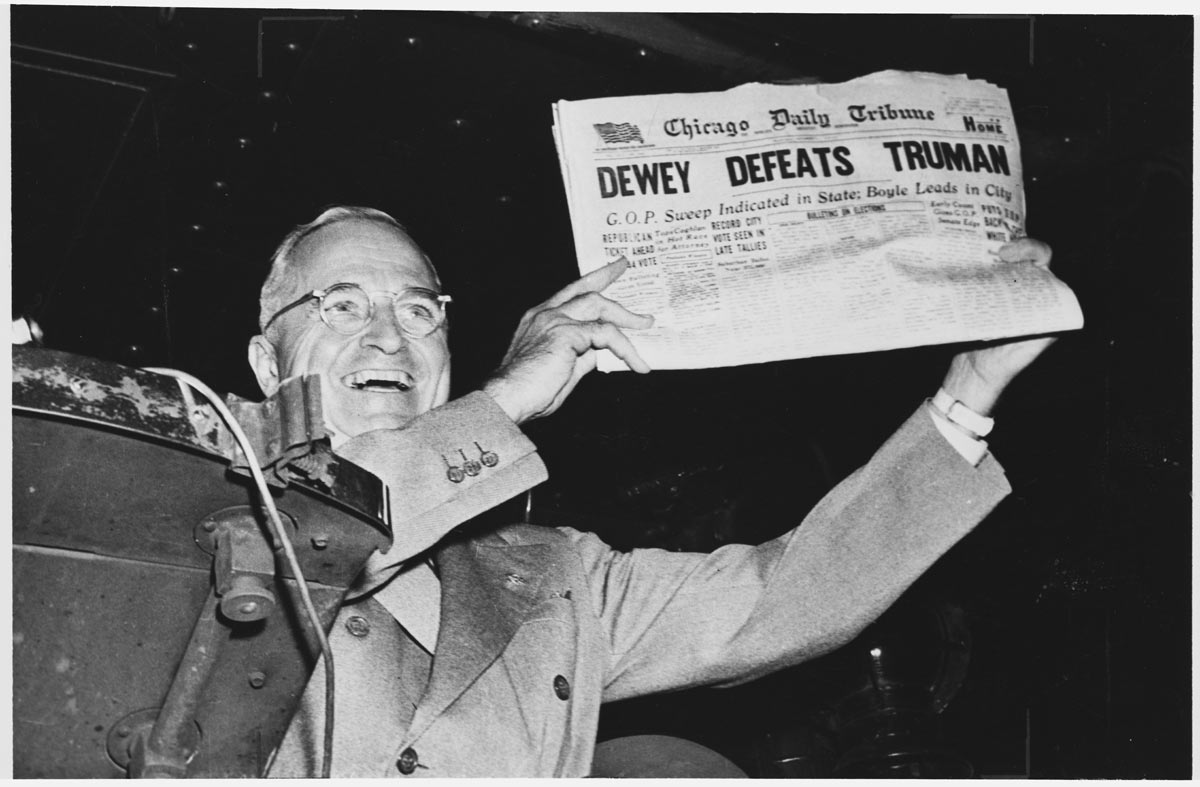
Henry Wallace was pretty bitter about getting booted out of the Veep spot for being too liberal, and like all wingnuts (leftist and rightist both) was truly convinced of his liberal platform.  He broke off and formed his own Progressive campaign.  When the Democratic platform at the convention came out with a strong civil rights policy that Truman publicly adopted, the Southern Democrats (Dixiecrats) walked out of the convention.  And when Truman signed that executive order desegregating the armed forces two weeks later, South Carolina's (yeah, them again) governor Strom Thurmond announced his own campaign for the Presidency on a racist "States Rights" platform.  The Democratic Party had basically disintegrated into three parts, where the Electoral system favored two parties (Democrat and Republican).  The Republican Party - nominee Thomas Dewey as their candidate - could pretty much lean back and coast to victory.

Except for the fact that the Republicans and Dixiecrats and Progressives were all up against Active-Positive Harry S. Truman.  A-Ps love the fight not for the sake of the fight but for getting something accomplished.  And Truman was up for this.

Truman's campaign was aggressive from the start.  He went after the Republicans in Congress for their conservative attempts at culling back the New Deal and at the gains workers - and an increasing middle class - had made.  Calling them "Do-Nothing", Truman made a show of calling for a special session of Congress to pass economic legislation.  Considering it a trap of sorts, the Republicans showed up but did little, inadvertently playing into Truman's accusations.  Truman effectively ignored both Wallace and Thurmond, since they were both in effect single-issue candidates lacking genuine broad appeal.  And Truman went on a whirlwind railroad tour of the nation, derisively called "whistle-stops" by Republican-backing newspapers but in fact hosting turnouts in the hundreds of thousands of supporters.

The national media didn't even seem to notice.  Mostly owned by conservatives or following "conventional wisdom", the newspapers failed to keep up with any polling past September and failed to notice Truman's public support.  It had become "conventional wisdom" that Truman was unliked and that it was due time for Republicans to return to the White House.  Assurances of Dewey's victory in November were rampant.  Right up until Election Night itself.

From the National Archives.  There's a reason Truman is smiling, and it involves being a badass.
That photo is arguably one of the most famous in American history.  One of the great reminders that "it ain't over until it's over," and that Truman had the political skill of the Active-Positive driving him to success (also it was another reminder that the geniuses inside the Beltway aren't as smart or as informed as they think they are).

The second term of office proved much tougher (history proves us that, regardless of the success or skill of any President): above all, Stalin encouraged his North Korean allies to invade South Korea, setting off the Korean War and the first major test of Truman's containment policy.

It was Truman's Confident trait that caused half the problems he faced going into this fight: he pursued an international coalition through the newly formed UN as both an effort to boost the UN's prestige and to avoid getting a declaration of war out of Congress that he felt wasn't necessary.  Both moves hurt him stateside.

The other half of the problem was dealing with Douglas MacArthur.  One of the most quixotic generals in American history, MacArthur could be a strategic genius and a tactical moron.  At the same time.  Having blundered through the first half of the Second World War and then regaining prestige and popularity towards the end of it, MacArthur was the general placed in charge of the Korean War efforts.  Pulling off one of the best military maneuvers in history at Inchon - making an amphibious assault under harsh conditions - MacArthur proceeded to overplay the UN's agenda by pursuing the North Korean forces right up to China's borders well enough for China to worry about invasion.  Despite Truman's warnings not to provoke the Chinese, MacArthur did so... and drew the Chinese 2 million strong into what was supposed to be a small-scale police action.

When the tide of fighting turned to stalemate, MacArthur pressed for the use of nuclear weapons, and worked under the belief that he had control of the arsenal - and ultimately the Army - and not Truman.  This was a critical moment in American history.  While there had been differences between Presidents and Generals before, tradition had developed that the civilian leadership controlled the military, that the President was Commander-in-Chief and that it kept the military in check.  MacArthur believed in Total Victory regardless of the objectives: Truman believed in containing Communism but avoiding perpetual warfare. Worse, MacArthur was privately and publicly undercutting Truman's authority as President.

Truman fired the son-of-a-bitch.

One other thing to note about Active-Positive Presidents: they do not do things because they are popular.  They do things because they are hard, and worth doing.  Firing MacArthur was political suicide in 1951: calls for impeachment were rampant and MacArthur returned a hero.  As the months passed and as Congress investigated Truman's decision, a lot of MacArthur's bullheaded actions were made public, and the decision Truman made became reasonable.  But the damage was done.  And Truman took the heat for it.

By 1952 the Korean War was a stalemated mess.  America got hit with a recession, and Truman's popularity was right around 22 percent, one of the lowest ratings in the history of polling such data.  When Truman's early forays into primaries for re-election went sour, he saw the writing on the wall and made the decision to not run again (he was exempt from the passage of the 22nd Amendment capping Presidential terms).  Truman did not leave office on the best of terms, but he left them on his terms and took his retirement to heart.

When historians speak of Truman's legacy, the first thing they'll note is that Truman is one of the first Presidents to have his reputation improve dramatically within years of leaving office.  It helped that a lot of what Truman believed in - keeping the New Deal agenda strong, avoiding full war in Korea/China, avoiding further use of nuclear weapons - turned out to have been the right calls.  Whenever a President drops significantly in the polls nowadays, they'll point straight to Truman and use him as an example of being unpopular but correct (despite how incorrect such a failing President might be).  Truman tends to appear in the Top Ten of any Presidential list ever since such lists were made, and if he's not he's usually slipped to Number 11.

Can't end this Truman fest without posting one of his best known quips: My choice early in life was either to be a piano-player in a whorehouse or a politician. And to tell the truth there's hardly any difference.

I motherfucking love this guy (except for the whole "Nuking Japan" thing, and even then I'll grant that was a tough call to make).  I'm glad I share a birthday with him.

Next Up: Everybody Likes Ike... Despite His Traits