While the philistines at the FOX Not-News channel wage their ungodly war on the pagan festivities, it might behoove me to pass along some tips on how to honestly and sincerely celebrate the Roman winter solstice holiday known as Saturnalia.
1) Decorate your home with sun and moon iconography. Apply garland wreaths where appropriate.
2) Hang out with Vestal Virgins.
2a) (update) In the possibility you cannot locate any Vestal Virgins to hang out with, you have a good excuse now to travel over to Rome, Italy and ask around for one. Hell, this is a good time for Rome to set up a Vestal temple for the tourists...
3) Decorate all trees on your property. They don't have to be the traditional triangle-shaped fir trees, any trees will do. For those of us in Florida, we've been decorating palm trees for years...
image from the Minimalist Sweet Home website
Update: that photo isn't showing anymore! The link might be broken. Let's try this one...
from the Jen On The Edge blog
4) Drink Roman-styled wine. There's a version called mulsum which mixes honey into the wine. Should be interesting around bears...
5) Give small presents. Nothing large or ostentatious. Maybe a set of keys to a new electric-powered car. ...what?
6) GO TO ANY TEMPLE OF THE GOD SATURN AND LIGHT A CANDLE TO EARN HIS FAVOUR. If you can't find a temple, trick your local churches into funding a charity that you'll secretly use to build one. That oughta learn 'em, stealing the winter solstice and all...
7) Gamble. It's allowed during this festive period. But do it in legally-approved areas like Hard Rock Casinos on local tribal lands or Las Vegas.
7a) Gamble using other people's money. See 6) for hints.
8) Sing classical Roman ditties. If you don't know any classical Roman ditties, sing "Louie Louie" off-key and no-one will notice.
9) Greet everyone by saying "Io Saturnalia!" Now here's the tricky thing about the Latin language: they didn't have a letter J to represent that phonic in the western tongues, so they doubled it to the letter I. It's really Jo Saturnalia! being said. And the Romans pronounced the J not like "jay" but like "yo". So it should sound like YO SATURNALIA (akin to YO ADRIAN). But type it IO SATURNALIA.
9a) Do this early and often around Bill O'Reilly until he goes batsh-t insane.
10) Enjoy the holiday season no matter how and why you celebrate it. If you're Christian, Hebrew, Muslim, Hindu, Buddhist, Zoroastrian, Shinto, Pastafarian, what have you. THIS IS A TIME TO CELEBRATE, TO REFLECT, TO ENJOY FAMILY AND FRIENDS TO THE UPMOST THAT WE CAN.
This message brought to you by a faction of the Unitarian Jihad.
There's really not a lot of Saturnalia-themed wallpapers via the Google search engine. I'm counting about... four, maybe six Saturnalia themes.
This is sad.
If our so-called War On Christmas is going to live up to Fox Not-News' bizarre standards, we're gonna need more Saturnalia stuff online in order to cheese off the O'Reillys of the world. We need to rile them up sufficiently so WE can go around and declare those insufferable far right so-called "values" people are waging a War On Saturnalia. See how they like it when the tables are turned...
Otherwise this will be a relatively sad and quiet holiday season focused on presents shopping, wrapping, getting the halls decorated fa-la-la-la-laaa.
IO SATURNALIA! It shall be our battle cry this festive month.
Unless you're into that whole Mithras thing. Yeah, then we're gonna need to coordinate our efforts and such.
Prepare for the horror that is... creamy Asparagus dishes! Artichokes! Swedish meatballs! ...no, seriously, some people do meatballs for Thanksgiving. Why? I mean, stick to the traditional meats like turkey, or honey ham, or fish. Fish is legal, it's a Pilgrim staple... ya, ya...
So anyhoo, for the benefit of the seven people who follow this blog, here's the keystone to our holiday festivity:
Now, about the proper way to sacrifice your turkey to the pagan Gods of the Harvest... First, lay out a table in a geometric pattern with silver stabbing weapons and ceramic plates in which the ritual offerings can be placed. Light some scented harvest-themed candles in the center of the table... Have the participants sit within an order decided by rank and by age... Bring forth the SACRIFICE! Offer a prayer to the appropriate deity of the house... AND BEGIN THE CUTTING...!
Multiple sacrifices AKA seconds may be granted depending on the satisfaction of the house deity.
TONIGHT! THERE WILL BE SATED GODS. ALL WILL BE WELL WITHIN THE PANTHEON OF DEITIES.
Also, it's the one-year anniversary of the Butt Fumble. Sometimes, we must wonder which Gods the Jets displeased...
Next up, SATURNALIA! I need more computer desktop wallpapers for Saturnalia, graphics artists! NOW...
Or is that Pax Reagana? Damn it, I've lost my Latin skills! I told you I'm bad with languages... got a hard enough time keeping up with Anglish...
Basically I'm talking about the Reagan Era, the moment when Ronald Reagan became President.
There are moments in American history where the flow of history - much like a mighty river - shifts direction and the whole landscape changes. Usually wars - the American Revolution, Mexican-American, Civil War, World War II (but not necessarily the first one), Vietnam, the War on Terror - and sometimes economic disasters - the Great Depression, the Great Recession - but rarely an election of a political leader. Oh, Lincoln's election was pivotal, but that was part of the Civil War, sort of co-sponsoring the national shift from slavery to emancipation and states' rights to federalism. No, I'm talking about election of the likes of Andrew Jackson, a forceful personality who basically willed an entire nation's political and economic structure to his whims. There's a reason the 1830s-1840s is called the Age of Jackson (or Jacksonian Democracy).
Another such election was Reagan's. Which is slightly ironic in that Reagan's personality was not forceful like Jackson's, nor was he Active like Lincoln. In his Presidential Character book, James David Barber designated Reagan as a Passive-Positive, and for good reasons. Pass-Pos Presidents don't tend to leave a major impact on history, and yet pretty much the Eighties and even the Nineties could be considered the Reagan Era. We're still living (2013) in the aftermath of that era, so much that the Republican Party still pursues the policies of that era out of some fevered nostalgic hope to reclaim the past.
What Reagan brought to his tenure as President was an affable charm. It was that part of him that made him a relatively successful movie actor of the Thirties and Forties. This made him as a political figure more an entertainer than enlightener, but for him it worked. To quote Barber:
By the time Reagan reached the stage of the White House, he had more experience pleasing audiences than any American politician since William Jennings Bryan... And not since Harding had a happy-talk President's character and style fit together so nicely with the public's yearning for positive thinking in politics. The President had a terrific sense of humor, which he exercised regularly in what started out to be formal prep sessions by his staff... (p.256)
Reagan's nickname became The Great Communicator. No other President could pull off a bon mot, a one-liner, a poetic reading, a shaggy dog tale, and a comeback like he could.
With this persona in play, Reagan could be on the one hand ruthlessly micromanaged by his own staff - like an actor with an entourage handling all the chores, with a chief of staff doubling as publicity agent and gatekeeper to the media - and on the other perform flawlessly at staged photo-ops and televised national addresses. With control of the persona, there was control of the message.
It is through that manipulation of Reagan's image that an ambitious political agenda could be unleashed. Reagan's rise to power - from actor to governor of California to President - came through his association to social and economic conservatism, as part of the Goldwater movement of limited federalism. He challenged Ford for the 1976 primaries coming from the Far Right vs. Ford's pragmatic moderate platform, and was the bannerman for the conservatives once more in 1980. Reagan's victory, along with Republicans winning control of the Senate, was viewed as a shift in the national mood away from the FDR-to-LBJ liberalism.
Yet appearances were modestly deceiving. For all of the conservatives' hopes of pushing massive legislative changes, very little went in the Far Right's favor. The massive tax cut Reagan achieved in 1981 proved disastrous and Reagan quickly switched gears on that, raising taxes by 1983 to help pay off the increased deficits those cuts created. During his second term, Reagan pushed for and got an Income Tax reform bill in an attempt to straighten out and simplify a bloated tax code. Social welfare programs saw some cuts but for the most part remained intact, due to a Democratic House unwilling to bend on those programs. As a Passive-Positive, Reagan was amenable to compromise and working with Democratic leadership (Tip O'Neill especially) to get deals done.
The biggest difference between rhetoric and reality for the Reagan administration was the Cold War. Reagan came into office in 1980 as a kind of "cowboy", presenting himself as a Cold War Warrior standing up against the Evil Empire of the Soviet Union: yes, this is an actor relying on movies like Star Wars to help explain his world-view. It was this persona that pursued a massive arms build-up that forced the Soviets to spend beyond their own means. Yet it was another movie The Day After, about a nuclear holocaust, that woke Reagan up to the fact that a nuclear war was unwinnable, and he seriously began pursuing an arms limitation treaty with the Soviets after having spent the 1980 campaign decrying such negotiations during the Carter years. As a result, Reagan is the President who achieved getting a massive arms reduction treaty passed. Both the massive defense spending and the nuclear arms reductions - a one-two punch - began the late Eighties dominoes of events leading to the end of the Cold War in 1991.
Reagan received a lot of criticism from the Far Right for failing to pursue their objectives - an end of the New Deal policies, pursuing an honest-to-God war against Communism - and yet today he's still the patron saint of the Far Right, of the Republican Party as a whole. Because of two things: First, Reagan's administration is the only administration of the last eighty years the Far Right can accept (can't accept Bush the Elder or Ford or Eisenhower as they were too "moderate", can't accept Bush the Lesser considering all the disasters he presided over, and can't accept Nixon's because yeah Watergate); and Second, Reagan did achieve making hard conservative values acceptable to the mainstream consensus. Such as deregulation of businesses, downsizing of government, limiting abortion access, giving politically-active religious groups more political prestige, and other social conservative issues.
It's that particular agenda that defines the Reagan era. It's one of the core elements of the modern Republican agenda - to deregulate everything, to privatize everything, to shrink the federal government down to where Grover Norquist can drown it in his bathtub, to insert conservative religious values everywhere - that we live with and fight against to this day.
And as a Third point: Reagan's Affability, his popularity, remains untouched even to this day. Although like other Passive-Positives he filled his administration with untrustworthy underlings - Reagan presided over a scandal-filled administration that produced a Savings And Loan fiscal crisis when that sector was deregulated; and the Iran-Contra Affair that saw illegal arms deals to Iranians to free Middle East hostages, with the funds illegally going to support Nicaragua Contra rebels - Reagan himself remained untouched by most of the scandals. And despite the fiscal damage of the S&L crisis, the American economy remained churning and most Americans didn't seem to care.
Reagan's legacy remains: the idea of shrinking the federal government's role in the lives of Americans (and in the deregulation of billion-plus corporate industries) remains potent even as the Reagan era itself has technically ended. Not many Passive-Positives can claim such a legacy.
Next Up: Bush the Elder. There's not really anything fancy I can say about that.
ADDED BELOW
I'm of the belief that you need to ask an American just three questions to ever figure out exactly who that person is: ask about the American's name; ask about what he/she does for a living; and ask what he/she thinks happened to JFK in Dallas Nov. 22 1963...
The assassination of John Kennedy
remains one of the most traumatic moments in American history. Up
there with the Civil War, Pearl Harbor, 9/11 attacks, and the rollout
of New Coke.
As a librarian I can tell you the
importance of a historical event by the number of books filling up
the shelves. Civil War books, usually the biggest section of the
900s (DDC) alone can take up a full shelf (with six packed rows of
books) in a small library, and take up an entire stack of shelves in
a big library.
The Kennedy assassination is getting up
there in the number of books written. It's been the cornerstone of
conspiracy thought ever since the Warren Report came out and people
hooked onto certain flaws found in it. It's been 50 years of arguing
over the assassination, over the report, over how history got screwed
(the number of What If plotlines and time-travel-to-save-JFK stories
are pretty numerous).
For myself, I grew up in the shadow of
the Sixties, a young child of the Seventies and a teen of the
Eighties. I was engulfed with the conspiracy talk ever since we got
to this part of U.S. history in the classroom. Having grown up
reading non-fiction books about mysteries – UFOs, witchcraft,
ghosts, Bigfoot, the Bermuda Triangle – the allure of conspiracy
about JFK's death was pretty irresistible.
So. Shall we play a game of Whodunnit
and argue over the various conspiracies over who shot JFK?
Lone Gunman
The official take. Oswald, ex-Marine
who defected to Russia and returned disillusioned, acts alone in the
planning of the assassination and is the only one pulling the
trigger. He kills a police officer while fleeing on foot before
getting captured in a movie theater. Oswald himself is killed by a
lone gunman, a paranoid club owner Jack Ruby.
Why this theory works: all the official
evidence points this way. What is known of Oswald fits into the
psych profile of other assassins. There are other parts of Oswald's
activities before the assassination – an attempted shooting of a
retired right-wing general – that points to a man desperate to
prove himself via Propaganda of the Deed.
Why this theory falls apart: the
“official evidence” could have been manipulated: there have been
enough complaints about the Warren Report having errors and
unfinished tangents deserving of investigation to make that report
suspect. While Oswald fits the profile of an assassin, he's unique
among all of the other shooters and would-be assailants in that he
refused to take credit. He's the only one on record saying he didn't
do it, and that he was a “patsy”. Having Oswald killed prevents
any truth of his actions from getting out. Considering the number of
political enemies Kennedy acquired over the years, having some nobody
be the one killing him just doesn't seem kosher.
The Russians/Commies Did It
The first possibility, considering we
were at the height of the Cold War. Kennedy had just stared down the
Russians from putting nuclear warheads in Cuba, and the Berlin Wall
had just gone up. Eliminating a political opponent wouldn't be out
of the question for the KGB.
Why this theory works: Oswald had
defected to the USSR and had just returned, reportedly kicked out by
a Soviet Union that found him useless. He could have been
conditioned or encouraged by his Soviet handlers to pull the trigger
on Kennedy.
Why this theory doesn't work: If this
were true, we'd have started launching nukes at the Soviets inside of
thirty minutes of finding out. This would have been such an act of
aggression that war would be the only logical response. The Soviets
may have been cunning, but they weren't crazy. They could deal with
Kennedy, and they didn't need to kill him.
The Castro Cubans Did It
Independently of their Soviet allies.
Castro had been surviving attempts on his life and was probably
pissed off enough to turn the tables. Oswald had been positioning
himself as a fan of communist Cuba, and may have shot Kennedy to
curry favor with Castro.
Why this theory works: It actually
doesn't. Because...
Why this theory doesn't work: There has
never been any conclusive proof that Castro or Cuban communists were
in contact with Oswald. The FBI and CIA made serious efforts to find
one, but never could (the possibility of Oswald going to the Cuban
embassy in Mexico is disputed with the fact that the documented
photos of someone claiming to be Oswald doesn't match the real
thing). Castro pulling something like this without the knowledge of
the Soviets is unlikely; and if found out would have forced Soviet
Russia to either cut ties to Cuba while the US invaded out of
revenge, or else sign on to nuclear Armageddon.
The Anti-Castro Cubans Did It
While there were a lot of people angry
at Kennedy, none of them were as driven as the exiled Cuban
community. They considered themselves twice betrayed: first when JFK
refused to provide air support for the failed Bay of Pigs, second
when JFK refused to invade Cuba over the missile crisis. It hurt
that Kennedy's deal with Khrushchev included a full stop to all
covert attempts to overthrow Castro.
Why this theory works: As noted, these
guys were PISSED at Kennedy. That fateful trip through the southern
states originally had Kennedy stopping in Miami (the center of
anti-Castro activity), but that was canceled when it was deemed
security wouldn't be tight enough. Given some of the evidence of
Oswald being involved with some elements of the anti-Castro covert
ops, it's possible Oswald got recruited by a small band to assist
either directly or indirectly with the shooting. As part of of this
conspiracy theory, they then get Ruby to shoot Oswald to cover their
tracks.
Why this theory doesn't work: There's
little evidence that the anti-Castro Cubans had this amount of power
to pull of an assassination like this. Or have this much control over
the investigation. If it ever got out that the anti-Castro groups
killed our President, the American people would have turned against
the anti-Castro crowds and their government handlers like the CIA.
The only way this theory works is if you add it to the larger
conspiracy theory such as...
The CIA/FBI/Shadow Government Did It
What quickly became the most prominent
theory among conspiracy buffs. Somehow, Kennedy was a threat to
their covert operations and overt attempts at starting World War III.
It's common knowledge nowadays that the Joint Chiefs and other key
government officials viewed Kennedy as soft on Communism (it was more
that Kennedy refused to ignite a nuclear war, something the war-hawks
viewed as survivable). Kennedy had threatened to dismantle the CIA
after the Bay of Pigs fiasco, blaming them for misleading him with
false intel.
Why this theory works: If Kennedy had
enemies within the government, it was most likely here. The heads of
the CIA and FBI both disliked JFK along with the upper echelon of the military. The CIA could have been in
contact with Oswald as part of the theory that Oswald was an attempt
to infiltrate the Soviet Union. The FBI had tabs on Oswald right up
to the assassination. And the FBI basically had control of the whole
investigation that created the Warren Report, meaning they could hide
any incriminating evidence they didn't like.
Why this theory doesn't work: a
conspiracy of this size and scope would have had to involve hundreds
of people through various agencies, any one of whom could have
slipped up on a detail or betray the secrecy in some fashion. Having
this covert group pull off a very public assassination would have
drawn too bright a light on their activities. And this shadow
government would have had other means of killing Kennedy – through
poisoning to make it look like a natural death. How many people knew
about Kennedy's Addison's Disease? Did his Vice-President know...?
Johnson Did It
As part of the government conspiracy
theory, where the CIA and FBI didn't do it, but Vice-President
Johnson did and the government merely helped cover it up. There'd
been stories that Kennedy was thinking of dropping LBJ from the
ticket in 1964, that Johnson's ties to a crooked land developer was
the key reason, although the Kennedys (including Bobby, Jack's
confidant) and Johnson didn't get along very much to begin with. As
Johnson desired the Presidency, if he got booted off the ticket
that'd be the end of that hope, so killing Kennedy to get promoted
sounds like motive...
Why this theory works: It really
doesn't. Because...
Why this theory doesn't work: There's
no direct or indirect link between Johnson, nor Johnson's people to
Oswald. We'd be better off thinking it was a massive government cabal with Johnson on the side benefittng from the results. Kennedy may have disliked LBJ but he needed Johnson's
negotiating skills to keep Congress in line. If Johnson knew about
Jack's Addisons, he could have easily created a situation that would
have triggered the illness and have Kennedy die of natural causes...
Cabal of Business Leaders Did It
Kennedy wasn't popular among various
business leaders, especially the oil men in Texas. One major
conspiracy theorist leaned on this as his go-to theory, even making a
rather dull movie about it.
Why this theory works: These men would
be far enough outside of government to avoid accountability, while
having enough ties to various agencies to ensure they would cover
their tracks. They would be able to hire the best assassins and
covert ops types of the day.
Why this theory doesn't work: Again,
there would be too many people involved in the planning, staging, and
execution of the attempt, let along the hundreds more needed to cover
up something of this scope.
The Mafia Did It
Stories abound of how Kennedy relied on
help from mobsters to secure certain election results to win the
Presidency... and then unleashed his brother Bobby as Attorney
General to hunt the Mafia down. Feeling betrayed by someone who was
literally in bed with them (well, in bed with one of the mob boss'
mistresses), the mobsters would have felt the need to strike back...
Why this theory works: The Mafia tended
to be a group that, when confronted with a problem, uses bullets to
remove said problem. There were ties to the New Orleans mob with
some of the more interesting characters in the various conspiracy
theories, although ties to Oswald are tenuous at best.
Why this theory doesn't work: Again,
anything on the scale of what the mob is accused of doing involves
too many people, any one of whom could have blown the whole deal.
The risks of trying were too high, even if they did succeed.
Aliens Did It
Why not?
Why this theory works: Aliens hated
Kennedy for some yet-unrevealed reason.
Why this theory doesn't work: Haven't
found any aliens at all, let alone aliens with a grudge against JFK.
You and Me Did It
The Rolling Stones argument. WE are
the ones who killed the Kennedys.
Why this theory works: Society is to
blame.
Why this theory doesn't work: You first
have to believe the Rolling Stones were capable of waxing
philosophical.
The truth?
We can never be really sure of it now.
It's been fifty years: most of the people involved with that tragic
day are dead, and while some documents have been released over the
years there's still a ton of evidence locked away for a long time.
For myself, I tend to lean towards the
Anti-Castro elements being the culprit as they had the greatest
motive and opportunity, but to prove that would require getting to
the bottom of whether Oswald was a serious attempt by the CIA to
infiltrate the Soviets, and what ties Oswald might have had to any of
the Anti-Castro groups operating along the Gulf of Mexico.
The more I've looked at the Warren
Report, the more I see an investigation that was more cover-up than
revealing, but not for sinister reasons: a lot of it seemed to be an
attempt to hide any failures of inaction on the FBI itself. The
conspiracy theory about the government behind it all doesn't the
basic scrutiny test of Why? Why commit an action fraught with risk
when simpler, more subtle methods were at hand?
Although I still have a question about one thing: when Oswald got kicked out of the USSR and came back to the US, why didn't anyone arrest him for desertion from the Marines when he fled to Russia? He was technically AWOL when he did that. The House UnAmerican Activities congressional committee was still operating at the time: why didn't any eager Congressman looking for media interest bring Oswald up on charges and make a public show of it? I'm still kinda bugged about this point. If someone can point me to a detailed answer to this question, I'd be grateful.
So, until next time, when we unravel
the possibility that the emerging American Football League of that
decade were in cahoots with Oswald after all...
ADDED: I know this is a bit sick to point out on the anniversary and all, but this bit from Red Dwarf just nails it...
What can you say about a Republican Congresscritter who voted eagerly to have food stamp recipients be tested for illegal drugs... getting caught buying illegal drugs?
Pretty much this: BWHAHAHAHAHAHAHA.
Republican U.S. Rep. Trey Radel of Fort Myers is due to be arraigned Wednesday morning on cocaine possession charges.
A Washington, D.C., court document says that on Oct. 29, Radel "did unlawfully, knowingly, and intentionally possess a quantity of cocaine, a controlled substance."
The misdemeanor drug charge carries a maximum sentence of 180 days in jail and or a fine of $1,000.
Radel is one of those high-and-mighty judgmental creatures you get in the Republican Party. The ones who express the viewpoint that everyone in poverty only have themselves to blame... that the poor are all "takers", living off the "makers"... that a lot of the poor and minorities are running around lazy and drunk and high on drugs. These are the ones who want to make unemployment benefits recipients be tested for drugs, despite the lack of evidence that drug abuse was rampant or a cause of their unemployment: Radel recently voted on having food stamp recipients be tested.
The hypocrisy reeks.
The Republicans are so eager to punish the impoverished and hungry, while the rich and powerful like themselves try to get away with breaking the very laws they're using to punish everyone else.
Radel isn't showing any sign of resigning or stepping aside for 2014, and he's trying to blow this off on his alcoholism driving him to make "bad decisions." But it's not alcoholism that makes you buy drugs, boss: it's the DRUGS you're buying that make you buy that drug. Which begs the question how long has he been buying cocaine? And it also begs the question how many other decisions under the influence he's been doing if alcoholism affects him this way?
Just got a reminder from one of the references I work with at the library.
Today is the 150th Anniversary of Lincoln's Gettysburg Address.
As oratory goes, the address is short and simple. The keynote speaker, Gov. Edward Everett, gave a more formal and better received speech at two hours length.
So why was the Gettysburg Address so famous while Everett's barely gets cited in any reference?
The Address has several advantages. Its shortness made it perfect to fit on a single page and column of a newspaper. It also makes it easier to memorize.
Above all, its simplicity in stating in such short words the cause of the war, and what the objective of the war should be: A New Birth Of Freedom, from the end of slavery and the emancipation of blacks into American society.
...It is rather for us to be here dedicated to the great task remaining before us—that from these honored dead we take increased devotion to that cause for which they gave the last full measure of devotion—that we here highly resolve that these dead shall not have died in vain—that this nation, under God, shall have a new birth of freedom—and that government of the people, by the people, for the people, shall not perish from the earth.
George Zimmerman was charged Monday with assault after deputies were called to the home where he lived with his girlfriend, who claimed he pointed a shotgun at her during an argument, authorities said.
Zimmerman pushed the woman out of the house and barricaded the door with furniture, Chief Deputy Dennis Lemma said at a news conference hours after the arrest. The girlfriend, Samantha Scheibe, provided deputies with a key to the home and they were able to push the door that had been barricaded.
Zimmerman, from before the Trayvon Martin shooting and even after his acquittal, has shown a serious habit of "expressing himself" in a rather violent, confrontational fashion:
In September of this year, he visited his estranged wife's home and was accused of threatening her and her father with violence, reportedly with the gun on his possession. The investigation stalled due to lack of evidence.
Zimmerman and his wife were separated at the time of the Trayvon shooting, following a fight between the couple. She filed for divorce once the trial ended, with the proceedings on hold following the September incident.
Zimmerman has been ticketed on three separate occasions for traffic violations, mostly speeding, since the acquittal.
In July 2005, Zimmerman was charged with resisting arrest during an incident involving underage drinking, attacking an undercover cop who was trying to arrest Zimmerman's friend.
The following month, Zimmerman's then-fiance filed a restraining order against him for domestic violence. Zimmerman filed his own restraining order against her.
And remember, these are the incidents that got the cops involved.
Every one of these incidents fit into a pattern of persistent behavior common with the Angry Guy Syndrome: a confrontational personality, issues with the women in his life leading up to domestic violence reports, a recklessness with respecting rules (such as traffic laws), a level of arrogance that makes him act like he's above the law.
And above all, a love of weapons and an eagerness to have them on him whenever he gets into a fight with someone like his ex-wife or current girlfriend.
The 911 phone calls have already been released: the girlfriend's as well as Zimmerman's. Zimmerman calling just as the cops showed up to answer the woman's earlier call. You gotta listen to Zimmerman as he's telling his version of events. Except you gotta be wondering "why isn't he talking to the cops that are already there?" And the answer is obvious: it's called "gaming the refs". Zimmerman knows the tapes always get released to the media, and so he puts out his own 911 call, knowing if he does it the right way he can paint himself as the victim of his "crazy girlfriend".
At this point should anyone even trust him anymore (not off-topic: Zimmerman's lawyer during the shooting trial quit on him after not getting paid)? Zimmerman keeps getting involved in these incidents, keeps painting himself as the victim. But here's the thing. All of these domestic violence calls, all of these traffic violations, all of the times Zimmerman has been confronted by the law, there has been one constant.
George Zimmerman. George Zimmerman being angry.
This is a trend that cannot be explained away. This is a constant, an ever-fixed mark of this guy's personality. Combine it with his love of guns, and we have a troubling threat to other people's safety.
It was mentioned earlier but Richard Nixon's collapse in 1973-74 made James David Barber's reputation as a Presidential scholar. Nixon was in office when Barber made his prediction that Nixon would self-destruct by over-reacting to a self-manufactured crisis, which became the Watergate scandals.
As a result, Barber's Presidential Character analysis came in vogue among the political class, which meant by 1976 we had a candidate for the office in Jimmy Carter who not only knew about Barber's work but tried to use it to define himself, to say "Well, hey, I'd love to think of myself as being on the awesome end of a psychological profile." I'm not joking, here's the quote:
...Carter said "I think I have been heavily influenced by James David Barber's writings and I think a lot of my ideas come from there." Did he think of himself as 'an Active-Positive'? Carter laughed. "That's a subjective analysis," he answered. "That's what I would like to be. That's what I hope to prove to be..." (p.399)
We're at that point in history where awareness and self-awareness collide. The problem here is twofold. First off, knowing what an Active-Positive is (or even an Active-Negative or Passive-Positive or or Passive-Negative) doesn't mean you can act that role. Barber himself notes on the same page:
Character persists. It cannot be tailor-made for campaign purposes. Carter could no more have made himself into an Active-Positive after reading my book than I could have become a Presidential candidate after reading his...
You are who you are through life experiences, your childhood and education, your formative adult years. Wisdom is not taught: it's learned. Character is not adaptable (even for Adaptive types like A-Ps): it defines your actions and limits your decisions.
The second problem is how Carter jumps at the label of "Active-Positive". It's pretty clear why: Active and Positive are both words with literally positive meanings. Who doesn't want to be more Active than Passive: who doesn't want to be the actor, not someone reacting to events? Who doesn't want to be viewed as a Positive force rather than a Negative one? But there's the problem: the words do not have the meanings that the labels are expected to provide. There are subtleties at play here.
Barber used Active-Passive and Positive-Negative as the simplest labels for the four points of the character chart. He does a better job going into describing the actual traits of a Character label, such as defining A-Ps as Adaptive or P-Ns as Dutiful. There's also the real usage of Positive and Negative: Barber is using those words to describe how a President views the powers of the office in terms of governance. A Positive would view the daily challenges as a delight, not a chore, and would be loose with the guidelines of the office if not ignoring things outright simply to get something done: A Negative would restrict himself to the letter of the Constitution and the Law, preferring to let the law resolve issues and getting the other two branches - Congress and the Court - have more say in what gets done.
An Active-Positive isn't always the best Character to be. It all depends on the times and challenges of the day: he may be the right man for the job but it would be at the wrong time. A-P Presidents leave a lot of damage in their wake, same as an Active-Negative or Passive-Positive (Passive-Negatives try not to leave any wake at all). Carter was blinded by the desire to be a Great Man in office, and so aimed for the Active-Positive traits as something to emulate and achieve.
Pity was, when I look at Carter's history and his actions as President, I'm seeing someone who was Active-Negative in Character. This is going against what Barber decided (he went with A-P in the end): thing is, from what Barber lays out for Carter's background and development, and considering how Carter acted in other elected offices as well as the Presidency... being Active-Negative is the only thing that makes sense. What I think happened was that Carter's attempts at behaving like an Active-Positive hid the actual performance.
Thing is, being an A-N President wouldn't have been that bad if only Carter let it be that way. Let his character play out. Instead you see a man fighting how he was working in office, switching positions and decisions in ways that left allies in the dark and his enemies - even within his own party - in anger.
Carter came in from a poor farming family from a corner of Georgia deep in the Deep South. From the hard work of the farm came the hard work as a student, graduating early at sixteen and taking some college courses here and there before making his way to Annapolis and the Naval Academy in 1943.
The War Effort beckoned to Carter as an achievement to reach, but war ended in 1945 leaving the midshipmen like himself wondering what the future held after graduation. From that, Carter looked into making a career in submarine duty, and from there had an opportunity to be in the first wave of new technology of nuclear-powered submarines. Called back home when his father died, Carter recognized the roots that his father had in the community and decided that he had to step in.
From that, Carter got into the local politics of Georgia. As anyone can tell you, politics at the local level can be a contact sport, and this was the Deep South where the passions would be war-like. And this was the 1950s, when the civil rights picked up in earnest regarding desegregating schools for the kids and the small-town communities were taking sides. Carter had been raised in a liberal house where his mother treated blacks with quiet respect, and when confronted directly he refused to side with the racists. But he and his family stood mostly alone, and faced too many situations where he could do little.
By 1962 he made the decision to run for state senate. Reform efforts had loosened up the restrictions that would let the likes of Carter make a go of it, but even then Carter faced opposition for the primary and on election day got pummeled through the traditional practice of the political boss cheating with fakes and dead voters.
In the past, the loser was expected to just let it go and bide his time paying dues within the party. Carter, however, wasn't going to play by the rules. Finding open evidence of fraud and violations of the law, Carter pursued the matter up the party ranks and when they found the party unresponsive, went to the courts which did favor Carter's effort to clear the corruption and let the voters in the general vote their choice by write-in. Jimmy Carter won by 1500 votes. The party boss who tried to screw him over ended up convicted of voter fraud in another election.
From this, Carter developed his reputation as The Outsider, the one who wasn't going to abide by a status quo. But was this a persona that was based on an Adaptive, let's-get-this-done Active-Positive or based on an Uncompromising, we-have-to-do-this Active-Negative?
I have to lean towards Uncompromising. While he had to work within a system among fellow state senators, this didn't mean much. But when he became governor of Georgia, he followed through on a series of civil rights reform and government reform that streamlined a lot and improved Georgia's administration. But he did so without playing the expected games of smoothing over political allies with patronage and handouts:
Carter's legislative relations were often stormy. He would not play the customary patronage and special privilege games... He was constantly dealing with members, showering them with facts, and he once spent a whole day on the House floor speaking for his cherished reorganization plan. But he was late to compromise, hard to convince... (p.429)
In this, using argument to win his issues, Carter shares a lot with Woodrow Wilson who also held firm to his issues. While not as harsh an idealist as Wilson, Carter carried with him a firmness of faith, one of the more openly Christian Presidents we'd see in the 20th Century. It would guide his more compassionate decisions, but would be a sign that he would stick to his guns as his faith guided him.
Winning a close election as President in 1976, Carter had come in campaigning as an Democratic Outsider candidate and populist figure, which helped in an era of Americans horrified by a corruption-plagued federal government piled up by the Johnson and Nixon years. But Carter didn't campaign on much of a specific platform, which made him susceptible to a Congress - even a Democratic-controlled one - that pursued their own legislative agendas since the President had none of his own.
Carter's Uncompromising style came to the fore as he worked with a legislature that kept expecting a White House to deal with them but found Carter unwilling to offer much of anything. Carter had issues with a Congress that threw up roadblocks and delays to getting much work done. It didn't help that Carter and his people kept mishandling their fellow politicians, committing various social faux pas that rubbed the likes of Speaker Tip O'Neill the wrong way.
What had to make things worse was how Carter was affected by self-awareness: he was living in a world where Professor Barber was documenting the historical atrocities of the Presidents... a world where Carter had the desire to be an Active-Positive. As a result, he focused on what he thought A-P Presidents did: push progressive reforms, fight against a corrupt Congress, and show an Adaptiveness in pursuing certain legislation and then changing the objectives to reach some obscure compromise.
Problem was, this made Carter more a flip-flopper in practice, changing his mind at the worst possible moment and leaving his legislative supporters dangling off a cliff wondering where his support went. Barely if ever explaining his reasons why. Ending up not with a reputation as a reformer but a reputation of weakness and dithering.
If Carter had any success it was where all Presidents go to get some satisfaction in life: foreign policy, where he pursued an aggressive peace process in the Middle East that resulted in an ambitious Israeli-Egyptian truce that has lasted to this day.
But even then Carter was hampered by an international crisis that would have tested even the best Active-Positive President to his core. When Iran exploded into revolution around a growing political influence different from Capitalism vs. Communism - religious Fundamentalism - the United States tried to back their player the Shah as he pursued a more repressive regime. When he fled, he ended up in the United States for medical treatment, which further inflamed the angry populace. They stormed the American Embassy and took hostages.
Carter was stuck negotiating with a political opponent in the Iranians who had no incentive to deal and in fact had a better incentive to humiliate the U.S. any way it could: echoes of LBJ failing to negotiate with North Vietnam. It hurt that the Iranian political landscape outside of the Ayatollah was in constant flux.
Into all this was the military option: a rescue attempt early on in the hostage situation that may have been messy but was an expected response. The problem was implementation: every branch of the armed forces - Army, Navy, Air Force - wanted to play a part, and Carter couldn't focus on letting just one branch do it. As a result, the mission was a jumbled mess that killed eight servicemen and left Carter with nothing but responsibility for the failure.
Another debacle was the Soviet invasion of Afghanistan. One of the most overt acts of the Cold War since North Korea's invasion of South Korea, the Russians had gone in under the excuse to stabilize a puppet regime facing a fundamentalist uprising of their own. International outrage was high and it strained the movement toward detente that had been fostered under Nixon and Ford. But Carter was in little position to do anything about it outside of calling for a boycott of the Olympic Summer Games scheduled for Moscow in 1980.
It would take a serious game of "What If" with a practiced analyst of Presidential behavior to determine how even an Active-Positive President could have handled these foreign policy nightmares. But we have to see how Jimmy Carter actually performed as President during what has to be regarded as a failed tenure. Too many instances of Uncompromising and self-limiting behavior. Too few instances of being genuinely Adaptive to external pressures and internal negotiations. To this I place him as an Active-Negative President, despite his hopes.
Next up: Can You Believe a Passive-Positive President Could Actually Pursue an Agenda?
As the lead-up to the 50th anniversary to the start of the long-running science-fiction show, the producers have seen fit to give us some closure regarding the dreaded backstory of the Last Great Time War. A war between the Time Lords and Daleks at the height of their respective empires that reportedly shattered much of space-time.
This mini-episode is about seven minutes long but packs a season's worth of details into it (The following CONTAINS SPOILERS STOP READING IF YOU HAVEN'T WATCHED THE EPISODE YET):
The Time War itself has become so massive that nearly every race has been dragged into it whether they wanted to or not.
The War began during the lifespan of the Eighth Doctor, but he himself refused to participate in it and tries to help people flee from it.
Other races are so horrified or disgusted by what was/is/will be happening that the ship's captain Cass flat out refuses the Doctor's help.
The other elder races of the universe - the Sisterhood of Carn for example - are well aware of what's happening. From earlier tellings we already know most of those races had fled the known universe altogether.
EDIT: Has been noted elsewhere that The Eighth Doctor mentions all of his companions from the Big Finish audio series - the thing that kept Doctor Who popular between the 1989 cancellation, 1996 movie, and 2005 rebirth. The Big Finish series is in fact still ongoing and very popular with the fans, and there's been a question if those stories would be accepted as canon. YES THEY ARE...
The Eighth Doctor himself is offered a handful of choices as he faces his own death in four minutes' time: accept his death and let the Time War destroy everything; regenerate and use his skill as The Doctor to save whatever he can before the Time War destroys everything... or become a Warrior and end the war by any means possible. As he considers the rejection he endured by Cass' rage towards him, The Eighth Doctor makes his choice...
Oh, and one more thing: McGann would have F-CKING ROCKED AS THE EIGHTH DOCTOR.
Damn you, Fox Channel. You really screwed the pooch with that 1996 movie.
I promise I will keep up with stuff like the Presidential Character reviews - next up, Carter! - and with any political craziness that may pop up on my radar here in Florida, but for now I'm not going to get too hopped up with some of the craziness on the national level.
Oh, and I'm currently stuck at 25,000 words. I was going at a decent pace but slowed up last night. I'll get back to it. Feeling good about this year...
As far as accidental Presidencies go, you can't get much further than this guy's. Due to the occasional pattern of a President dying in office, the issue of succession got to be a growing concern. While the Vice President was accepted as promoting upward into the White House, it left a vacancy in the Veep spot and it left questions as to who would serve next (the Speaker, Senate leader, Cabinet Secretary). With the United States becoming a superpower by the 1940s, and becoming a nuclear power by the 1960s in the midst of a Cold War with the Soviets, the need to establish an immediate chain of succession became a must. The need to fill a VP vacancy to keep that chain unbroken became a must. Congress got around to passing the 25th Amendment, one of the more dramatic elements of the Constitution we have (because with its advent we have political thrillers over succession crises all over the bookshelves and movie screens). It codified that the Vice President becomes President in case of death, impeachment or detrimental impairment. When Tyler started the practice, it was only accepted as tradition, not strictly legal. The amendment fixed that. It required Congress to fill any Vice Presidential vacancy by voting for/against someone nominated to the post by the President.
The amendment basically made sure government would function as best as possible in case of emergency. And by 1974 there was an emergency... and it had nothing to do with the Cold War.
The second term of Richard Nixon had become engulfed with scandal over the Watergate break-ins. As more elements of the cover-up were revealed, other crimes broke to national attention. Including revelations that Nixon's then-Vice President Spiro Agnew was involved in some bribery when serving as Maryland governor. Agnew was forced to resign in 1973, leaving the Veep spot open and becoming the first use of the 25th.
When Nixon asked Congress - as a matter of custom, the President asks around for nominees - about a replacement, both Republicans and Democrats said the same name: Gerald Ford.
Ford at the time was the House Minority Leader (head of the House Republicans), a long-standing member with a solid track record of getting bipartisan legislation passed. The guy was almost universally liked, and above all had an unblemished personal history. Considering the scandal-plagued Nixon administration, getting the cleanest pol in the government was the only move Nixon could take.
While getting Ford to come into his administration was a necessity, it did nothing to slow down the on-going cascade of failure that was the Watergate scandal. By August 1974, Nixon was facing a genuine impeachment vote (not a partisan one that other impeached Presidents had faced) and rather than accept the ignominy of that, he resigned.
Putting into the White House the only (so far) man never to have been elected to the job as either President or Veep. Gerald Ford, someone whose highest aspirations beforehand was to become the University of Michigan's best-known football fan. How accidental can you get?
I kid about Ford's aspirations: he actually had hopes of becoming Speaker of the House considering his long career there and the hopes of the electoral cycle playing to his favor. But I'm serious about Ford's love for his alma mater: he forced the bands at the White House to play U Michigan's fight song rather than Hail To the Chief.
Past that, there is a kind of sadness about writing Ford's brief tenure as President. It came during one of the more trying decades - the 1970s - in our nation's history: shaking off the bad buzz of the 1960s; coping with the unsatisfying end of the Vietnam War with South Vietnam falling in '75; the economic turmoil of inflation during a recession as the bills of the War and LBJ's Great Society dreams came due; and of course Disco. Thank GOD we had Star Wars in 1977 (pity it didn't happen during Ford's administration).
Because of the ongoing crises both economic and foreign, Ford entered into the Presidency with a lot on his plate. It's a tribute to his Active-Positive nature that he even survived the first few months without going batsh-t insane.
Lemme refer to our Professor Barber on this:
Strands of the Ford style and world view were gaining clarity even as he assumed office. He would exemplify "simplicity, directness"; had "been a person who's helped to arrange compromises and co-ordinate things"; was one who "may not push so easily"... He's going to try to make the policies he adopts work, but I don't think you're going to find him hanging on to something after it's proved that it's not useful... (p. 387, noted as stuff he wrote as Ford entered the office in 1974)
As mentioned earlier, Active-Positive types are Adaptive and compromising, willing to work with others (a trait Ford carried with him as a long-term Congressman and party leader), and flexible in a pragmatic fashion. Barber notes elsewhere (p.389) about Ford's childhood as one of activity and meeting challenges, bringing to it a vitality and enjoyment of life.
The pity of Ford's administration was that even an Active would get overwhelmed by the cascade of troubles that afflicted the nation: a Positive President who accepted the challenges but like all other A-Ps never realized the consequences until too late. One thing that was different this time around was the speed at which results became clearer: previous waves of damage left in the wake of earlier A-P Presidents wouldn't come along for years, but due to the enormity of problems facing the nation that decade the reactions to Ford decisions were responding within months or weeks.
Ford's economic policies to end inflation was to encourage less buying/purchasing of goods and services, which dropped inflation out of double-digits... but the result of that was a lot of industries cutting back on jobs and closing out entire factories, increasing unemployment.
Ford made strides in foreign policy dealings especially in improving relations with the Soviet Union and China, but had growing struggles with the Middle East erupting over the violent Israeli/Arab conflicts and with the Greece/Turkey dispute over Cyprus.
While habitually attuned to compromise, due to Watergate and voter dissatisfaction the 1974 midterms created a super-majority for Democrats in the House, which created a situation where Congress would demand spending budgets and side projects that Ford would be forced to veto to impose some compromise deal. And because Congress could override those vetoes, Ford didn't have much of a bargaining position.
Throw into all of this the most damaging thing an Active-Positive President could do: Ford issued a pardon to Nixon - who was facing criminal charges even after resigning in disgrace - covering all crimes related to Watergate investigations. While Ford was doing so in an attempt to end "the long national nightmare", he failed to realize that Americans needed closure not in forgiveness but in courtroom resolution, forcing Nixon to face the consequences of the broken faith in honorable governance he created.
Ford accepted the challenge of running for the Presidency on his own terms in his own right by 1976, facing first a primary challenge within his own party (Ronald Reagan running as a Goldwater-esque Far Right candidate) and then facing the general election against a genuine Outsider candidate in Governor Jimmy Carter. Despite the public perceptions, despite the economic woes of the day, Ford campaigned as solidly as he could, and narrowly lost in one of the closest elections that didn't involve disputed ballot boxes our nation had seen. The general consensus was that his pardoning Nixon cost him the election.
Ford didn't leave much of a legacy, having served so short a tenure as President. If history remembers him it will be for his more honest administration restoring faith in government after the disasters of the Johnson and Nixon years, and for the amicable post-Presidency he served as elder party leader of a moderate faction in a Republican Party shifting ever rightward.
Next up: HISTORY'S GREATEST MONST... Oh, for God's Sake, Simpsons Writers, LIGHTEN UP.
He served his first term as a Republican, but had governed in such a moderate, bipartisan effort that he found himself on the outs with the party. He ran for the US Senate in 2010 as an Independent, but ended up splitting the vote with the Democratic candidate that allowed Marco Rubio to win that race.
There is a primary at stake, with Nan Rich already in the race, but Crist is the better-known name, and has a better track record at raising campaign funds and voter support. We'll see how it goes.
Crist has a few positives as a candidate. He's got governing experience. He's shown skill in handling tough issues and balancing the divisive issues across the state. And, he's not a bleeping thief like Rick "Medicare Fraud" Scott.
...just gotta find a campaign website for Crist now. Hurm.
One big sign that the Far Right Republicans in Congress are willing to put the country through the nightmare they pulled at the beginning of this month?
This particular vote went nowhere. It was an open attempt by the Senate Republicans to position themselves for any primary challenges they'll face next year and/or 2016. They want to be able to say with a straight face in a slew of ads starting right about now that "oh, we were always against a functioning federal government, we just don't want you noticing the vote we passed before this one to keep government functioning!"
Insert headdesking here.
The thing is, the deal that got passed to end the Shutdown was just another temporary reprieve. The agreement will only last until February, perhaps March of 2014. Which is right about the time a good number of primaries for the Congressional midterms can happen. At least a sizable number of challenger campaigns will be in full gear by that point. Meaning there will be even greater incentive for the sitting incumbents to suck up even more to the extremist base voters that are key to every primary.
And the best - the ONLY - way to show off their Far Right credentials is to pull another Shutdown and threaten the government with default. Again.
But there's a problem. While the base voters are key to the primary stage of an election, the moderate and independent voters are key to the general election, the election that really matters. And if the Republicans have either A) voted in a challenger whose credentials are further to the Right than ever before or B) voted for an incumbent who won by swinging further to the Right than ever before, they're suddenly stuck with candidates and platforms that will not appeal to moderate and independents, who will go stampeding off to the other choice (the Democrats in those races).
What's happening in Virginia right now is a decent example. The Democratic candidate McAullife is beating the Republican candidate Cuccinelli by an almost double-digit percentage lead (caveat: polls are not always accurate. But when a slew of them show similar numbered results, there's a trend worth noting). Granted, the numbers are pretty skewed compared of the regular 52-48 close-call race, but the shocking thing are the unfavorable numbers against Republicans:
Among minorities, it's a given the unfavorable numbers are that high: the shocking number are among independents, who are now firmly opposed to the Republican ideology (you used to see the numbers more even, with independents giving either party a meh approval). I've rarely seen independent voters be anywhere close to 60 percent unfavorable against one party.
And try to remember that McAullife, who is more businessman than politician, isn't someone the majority of his own party actually likes: at the start of all this the general response among Virginia Democrats was "Oh God was THIS the best we could do?" And this is a guy whose questionable business practices echo the same miscues as his primary backer Bill Clinton, which is saying something. And STILL McAullife is about to win the governorship by a double-digit percentage lead, mostly because a majority of voters aren't voting for him they are voting against Cuccinelli and the GOP (the down-ticket candidates in Virginia are suffering too).
We'd still need to see the final results for the Virginia election next week, and we'd still have to recognize that Virginia is NOT a common bell-weather indicator for 2014 midterms (mostly because Virginia - a major employment zone for the feds - was hard hit by the GOP-led Shutdown this month, which pissed off Virginia voters to no end). But it's still important to note: Virginia's population is large enough and diverse enough to provide comparisons to other bell-weather states like Ohio, Pennsylvania, Florida, Colorado, maybe even states like Texas where the dissatisfaction among women voters are likely going to make things look very bad for the Republican label. The results are going to matter because there are a lot of other states that can reflect the same response against the Republicans.
Hell, this is a key element in the New York City Mayoral race where a liberal Democrat (De Blasio) is running about a 40-point advantage over a Republican challenger (Lhota) where De Blasio's accusations that Lhota is a Tea Partier is working to full effect... even though Lhota as a New Englander Republican is actually pretty moderate. The polling has 4 out of 10 New York Republicans opposed to the Republican Party. That level of abandonment against their own party is unheard of in today's GOP: This is how toxic the Republicans are right now to themselves. Just how toxic do you think they'll be to the independent voters?
And they don't care about that. The Far Right GOP are going to keep doing this until they gain control of the federal government AND until they wreck it, break it down to a small enough size to drown in Grover Norquist's bathtub.
This Long October won't end until November 2014, when I hope to God enough people vote the Republicans out of power for good. Until then... keep working. Get the vote out.
Is he satisfied—quite, now, I wonder? We ought to know. He is one of us—and have I not stood up once, like an evoked ghost, to answer for his eternal constancy? Was I so very wrong after all?- Joseph Conrad, final chapter of Lord Jim
I read Lord Jim for college studies - a class on Conrad - and while I liked Conrad's short stories I ended up not liking the novel. Partly because I saw a little too much of myself in the named character and recoiled.
Not a few years after, I was at my first job after getting my Masters in Library Science working part-time at the reference desk at the Clearwater branch of St. Pete (Junior) College. One day, we received news that Richard Nixon, former President, had passed away.
I immediately thought of Lord Jim while I gathered up some books for an impromptu display in one of the library's corners. Particularly that quote, which I used as an epitaph of sorts on the signage taped over the book display.
It wasn't that I thought of Nixon as a hero, but more of a failed attempt at becoming one (which Lord Jim proved to be). No, not even that really. Nixon as someone self-deluded, talented but troubled perhaps? Nixon as Nietzschian wannabe, self-made man who self-destructs? Nixon as used car salesman? Nixon as American?
There was/is a biography of Nixon exactly titled One Of Us, although I didn't know of that until after I made the book display. But it becomes a common theme about Nixon: that in most respects he was a common American at heart and origin, rising from a humbling background that any other average American could claim. Driven by the same ambitions to achieve success that any other young white man of the day would seek, albeit in politics rather than business or medicine or other path to notice and fame. Not a glamorous figure like a movie star or singer or scion of a wealthy family, someone who has success just by being who they were, but self-made through hard work and personal strife.
But where Nixon could be one of us, he was the part of us that we tend to not talk about. We don't talk about the shady deals we make to keep our businesses going, or the lies we tell ourselves when we ignore a social need to fulfill a personal want. There's that concept, that meme derived from the rivalry (and friendship) that existed between the glamorous John Kennedy and the hard-driven Richard Nixon: that Kennedy is the America we pretend or hope to be - habitually rich, handsome, confident, life handed to him by eager friends - while Nixon is the America we really are - glum, stubborn, outwardly successful but inwardly doubting and defeated, struggling against forces outside of his control...
I shouldn't ramble like this. One of the things I've got to do in this review of Nixon's character is focus on the facts and present the evidence. Which means I've got to start referring to the work James David Barber already did on the guy. And this is important to remember: Nixon is the first one Barber publicly profiled for his Presidential Character studies, which he notes in the introductory paragraphs to Nixon's chapter (p.123). And it's also important to note that Barber not only predicted Nixon's success, but also Nixon's self-destruction...
Barber as always looked first to the childhood and drew evidence from Nixon's upbringing and childhood adventures. From the stern distant father, the loving but burdened mother, the childhood tragedies of ill siblings and Nixon's own near-fatal accidents, this was what he found:
...Out of his childhood Nixon brought a persistent bent toward life as painful, difficult, and - perhaps as significant - uncertain. He learned to work very hard... between the traumatic events there were long stretches in which Richard felt the tension around him and learned to deal with it - especially, when, with Frank (father) at him, the knots might suddenly tighten. Speak softly, diplomatically, carefully, and ambiguously; let sleeping dogs lie; work hard and be prepared. Those were the lessons Nixon's childhood brought home to him... (p.128-9)
Nixon the student was hard-working and intelligent, respected but aloof. His social skills seemed to revolve around the debate societies than anything else. He graduated second in his class at college and third in his class at law school. Nixon attributed it not to skill or being smarter than his more "gifted colleagues" but to his "competitive drive," to his need for maintaining his scholarships, and to the parental expectations of getting a good education (the few times Nixon notes any love from his contentious father was when he came home with good report cards). (p.135-6)
After school, there was looking for work - a trip to New York's law firms proved fruitless, leaving Nixon to take a job back in hometown Whittier - and then looking for income, looking for a wife (courting Pat for 2 years, even staying in "the friend zone" as we'd call it now trying to prove he was a nice guy while she dated other guys), settling into family life. And into this came the Second World War.
Nixon spent the first year working as a government employee for the tire-rationing office where he became disillusioned by the bureaucracy and "empire-building" by political appointees. He switched over to the Navy, becoming a junior lieutenant as a supply officer, not a glamorous job (or a harsh one that combat entailed) but a necessary one and one that fit his overall Quaker, pacifist beliefs.
Barber didn't make a major note of it, but a key moment in Nixon's life was gaining an interest in poker. With little else to do at a naval station out in the Pacific Ocean but drink or play cards, Nixon went for cards (which still went against Quaker tradition against gambling). Above all, Nixon became a pretty good poker player by all accounts, and he fondly recalled years later a particular hand that was a one-in-a-million draw that helped him win a pretty-sized pot.
Above all, Nixon learned to bluff. To present himself holding a hand that was better than it was, and force others to concede. Merged with his debating skills, this made for a dangerous political opponent when the time came and Nixon was asked to run for a Congressional seat in 1946.
At this point Barber establishes Nixon's core traits of rhetorical confrontation - an aggressive campaign style that would become the trademarks of what we would consider "mudslinging" today - and an obsessive need for direct decision-making that left nearly everyone but himself in the dark. Barber defines it as a kind of "crisis" behavior:
...all of these feelings come together in Nixon's "classic crisis." There he relives each time the agony of self-definition, as he decides whether or not a crisis is "his"; the confirmation of suffering, as he wearily drives himself to get ready; the freedom of aggression, as he takes clear action; and the closure of control, as he reasserts self-restriction in the aftermath. There, in a short space of time, Nixon acts out the drama of his life - over and over again... (p.142)
...Nixon won the Presidency in 1968. The main worry of his critics was that he would be too flexible, too unprincipled, not that he would freeze up in a pattern of rigidification. Nixon himself said he intended to anticipate and avoid crises... but his intentional contradicted his character. He needed crisis to feel alive. He would hold and concentrate power in himself... The old Nixon showed through in his fight to get his Supreme Court nominees approved by the Senate - and in his fury when, for the first time in forty years, the President failed in that effort...
...This character could lead the President on to disaster, following in the path of his heroes Wilson and Hoover and his predecessor Johnson. So far his crises had been bounded dramas, each apparently curtained with the end of the last act. The danger was that crisis would be transformed into tragedy - that Nixon would go from a dramatic experiment to a moral commitment, a commitment to follow his private star, to fly off in the face of overwhelming odds.That type of reaction is to be expected when and if Nixon is confronted with a severe threat to his power and sense of virtue... (p.142-3)
Barber wrote that second tidbit just before the Watergate break-in happened. But we'll get to that in a minute.
Barber makes the comparisons here towards previous Presidents like Wilson and Hoover and also Lyndon B. Johnson, all of whom we'd already seen Barber classify as Active-Negative characters. Nixon's confrontational habits - the aggressive campaigning - echoed the habits of Wilson's refusal to compromise or treat with political opposition. The obsession with problem resolution echoed Johnson's obsession with deal-making, albeit with Nixon's zeal for bluffing than for horse-trading. The Uncompromising nature of Hoover - the "I Must" duality that drove Nixon to work hard yet limit himself to his narrow options - that made it all a Zero-Sum game for Nixon when dealing with Congress or the nation or his enemies at large.
What is so confounding about all that is that Nixon's own administration showed points where he could have easily stepped away from such self-inflicted Active-Negative impositions. His domestic agenda for the most part leaned towards a liberalism - defined by his Quaker faith - that most Republicans today would consider socialism. He pursued a foreign policy agenda that outside of the Vietnam War (and Southeast Asia) practiced a kind of pragmatic relationship with allies and enemies alike that allowed for a strident anti-Communist as himself to open relations with Red China, driving a wedge in Sino-Soviet relations that brought the USSR to the negotiation table on their own (even the Vulcans created a meme out of it: "Only Nixon Could Go To China.").
And yet... and yet that self-destructive tendency was there. Pushing Vietnam by escalating the bombing rather than taking a peace deal in 1969 just so he could claim in 1972 he ended the conflict as "Peace With Honor." Secretly bombing Cambodia as part of that war effort and against what was viewed as a Domino Effect with Communism threatening to consume all of Southeast Asia (the secret bombing actually escalated that). Two gigantic flaws - even a war crime considering Cambodia - that marred an otherwise awe-inspiring foreign policy era.
Regarding things back home, Nixon's desire for control as a means of ensuring success in his conflicts led to his administration abusing the bureaucracy of the executive office in a way not seen since the Spoils system under Andrew Jackson (another A-N). Nixon's controlling nature led to a form of inter-office rivalry between his key handlers (which led to inter-office spying and interference not only in the West Wing but across the Departments) and a steady diet of lying to his own people. That all created a trickle-down of sorts, where a pattern of acceptable behavior ("ratfucking") allowed Nixon's 1972 re-election campaign (CRP, actually CReEP) to sabotage the Democratic primaries and drive them to wiretap the Democratic National headquarters situated in the business offices of the Watergate Complex.
On the face of it, the break-ins were minor, BS stuff that shouldn't even have been authorized by anyone in the first place. Getting caught doing it looked bad. But it brought about Nixon's downfall because like Barber predicted, Nixon's desire to confront each setback or quandary as a "crisis" led Nixon to over-react.
It's an unwritten rule of paradoxical human behavior: it's not the crime that kills you, it's the cover-up. Where the original event itself - breaking in and setting up unwarranted wiretaps - would have been easily excused as "a third-rate burglary" that didn't involve Nixon himself, Nixon insisted on both paying "shush money" to the burglars and on obstructing any federal investigation into the break-in. But by stepping on the then-autonomy of the FBI, he angered enough key officials in the Bureau - including one Mark Felt - that the investigations continued, and with each revelation to the public exposed another part of Nixon's power structure that exposed a nest of backstabbing and unethical behavior.
Nixon's desire for conflict and resolution made him jump into the path of the train. A more self-controlled personality would not have been so obviously self-destructive. It was as though Nixon was Lord Jim, fully accepting a fate that didn't have to be his, only because his idealized vision of himself insisted he stand there and take the bullet. Only in Nixon's case, there wasn't any ideal: merely a form of crass cynicism railing against an unjust universe that never loved him.
Just try to remember these few facts: this was a very bitter man whose ambitions compromised his potential, who saw enemies to defeat rather than rivals to deal, who lied even to his closest allies and even himself to an extent never seen before, who knew deep down he could never be loved as a leader so aimed for the next best thing to be feared... and failed miserably, becoming hated in the end.
"He would have been a great man if somebody had loved him," Kissinger once quipped, and while it reflects ruefully on Pat Nixon (clearly she had to have loved Richard) and on Nixon's mother (whom Barber noted did show affection toward a favored child) Kissinger was probably thinking of Machiavelli's question about being loved or feared as a means of gaining respect. Nixon was terrible at being feared: dangerous, yes, but easily mocked and just as easily despised by the people who took him at face value and hated what they saw. If he had ever considered being loved as a means like his rival Kennedy, or his predecessor Eisenhower. If Richard Nixon had learned the skill sets to be loved...
Nixon's legacy still haunts us to this day. The nature of the Republican Party itself - the aggressive campaigning and emphasis on winning elections, the obsession with political control of the bureaucracy, this madness of "crisis government" where every political action causes a disproportionate reaction (a kind of party brinkmanship) - owes more to Nixon than any other Republican figure (not Ike, not Teddy, not even Hoover) today. The modern GOP may publicly worship the likes of Ronald Reagan (who was loved), but they speak, deal, act like Nixon.
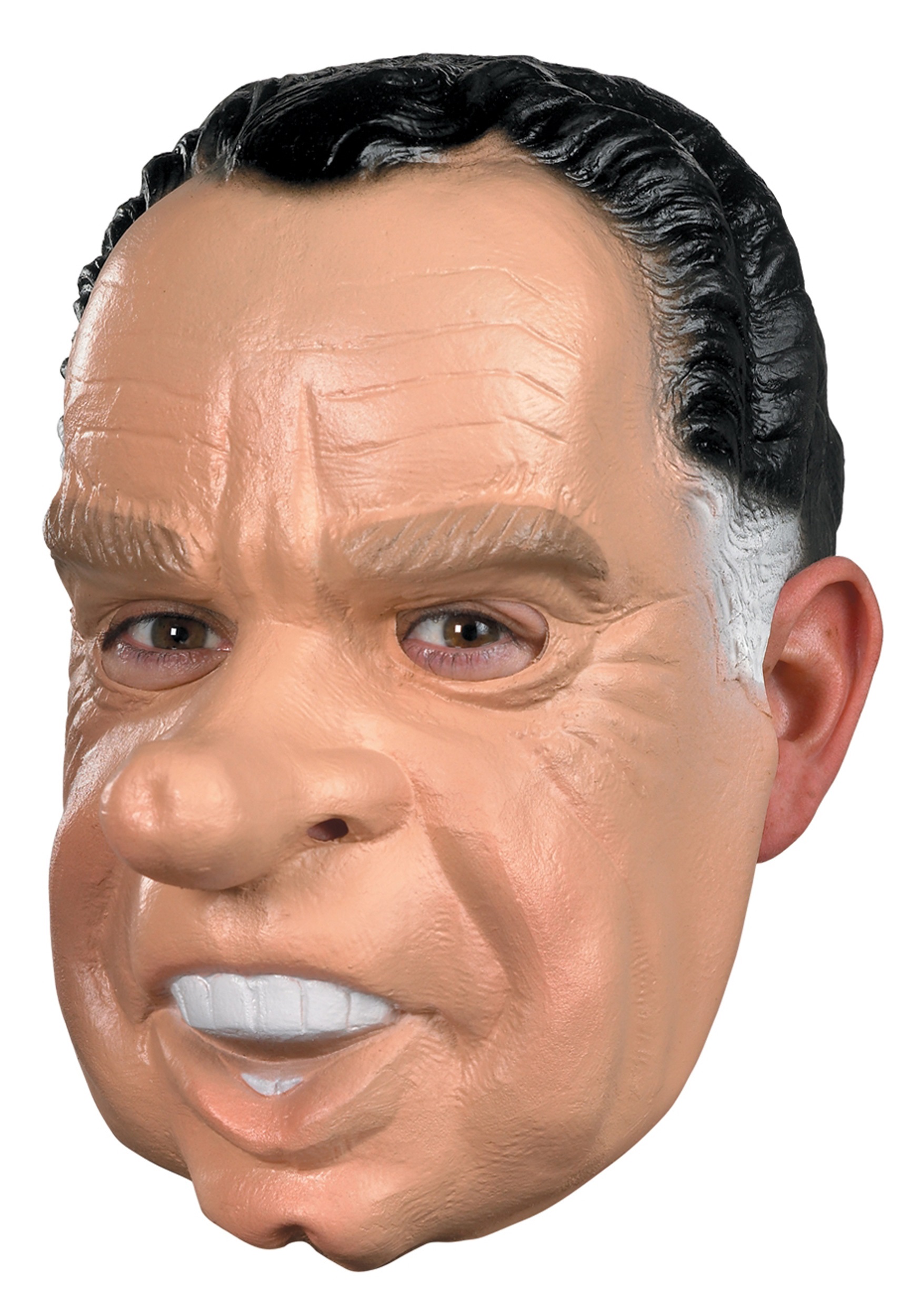
I leave you with one more thought: no other President proves as popular when it comes time to pulling bank heists and Halloween trick-or-treating:
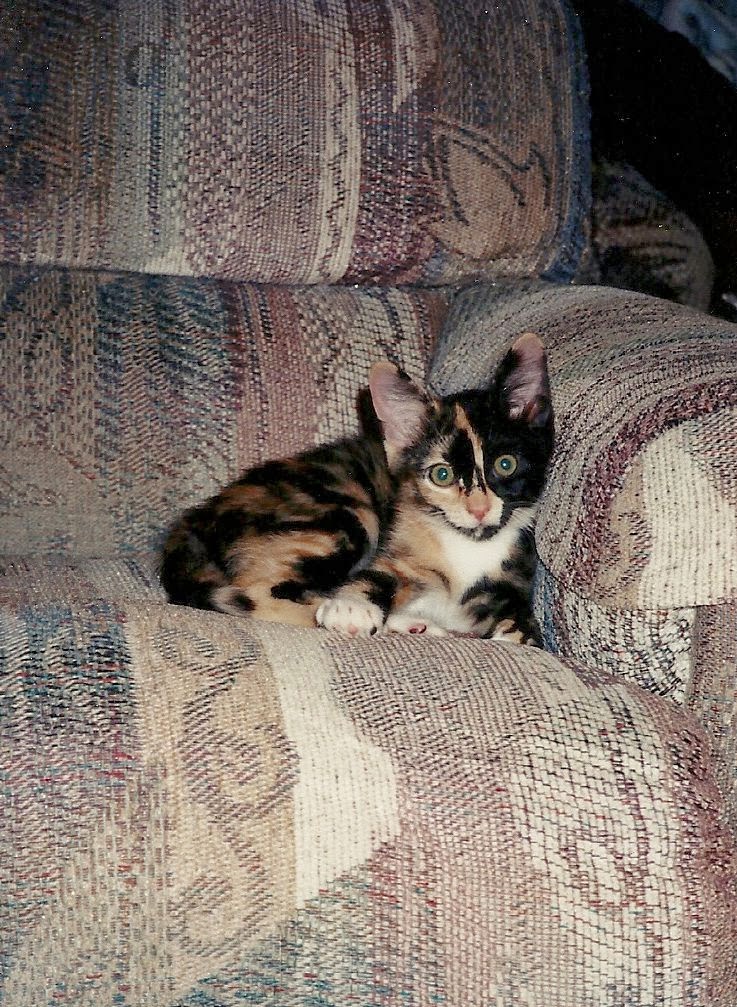
As I'd mentioned to my friends on Facebook, and through postings on other forums and on my writer's blog, last night I had to let go of a pretty kitty.
There's not more to say about that. The apartment right now feels empty.
I've been digging through all my photos now. I took so many and then left so many of them in boxes. There's a bunch I took before I got digital cameras, old film photos that need to get scanned or something.
I had this at my office. It was the best photo of Tehya and her adopted sister Page sitting together on a window sill (that was rare, Tehya I adopted first and she never got along with Page when I adopted her a year later).
Page has this pleasing "How May I Help You Kind Sir" expression on her face. Tehya's arm is stretched out with her paw next to Page's.
Page passed away two years ago, before Thanksgiving.
An honest man, like the true religion, appeals to the understanding, or modestly confides in the internal evidence of his conscience. The imposter employs force instead of argument, imposes silence where he cannot convince, and propagates his character by the sword.
- Junius (Letter 41, 1770)