Monday, January 04, 2016

The Revolution of 2016 Will Not Be Organized

Who planned this thing?

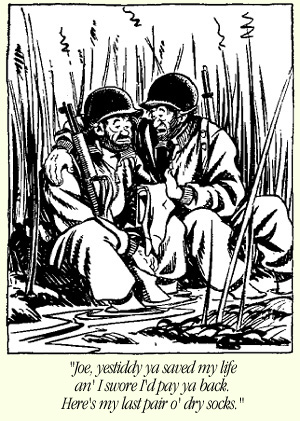
Reports are coming out now that the armed thugs seizing control of a national park building in Eastern Oregon are sending out Facebook and Twitter requests to fellow "militias" to ship them snacks and cold weather supplies like socks.

Ignoring the irony of having anti-government gunmen call on their allies to use the US postal service to ship them supplies, the sheer ineptitude of mismanagement is on full display here.

It's like, "Hey Blaine, it's cold where's the socks?" "Uhhhhhh, back at the hotel?" "DAMMIT BLAINE YOU HAD ONE JOB."

This is the one thing you never wanna do to a revolution: You NEVER set yourself up for immediate mockery on social media.

I didn't make this: I need to cite the person who did

What was it Eisenhower said about how the military operates? "In preparing for battle, I have always found that plans are useless but planning is indispensable." That means the plan you have to attack can fall apart when the operation goes live - your enemies respond in ways you didn't expect, or external forces and accidents interrupt key steps - but if you think ahead on your supplies and support and contingencies (the planning) you can survive the confusing fog of war and win the battle.

There's a reason why the best armies throughout history are the best-supplied ones.

When the US armed forces go out into war, you're damn well certain we are going with enough socks to last the winter.


Bill Mauldin

If you revolutionary wannabes were serious about this "protest" to seize a federal building in a seditious act, you'd have planned it out better. For starters, NOT IN THE MIDDLE OF THE PACIFIC NORTHWEST IN THE MIDDLE OF WINTER WHEN IT'S FREAKING COLD IN THE MOUNTAINS FOR GOD'S SAKE.

It's like they'll want to blitz the Russian steppes next February for sh-ts and giggles.

Here's the deal, you militia morans, you Y'allQaeda insurgents, next time someone offers to organize an armed uprising somewhere, you should ask that person three things:

1) Will there be drinks and Doritos?
2) Will there be pleasant distractions such as a month's supply of DVDs of our favorite shows?
3) Do we need to pack extra underwear and wool socks for, oh I dunno, FREAKING WINTER WEATHER?
4) Will you actually plan this sh-t out? Wait, this is four. FOUR Questions you need to be asking, plus if there's working bathroom facilities on the premises and... FIVE... FIVE QUESTIONS that needs be asked, plus whether or not we need to bring our own trash bags to pick up after ourselves and... ah dammit.

Woodstock 1969 was better organized than this. I'm not saying that in a good way.

Sunday, January 03, 2016

Well, 2016 Escalated Quickly

You'd think in the post-holiday down-time that is the month of January there'd be a slowdown in the wingnut craziness of this nation. You know, the calm before the storm that's going to be the 2016 primary season unlocking its ballot boxes starting this February.

Nope.

An armed militia took over a building at a national wildlife refuge in Oregon late Saturday and vows to occupy the outpost for years to protest the federal government’s treatment of a pair of ranchers facing prison time.
The occupation of a portion of the Malheur National Wildlife Refuge 30 miles southeast of Burns, Ore., followed a peaceful march for ranchers Dwight Hammond, 73, and Steven Hammond, 46, who are scheduled to report to federal prison in San Pedro, Calif., on Monday after being convicted of arson, according to the Oregonian.

Sigh. I'll go get a new desk panel for my IKEA workstand so I can /headdesk with a fresh pressed-wood sheet.

Thing is, the Hammonds are already planning to turn themselves in to authorities to serve out their sentences, and that they were part of a peaceful protest that happened earlier in the day, and so far don't seem to have anything to do with this seizure of federal parkland going on in their community's back yard. The Hammonds just issued a statement to the local media that basically said in one sentence "WTF you all doing, we don't want you doing this."

What's happening here is outside agitators showing up with their own anti-government greivances, and unable to garner a violent response from authorities so they can play the martyr they all decided to go pro-active and instigate a more direct means of confrontation to ensure they get that martyrdom.

The angry guys leading this terrorist act are all familiar anti-government faces: three of them are from the Bundy clan out in Nevada who started an armed confrontation with authorities over unpaid fees for using federal grazing lands. Like Coates noted back in 2014 these clowns are a perfect example of privileged whites armed to the teeth to defend their criminal acts, who are then let off the hook because the government fears instigating another Waco (because THAT led to a lot of innocent people dying in terror acts like Oklahoma City).

So far, the response has been minimal by authorities, mostly local cops and national park workers monitoring from a distance. However, the lack of a more urgent response - the unusual lack of locking down the surroundings to prevent people going in or out, no barricading efforts, no word about the National Guard getting called in - is telling in its under-reaction. We've got the local communities shutting down their schools in panic, but that's been about it.

Twitter is heating up with observations about how Black protests over police shootings (Black Lives Matter) get immediate SWAT response with tear-gas and rubber bullets and batons, but a bunch of armed white guys illegal seize federal property - it falls under Seditious Conspiracy (18 US Code s2384) and carries 20 years as a felony - and everyone in a position of authority are moving like they're swimming in molasses.

Right now, there's no shooting or deaths reported. But what happens when this carries onward, from days into weeks? We've got a company of armed angry white guys, calling out to their fellow angry white guys to rally to their banner, and the ever-increasing likelihood that this is going to turn into a shootout with a body count and the Far Right enraged to the point of open warfare.

Just how far into the madness are the political and media elites who can do something about this to tone it down and lessen the anger - the Far Right Noise Machine - willing to let this all fall?

Saturday, January 02, 2016

Thoughts on Numbers and Maps 2016 Edition

(Update: Hello again and Happy New Year to the Crooks & Liars readers. Thanks again to Mike's Blog Round-Up and to BlueGal in particular for linking this article there. Please take some time to visit the rest of the blog, especially the current stuff tracking the crazy situation in Oregon. If anyone can tell me where the "Please Send Snacks" Gadsden flag came from, please let me know via Twitter @PaulWartenberg or here in comments. Danke.)

I'm just gonna start throwing numbers out here for the 2016 election:

Census numbers as of 2014 (click on the XLS file links to open spreadsheets) tells us there's about 142 million registered voters. Out of a citizenry over 18 years of age - minimum age to vote - of 219 million, that about 64 percent of the population able to vote.

It is more difficult to determine actual voter registration by party because only 28 states (and DC) allow people to register a party preference. If we go by national polling self-identification - for Gallup in July 2015 it was 46 Democrat 41 Republican - and put that as a percentage to 142 million, you get 65 million Dems and 58 million GOP.

But that's not including NPA/Third party, so we need to include that... gotta find the chart for that ah here it is... this is weird in that it says 43 percent identify as Independent while 30 percent are Democrat and 26 percent are Republican. But that normally doesn't mesh with real-world numbers: actual voter registration in Florida for example has the party identification about 38 D- 34 R - 27 N. It's possible that due to the states that DO NOT require voters to identify to a party, most registered voters would think themselves independent, but that may not reflect on their direct enrollment to either major party at the state level.

If we take the Gallup poll that includes Indy voters at face value: that would be 61 million Indy/Third party voters, 42 million Democratic voters, 37 million Republican voters. That doesn't entirely reflect actual voter turnout...

If we go by the 2012 voter turnout demographics for the Presidential election by Party, it looks like this (via that Wiki article):

Party
Democrats927138
Republicans693132
Independents4550529
That table demographic if applied to the 2012 voter turnout - 126 million give or take a Cook County gravesite - 48 million Democrats voted, 40 million Republicans voted, 36 million Indy/Third voted. THAT seems more realistic (and more shocking, that so few Indy voters at 61 million self-identified as such and only 36 million showed... tsk).

Make it a given (axiom) that the party members will vote heavily for their own party (which we see in that table) regardless of the year/candidate, it comes down to how the Independents/NPAs are going to vote. If the Democrats can keep (or even improve on) their 45-50 percentage to Republicans - close split of the non-aligned voters - they can pretty much keep their overall advantage of 38-to-32 percent total voters.

The trick then for both major parties in 2016 is to not only appeal to their base - as always - but to get enough of the Independents to swing to their side. The Republicans did get 50 percent of the Indy vote but it wasn't enough to win enough states or the popular vote overall. The Democrats just have to keep the 45 percent of Indy votes they appeased last cycle while keeping their own base appeased as well.

By that logic, the Democrats have the easier path. The Republicans have to do a better job of appealing to NPA/Indy voters... which is next-to-impossible if their party platform is an extremist one. By an October 2015 WSJ/NBC News poll, self-identified Independent voters viewed Republicans as "out-of-mainstream" on five (finance, abortion, gay marriage, immigration, climate change) of six issues (the only mainstream view being about guns). If that view remains fixed by October 2016, there's little to shift Indy voters more to the GOP to change those 2012 numbers.

If we go by map it looked like this:

from the 270towin.com site

This is why the Democrats are focusing on repeating 2012 turnout as best as possible: it not only guarantees the popular vote win but also the Electoral College win. As long as the states that voted for Obama still vote for Hillary/Bernie, the Democrats keep control of the White House. Link to an interactive map to make your own prediction, by the by.

If there are any numbers that should bother both major parties, it's this: that same October 2015 poll I listed earlier also charted the Unfavorable numbers for the major candidates in both primaries.

from Wall Street Journal/NBC News Oct. 2015 polling
It's interesting that poll did not include Bernie Sanders' favorables as a contrast to Hillary, then again the media elites are taking it as a given Hillary will win the Democratic nomination. Still, it shows the two leading names - Clinton and Trump - at near-majority hatedoms. Apply the Machiavellian maxim of "whether it is better to be loved or feared, the real trick is to avoid being hated", those unfavorable numbers bode ill for voter turnout. People won't show if their choices are between those they hate. Republican alternatives don't fare much better as Jeb Bush and Ted Cruz are both over 30 percent unfavorables - that's a solid no-vote cutoff line IMHO - while Carson and Rubio are at least under 20 percent hater status (which does explain why the media keeps thinking Rubio's gonna happen).

So what we're going to see in the 2016 election cycle is this: massive pandering by the Republican candidates to win their voting base, and then utter failure to swing back to the Moderate/Centrist facade because they caved too far Right Wing; utter silence by the Democratic Party as they try to keep a low profile, keep their far Left Wing happy with table scraps, and play to that Moderate/Centrist location to win over enough Indy voters to secure enough states for Electoral College wins.

Expect a lot of despair and frustration over the national ticket well into March when the Primaries actually kick in.

Thank GOD there's the NFL Rookie Draft in April to keep me distracted.  Tampa Bay needs a lot of help at Defensive End and Cornerback this off-season, and Free Agency moves at DE have not panned out...

How 2016 Is Gonna Be a Weight On The Soul

Charles Pierce at Esquire pretty much sums up in one sentence how this year is gonna roll, son:

For the very first time that I can remember, I am completely revolted by the prospect of covering a presidential campaign.

I feel ya.

There is going to be a lot of storm and fury signifying nothing but desperately stirring up voter anger as though that is the only motivator for people to vote. The emotional relevance of voting has overwhelmed common sense and common decency. We're going to hear and see a lot of offensive ads and tweets and spam mails from a lot of Active-Negative types campaigning for the Presidency... on BOTH sides of the ballot (I've made my evaluations of the Republicans - Nixonian A-Ns - and Hillary Clinton - LBJ style A-N - already).

The only way this ends well is with massive voter turnout, which draws in a lot of moderate voters who can affect the down-ballot votes in Senate and House (and State lege) campaigns. So even with the noise of hell and horror buzzing in our ears, we Americans need to remind ourselves that, and get the damn vote out, okay people?

There's more to be said today on other issues. Stay tuned.

Friday, January 01, 2016

Okay, So I've Been Thinking About This New Year's Project

First off: HAPPY NEW YEAR to everyone this 2016 and OH GOD IT'S AN ELECTION YEAR THE MADNESS IS GONNA GET WORSE. There, got that out of the way. I can write about that in greater detail as the chaos deepens.

Moving on...

One idea that's gotten into my head is putting together a set of the blog articles I've written on this site and getting it published in print form.

The practical reasons aren't entirely there, if I have to argue against this idea. I've developed a bit of a readership - Hi, everybody! - but it's not like there's a clamor for me to get something wrapped up in a book with a nice hardcover and a fresh off-the-press scent.

In terms of marketability, I'm not entirely credible as an expert on some of the political and social issues I discuss here. It's not like I'm a PhD in Public Administration or a constant presence on a cable channel talk show. Anything I have as 'experience' is a degree in Journalism (just not a career in it), and eight years worth of ranting on a blog with about 1500 views a month on average (unless Crooks and Liars promotes an article on the Mike's Blog Round-Up, which bumps up the monthly stats to about 3500, which is why I'm always ever so grateful). It's not exactly something to burnish as credentials to get a book like this on a Barnes & Noble store shelf.

One idea I've been having is taking the articles I've written about Obama's tenure as President - during which most of my blogging's been done - and putting them together as a sort of pro-Obama critique of his administration. One of the things that keeps bothering me at the library are all these anti-Obama diatribes getting shelved and checked out. I can count on one hand the number of pro-Obama books I've come across. I just feel there's a need for a book that would point out the positives of the presidency and the follies/fallacies - my Shoelace Hypothesis - of the haters.

I could focus on just the overall craziness of the American political landscape. One of those "this is what the nation was like, future generations" diaries that were so popular in the 19th Century. Only with more profanity.

(The real reason I'm thinking of this is because I overpurchased a Print-on-Demand book service about 10 years ago, it's still sitting there, and I really want to get that taken care of as quickly and without consuming any more time away from other projects as possible)

I dunno. To the seven regular readers of this blog, is any of this a good idea? You think this has merit? Leave a comment please.


Thursday, December 31, 2015

What to Expect in 2016

This IS after all A Year of Election, this coming 2016.

Predicting how it will all play out is ridiculous, because the future isn't set yet from our perspective and anything can change everything else. The best we can say for certain is that the Tampa Bay Bucs are going to draft in the top ten spots of the April rookie draft.

What I can say about 2016 with regards to politics is that:


What I can say about 2016 itself is that:


  • Batman vs Superman Dawn of Justice better NOT SUCK.
  • Also, I really think the NFL is making a big mistake forcing - and they are - the San Diego Chargers to relocate to LA. Let the Raiders have that market, okay? Sheesh.
  • Also, I need to market my ebooks better. 


Happy New Year to ye, and hope to see you in 2016.

A Tale Of Two Books (2015)

I need to get this review done before the year does.

I bought these two books at the same time.

This was back in July, when they were released to the public at roughly the same time.

Harper Lee's book was the more promoted and anticipated work. If you lived through high school American Lit, you read To Kill A Mockingbird. It was unavoidable: Lee's magnum opus about growing up in 1930s Deep South, a searing indictment of racism and cultural violence. It'd been rumored for decades that Lee wrote a follow-up book - it was in fact her original work, but her publisher talked her into re-writing with a focus on her main character's childhood and on father Atticus Finch - that had disappeared. It had actually been misplaced, and when it popped up there had been a bit of a legal and public scuffle over whether or not to publish Go Set a Watchman at all. Once the crying and the thou-shall-nots subsided, it went to market and broke several sales records... and quickly stirred up a whole new hornet's nest of trouble, which I shall discuss in short order.

Ta-Nehisi Coates' book had received some fanfare before release, due to Coates' growing reputation in the political punditry circles from his years of writing for The Atlantic and other publications, but his fame was nowhere near Lee's and his book Between the World and Me was a modest success compared to Watchman. But it received near-universal acclaim, won awards, and became the most-talked-about political essay - with people praising it or debunking it - of the year.

I bought both, and wanted to read both, and want to discuss both at the same time because both works deal with perhaps the key issue of the American idea of itself: the issue of racism, observed from differing points of view. From Lee's perspective as a liberal southern White of the then-Civil Rights struggle of the Fifties, and from Coates' perspective as an urban Black of the post-Civil Rights / Reagan era enduring the realities of a still-racist socio-political system.

Go Set A Watchman opens on the return of an adult Scout (aka Jean Louise) to the backwoods home town of Maycomb, Alabama. On a visit to see her aging father Atticus, Jean Louise confronts some of the still-standing cultural norms - the Jim Crow segregation - of the Deep South in the mid-1950s.

Watchman turns on a pivotal moment - Chapter 8 in fact - where Jean Louise discovers a shocking truth about her own father, someone she had viewed as a paragon among lesser mortals. Page 100 (of the hardcover) in fact, and Lee even gives us the time of hour when all illusions are shattered:

...Jean Louise was snatched from her quiet realm and left alone to protect her sensitive epidermis as best she could, on a humid Sunday afternoon at precisely 2:28 PM...

She discovers a pamphlet hidden among Atticus' reading materials. It's titled the Black Plague, and she takes some time to read it:

When she had finished, she took the pamphlet by one of its corners, held it like she would hold a dead rat by the tail, and walked into the kitchen. She held the pamphlet in front of her aunt.
"What is this thing?" she said.
Alexandra looked over her glasses at it. "Something of your father's."
Jean Louise stepped on the garbage can trigger and threw the pamphlet in.
"Don't do that," said Alexandra, "They're hard to come by these days."
(p.102)

That sound you heard when 500,000 readers got to those pages were a lot of hearts and souls getting broken all at the same time finding out that Atticus, dear old Atticus of To Kill A Mockingbird who stood up against the injustice of racism, was really racist all along.

It gets worse for Jean Louise as she hurries off to sneak into the meeting Atticus and his law partner Henry - and would-be suitor for Jean Louise - had scheduled that afternoon. She discovers it's a Citizen's Council meeting, and they're listening to a racist preacher espouse hatred to a nodding crowd. Confronting both Atticus and Henry about it, her outrage grows to the point where she plans on leaving the small town - and her family - forever.

Watchman has its flaws as a novel. You'd expect that from a publication that went to print without any editorial controls - we're essentially reading a rough draft because Lee's legal guardians were likely wary of having anyone "tweak" the novel and face accusations it wasn't really Lee's work - and with little realization how Watchman has continuity errors with Mockingbird. For starters, the centerpiece of Mockingbird - the rape trial involving Tom Robinson - turned out differently in Watchman where Atticus won the case - in 1930s Alabama?!?! - by arguing the "rape" was consensual. Someone with an eye towards making both novels fit their same histories would have fixed that to fit the more tragic ending in Mockingbird.

Where Watchman has a strength is its frank revelation of how pervasive racism was - still is - in the American Deep South.

One of the darker parts of the book is the final confrontation Jean Louise has, this time with her uncle - a doctor no less - who physically slaps her and then chews HER out for being prejudiced and narrow-minded judging her father. Domestic violence issue aside, a modern reader would notice the practice of "blaming the victim" here as Dr. Finch points out how Jean Louise has her own biases blinding her to how everyone has their own watchman, their own conscience, and that despite her realizations that Atticus is racist he still raised her to "set her own watchman" (hence the book title). The book ends with that tone, with Jean Louise reaching some kind of rapprochement with her father - Atticus expressing that's proud of her for standing her ground, Jean Louise admitting that Atticus has a point about the civil rights movement "moving too fast" and that she still loves him - although the events of the weekend have changed warmth to wariness.

It's a weak ending, but it's one that fits within the context of the 1950s when it was written. Racism was so ingrained into the cultural norms not only of the Deep South but across much of the nation. And it's not the blatant racism - the burning crosses, the hanging nooses - that Harper Lee is focusing on in this novel, it's the unthinking and reflexive kind that she brings up: the sharing of racist literature among the community, the public meetings of "councils" to discuss how to keep "outside" agitators like the NAACP from disrupting their segregated towns, the small-town mindset to "keep it in the community" and do things the way they've always been done.

To the modern reader, one who's lived through - been born after in a lot of cases - the civil rights movement of the 1960s and into the post-Jim Crow world of the late 20th Century, Watchman has a nostalgic aura but one that shines a light on the hypocrisy of that era. But it's also a light that shines on the hypocrisy of our own modern decade of the 21st Century... because Ta-Nehisi Coates' book highlights how all those sins Harper Lee wrote about back in the 1950s are still with us.

Between the World and Me is slightly misleading in that while the book is written in the style of letters from a father to his young son, BtWaM it's really Coates writing to the rest of us about how it was - how it still is - for a young Black child to grow up a Black man (or woman) in a United States where nearly every institution - the schools, the police, the law, the government, the businesses, the communities - viewed Black Americans as "property"... and how that property can be destroyed by the whims and needs of those institutions:

The new people are not original in this. Perhaps there has been, at some point in history, some great power whose elevation was exempt from the violent exploitation of other human bodies... But this banality of violence can never excuse America, because America makes no claim to the banal, America believes itself exceptional, the greatest and noblest nation ever to exist... I propose to take our countrymen's claims of American Exceptionalism seriously, which is to say I propose subjecting our country to an exceptional moral standard. This is difficult because there exists, all around us, an apparatus urging us to accept American innocence at face value and not to inquire too much... (p. 8)

Coates' work is coming at a pivotal time in modern America, as awareness to how Black lives are suffering at this very moment:

I write you in your fifteenth year. I am writing you because this was the year you saw Eric Garner choked to death for selling cigarettes; because you know now that Renisha McBride was shot for seeking help; that John Crawford was shot down for browsing in a department store.  And you have seen men in uniform drive by and murder Tamir Rice, a twelve-year-old child whom they were oath-bound to protect. And you have seen men in the same uniforms pummel Marlene Pinnock, someone's grandmother, on the side of a road. And you know now, if you did not before, that the police departments of your country have been endowed with the authority to destroy your body. It does not matter if the destruction is the result of an unfortunate overreaction... Resent the body trying to entrap your body and it can be destroyed... And destruction is merely the superlative form of a dominion whose prerogatives include friskings, detainings, beatings, and humiliations. All of this is common to black people. And all of this is old for black people. No one is held responsible. (p. 9)

Coates details for his teen son his own horrors of growing up, his own childhood fears, fully aware of the psychological breakdown that haunted his black community then and since. One incident in particular haunts Coates and appears often in BtWaM: the death of fellow Howard student Prince Jones, whose only crime was to drive through an affluent neighborhood in the DC metro and ended up shot to death by a county policeman (and outside of his jurisdiction). Angered by the injustice, Coates then had to come to terms with the facts that the cop who shot Jones was black, worked for a county government and chain of command with black leadership, and yet it all still marginalized and destroyed black lives. To this Coates sees a nation and a world of rules designed to take rather than liberate or restore:

This need to be always on guard was an unmeasured expenditure of energy, the slow siphoning of the essence... So I feared not just the violence of this world but the rules designed to protect you from it, the rules that would have you contort again to be taken seriously by colleagues, and contort again so as not to give the police a reason... this is how we lose our softness. This is how they steal our right to smile... It struck me that perhaps the defining feature of being drafted into the black race was the inescapable robbery of time, because the moments we spent readying the mask, or readying ourselves to accept half as much, could not be recovered... (p.90-91)

Where Lee's two books provided the view of America from the White perspective - where the American Dream of quiet neighborhoods with picket fences and happy singing birds, no matter how benign the intentions are to make this so - Coates' book provides the view from the Black perspective where the American Dream was founded, funded and built upon the destruction of black neighborhoods where intent does not matter, only the destruction does.

This is where racism becomes and remains the great original sin of the United States. Willing to divide ourselves, by those who profit and achieve power by those institutions that enforce such divisions, the United States cannot claim the purity of exceptionalism the nation claims as its identity.

Halfway through Watchman, Atticus takes on a case for a young black man charged with vehicular manslaughter who turns out to be Calpurnia's - the housekeeper for the Finches in Mockingbird - great-grandson. However, Jean Louise finds out he's only doing so to stop the NAACP from coming in and taking over the defense. Dismayed, she visits Calpurnia's family on her own to offer some form of condolences and try to put a positive spin on her father's taking the case, but the meeting becomes strained because Calpurnia knows why Atticus is doing what he's doing:

She looked into the old woman's face and she knew it was hopeless. Calpurnia was watching her, and in Calpurnia's eyes was no hint of compassion.
Jean Louise rose to go. "Tell me one thing, Cal," she said, "just one thing before I go -- please, I've got to know. Did you hate us?"
The old woman sat silent, bearing the burden of her years. Jean Louise waited.
Finally, Calpurnia shook her head. (p.160)

Calpurnia has to think it over before giving her answer. SHE HAS TO THINK ABOUT IT.

That's what racism does to this nation. It makes people like Jean Louise have to ask if she and fellow whites were/are hated, it makes Calpurnia have to sit there and think through the slights and wounds she had endured because of it, it's left Prince Jones and Tamir Rice and Trayvon Martin dead before their times, it's put a warning sign on Ta-Nehisi's son that all of this will happen to him.

This is a tale of two books. It is a tale of one nation divided into pieces over our nation's deadly sin.
 

Wednesday, December 30, 2015

Things We Learned in 2015

As the year comes to a close, these lessons:


Oh, and I'm thinking of putting some of the blog articles I've written into print format as a book. Think there'd be a market for it?

Sunday, December 27, 2015

Another Thought About the 2016 Primaries: Numbers and Chaos

Having worried about the Winner-Take-All states like Florida and Ohio looming soon on the primary schedule for the Republicans, I got to wondering about how exactly the Proportional Win states like Texas would work out.

(I'm going with Texas because it's one of the largest delegate counts using Proportional methods, and it has a rather complex mechanism involving "thresholds")

Part of it is pure curiosity: the dangers of the WTA states are pretty obvious, but how much damage would a large-scale Proportional state do to the convention delegate chances of -  17 14 12 are we at 11 yet? - the remaining candidates trying to stop Trump from, you know, DOOMING ALL OF CIVILIZATION.

Part of it is trying to understand exactly how the Proportional states assign delegates: there's an At-Large section, a District-Win section, a No-Dogs-Allowed section, a Buy-Two-Get-One-Free section, a Clearance rack, and a partridge in a pear tree. In short, the rules look confusing.

So I went and emailed the Green Papers blog. I've linked to them from before on a few topics, and they are focused like a laser on how the primaries and our overall elections are working. They have set up pages for each state primary for parties, as well as the delegate rules for each, so they might be able to answer the questions I had.

The questions went like this:

Hi. I write a blog called You Might Notice a Trend, and I recently blogged about how the polling numbers tended to match up to primary results. I still have a question or two about it, and I hope you at Green Papers might have an answer.
For the Proportional delegate states like Texas that require Proportional, 20% threshold–If a candidate wins more than 50% of the statewide vote, he or she is awarded all of the state's at-large delegates. If a candidate wins more than 50% of the vote in a district, he or she is awarded all of the district's delegates, how would the delegation count look like if Trump gets 27 percent, Cruz gets 23, Bush gets 18, Rubio gets 17, Christie gets 10, maybe Rand gets 5, nobody else (if they all stay in) over 1 percent? It would then depend on who wins each district (which refers to Congressional district, right?) over 50 percent or at least plurality of that district?

The answer came back prompt and courteous:

Dear Mr. Wartenburg-
Yes, you are correct-- in a State doing things in the manner of Texas, a candidate who receives at least majority of the popular vote in a Congressional District would get all that District's delegates (3 total); where at least one candidate receives at least 20% of the popular vote, that candidate would get 2 District delegates and the second-place finisher in that District (even with less than 20% of the popular vote) would get the remaining District delegate; and, where no candidate gets at least 20% of the popular vote in that District,  the top 3 vote-getters in that District would split the 3 District delegates amongst themselves.
The 20% Statewide vote threshold has no impact whatsoever on the distribution of Congressional District delegates amongst GOP presidential contenders (thus- in your own hypothetical percentage breakdown of the Statewide percentages- Bush, Rubio, Christie [and even Rand Paul] might well gain the pledges of at least some Congressional District delegates)...
as for the Statewide percentages you have hypothesized themselves: only Trump and Cruz would get at-large delegates (Trump would- if we so simplify things here- get 26 of the 47 at-large delegates from Texas, with Cruz gaining the remaining 21 of these).
Sincerely,
RICHARD E. BERG-ANDERSSON
TheGreenPapers.com Staff

I went with those polling numbers for Texas because I vaguely recalled Trump and Cruz being in the high-20s but wasn't sure about the others. So I went back to Real Clear Politics for their polling tracker and found that the last tallied poll (in November) for the Texas primary showed:

Polling Data


PollDateTrumpCruzCarsonBushRubioFiorinaHuckabeePaulChristieKasichSantorumJindalPatakiSpread
RCP Average9/8 - 11/823.319.016.09.06.35.02.32.01.00.70.70.30.3Trump +4.3
UT/Texas Tribune10/30 - 11/82727134942411100Tie


(hey, copying the table seemed to work...)

If the RCP average ends up as the actual Texas Primary result on March 1, I think that means Trump gets ALL the At-Large state delegates having passed the threshold while Cruz at 19 percent misses out. If the last poll (UT/Texas Tribune) is correct, Trump and Cruz would split the At-Large delegates even-stevens at 23 each with a hanging Chad split down the middle like an apple pie. Mmm, pie. If NONE of them get over the statewide threshold, it looks like the At-Large get proportioned out.

That is a huge incentive for the Republican Party to keep as many candidate choices as possible to pull away from Trump's numbers and get him (and Cruz) under the 20 percentile.

No matter what, the bulk of the delegates depends on the individual districts, which the GOP uses Congressional districts to determine. In those cases, the party has to hope that no one gets over 50 percent of the vote in any district lest he/she claims all three delegates. That may not sound like much for one, but if one candidate does well in enough of those districts that's fewer delegates to share.

Just to note: Any Proportional state for delegates with thresholds will cut off a lot of the low-percent candidates, which may hasten their departure and make it easier for the high-percent - currently Trump, maybe Cruz and Rubio, maybe Carson and Christie somewhere in the middle of what's left of the pack, Jeb if he's stubborn enough to waste all his PAC money and luck into Third Place for the later rounds - candidates to cross those thresholds anyway. Those states cover Texas, New York, Georgia, Alabama, Tennessee, and a few others with low enough delegate counts to be of minimal value (for now).

The states of highest value regarding Proportional are going to be the ones that won't set any thresholds: those will allot delegates by high enough percentages in the results. That means the mid-pack candidates REALLY need to focus on states like Virginia, North Carolina, Oregon, Missouri.

The key thing overall I'm seeing is that the Republican establishment has a vested interest in keeping at least six candidates running in the field well into June. If a brokered convention is the only thing that can stop Trump, they need those delegates divided.

For the Winner-Take-All states, expect the party leaders to try and get the primary voters in them to throw enough support to one of the non-Trump candidates. For the Threshold states, expect that as well with a focus on splitting those At-Large numbers between Trump and the non-Trump. For the Free For Alls... well, expect a free-for-all because it'll be Every Candidate for Himself (forget it Carly).

With thanks to Mr. Berg-Andersson for answering my question and clarifying things. If you read this and see my reasonings are wrong, please correct. Good luck, and happy holidays.

Saturday, December 26, 2015

The Primaries That Should Scare Everyone Including Republicans This 2016

I mentioned earlier getting into an argument with a Twitter-Troll over Rubio's lack of chances this 2016, and pointed to how the polling was currently going for the candidates and how previous election cycles demonstrated how the polling numbers tended to line up - give or take a switch of positions by candidates running close to each other - with the actual voting results.

That means: if the candidate is polling well leading up to the actual primary in that state, that candidate is going to get those results where it matters (actual delegates). Polling does include actual voters as well as likely voters, dontcha know.

In that regards, considering how Trump is leading in nearly every state, we ought to be f-cking sh-tting the beds and rioting in the streets. This is not a good thing to consider, is it?

This is where and how the delegation counts come into play. A lot of Republican primaries and caucuses tend to be proportional, so that if Trump only gets about 23 percent of a primary result, he'll get the plurality of delegates but not a solid majority. Hence the thinking we can see a brokered convention in Cleveland this 2016 since Trump may not garner enough delegates to cross the finish line.

Except for one fact: some states are Winner-Take-All, where the top vote-getter gets ALL (or most) of the state's delegates. There are certain rules that allow other candidates to get a few delegates from a WTA state, but the key word there is "few".

One other thing about that fact: some of the largest delegation states - Florida, Ohio, California - are WTA. Granted, some states' rules do break down to allow candidates to win selected districts if they can - California in particular - but the odds are whoever wins the whole state is winning a lot of districts as well.

If we look at my home state - Florida - the delegate count is 81 District, 15 At-Large, 3 RNC for a total of 99. The rules are "Winner-take-all: At-large and district delegates are both allocated based on the statewide vote," which I think means whoever wins the statewide polling gets both District and At-Large (RNC gets delegated another way). Meaning whoever is leading in the polls by March 15 2016 can well win Florida, and that's a guaranteed 96 delegates. If you're Second Place, you don't even get a set of steak knives.

Look at who's leading in Florida right now in the polls. Donald Trump, with no sign of major drop in support over the last two-three months. Ted Cruz may be polling now in Second, but he's on average about 10-14 points behind, not enough margin for statistical error to consider he's even got a chance. (If there is any satisfaction from this polling, it's that Jeb is so far behind in Fourth Place that there's no way he can cheat his way to win his "home" state)

It'd be helpful to look at each state's polling for candidates, to get a clearer picture of who's winning by how much, but there doesn't look to be - unless I'm looking in the wrong spots - a lot of polling going on outside of battleground states. I'm currently looking at Real Clear Politics for tracking the numbers, which only gives me a lot of Iowa and New Hampshire, some South Carolina and Florida results. The last poll for Ohio they've got is from Quinnipiac for October, which doesn't help. That shows Trump in a bare lead (+5) over Carson, and we know Carson has slipped nationally since then.

All we have for certain are the nationwide polling results, with Trump garnering on average 36 percent of primary voters: he's leading double-digits over everyone else, which may mean he's leading - at least polling in the Top Three - in every state, meaning he's leading in the delegate counts as well.

March 1 may be when a lot of states poll their caucuses and primaries, but they're mostly Proportional wins with threshold requirements: They may give the candidates grinding out Second through Sixth Places hopes of snagging enough delegates to matter in July. But March 15 is A Day of Reckoning: that's when Florida and Ohio both chime in with their WTA results, and with large enough delegate counts to put one candidate - Trump, OH GOD NO - well ahead of the others.

And like it or not, momentum from February and March carries a lot of weight even into June during primaries regardless of what the party's leadership - and deep-pocket backers - wants.

Florida and Ohio are key. He who controls the spice controls the universe those two states get a huge lead in the horse race heading into California in June.

Which is why I'm begging the residents of Florida to drop out of the Republican Party and switch to NPA. I don't want my state to screw over the nation AGAIN if it ends up being Trump. I'd like to think there's...

Wait a minute. I'm being told if I talk people out of the GOP, I'm likely getting the sane voters whereas the insane voters will stick with Trump. Okay. Okay, gotta go the other way then. Gotta convince 4 million registered Florida Republicans to put their support in a sane candidate for the GOP. Okay, sane candidate... (looks at Kasich as the only sane one left) Oh, c'mon John, you gotta AT LEAST be winning YOUR own home state...!

Friday, December 25, 2015

The Hero's Journey Redefined

(say hello to my 200th post in one year. I will be going over that number, so my OCD is gonna kick into overdrive and force me to round up to 250 or something...)

There is apparently still a need for SPOILERS: so if anyone doesn't want to find out how much of the movie turns out, please stop here and go SEE THE MOVIE RIGHT NOW IN 3D. (points in the direction of the nearest IMAX theater) GO NOW.

Okay, for the rest of you... no excuses.

I could spend this post geeking out over how GOOD (not great, I will grant you that) the latest Star Wars movie The Force Awakens is.
An orphaned Heroine with her Herald

Or I can go all academic and offer a half-baked analysis of one of the key reasons I love the movie. I love the movie because it takes the core element of what made the original - New Hope, Empire Strikes Back, Return of the Jedi - Star Wars trilogy great - the Hero's Journey - and tweaks it in a way that makes it recognizable yet still fresh.

The Hero's Journey - proposed by Joseph Campbell using Jungian psychology emphasis on Archetype - is a description of a near-universal narrative throughout human mythology that evolved into modern story-telling. It details the origins of a heroic figure (the isolated childhood in an ordinary, hidden place), the Call To Adventure (a herald arrives, or a mission needs undertaking), then the Crossing of Thresholds (barriers to the Adventure, sometimes in the form of adversaries), the gathering of allies and friends (Avengers Assemble, or Seven Samurai style recruiting), more Trials (fights, betrayals, tests of character) leading up to a symbolic death (Belly of the Whale) and rebirth (Resurrection), a final confrontation (Apotheosis), the granting of a Boon (not always a gift but usually some Insight or Wisdom Achieved), and a Return (usually back to the boring corner of the world the Hero left, but returning with the Boon as a gift to the community that they may prosper afterward). Closing with a Celebration of sorts (either a memorial to Absent Friends or a life-affirming activity such as a wedding or child-birth) in which the Hero achieves emotional closure (and sets up the cycle for the next Hero).

As noted, it's a near-universal narrative: it covers the rise (and fall) of various mythical heroes from Perseus to Beowulf, it covers the religious awakenings of Moses and Jesus and Buddha, it covers even the histories of real-world documented kings and Presidents and political figures.

It's a common theme in fantasy literature, which is why Star Wars does so well with it. And yes, for all the trappings of Science Fiction - other worlds, spaceships, aliens, Faster-Than-Light travel - this series is actually Fantasy: switch out planets for magic kingdoms, spaceships for flying pirate ships, aliens for monsters, FTL for mirror teleporters.

I mean, come on, there's a lot of overlap between the two genres. Here, take Tolkien's Elves, put them in space with phasers and tricorders instead of arrows and scrolls, and you get Vulcans (aka SPACE ELVES). Jedi are merely MAGIC SPACE WIZARDS.

Even as Sci-Fi, the Hero's Journey has a place in that genre, but it so often follows the tropes and rules for Fantasy story-telling that it invariably gets labeled as Fantasy.

With that, Luke Skywalker - farmboy turned war hero turned Jedi turned Redeemer - of the original trilogy became one of the recognizable Heroes of our modern myths. And one of the reasons why George Lucas' prequel trilogy - Phantom Menace, Attack of the Clones, Revenge of the Sith - remain flawed yet under-appreciated classics is how the prequels deconstructed the Hero's Journey by showing how that Journey could turn dark and create the Villain.

But one of the things - one of the problems - about the Hero's Journey - no matter the genre it's being used - is how gender-specific the narrative cycle has been.

It's almost always applied to young men: Boys growing up from obscure origins to become celebrated heroes and even kings ruling over all.

Part of the problem is the source: Campbell developed his monomyth and Hero's Journey templates based on earlier existing myths. As previous earlier cultures were all patriarchal and male-dominated, his theories ignored the role women could play in the narrative either as support, ally, or even the Hero(ine) herself. Women in these tales tended to be princesses or girlfriends waiting at home, not destined for action but designed to be rescued or redeemed. It gets a little demeaning, and the wrong kind of cliche.

But the past is not our present, and should not trap or define our future. We don't HAVE to be stuck with the Hero always being a man. Sure, it works for Harry Potter, it works for Frodo Baggins, it works for Kal-El and Steve Rogers... why can't it work for Katniss, or Buffy, or Hermione, or Ripley, or Furiosa?

Which is why The Force Awakens is so powerful a film. Because it takes the story most closely associated to the Hero's Journey - Star Wars and the legend of Luke Skywalker - and proves the narrative can work with a young girl as The Hero.

Into the new trilogy - thirty years after Luke claims his destiny as a Jedi and ends the rule of the Sith - the audience discovers that the sixth movie did not really end well. Luke's attempt to rebuild a Jedi academy for Force-sensitive students ended in betrayal and destruction, driving him to flee the known galaxy and denying the stabilizing presence of Jedi as a means of justice and peace. The New Republic that tried to rise in victory after the Battle of Endor has to contend with the First Order, the remnant of that dreaded Empire still looking to impose a dark rule. Unwilling to continue the war, the Republic instead allows a Resistance to impede the First Order's efforts in a kind of Galactic Cold War.

What starts the story proper is the quest for Luke, as the Resistance wants him back as a symbol of good and as the First Order's Dark Side agents want the Jedi wiped out forever. A map has been found on a desolate desert world - not Tatooine but Jakku, a scavenger planet littered with the debris of the galactic conflict - and the possibility of finding the last Jedi sparks the birth of a new war.

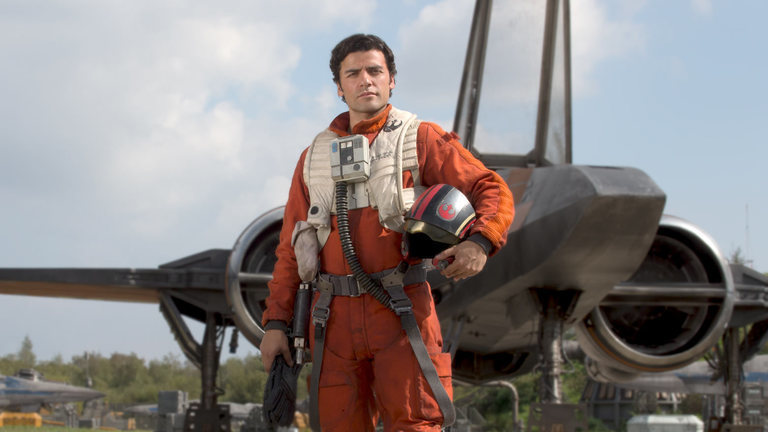
We're actually presented with two possible Hero candidates at the start of the movie. Poe Dameron is a hotshot pilot sent to retrieve the map for the Resistance. While he's certainly brave, and more than a little cocky... Poe doesn't fit the Journey's cycle as Hero. He's already fulfilled his destiny as the best pilot of the Resistance, and is more of a Mentor/Ally as the episode progresses. Indeed, he disappears with little explanation between the First and Second Acts - having played his part lining up the second candidate - and doesn't re-appear until he's needed for the Big Damn Heroes moment closing the Second Act and completing the Third.

The second candidate is Finn. While some critics note he's a new variant on the Hero's narrative, he's actually fulfilling established checkpoints for the Hero to follow. Introduced as one of the many faceless soldiers that make up the Stormtrooper forces for the First Order, Finn begins as a novice in the war engaged in his first battle that turns into a massacre of innocents. The only one of the troops to show an individual's response to the atrocities - indeed he's the first Stormtrooper we meet who voluntarily removes his helmet to show his face - he's someone we're meeting halfway down the Hero's path: already forced into the Call to Adventure having been abducted by the fledgling First Order as a baby and conscripted to serve as a soldier. However, his personal instincts of right over wrong compel him to reject that imposition: he rescues Poe in order to rescue himself and attempts a rather blunt Refusal of the (false) Call. Yet every other step during that Refusal - he wants to flee the war altogether, knowing full well what the First Order is capable of - keeps Finn on the Journey's path - it's known as The Call Knows Where You Live - and his instincts to protect others make him answer the True Call to Adventure.

He doesn't qualify as The Hero, however, because he lacks the true key, the otherworldly gift / actual skill The Hero secretly possesses. Every time Finn rises up to face the challenges on the Journey, he gets his butt kicked. Not out of any ineptitude on his part: Finn still is a heroic character for genuinely caring and trying. But any battles he survives are due to the aid of other Allies and Mentor figures, as well as the Hero herself. Finn is more an Ally archetype. Actually in this post-modern narrative reality Finn is our Audience Surrogate.

The Hero is Rey, and we should be aware of that the moment we meet her (it helps that John Williams gives her an identifiable leitmotif). Introduced third of the new Power Trio characters, without any spoken exposition we discover she's living by herself, abandoned as a young child and forced to survive as a scavenger. Essentially she's an orphan (major identifier for the Hero) still convinced there's a family for her that will come back... someday... and take her from this desolation.

Even as someone hardened by a harsh existence, Rey still has Faith and dreams of a better life: she believes in the stories of heroes and Jedi and the mystic Force - to her they are legends - and because of that she lives by a moral code that makes her all-loving (a key element of the Hero figure is empathy and willingness to help others). She rescues and befriends Poe's lost droid BB-8 (the Herald and her first Ally), she quickly accepts the trust of Finn (her second Ally and fellow Journey taker), and joins in the fight against the First Order troops (one of her first challenges, although the Threshold Guardian she needs to confront comes later) as the Journey propels her to Mentor figures (Han, Chewie, Leia... the heroes of the previous trilogy), revelations (that she is a Force User with a powerful connection to Luke via a family heirloom: the lightsaber of Anakin Skywalker), confrontations with a Shadow figure (Dark Force User Kylo Ren), passing of tests (discovering her own power with the Force), and confrontation (defeating Kylo with Anakin's saber as she wills herself to feel the Force).

Some of the buzz/complaints that came in the wake of the movie's release is how Rey appears as a Mary Sue figure - too competent, too nice, too quick an access to powers that would take other characters entire movies to learn - which angers up a lot of the film's defenders and for good reason. A Mary Sue - not the website, mind you, even though they love the movie and especially Rey - is a flight of fantasy character even in a fantasy work: an author's egotistical attempt to insert herself/himself into an existing narrative as a flawless character. Rey isn't that: she does make mistakes and she does Refuse the Call at a key moment, something a Mary Sue would never do.

Rey's virtues and powers in the narrative are from her being the Hero of the story. What's happening is that the critics aren't used to seeing the Campbellian Hero be female, even with the likes of Buffy and Katniss sitting there in the cultural pantheon of hero figures since the 1990s (when Girl Power and the rise of feminine heroes like Scully opened up the Grand Narrative to diversity). They never really saw female heroes as such, not until this situation where Star Wars - the touchstone of Archetype - made it clear that a woman CAN fit the Hero mold and make it work.

To quote that article from the Mary Sue website by Teresa Jusino:

...And to those who are skeptical about her abilities and think that they came “too easy,” I want to remind you that it’s because of this hardscrabble existence that she’s been forced to be good at so many  things... She’s had to learn how to fight and carries a staff wherever she goes, because she is a lone female in a seemingly male-dominated trade, and has to protect not only herself, but the goods she intends to sell. It’s likely that, in the course of her scavenging career, she’s had to learn to drive and/or fly any number of vehicles to transport them, or goods, to be bought or sold. So, it didn’t seem to come “out of nowhere” that she’d be a decent pilot. She’s no Poe, but she’s good... 
As for the Force, I love how subtly her increasing ease with it evolved over the course of the film. After meeting Han Solo on the Millennium Falcon, she expresses a fangirlish glee when he says that he knew Luke Skywalker. What’s more, when they talk about the Force, she is such a Mulder—she WANTS TO BELIEVE. So, clearly the Force is something that’s already been on her mind and in her head. This is not new information for her, merely a confirmation.
When Kylo Ren first tries to get into her head to find the location of the map to Luke, Rey looks afraid, and she obviously doesn’t want Kylo Ren to have this information. In a brilliant, wordless moment, we see that Rey’s strength in the Force happens pretty much by accident. At first, she doesn’t seem to realize she’s doing it, and it’s the look on Kylo Ren’s face that leads her and us to believe that he’s having trouble...

The moment Rey uses the Force to make Anakin/Luke's blue lightsaber fly into her hands - after her gaining the knowledge that she CAN use The Force - so she can battle Kylo is a powerful and transformative moment in cinema. It takes the power of being the Hero out of the grasp of male characters - even the ones who can fit the role - Finn - but really can't - Kylo, who's the Shadow and potential Dragon/Big Bad - and presents us with a new Narrative reality that both genders can fit the role.

This is a very big reason why The Force Awakens deserves a lot of repeat business in the theaters and massive love by fans when it comes out on DVD/Blu-Ray/Streaming.

Well, that and the fact that the movie is genuinely funny and FUN (things sorely lacking from the prequels and haven't been seen out of a Lucas-based production since, well, Indiana Jones and the Last Crusade).

(Edit: for the two of you who viewed this article while I added more updates to tweak my thoughts and add more links and quotes, please refresh the page and re-read the new stuff, thanks).

Thursday, December 24, 2015

Honest Bumper Stickers 2016, Episode VIII: The Farce Awakens

(Update: Hello Crooks and Liars audience, welcome back! Sorry for the shape of the place, I've been off to see The Force Awakens for the third time in theaters. Please check out the other recent postings, leave comments if you want. There are other bumper stickers on earlier postings, just click the label for bumper stickers and they should pop up.)

So there I was after the last GOP debate session engaging in a Twitter battle - yeah, I've been told not to, but dammit there's a war on! - with a pro-Rubio backer trying to patronize me. Emphasis on trying, because he was really bad at it ("New at this"? Muthafu--- I've been living this sh-t since I was ten...)

So I dig out the track history of how polls tend to match up to actual results, focusing on the most recent example of 2012. I pulled up Real Clear Politics' polling info and looked at the early primaries, specifically New Hampshire (Iowa is more an aberration to final results because of its wonky caucusing methods). If you follow that link and look at the numbers, the candidates that were First (Romney) and Second (Ron Paul) place stayed that way. Third place (Huntsman) wobbled a bit but garnered Third with the voters. Fourth (Newt) and Fifth (Santorum) also bounced between each other in the polls but the end results were statistically in line with how they finished.

Look to 2016's polling for the same state. There's chaos here with the also-rans while Trump claims a solid lead well into December, and Rubio currently holds the Second spot, but for October Rubio was barely holding Third, and right now he's got Cruz AND Christie rising up to challenge for Second. By the time of the actual primary, Rubio may well be back at Third, maybe even Fourth.

Nationally, Rubio's sitting at Third behind Trump (polling for him is more than double what Rubio has) with no sign of even challenging for Second (which is now Cruz, which is another level of OH GOD NO). Some of this deserves further attention in another blog entry, just to note...

So yeah, I stand by what I said about Rubio. I even went back into my CorelDraw editor and came up with a brand new bumper sticker to say it:


Not just a taunt at that pro-Rubio tweeter, but to the entire media elite that KEEPS backing Rubio despite the obvious lack of actual voter support.

Man, it's been awhile since I've made these bumper stickers. What the hell, America, it's Christmas Eve and I got time to make them. Hold on.


IO SATURNALIA, Americanum!

(that translates to "Party hard, my peeps!")