Actually, there's a good number of reasons. For starters, banning abortion has been a top ticket item for the Republicans ever since Roe V. Wade became a campaign issue. It's just never been a Top 10 issue for voters overall (most voters have as their top issues Jobs, Jobs, Better Wages for Jobs, Better Education, Education That Leads to Jobs, and Not Having Anybody Pay For Anything Anymore).
The second reason there's been a recent surge in the anti-abortion legislation has been that Tea Party "revolution" the Far Right kicked up in response to Obama's 2008 win. While the Tea Party supposedly formed over libertarian issues such as opposing government-controlled health care reform, in practice the Far Right that benefited from Tea Party support has been pushing a harsh socio-religious agenda and ignoring economic issues outside of massive tax cuts to corporations.
But what got me quizzical is "why now?" Why are the Republicans - at least at the state level - going batshit crazy trying to get restrictive legislation that would essentially block any abortion, and doing so in such heavy-handed ways?
It's not that the courts are suddenly more pro-fetus than ever before. Wisconsin's anti-abortion legislation just got held up by the courts already, and there's a certain guarantee that the Ohio, Texas, and North Carolina anti-abortion laws (North Carolina's lege hid their anti-abortion bill in a motorcycle safety bill!) will get blocked by the courts as well.
And, here's the thing that gets me, it's not like the Republicans ever really pushed this hard against abortion when they really had the opportunities to do so. I mean, look at the states that had a Republican-controlled legislature for the last two or three decades. Outside of the occasional attempt to restrict funding and access - and taking on partial-birth abortions as a method sure to turn off even pro-abortion supporters - I don't recall any of those states making a major push before 2011. I live here in Florida, where the Republicans have basically been in control since Jeb Bush was governor in 1998 onward: I don't recall any major anti-abortion fights (and still haven't, probably because of other reasons I'll get into later). Texas has been pretty much all-GOP since Dubya was governor in 1994... until this year, not a peep.
The thing I figured out, pretty much around 2006, was that while the Republican Party talked tough on the abortion issue, they really didn't want to vote it out of existence. Partly because it would get rid of their most fanatical voting base: the pro-fetus voters are almost uniformly single-issue voters, and uniformly GOP. Get rid of that as a rallying issue and you'll see the support wither. But also because if the Republicans did make a major push against abortion, it would not only rile up and unite the Far Left voters (who've been for the most part disorganized compared to their Far Right numbers) but also alienate the more moderate voters who normally wouldn't care.
It's one of the paradoxes of being human: we're against something unless we gotta be for it. Most Americans would consider themselves pro-life in that they don't want to see a fetus get aborted: most would never consider it, they'd want to raise the child or see it raised by an adoptive family. However, most Americans also know that there are cases - rape especially, also the health of the mother - where abortion is an honest option. (This is why the Far Right tries to dismiss rape as an issue nowadays, they're trying to degrade rape as an exception.) If the GOP went after abortion access even in cases of rape, incest and saving the life of the mother, there would have been a huge cry from voters who'd otherwise not even think of abortion and those voters would have switched to more pro-choice candidates.
I'd thought this was the real reason why, when the Republicans had all three branches of the federal government - Dubya in the White House, control of the House and for the most part the Senate, 5-4 control of the Supreme Court - they barely ever looked at abortion as an issue. They went after partial birth in 2003, but then... nada. Cricket chirp noises.
But now, ever since 2010 when the Far Right used Tea Party outrage to retake the U.S. House and a good number of state governments, there's been a massive push.
Part of it is due to Reason Two I gave earlier: the Tea Party movement brought into power elected officials who were far more wingnut than previous officials, and more likely to push the agenda in spite of the electoral hazards. But this doesn't explain all the normally standard-issue Republicans suddenly backing these pushes (and fear of getting primaried out isn't that high a reason: there's too many seats involved and even Norquist doesn't have that kind of reach). This is where Reason Three comes into play: the underlying fear by the GOP at both the state and federal level that their party is running out of time.
Look again to Texas. Like I noted earlier, Texas has been GOP for decades, they've been socially conservative on a lot of issues for far longer. But the population has been trending further Hispanic, (and not even due to illegals, simple birth rates are what's happening) enough that even the massive gerrymandering efforts to hinder Hispanic voter responsiveness won't protect Republican incumbents. And Hispanics, despite being conservative on some issues, tend to vote for Democrats because they agree with Dems on health care and education. (the shift in Hispanic population is one of the reasons California's gone Blue State). The painful thing: Hispanics may be prominently pro-life, but they still vote Democrat because health care and education and immigration are bigger concerns. Texas may not shift to Democratic control by 2014 (or even by 2016), but sooner rather than later the Democrats will have solid control of Texas at a national, state and maybe even local levels. Texas has an even better chance of going Purple (like Florida and Pennsylvania) this 2014, which still hurts the wingnut agenda.
The other states like Ohio, Wisconsin and North Carolina are under threat of losing Republican control as well (I'd throw in Florida, but for some reason we're not pursuing a heavy pro-fetus agenda in this state. I think the heavy Hispanic population is already a deterrent), less due to Hispanic voters and more due to the GOP voting base - angry elderly white guys - dying off and getting replaced by Millennial voters who are more left-leaning on a lot of issues than even previous generations at their age. Those states are not as solidly pro-Republican as the party would admit: North Carolina in particular is showing major signs of buyers' remorse letting the wingnuts take control, and the next election cycle might see a major purge (unless the voter ID laws they're bound to push effectively cut off voter turnout). Walker might skip running for Wisconsin governor for the excuse of focusing on 2016 and the White House (conveniently avoiding the embarrassment of likely losing re-election in 2014).
It's this reason - the Republican Party as it knows itself is doomed by basic demographics and the march of time - that I think the Far Right has gone overboard this year pushing their pro-fetus, kill-Planned-Parenthood, fuck-women's-health agendas. They may not get another chance like this again. Even though this may accelerate the Republicans' loss of control by alienating more voters than ever before, they'll do it. They have the wingnut will to do it now: and they only have two more election cycles (2014 and 2016) to do anything about it before the population really does turn against them.
For what it's worth: just don't vote Republican, okay? Please? Thanks.

Wednesday, July 10, 2013


Part One Of Today's Post: Congress, Well Actually The Republican Party Sucks And Here's Why
I mentioned earlier about the immigration reform issue that's now a matter for the GOP-led House, and how even failing to get something out of committee would be a sign of how incompetent the Republican Party has become.
Well:
Well:
...The key moment came when Sen. Chuck Schumer (D-NY) — the leading Democratic author of the Senate’s immigration bill — laid things out for House Speaker John Boehner.“Without a path to citizenship, there is not going to be a bill,” he said. “There can’t be a bill.”Convening a conference committee with a House Republican bill that does not include a path to citizenship, he added, would amount to a “a path to a cul-de-sac, to no immigration bill.”In a Tuesday meeting with fellow Democrats, Schumer laid out Boehner’s five options, according to the New York Times.“(1)Doing nothing; (2)opting for a piecemeal approach of several separate but related immigration bills; (3)passing a comprehensive bill that does not include a path to citizenship; (4)passing a comprehensive bill that does include a path to citizenship that is different, and likely stricter, than the one offered in the Senate bill; (5)or taking up the legislation that has passed the Senate.”We still don’t know for sure what the House will do. But under Schumer’s terms, options one, two and three are deal breakers. Option four is extraordinarily unlikely under the constraints House Republicans have imposed on themselves (the Hastert rule, the preference for a pathway that’s “triggered” once the border is secure in some abstract sense). Boehner has ruled out option five.
So the question is whether House Republicans can get it together enough to do something like option four, in a way that wins support from at least half the conference, but that doesn't cop out on citizenship.
Here’s why I don’t think that’s possible: Even if the House GOP pulls off the unthinkable and puts a bill on the floor that includes a citizenship component — even one that’s “triggered” — conservatives will recognize it as a feint. They’ll be convinced, perhaps correctly, that the Senate position will win the day in conference, and that they’ll be faced with a take-it-or-leave-it proposition once the bill is really, truly finalized.So they’ll withhold support for that reason. And suddenly the bill will no longer be Hastert rule compliant.That’s why I think we’re in the defibrillation stage... They could drag this out for months before settling on terms of eventual citizenship. Democrats could fold on “triggering” the citizenship guarantee — or come to terms with the GOP on something that could be sold as both a “trigger” and a guarantee. Boehner could step up, break the Hastert rule, probably lose his job. But these are all pretty implausible scenarios. Particularly given how averse House Republicans and movement folks have become even to highly conservative legislation that they recognize as a potential vehicle for compromise.
The House won't even go with the "totally evil" route of coming up with an immigration bill that's so restrictive the Senate would balk, giving the House GOP the excuse of "blaming them libruls". This is going to fall entirely on the House for the bill failing. They'll still try to blame it on Obama - they always do - all the while refusing to admit in public something that's been pretty clear since Day One of Obama's tenure: the Far Right Republicans in control of the U.S. House simply do not want to pass legislation for Obama to sign, especially any legislation that Obama could hold up as an administration win.
So in the meantime nothing gets done. Nothing gets passed. We're stuck with a sequester budget that nobody really wanted because the Congressional Republicans refused to deal on tax hikes on the upper incomes. We're stuck with a Congress that refuses to pass any meaningful jobs bill that could help relieve our stagnant economy. We're stuck with a Congress that refuses to do anything about reducing the insane increase in college loan rates and the overall costs of going to college. We're stuck with a GOP-led House that's about to vote for a repeal of Obamacare for the 38th time (what are they aiming for, 42?).
We're stuck as a nation chugging along.
As long as we've got a political party in the Republicans who refuse to do the actual hard work of compromising to get bills passed, as long as we've got party leadership that kow-tows to Rush Limbaugh and Fox Not-News and the National Review editors, as long as we've got a party that openly hates the poor and minorities and voters young AND elderly, we as a nation are screwed.
Please. For the love of God, voters. Stop voting Republican. You don't have to vote Democrat if you don't want, you can always see if there's a Modern Whig ticket on your ballot or something, just PLEASE stop voting Republican. It's not that they're too ideologically rigid, it's not that they're too Far Right. It's that they're too damned incompetent. It's because they as a party ARE DOING NOTHING AT ALL.
Monday, July 08, 2013
Anniversaries: On This Day In Zeta Reticula History
Google has an animation gracing their search engine page honoring the 66th anniversary of the Roswell UFO crash.
Yep, we're celebrating the fact that highly evolved lifeforms couldn't handle New Mexico traffic stops at night.
In seriousness, I grew up reading up the paranormal: I spent more time in the 133 shelves than the juvenile fiction. Flying Saucers for me was a mind-blowing thing. When The X-Files started I got hooked right off the bat. Part of me understands the sheer improbability of space travel - damn you, laws of physics - but the child in me hopes we are not alone in the universe and that there are enough nice - the ones that won't eat our brains - sentient beings to co-exist with us.
Of course, the guy at xkcd just has to point out something for the anniversary as well: with the spread of smartphones with cameras, trucks with dashboard cams, the immediacy of YouTube... the evidence of UFOs, Loch Ness Monster, Bigfoot and ghosts hasn't kept up.

Which is actually kind of heart-breaking...
Yep, we're celebrating the fact that highly evolved lifeforms couldn't handle New Mexico traffic stops at night.
In seriousness, I grew up reading up the paranormal: I spent more time in the 133 shelves than the juvenile fiction. Flying Saucers for me was a mind-blowing thing. When The X-Files started I got hooked right off the bat. Part of me understands the sheer improbability of space travel - damn you, laws of physics - but the child in me hopes we are not alone in the universe and that there are enough nice - the ones that won't eat our brains - sentient beings to co-exist with us.
Of course, the guy at xkcd just has to point out something for the anniversary as well: with the spread of smartphones with cameras, trucks with dashboard cams, the immediacy of YouTube... the evidence of UFOs, Loch Ness Monster, Bigfoot and ghosts hasn't kept up.
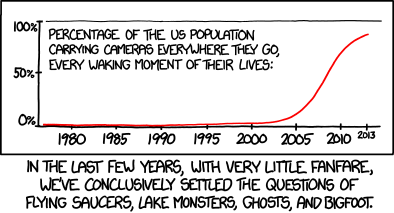
Which is actually kind of heart-breaking...
Sunday, July 07, 2013
Presidential Character: Week Twenty-Three, I Got Nothing But a One-Termer Again
Another One-Term President to evaluate. This shouldn't take too long...
The Republicans had enjoyed from Lincoln up to Arthur an extended period of White House control. Grover Cleveland broke the cycle, bringing into office a reform-minded but-strict-as-hell Democrat that may have functioned but remained vulnerable to the whims of an electorate frustrated when Cleveland's administration failed to respond to their wants (not exactly their needs...). They came into the 1888 election cycle with high hopes... and promptly ran into a deadlocked convention between two popular choices at the time. Forced to find a compromise candidate, they settled on Benjamin Harrison, grandson of the late William Henry Harrison (yeah, they facepalmed about that back then too), scion of Ohio, officer of the Civil War (still a major campaign plus), occasionally elected to various offices... and pretty much one of the most bland unremarkable figures to get tabbed for the Boss job.
I exaggerate, I suppose. Harrison had to have some qualities of value that made him an acceptable candidate. Unfortunately, the biggest value he had was his malleability: the party bosses knew they could manage him.
Harrison's personality was one of reluctance. He had to be talked into running for Governor of his state once (he lost a narrowly contested campaign). Tabbed to serve as Senator (back then, a Senator was nominated by the controlling powers of the state legislature, not direct vote), he did so with little distinction preferring to vote along party interests and rarely making a name for himself.
And yet, Harrison doesn't entirely fit the Passive-Negative model of Presidential Character. He shared a positive view of government's role in education and social improvement: he was the first President since Grant to make serious efforts to break the Jim Crow power in the south by pushing for federalizing the elections process and ensuring education funding for all. Both didn't get far in a Congress where Republican allies traded away those issues for economic ones.
If I had to, I'd have to put Harrison right on the edge of the Passive-Negative line, but would make him a Passive-Positive. Either way, he reacted to issues rather than acted, sought compromise, and worked with others to achieve their goals more than his own.
Next Week: Hey, didn't we meet this guy already...?
The Republicans had enjoyed from Lincoln up to Arthur an extended period of White House control. Grover Cleveland broke the cycle, bringing into office a reform-minded but-strict-as-hell Democrat that may have functioned but remained vulnerable to the whims of an electorate frustrated when Cleveland's administration failed to respond to their wants (not exactly their needs...). They came into the 1888 election cycle with high hopes... and promptly ran into a deadlocked convention between two popular choices at the time. Forced to find a compromise candidate, they settled on Benjamin Harrison, grandson of the late William Henry Harrison (yeah, they facepalmed about that back then too), scion of Ohio, officer of the Civil War (still a major campaign plus), occasionally elected to various offices... and pretty much one of the most bland unremarkable figures to get tabbed for the Boss job.
I exaggerate, I suppose. Harrison had to have some qualities of value that made him an acceptable candidate. Unfortunately, the biggest value he had was his malleability: the party bosses knew they could manage him.
Harrison's personality was one of reluctance. He had to be talked into running for Governor of his state once (he lost a narrowly contested campaign). Tabbed to serve as Senator (back then, a Senator was nominated by the controlling powers of the state legislature, not direct vote), he did so with little distinction preferring to vote along party interests and rarely making a name for himself.
And yet, Harrison doesn't entirely fit the Passive-Negative model of Presidential Character. He shared a positive view of government's role in education and social improvement: he was the first President since Grant to make serious efforts to break the Jim Crow power in the south by pushing for federalizing the elections process and ensuring education funding for all. Both didn't get far in a Congress where Republican allies traded away those issues for economic ones.
If I had to, I'd have to put Harrison right on the edge of the Passive-Negative line, but would make him a Passive-Positive. Either way, he reacted to issues rather than acted, sought compromise, and worked with others to achieve their goals more than his own.
Next Week: Hey, didn't we meet this guy already...?
Saturday, July 06, 2013
Nobody's Winning Egypt
It's pretty harsh to say it, but so far this has been a no-win scenario for all parties concerned.
For Morsi and his Muslim Brotherhood party, it's a clear loss because he's been kicked out of office. There were valid reasons for it: there were no check/balance mechanisms in place to make Morsi more responsive to the needs of the people; Morsi had done nothing to clean up the corruption that existed under Mubarak and in fact it was getting worse; the Muslim Brotherhood (MB) may have been better organized than any other coalition in the nation, but they simply weren't designed to make decisions and compromises that high office requires. And consider the origins of the MB as a radical, occasionally violent opposition: by ousting them like this, they won't see any incentive in taking democracy seriously as a means to power. They may well fall back into their old bad (and violent) habits, as demonstrated by the outbreak of violence between the pro-Morsi forces and the protesters last night.
The Army may look like the winners (again), but in truth this coup has hurt their position as well. Rather than being unbiased players in the game, they've re-inserted themselves into the democratic process in a way that weakens said democratic process.
The foreign policy wonks pushing for democracy aren't happy: while Morsi was a terrible President he was democratically elected. This coup discredits the validity of elected leadership across the Middle East, especially at a time when nations shrugging off decades of dictatorship - Algeria, Libya, Iraq - are struggling to forge new governments. Tossing him out in a coup merely sets up the possibility of any future Egyptian President getting tossed out even if said President is actually doing his job.
The people protesting in the streets may have gained their primary objective - ousting Morsi - but there's no guarantee his replacement will fare any better. Egypt's economy is in the tank alongside half the planet thanks to this global recession: tourism is also suffering, and being an unstable nation two steps away from open rioting doesn't market well at the AAA travel agency. The corruption hurting Egypt's ability to provide even basic services like trash pick-up is deep rot: it will take years to flush it out even for a principled reformist. The protesters may just be back out in the streets within another year.
The more liberal and moderate parties in Egypt may benefit from this, but there was a good reason why the MB won elections: the liberal and moderate groups in Egypt are not that well organized and in some cases unwelcome to a populace that may benefit from liberal reforms but in practice aren't fond of liberal ideas. There's no sign of anyone in any position to step up and provide a moderate alternative.
There is a chance this could all still work out. The Army has set up for emergency elections, and depending on the results a sensible moderate leader could be found. But then the Army has to step back to let that President do his job. There has to be serious reform efforts in both service and in the legal system (and in local law enforcement) to crack down on the corruption (and provide security against any violent reaction from the far right). And whoever gets elected President has to make good-faith efforts to keep the Brotherhood engaged... and the Brotherhood has to make good-faith efforts to learn from this and change their methods to be more compromising and amenable to criticism.
It's a very thin needle eye to thread.
For Morsi and his Muslim Brotherhood party, it's a clear loss because he's been kicked out of office. There were valid reasons for it: there were no check/balance mechanisms in place to make Morsi more responsive to the needs of the people; Morsi had done nothing to clean up the corruption that existed under Mubarak and in fact it was getting worse; the Muslim Brotherhood (MB) may have been better organized than any other coalition in the nation, but they simply weren't designed to make decisions and compromises that high office requires. And consider the origins of the MB as a radical, occasionally violent opposition: by ousting them like this, they won't see any incentive in taking democracy seriously as a means to power. They may well fall back into their old bad (and violent) habits, as demonstrated by the outbreak of violence between the pro-Morsi forces and the protesters last night.
The Army may look like the winners (again), but in truth this coup has hurt their position as well. Rather than being unbiased players in the game, they've re-inserted themselves into the democratic process in a way that weakens said democratic process.
The foreign policy wonks pushing for democracy aren't happy: while Morsi was a terrible President he was democratically elected. This coup discredits the validity of elected leadership across the Middle East, especially at a time when nations shrugging off decades of dictatorship - Algeria, Libya, Iraq - are struggling to forge new governments. Tossing him out in a coup merely sets up the possibility of any future Egyptian President getting tossed out even if said President is actually doing his job.
The people protesting in the streets may have gained their primary objective - ousting Morsi - but there's no guarantee his replacement will fare any better. Egypt's economy is in the tank alongside half the planet thanks to this global recession: tourism is also suffering, and being an unstable nation two steps away from open rioting doesn't market well at the AAA travel agency. The corruption hurting Egypt's ability to provide even basic services like trash pick-up is deep rot: it will take years to flush it out even for a principled reformist. The protesters may just be back out in the streets within another year.
The more liberal and moderate parties in Egypt may benefit from this, but there was a good reason why the MB won elections: the liberal and moderate groups in Egypt are not that well organized and in some cases unwelcome to a populace that may benefit from liberal reforms but in practice aren't fond of liberal ideas. There's no sign of anyone in any position to step up and provide a moderate alternative.
There is a chance this could all still work out. The Army has set up for emergency elections, and depending on the results a sensible moderate leader could be found. But then the Army has to step back to let that President do his job. There has to be serious reform efforts in both service and in the legal system (and in local law enforcement) to crack down on the corruption (and provide security against any violent reaction from the far right). And whoever gets elected President has to make good-faith efforts to keep the Brotherhood engaged... and the Brotherhood has to make good-faith efforts to learn from this and change their methods to be more compromising and amenable to criticism.
It's a very thin needle eye to thread.
Thursday, July 04, 2013
Life Liberty and the Purrsuit of String Toys
I'm baking some beans for a friend's party. This is the Fourth of July, peoples.
Wednesday, July 03, 2013
Anniversaries: Gettysburg Day Three
The battle in most respects determined the fate of the war: the South suffered a decisive loss in the Eastern theater for the first time; Lee's army lost men it couldn't replace; and it failed to end the siege of Vicksburg the way Lee had hoped.
The war was fought for another two years (close enough) after this, because by this point only a total defeat of either side - especially the South, its leadership convinced in the righteousness of its cause - would have ended it. But from this point on, all the advantages were to the Union: they had finally gotten a semblance of military leadership under Meade (and later Grant) to fight the Virginian theater, they had the numeric advantage of troops (the South intentionally fought with less manpower because they needed to keep enough white men back home to keep the slavery population in check), they had the economic and engineering might (the South had foolishly stuck to a cotton industry dominance and failed to create enough ironworks and grain farms to supply themselves). This defeat combined with Lincoln's Emancipation Proclamation effectively kept Europe out of the war for good.
On an end note, a fellow Hordian Andy Hall runs the Dead Confederates blog (tracking southern and Texan history), and had his own take on the Second Day of Gettysburg from the memoirs of a Texan soldier caught in the thick of it. He's got a great blog: link it.
The war was fought for another two years (close enough) after this, because by this point only a total defeat of either side - especially the South, its leadership convinced in the righteousness of its cause - would have ended it. But from this point on, all the advantages were to the Union: they had finally gotten a semblance of military leadership under Meade (and later Grant) to fight the Virginian theater, they had the numeric advantage of troops (the South intentionally fought with less manpower because they needed to keep enough white men back home to keep the slavery population in check), they had the economic and engineering might (the South had foolishly stuck to a cotton industry dominance and failed to create enough ironworks and grain farms to supply themselves). This defeat combined with Lincoln's Emancipation Proclamation effectively kept Europe out of the war for good.
On an end note, a fellow Hordian Andy Hall runs the Dead Confederates blog (tracking southern and Texan history), and had his own take on the Second Day of Gettysburg from the memoirs of a Texan soldier caught in the thick of it. He's got a great blog: link it.
Tuesday, July 02, 2013
Anniversaries: Gettysburg Day Two
This happened 150 years ago today:
That sound you hear is Joshua Lawrence Chamberlain of the 20th Maine codifying the Badass Bookworm trope for American history buffs.
Monday, July 01, 2013
July 1st, So Many Things To Say
I was going to just focus on the fact that today is the 150th anniversary of the First Day of the Battle of Gettysburg.
But there's a ton of stuff happening in the world, which I gotta mention:
In Texas, the people are up and protesting against the Far Right Republican push to restrict access to abortion - and basically making it impossible for women to have decent health care in the process - using another special session of their legislature to circumvent a good number of procedural rules normally part of the regular sessions.
In North Carolina, the people are up and protesting against the Far Right Republican push to, well, destroy everything that's not a corporate tax cut. Not just the pro-fetus agenda, but that the state GOP has killed off unemployment benefits (RAAAAAAGGEEEE!) in order to push their austerity agenda. And this is in face of the facts that this has been one of the worst employment markets ever, and the fact that the unemployment benefits help the unemployed look for a job... any job...
In Egypt, they don't have Far Right Republicans to protest against... they do have the Muslim Brotherhood and their self-serving President Morsi, who have basically mismanaged the nation in its first year of supposed democracy into bringing out protests LARGER than the ones that pushed out Mubarak.
In fact, it's been a really busy week in protests.
More on Gettysburg for Day Two. That is the one with Little Round Top. (fanboy squeal)
But there's a ton of stuff happening in the world, which I gotta mention:
In Texas, the people are up and protesting against the Far Right Republican push to restrict access to abortion - and basically making it impossible for women to have decent health care in the process - using another special session of their legislature to circumvent a good number of procedural rules normally part of the regular sessions.
In North Carolina, the people are up and protesting against the Far Right Republican push to, well, destroy everything that's not a corporate tax cut. Not just the pro-fetus agenda, but that the state GOP has killed off unemployment benefits (RAAAAAAGGEEEE!) in order to push their austerity agenda. And this is in face of the facts that this has been one of the worst employment markets ever, and the fact that the unemployment benefits help the unemployed look for a job... any job...
In Egypt, they don't have Far Right Republicans to protest against... they do have the Muslim Brotherhood and their self-serving President Morsi, who have basically mismanaged the nation in its first year of supposed democracy into bringing out protests LARGER than the ones that pushed out Mubarak.
In fact, it's been a really busy week in protests.
More on Gettysburg for Day Two. That is the one with Little Round Top. (fanboy squeal)
Saturday, June 29, 2013
President Character: Week Twenty-Two, Gone To The White House
When we write of Grover Cleveland, we write of a man best-known to Americans as "The Guy Who Served Two Separate Terms". A guy good for a punchline in the Simpsons/Futurama 'Verse. There are other things he should be known for.
He should be known as one of the few Presidential candidates to win the popular vote three straight times (FDR is the other, and he's got the excuse of being a Four-Termer). He didn't win the Presidency the second time because of the Electoral College. Cleveland was also the first Democrat elected to the Presidency since 1860 (Johnson was not elected to it, Tilden should have won it but the corruption of the electoral system in 1876 blocked him), breaking the Republican monopoly on the office of 24 years.
He's also a candidate that had one of the biggest bombshells of a Presidential campaign ever: the revelation days after his nomination that he had fathered a child out of wedlock (he was enjoying the bachelor lifestyle up to that point). It didn't help that he publicly acknowledged the child as his (although he and his supporters took pains to note he provided financial support). Republicans gleefully took to the streets chanting "Ma! Ma! Where's My Pa!" This was a huge load on Cleveland's election hopes, because outside of his personal lifestyle, Cleveland was arguably the most incorruptible political figure this nation ever saw: this was a guy with a reputation for vetoing bad bills, for gutting out corruption in local and state office, for going against Tammany Hall (the political machine of the 19th Century) and winning. Cleveland was quoted as saying "Public Office is a Public Trust" and he damn well meant what he said.
His opponent was one of the Grant-era ethically-challenged congressmen, Blaine, who was reportedly pious in his personal life but up to his hips in corruption in his public job. As a result, the debate became a question between voting for a man with questionable personal habits but clean policy record or for a man with questionable policy records and clean personal habits.
And it was a close race, the mudslinging involved one of the nastiest since Andrew Jackson's era and unrivaled until, well, Clinton and/or Obama's. It took a last-minute PR faux pas of a Protestant preacher denouncing Irish voters in New York to switch the vote there to Cleveland's favor, in which he squeaked out a win by 1,000 votes.
Democrats responded to the Republican rally cry by answering "Gone to the White House Ha! Ha! Ha!"
And what did Cleveland do once he reached the White House?
He vetoed more Congressional bills than any other President in history. Granted, a lot of those bills were individually written to pension out war veterans rather than there being one over-arching congressional bill that would have covered them all. But Cleveland wasn't the sort to let a single bill pass his inspection, and he didn't agree that Congress should override the veterans' Pension Office that had denied those pension petitions already. But this was a sign of how Cleveland worked: he believed in limited government in the small-c conservative way, and every political stance - reducing the tariffs (taxes) because there was an ongoing surplus, supporting the gold standard over silver (which meant cheap money) - reflected that.
All in all, Cleveland demonstrated a lot of the traits - highly driven but unimaginative, reactive rather than active, Uncompromising above all - that are found in Active-Negative Presidents. Granted: he never demonstrated obsessive self-interest and self-loathing most Negatives have, and had the love and faith in public office that an Active-Positive has, probably putting him more on the borderline between the two traits than most other Presidents. But he was more A-N than A-P.
I'd say more, but there's still another blog entry I gotta write on the guy. Non-consecutive blog entries, after all we got a schedule to maintain and Cleveland won't begrudge us that...
Next Week: Benjamin's just this guy, ya know?
Friday, June 28, 2013
The Republicans' Real Problem If They Can't Pass This Immigration Bill
It's not that the Republicans will lose favor even more with the growing Hispanic population - a voting bloc the GOP is convinced could lean conservative enough to their side - if they fail to pass the bill the Senate just signed off on. It's not like there's a lot that would convince ethnic voters to side wholeheartedly with a party that just succeeded in shredding voting rights for said ethnic voters. Like Conor notes over on The Atlantic:
If the bill passes, there won't be a huge surge of Hispanic voters over the Republicans: the party would at least retain a sizable portion of that vote (a lot more than the 1-2 percent of Black voters still voting Republican... yeah the last polling showed close to ZERO percent but I'm pretty sure there had to have been a few Blacks who went Romney... why I don't know, but I digress) and have a more diverse base of voters for the next Presidential cycle. But what would happen if the GOP House - with a sizable number of Far Right congresspersons who aren't huge fans of "illegals" and "freeloaders" - failed to take up the issue, to pass a similar bill that would get worked out in committee and sent to the President for a signature?
They'll still be in the same leaky boat in terms of Hispanic outreach, obviously, but the real damage will be to the Republicans' credibility as a functioning political party. It's not just the Hispanics they'll be losing, it will be the good-sized middle-of-the-road voters, the moderates or non-ideologue voters.
Even with all the obstructionist efforts the GOP has pulled since retaking the House in the 2010 midterms, there was at least this perception that the Republicans were, well, doing things. They'd at least tried to present some ideas in terms of budgeting and government oversight (albeit obsessed with tax cuts and deregulation as the CURE FOR EVERYTHING), they at least looked the part of a political party. Perception means a lot in politics: looking competent is more valuable than actually being competent.
But this would be the break with that perception, a huge one. There's been media buzz about the GOP fracturing ever since the earlier vote in the House for Hurricane Sandy relief that ended up passing without a majority of Republican votes. The House is now presented with a bipartisan Senate bill (as close to bipartisan as possible: it passed a Cloture vote, which is damn near miraculous this day and age), and a bill on immigration reform that the media (and thus the nation) perceives as a must-pass for the Republicans. If they can't even get this out of committee, the perception of party dysfunction would be overwhelming to everyone outside of the Tea-Party, anti-immigrant, anti-government crowd (and the Tea Party wingnut faction is not as big as the Fox Not-News commentators think it is).
There's not even a guarantee Speaker Boehner could pull off an attempted "poison pill" bill, something on immigration that would be so anathema to the Senate Democrats that the compromise committee that works on fixing disparate Senate-House bills would refuse to deal and thus give Boehner the excuse to blame the libruls. The wingnut faction of the House is so opposed to immigration they may refuse to vote on anything close to reform... and if there's enough of them, Boehner won't be able to get a floor vote on it, even with that poison pill. The blame will end up entirely on the GOP House. (if Boehner does get a bill passed with that poison pill, there's still no guarantee he'll be able to claim the Democrats killed it if the two houses can't agree).
The perception in politics will no longer be that "Congress is dysfunctional" because after all the Senate got something done. The perception will be "The Republican Party is dysfunctional." And while the Far Right won't be surprised or angry about it - after all, it's the kind of Party they want - whatever is left of the Center-Right and Moderate GOP voters (the RINOs that haven't fled yet) could well walk away.
The thing that always upsets me as an independent voter is that there's been enough middle-of-the-road, non-party-affiliated voters over the last 10 years who gave and still give the Republicans the benefit of the doubt. Having been burned by the Norquists and Limbaughs and Breitbarts that have taken over the party, I just couldn't grok how any moderate voters, any non-wingnut voters, were still voting for the ( R ) bracket. But one of the things about moderate voters isn't loyalty to a party, it's the desire to choose and vote for a candidate that creates and maintains an image of competency, of ability. They'll vote for a Republican if that Republican looks capable of walking and chewing bubble gum at the same time.
But a Republican that's part of a House of Representatives that couldn't even pass a symbolically important immigration reform bill? The perception of incompetence would be more destructive than the perception of that Republican being a hypocrite.
Despite the survival tactics that the Republicans use for midterm elections - the Congress-only, state Governor elections - that rely on low voter turnout and only the extremists voting, there's always the risk of playing it too close to the wire. While the average (read: moderate) voters won't turn out for midterms, they could turn out in enough numbers to voice their discontent against the party with the most at stake (read: the ones running Congress). During good years, the party in control tends to stay in control of Congress. During bad years, during sessions where the majority party is viewed as incompetent, failing, broken... you get the turnover. Look to 2006: the failure of leadership as the Iraq occupation turned sour was a major key to the Republicans losing to the Democrats in both houses. Look to 2010: the session-long struggle to pass health-care reform made the Democrats look out-of-touch and unfocused (even if they still passed it: perception, remember, counts for a lot), letting the Republicans retake the House.
The Republicans may have an advantage with gerrymandered districts that favor them despite the larger vote totals for Democrats, but a good number of those gerrymandered districts are stretched thin and more vulnerable than they seem. Get enough moderate Republicans and NPA voters disgruntled, get a Democratic candidate in one of those districts who can walk and chew gum, and you could well see a 51-48 victory for that Democrat.
The only things saving the Republicans at the moment are those gerrymandered districts and the possibility they can (and will) rewrite state voting laws to block all the voters they hate. But fail at this vote, fail to maintain even a semblance of competency... the Republicans can suffer even with the voters they hope would be on their side, the ones they'll let past the vote-blocking.
Try to remember this about the moderate/centrist voters: they vote for competency, not ideology. An incompetent Congress will lose those voters regardless of geography or gender or race. And there's more of us moderate voters than the wingnuts will admit. Count on it.
It's true that there's a nativist element in the Republican Party that talks about illegal immigrants as if they are sub-human. There are, as well, other Republicans more restrained in their rhetoric, but who give off the impression that they aren't huge fans of Hispanic immigrants. This definitely alienates Hispanic voters, but it is unclear to me that the passage of immigration reform would win over these people -- whether a reform bill passes or not, that element will still exist in the Republican coalition. So long as the questionable rhetoric continues, so will the mistrust...
If the bill passes, there won't be a huge surge of Hispanic voters over the Republicans: the party would at least retain a sizable portion of that vote (a lot more than the 1-2 percent of Black voters still voting Republican... yeah the last polling showed close to ZERO percent but I'm pretty sure there had to have been a few Blacks who went Romney... why I don't know, but I digress) and have a more diverse base of voters for the next Presidential cycle. But what would happen if the GOP House - with a sizable number of Far Right congresspersons who aren't huge fans of "illegals" and "freeloaders" - failed to take up the issue, to pass a similar bill that would get worked out in committee and sent to the President for a signature?
They'll still be in the same leaky boat in terms of Hispanic outreach, obviously, but the real damage will be to the Republicans' credibility as a functioning political party. It's not just the Hispanics they'll be losing, it will be the good-sized middle-of-the-road voters, the moderates or non-ideologue voters.
Even with all the obstructionist efforts the GOP has pulled since retaking the House in the 2010 midterms, there was at least this perception that the Republicans were, well, doing things. They'd at least tried to present some ideas in terms of budgeting and government oversight (albeit obsessed with tax cuts and deregulation as the CURE FOR EVERYTHING), they at least looked the part of a political party. Perception means a lot in politics: looking competent is more valuable than actually being competent.
But this would be the break with that perception, a huge one. There's been media buzz about the GOP fracturing ever since the earlier vote in the House for Hurricane Sandy relief that ended up passing without a majority of Republican votes. The House is now presented with a bipartisan Senate bill (as close to bipartisan as possible: it passed a Cloture vote, which is damn near miraculous this day and age), and a bill on immigration reform that the media (and thus the nation) perceives as a must-pass for the Republicans. If they can't even get this out of committee, the perception of party dysfunction would be overwhelming to everyone outside of the Tea-Party, anti-immigrant, anti-government crowd (and the Tea Party wingnut faction is not as big as the Fox Not-News commentators think it is).
There's not even a guarantee Speaker Boehner could pull off an attempted "poison pill" bill, something on immigration that would be so anathema to the Senate Democrats that the compromise committee that works on fixing disparate Senate-House bills would refuse to deal and thus give Boehner the excuse to blame the libruls. The wingnut faction of the House is so opposed to immigration they may refuse to vote on anything close to reform... and if there's enough of them, Boehner won't be able to get a floor vote on it, even with that poison pill. The blame will end up entirely on the GOP House. (if Boehner does get a bill passed with that poison pill, there's still no guarantee he'll be able to claim the Democrats killed it if the two houses can't agree).
The perception in politics will no longer be that "Congress is dysfunctional" because after all the Senate got something done. The perception will be "The Republican Party is dysfunctional." And while the Far Right won't be surprised or angry about it - after all, it's the kind of Party they want - whatever is left of the Center-Right and Moderate GOP voters (the RINOs that haven't fled yet) could well walk away.
The thing that always upsets me as an independent voter is that there's been enough middle-of-the-road, non-party-affiliated voters over the last 10 years who gave and still give the Republicans the benefit of the doubt. Having been burned by the Norquists and Limbaughs and Breitbarts that have taken over the party, I just couldn't grok how any moderate voters, any non-wingnut voters, were still voting for the ( R ) bracket. But one of the things about moderate voters isn't loyalty to a party, it's the desire to choose and vote for a candidate that creates and maintains an image of competency, of ability. They'll vote for a Republican if that Republican looks capable of walking and chewing bubble gum at the same time.
But a Republican that's part of a House of Representatives that couldn't even pass a symbolically important immigration reform bill? The perception of incompetence would be more destructive than the perception of that Republican being a hypocrite.
Despite the survival tactics that the Republicans use for midterm elections - the Congress-only, state Governor elections - that rely on low voter turnout and only the extremists voting, there's always the risk of playing it too close to the wire. While the average (read: moderate) voters won't turn out for midterms, they could turn out in enough numbers to voice their discontent against the party with the most at stake (read: the ones running Congress). During good years, the party in control tends to stay in control of Congress. During bad years, during sessions where the majority party is viewed as incompetent, failing, broken... you get the turnover. Look to 2006: the failure of leadership as the Iraq occupation turned sour was a major key to the Republicans losing to the Democrats in both houses. Look to 2010: the session-long struggle to pass health-care reform made the Democrats look out-of-touch and unfocused (even if they still passed it: perception, remember, counts for a lot), letting the Republicans retake the House.
The Republicans may have an advantage with gerrymandered districts that favor them despite the larger vote totals for Democrats, but a good number of those gerrymandered districts are stretched thin and more vulnerable than they seem. Get enough moderate Republicans and NPA voters disgruntled, get a Democratic candidate in one of those districts who can walk and chew gum, and you could well see a 51-48 victory for that Democrat.
The only things saving the Republicans at the moment are those gerrymandered districts and the possibility they can (and will) rewrite state voting laws to block all the voters they hate. But fail at this vote, fail to maintain even a semblance of competency... the Republicans can suffer even with the voters they hope would be on their side, the ones they'll let past the vote-blocking.
Try to remember this about the moderate/centrist voters: they vote for competency, not ideology. An incompetent Congress will lose those voters regardless of geography or gender or race. And there's more of us moderate voters than the wingnuts will admit. Count on it.
Wednesday, June 26, 2013
In This Case, the March Of History Goes Forward, Thank God
Yes, yesterday's SCOTUS ruling killing off voting rights was a huge bummer.
Today, the Supreme Court rulings - in separate decisions - that the federal DOMA and California's Prop 8 were unconstitutional turned into a major gain for civil rights.
In truth, the SCOTUS rulings are not a final say on the matter. Overturning DOMA meant civil unions were possible and that states that passed same-sex marriage laws could uphold them, it didn't grant gay marriage rights across the nation. And the Prop 8 decision was that the persons who brought suit to the Supreme Court - third-party groups that backed the referendum, not the state of California itself - did not have legal standing to do so.
Still. This is a great day to be Pro-People. Play on, Don Coates:
The fight's not over, I'll agree on that point. But this is akin to winning Gettysburg: there may be another two years of war but the end - marriage equality - is in sight. And as we advance on these rights, making them stronger and making our nation stronger, we can keep fighting for all the other rights - the right to vote, the right to earn a fair wage, the right to live healthy - that are self-evident (Yup, I'm enjoying that phrase).
So let the celebrating begin!
 Yeah, that's right. Even the heteros can gay-marry now. Deal with it, Mr. Huckabee.
Today, the Supreme Court rulings - in separate decisions - that the federal DOMA and California's Prop 8 were unconstitutional turned into a major gain for civil rights.
In truth, the SCOTUS rulings are not a final say on the matter. Overturning DOMA meant civil unions were possible and that states that passed same-sex marriage laws could uphold them, it didn't grant gay marriage rights across the nation. And the Prop 8 decision was that the persons who brought suit to the Supreme Court - third-party groups that backed the referendum, not the state of California itself - did not have legal standing to do so.
Still. This is a great day to be Pro-People. Play on, Don Coates:
I haven't read any of my fellow writers yet, but I did want to take a moment to say how important this moment is in the war against inequality. I was tempted to say "social inequality" but in America, there simply is no real way to separate the social, the political and the economic. When the larger country decided to stand aside as South Carolina went about the business of disenfranchising half its citizenry, the weapon was political, but the implications were economic and social. With no access to the franchise, black people lacked the means to protect their wealth. The poverty of wealth which befell them then reinforced their status as social pariahs, and their status as social pariahs reified (sp?) the racist justifications for their disenfranchisement and the inglorious cycle was complete...
It must never be forgotten that in America, the right to marry is the right to protect one's family. Certainly the pictures of same-sex couples embracing and hugging warm the heart and are a powerful weapon in country that prides itself on fairness...
The state repossessing a couple's wealth because it finds them icky, is wholly unjust. It recalls a particularly horrible aspect of slavery--the assault on the families of people deemed to be outside the law. There is a particular war here, which better people than me can speak to. But power is at the core of the long war which began sometime in the mid-17th century with the passage of the first slave codes. The prohibitions against same-sex marriage are not simply about witholding the right to be pretty in a dress or dashing in a tux (though I would deny no one their day.) It is about ensuring that only certain kinds of people, and certain kinds of families, are able to amass power, and with that power, influence over the direction of our society...
It is wrong to strip people of wealth because you are bigot. It is wrong to strip people of the right to name their caretakers because you are afraid. It is wrong to make war on people because you can not get over yourself. And though today we may say that we have advanced, through much of this country, the wrong continues unabated...
So let the celebrating begin!

Tuesday, June 25, 2013
The March of History Isn't Supposed to Go Backwards
I was born in 1970. Five years before, the nation passed a Voters Rights Act that ended a century of Jim Crow discrimination denying a sizable portion of our population from the God-given self-evident right to vote.
I didn't read up on history that much until high school, about 1984-85, around the 20-year anniversary. They had it in the high school textbooks, which basically makes it ancient history to high schoolers. For all I've known, the right to vote was meant to be as universal as possible regardless of race or gender (age being the only limiter with the 26th Amendment).
From all that I've studied on history - the slow, sometimes messy, march of ideas and ideologies towards an enlightened liberty and freedom of expression - I've rarely seen any situation where rights, once given, were later taken away. The only times from what I saw was the Jim Crow era that took away the Black Man's right to vote for 100 years... and even then the VRA did away with that. The rights came back, and it's been like that my whole life.
And now, I'm dreading that the rights are getting taken away again. Something that shouldn't be happening.
The conservatives on the Supreme Court ruled in Shelby County v. Holder that a key provision of the VRA - Section 4, which provided metrics on what parts of the nation (Deep South states and key counties) had to get federal pre-clearance on any drastic changes to voting laws - was unconstitutional. It basically neuters Section 5 (the authority of the Justice Department to act) until Congress ever decides to draw up a replacement metrics system that would pass Court's approval. And considering the wingnut-controlled House and filibuster-stalled Senate, that will not happen.
My online friends among the Horde are mostly up in arms. I'm upset as well. Having witnessed just recently the Republican-controlled Florida government doing their damnedest in 2012 to deny people the right to vote - taking away early voting days, shutting down precincts, trying to pass a strict voter-photo ID bill, forcing county supervisors to purge voter rolls - I am well aware of how close we are to having one of our key rights - the right to vote, as sacred a right as free speech and right to assemble - taken away. And not just the minorities like Blacks and Hispanics getting denied the right to vote through some complicated redistricting gerrymandering designed to hit ethnics, but poor people of every ethnicity (and a lot of women to boot) denied because they can't afford a photo ID, or college students denied because they tend to relocate often without a primary residence from which to vote.
For all the bad times I've seen our nation go through in my lifetime, I have never seen a moment where the march of history stepped backwards. We're back to 1950 now, fighting the same damn fight to get people their self-evident right of equality before the law, their self-evident right to speak up and choose their representation, their self-evident right to be Americans. And if it keeps going like this we'll be back to 1850 and what that all entails.
I hope to God this has the adverse reaction the goddamn Far Right Wingnuts expect: I hope to God this brings out the moderate voters in droves this midterms - the ones who usually don't show up when there's no President to choose - to vote the goddamn Republicans out of office and vote in people who will actually make government work and vote a new VRA into place.
That still hasn't been taken away: getting out the vote. Not yet. So there's work to be done. Getting people registered right now no matter what. GET IT DONE, PEOPLE. Get EVERYONE registered right fucking now. And get the goddamn vote out against the goddamn wingnuts. Pardon my Swedish.
I didn't read up on history that much until high school, about 1984-85, around the 20-year anniversary. They had it in the high school textbooks, which basically makes it ancient history to high schoolers. For all I've known, the right to vote was meant to be as universal as possible regardless of race or gender (age being the only limiter with the 26th Amendment).
From all that I've studied on history - the slow, sometimes messy, march of ideas and ideologies towards an enlightened liberty and freedom of expression - I've rarely seen any situation where rights, once given, were later taken away. The only times from what I saw was the Jim Crow era that took away the Black Man's right to vote for 100 years... and even then the VRA did away with that. The rights came back, and it's been like that my whole life.
And now, I'm dreading that the rights are getting taken away again. Something that shouldn't be happening.
The conservatives on the Supreme Court ruled in Shelby County v. Holder that a key provision of the VRA - Section 4, which provided metrics on what parts of the nation (Deep South states and key counties) had to get federal pre-clearance on any drastic changes to voting laws - was unconstitutional. It basically neuters Section 5 (the authority of the Justice Department to act) until Congress ever decides to draw up a replacement metrics system that would pass Court's approval. And considering the wingnut-controlled House and filibuster-stalled Senate, that will not happen.
My online friends among the Horde are mostly up in arms. I'm upset as well. Having witnessed just recently the Republican-controlled Florida government doing their damnedest in 2012 to deny people the right to vote - taking away early voting days, shutting down precincts, trying to pass a strict voter-photo ID bill, forcing county supervisors to purge voter rolls - I am well aware of how close we are to having one of our key rights - the right to vote, as sacred a right as free speech and right to assemble - taken away. And not just the minorities like Blacks and Hispanics getting denied the right to vote through some complicated redistricting gerrymandering designed to hit ethnics, but poor people of every ethnicity (and a lot of women to boot) denied because they can't afford a photo ID, or college students denied because they tend to relocate often without a primary residence from which to vote.
For all the bad times I've seen our nation go through in my lifetime, I have never seen a moment where the march of history stepped backwards. We're back to 1950 now, fighting the same damn fight to get people their self-evident right of equality before the law, their self-evident right to speak up and choose their representation, their self-evident right to be Americans. And if it keeps going like this we'll be back to 1850 and what that all entails.
I hope to God this has the adverse reaction the goddamn Far Right Wingnuts expect: I hope to God this brings out the moderate voters in droves this midterms - the ones who usually don't show up when there's no President to choose - to vote the goddamn Republicans out of office and vote in people who will actually make government work and vote a new VRA into place.
That still hasn't been taken away: getting out the vote. Not yet. So there's work to be done. Getting people registered right now no matter what. GET IT DONE, PEOPLE. Get EVERYONE registered right fucking now. And get the goddamn vote out against the goddamn wingnuts. Pardon my Swedish.
Sunday, June 23, 2013
Presidential Character: Week Twenty-One, The Effects of Office
It could be said that each President brings to the office a bit of himself, establishing a precedent, affecting a change in how the role is played. It could also be said that the office affects the man, that the power could change them (the old phrase of power corrupts), although with Barber's research into Presidential Character there's been solid evidence that such changes are rare. Once the man develops his traits, he carries them with him into the office, defining his tenure.
There are Presidents we've reviewed so far - John Quincy Adams, Franklin Pierce, Rutherford Hayes - who had certain traits but were thwarted in expressing their characters to due to external obstacles. It still didn't change much of who they were (other than making them more embittered than they already were). The 21st President, however, may be the first - may be the only President on the roster in fact - to genuinely evolve from an incoming Character trait into another: the first President who changed himself to fit the needs of the office at the moment of decision.
I speak, of course, of Chester A. Arthur.
...Yes, the trivia answer from the third Die Hard movie. Please try to keep up...
That Arthur changed some of his positions - his political views on the Spoils system in particular - in office shouldn't be that much of a surprise: an assassin hoping to benefit from that Spoils system had killed Arthur's predecessor James Garfield, and even the simple optics of the PR nightmare that created would have made any Stalwart (pro-Spoils) change his label to Half-Breed (civil service reform). The real surprise is how much of Arthur's previous habits - his laid-back ideology, his crony-ism, affability and desire to be loved - that made him a Passive-Positive character disappeared the second he took the oath to be President. He went from being a Pass-Pos to an Active-Positive character.
Arthur's Pass-Pos traits could be noted through his aversion to actually running for office: Arthur had never before run for a job. Every position he'd ever held in public service were through appointments and patronage, a system he wholly bought into as a means for a steady income. Getting the job of Port Controller of New York (the key port of trade and major tax base) during the Grant administration was the highest office he'd yet held: he oversaw thousands of jobs, through which patronage was doled out to the loyal and politically useful. There's little evidence that Arthur himself benefited from any massive graft or corruption in the Port office (he did profit from a "moiety" kickback of sorts), but he played his part as a machine politico, working behind the scenes with his good friend Roscoe Conkling.
Even then, reformers in their own party were getting into positions of authority to try and end the "political machines" and the corruption they entail. By 1878 Hayes, needing to show he was serious about civil service reform, did what he could to remove Arthur - not the most corrupt political boss but the most public - from the Port Controller job. It didn't work as Hayes had hoped: Conkling by that point was a Senator, and there were still too many Republicans favoring and favored by the Spoils system (Stalwarts) that they were strong enough to deadlock the 1880 Presidential convention against the reformists (Half-Breeds). The Half-Breeds compromised on Garfield instead of Blaine, and the Stalwarts compromised on making Arthur the Vice-Presidential candidate to balance the ticket.
And as I've said before: ticket balancing never works the way the party hopes it will. The ticket balancing Veep is usually someone who's NOT representing the majority of the party, merely a faction that has to be appeased. In this case, it might have meant the Stalwarts through "their boy" Arthur reclaiming office to ensure their Spoils system of political machinery would remain intact.
Arthur defied that, because the moment of history was so blatantly against the Spoils system. Much like the Civil War, the tides of history had flowed to this shore where corruption could no longer be tolerated or ignored. In a previous moment just like this, a Pass-Pos like Franklin Pierce refused to rise to the moment: he refused to change himself. Arthur realized he had to change himself in order to make the changes the nation needed to endure: he changed his Passive-Positive nature to an Active-Positive, pushing himself to the forefront of the civil service reform efforts, overseeing the legislation and vigorously enforcing the law as a President should.
This is why we as a nation think of Chester A. Arthur as a good President and why we barely think of Franklin Pierce at all.
Further signs of how the Presidency changed him: Arthur broke his friendship with Conkling to demonstrate his break with machine politics. Although he nominated Stalwarts to most of the Cabinet vacancies - the Half-Breeds in Garfield's administration didn't want anything to do with him - Arthur did select men with reformist leanings and a willingness to root out corruption.
Arthur's other legacy involved the immigration issues that arose in the late 19th Century. America had started as an immigrant's destination and so had cherished the the ideal of being open to any who chose to move here. But by the 1880s the flow had turned into a flood, and there was a rising anti-immigrant sentiment. It was worst in the Western states where a massive influx of Chinese was overwhelming the "established" Euro and Hispanic populations. A series of harsh anti-Chinese bills were passed through Congress... and vetoed by Arthur, who viewed them as violating any foreign policy accords we had with China. He vetoed other harsh anti-immigrant bills as well but Congress overruled those vetoes.
Arthur also presided over improvements in the U.S. Navy, and vetoed a massive spending bill for being too excessive and not fulfilling the requirements of promoting the defense and general welfare of the nation... even though the nation was dealing with an oversized surplus due to high wartime tariffs to protect Republican business interests. The veto was popular with the nation but not so with Congress, which overruled Arthur on that (it did reduce the surplus, but caused further issues with corruption down the road). If his tenure had any serious failures it was failing to break the power of the segregationists enforcing Jim Crow laws in the post-Reconstruction South. And Arthur's hopes of helping Native American tribes with allotments (allowing individuals to buy up land instead of the tribes collectively) backfired when white speculators bought up the lands instead.
By 1884, Arthur had presided over a hectic and varying successful tenure in office... but because he still wasn't fully trusted by the reformists and was now reviled by his Stalwart friends, Arthur didn't have much chance at a re-election despite his hope for vindication. It didn't help that health worries were rumored: Arthur was suffering from Bright's Disease and the physical toll was very visible. He would leave the office in 1885 (and die a year later) but would leave with noticeable affection by a majority of Americans: a widower, Arthur was approached by four different women with marriage proposals on the day he left office. And he left with Mark Twain - who once called him a "flathead" when Arthur ran the New York Port office - saying "it would be hard to better President Arthur's administration."
It's a pity few One-Termers retain enough of a foothold on our nation's history to be better remembered. Arthur - willing to defy his personal character and evolve in the Presidency to become a better man - deserves a little more recognition.
Next Week: We'll also be talking about this guy two weeks later. Yes, the non-consecutive jokes are due to... well, I'll tell you later.
There are Presidents we've reviewed so far - John Quincy Adams, Franklin Pierce, Rutherford Hayes - who had certain traits but were thwarted in expressing their characters to due to external obstacles. It still didn't change much of who they were (other than making them more embittered than they already were). The 21st President, however, may be the first - may be the only President on the roster in fact - to genuinely evolve from an incoming Character trait into another: the first President who changed himself to fit the needs of the office at the moment of decision.
I speak, of course, of Chester A. Arthur.
...Yes, the trivia answer from the third Die Hard movie. Please try to keep up...
That Arthur changed some of his positions - his political views on the Spoils system in particular - in office shouldn't be that much of a surprise: an assassin hoping to benefit from that Spoils system had killed Arthur's predecessor James Garfield, and even the simple optics of the PR nightmare that created would have made any Stalwart (pro-Spoils) change his label to Half-Breed (civil service reform). The real surprise is how much of Arthur's previous habits - his laid-back ideology, his crony-ism, affability and desire to be loved - that made him a Passive-Positive character disappeared the second he took the oath to be President. He went from being a Pass-Pos to an Active-Positive character.
Arthur's Pass-Pos traits could be noted through his aversion to actually running for office: Arthur had never before run for a job. Every position he'd ever held in public service were through appointments and patronage, a system he wholly bought into as a means for a steady income. Getting the job of Port Controller of New York (the key port of trade and major tax base) during the Grant administration was the highest office he'd yet held: he oversaw thousands of jobs, through which patronage was doled out to the loyal and politically useful. There's little evidence that Arthur himself benefited from any massive graft or corruption in the Port office (he did profit from a "moiety" kickback of sorts), but he played his part as a machine politico, working behind the scenes with his good friend Roscoe Conkling.
Even then, reformers in their own party were getting into positions of authority to try and end the "political machines" and the corruption they entail. By 1878 Hayes, needing to show he was serious about civil service reform, did what he could to remove Arthur - not the most corrupt political boss but the most public - from the Port Controller job. It didn't work as Hayes had hoped: Conkling by that point was a Senator, and there were still too many Republicans favoring and favored by the Spoils system (Stalwarts) that they were strong enough to deadlock the 1880 Presidential convention against the reformists (Half-Breeds). The Half-Breeds compromised on Garfield instead of Blaine, and the Stalwarts compromised on making Arthur the Vice-Presidential candidate to balance the ticket.
And as I've said before: ticket balancing never works the way the party hopes it will. The ticket balancing Veep is usually someone who's NOT representing the majority of the party, merely a faction that has to be appeased. In this case, it might have meant the Stalwarts through "their boy" Arthur reclaiming office to ensure their Spoils system of political machinery would remain intact.
Arthur defied that, because the moment of history was so blatantly against the Spoils system. Much like the Civil War, the tides of history had flowed to this shore where corruption could no longer be tolerated or ignored. In a previous moment just like this, a Pass-Pos like Franklin Pierce refused to rise to the moment: he refused to change himself. Arthur realized he had to change himself in order to make the changes the nation needed to endure: he changed his Passive-Positive nature to an Active-Positive, pushing himself to the forefront of the civil service reform efforts, overseeing the legislation and vigorously enforcing the law as a President should.
This is why we as a nation think of Chester A. Arthur as a good President and why we barely think of Franklin Pierce at all.
Further signs of how the Presidency changed him: Arthur broke his friendship with Conkling to demonstrate his break with machine politics. Although he nominated Stalwarts to most of the Cabinet vacancies - the Half-Breeds in Garfield's administration didn't want anything to do with him - Arthur did select men with reformist leanings and a willingness to root out corruption.
Arthur's other legacy involved the immigration issues that arose in the late 19th Century. America had started as an immigrant's destination and so had cherished the the ideal of being open to any who chose to move here. But by the 1880s the flow had turned into a flood, and there was a rising anti-immigrant sentiment. It was worst in the Western states where a massive influx of Chinese was overwhelming the "established" Euro and Hispanic populations. A series of harsh anti-Chinese bills were passed through Congress... and vetoed by Arthur, who viewed them as violating any foreign policy accords we had with China. He vetoed other harsh anti-immigrant bills as well but Congress overruled those vetoes.
Arthur also presided over improvements in the U.S. Navy, and vetoed a massive spending bill for being too excessive and not fulfilling the requirements of promoting the defense and general welfare of the nation... even though the nation was dealing with an oversized surplus due to high wartime tariffs to protect Republican business interests. The veto was popular with the nation but not so with Congress, which overruled Arthur on that (it did reduce the surplus, but caused further issues with corruption down the road). If his tenure had any serious failures it was failing to break the power of the segregationists enforcing Jim Crow laws in the post-Reconstruction South. And Arthur's hopes of helping Native American tribes with allotments (allowing individuals to buy up land instead of the tribes collectively) backfired when white speculators bought up the lands instead.
By 1884, Arthur had presided over a hectic and varying successful tenure in office... but because he still wasn't fully trusted by the reformists and was now reviled by his Stalwart friends, Arthur didn't have much chance at a re-election despite his hope for vindication. It didn't help that health worries were rumored: Arthur was suffering from Bright's Disease and the physical toll was very visible. He would leave the office in 1885 (and die a year later) but would leave with noticeable affection by a majority of Americans: a widower, Arthur was approached by four different women with marriage proposals on the day he left office. And he left with Mark Twain - who once called him a "flathead" when Arthur ran the New York Port office - saying "it would be hard to better President Arthur's administration."
It's a pity few One-Termers retain enough of a foothold on our nation's history to be better remembered. Arthur - willing to defy his personal character and evolve in the Presidency to become a better man - deserves a little more recognition.
Next Week: We'll also be talking about this guy two weeks later. Yes, the non-consecutive jokes are due to... well, I'll tell you later.
Thursday, June 20, 2013
My Two Cents On Syria
1) It's a mess no matter what Obama does. Refuse to go in, and we're still dealing with a massive humanitarian disaster with thousands millions of refugees/civilians caught in the firefight. Going in, we're basically opening up a third battlefront, stretching our military resources and our diplomatic resources ever thinner (dealing with yet another military engagement with Afghanistan still a quagmire and us still not 100 percent disengaged from Iraq, not to mention the diplomatic nightmares of straightening out Lybia, Egypt and other Middle East nations undergoing rough transitions).
2) Obama better go in with eyes wide open: the rebels we're arming are NOT white hats. We're facing a situation where we may end up forging another wingnut group like the Taliban that took over Afghanistan after we supplied them with weapons to repulse the Soviets. If we're going to go in to buy this war, we better be prepared to own it.
3) Mission Creep. When you go in without a clear set of goals, when you go in without a planned exit or alternative solutions when your primary goal gets f-cked in the fog of war, you get mission creep where you keep re-justifying just what the hell you're doing when you're out of options.
This was what happened with Vietnam: our objectives kept changing, our "needs" (actually our political leaders' fear of losing) kept growing, until we got a war we didn't really want or need. This was Lebanon: we went in thinking just our military presence would calm thing down, it didn't, Marines died and Reagan got us the hell out. This was Somalia: we went in for humanitarian reasons to end a famine, it changed into trying to stop the in-fighting between factions, got into a firefight we couldn't control, Clinton ended up bugging out (Somalia's still a war-torn mess). Afghanistan was a response to 9/11 and in a way had to happen, but we went in without a clear objective or defining endgame, and we then piled a second war - the Iraq Invasion/Occupation - on top of it. And speaking of the Second Persian Gulf War, we went in with an objective - get rid of Saddam - but didn't have a smart plan in place for getting out (the plan for getting out was putting a puppet Chalabi on the throne: when the Iraqis refused him, we got stuck without a Plan B).
When we had clear goals and authority to do so - the first Persian Gulf War is as close to an example we can get in the modern era - we had some success: we went in, we got out.
If Obama's track record is any indication, we can hope (barely) that Mission Creep won't happen: his handling of Libya - minimal ground support, air support to enforce a no-fly zone - showed keen focus on objectives and sticking to them. And aside from the Benghazi attack - done by insurgents threatening the more open Libyan nation already - the gameplan seemed to work.
Right now, Obama is just arming rebels. What happens when the means for "victory" requires U.S. air support to enforce a no-fly zone over a more dangerous airspace than Libya's? What happens if Assad gets outside support (unlikely, but possible)? We face the real danger of Mission Creep...
Of great concern is that Obama is doing this without taking it to Congress: the whole argument behind the War Powers Act was to stop military adventures without oversight or responsibility. It'd be nice to think Obama could take this to Congress... except given the GOP's gameplan of obstructing Obama at every turn, I'd worry Congressional Republicans would use it as either 1) a way to attack Obama or 2) a bargaining chip to force Obama to accept a Far Right agenda (tax cuts for the rich) on the economy (or even worse a repeal of Obamacare, just so they could stick the dagger in).
For myself, I trust Obama on this: he didn't overplay his hand on Libya the way Bush the Lesser and Cheney did over Iraq. I'm just worried about the ongoing precedents of executive adventurism...
2) Obama better go in with eyes wide open: the rebels we're arming are NOT white hats. We're facing a situation where we may end up forging another wingnut group like the Taliban that took over Afghanistan after we supplied them with weapons to repulse the Soviets. If we're going to go in to buy this war, we better be prepared to own it.
3) Mission Creep. When you go in without a clear set of goals, when you go in without a planned exit or alternative solutions when your primary goal gets f-cked in the fog of war, you get mission creep where you keep re-justifying just what the hell you're doing when you're out of options.
This was what happened with Vietnam: our objectives kept changing, our "needs" (actually our political leaders' fear of losing) kept growing, until we got a war we didn't really want or need. This was Lebanon: we went in thinking just our military presence would calm thing down, it didn't, Marines died and Reagan got us the hell out. This was Somalia: we went in for humanitarian reasons to end a famine, it changed into trying to stop the in-fighting between factions, got into a firefight we couldn't control, Clinton ended up bugging out (Somalia's still a war-torn mess). Afghanistan was a response to 9/11 and in a way had to happen, but we went in without a clear objective or defining endgame, and we then piled a second war - the Iraq Invasion/Occupation - on top of it. And speaking of the Second Persian Gulf War, we went in with an objective - get rid of Saddam - but didn't have a smart plan in place for getting out (the plan for getting out was putting a puppet Chalabi on the throne: when the Iraqis refused him, we got stuck without a Plan B).
When we had clear goals and authority to do so - the first Persian Gulf War is as close to an example we can get in the modern era - we had some success: we went in, we got out.
If Obama's track record is any indication, we can hope (barely) that Mission Creep won't happen: his handling of Libya - minimal ground support, air support to enforce a no-fly zone - showed keen focus on objectives and sticking to them. And aside from the Benghazi attack - done by insurgents threatening the more open Libyan nation already - the gameplan seemed to work.
Right now, Obama is just arming rebels. What happens when the means for "victory" requires U.S. air support to enforce a no-fly zone over a more dangerous airspace than Libya's? What happens if Assad gets outside support (unlikely, but possible)? We face the real danger of Mission Creep...
Of great concern is that Obama is doing this without taking it to Congress: the whole argument behind the War Powers Act was to stop military adventures without oversight or responsibility. It'd be nice to think Obama could take this to Congress... except given the GOP's gameplan of obstructing Obama at every turn, I'd worry Congressional Republicans would use it as either 1) a way to attack Obama or 2) a bargaining chip to force Obama to accept a Far Right agenda (tax cuts for the rich) on the economy (or even worse a repeal of Obamacare, just so they could stick the dagger in).
For myself, I trust Obama on this: he didn't overplay his hand on Libya the way Bush the Lesser and Cheney did over Iraq. I'm just worried about the ongoing precedents of executive adventurism...
Wednesday, June 19, 2013
Off-Topic: Gandolfini
The Sopranos changed a lot of how television works anymore.
Before, few shows were designed to hold season-long, series-long narrative arcs (the ones that promised to like The X-Files couldn't really pull it off). Very few shows were character studies. Drama itself was viewed as a dying breed as the costs of making them for the major networks were getting too high. And TV drama was stuck in a kind of self-censored halfway point, unable and unwilling to push the boundaries of decorum to see how far audiences were willing to go.
In stepped HBO, offering an openness of its marketplace to allow for the creation of a show like The Sopranos to flourish. Looking past the nudity and profanity and gore, this was a show that asked us to examine the life of a mafioso, slightly more sociopathic than most people but in most respects an Everyman stuck with the traumas and dread of middle-class, middle-age self-inflicted hell.
James Gandolfini imbued Tony Soprano with calculated savvy and genuine intellect: a character twice as smart as everybody else in the room yet with little to show for it, but a suppressed rage and a desire to find some honest meaning in the world and his place in it. Before this, he'd been a Hey It's That Guy background character, providing some memorable performances in small roles such as the ex-stuntman in Get Shorty, or the guy beating up Patricia Arquette in True Romance, talking about how his first kill was such a shock to his system and inadvertently giving Arquette the incentive to kill him. Tony Soprano made him an A-Lister.
Gandolfini passed away today at 51, preliminary report is due to a heart attack.
Trying to find an appropriate YouTube clip to do him justice.
This might work. It's from Get Shorty.
Before, few shows were designed to hold season-long, series-long narrative arcs (the ones that promised to like The X-Files couldn't really pull it off). Very few shows were character studies. Drama itself was viewed as a dying breed as the costs of making them for the major networks were getting too high. And TV drama was stuck in a kind of self-censored halfway point, unable and unwilling to push the boundaries of decorum to see how far audiences were willing to go.
In stepped HBO, offering an openness of its marketplace to allow for the creation of a show like The Sopranos to flourish. Looking past the nudity and profanity and gore, this was a show that asked us to examine the life of a mafioso, slightly more sociopathic than most people but in most respects an Everyman stuck with the traumas and dread of middle-class, middle-age self-inflicted hell.
James Gandolfini imbued Tony Soprano with calculated savvy and genuine intellect: a character twice as smart as everybody else in the room yet with little to show for it, but a suppressed rage and a desire to find some honest meaning in the world and his place in it. Before this, he'd been a Hey It's That Guy background character, providing some memorable performances in small roles such as the ex-stuntman in Get Shorty, or the guy beating up Patricia Arquette in True Romance, talking about how his first kill was such a shock to his system and inadvertently giving Arquette the incentive to kill him. Tony Soprano made him an A-Lister.
Gandolfini passed away today at 51, preliminary report is due to a heart attack.
Trying to find an appropriate YouTube clip to do him justice.
Monday, June 17, 2013
Presidential Character: Week Twenty, Garfield Died For Our Sins
No, NOT THE CAT.
The election of James Garfield as our twentieth President came during the height of the Spoils system within our government. A political party winning the Executive office (Presidency) would expect to fill government job vacancies - well-paying and in some positions ripe for kickback abuse - by picking various "friends" and underlings who helped with the elections to fill said jobs.
To say corruption ruled within the Spoils system is an understatement: it was at its worst under the Grant administration (review his sad administration for the basic information), with the subsequent Presidency under Hayes doing its utmost to undo the damage (Hayes personally kicked one patronage figure Chester A. Arthur from the key post of Collector of the Port of New York (basically the tax collector at our busiest richest port)).
By 1880 government corruption was a major issue, and civil service reform a major topic. Unfortunately, such reform needed a focused Congress to make the legislation, and Congress was - still is - a little too divided against itself to make meaningful legislation when it needs to. Congress has to be prodded to do what's right from an external - sometimes painful - act.
Even though the Republicans at the time were the dominant party - and the one with roughly 16 straight years of corrupt office as a loadstone - they were large enough to have a reform faction gaining influence this election cycle. Their candidate was Garfield, a long-standing Congressman with perhaps the most jaw-dropping political resume our nation ever saw: college professor and president, lay preacher, lawyer, practiced orator, Civil War volunteer corps leader promoted to battlefield general, voted into Congress and only taking the job (which meant resigning his battlefield position) by direct order of Lincoln himself, serving 16 straight years (which at the time was practically a record, and a clear testament to how the voters liked him). Garfield had a blemish, accused of taking part of the corruption in Congress during the Grant years, but the charges were never proved and Garfield's performance before and after suggested he was incorruptible.
Garfield's faction - the Half-Breeds, apparently the 19th Century equivalent of RINO - had another candidate on the ballot (Blaine) but Garfield's name quickly rose as a compromise candidate against the Stalwarts (led by political machine boss Conkling) who were pushing for Grant on a third term (were they really THAT tone-deaf?). After the fractured convention, Garfield was forced to take on Arthur as his Vice-President to balance the ticket.
It was one of the closest popular votes ever - Garfield had roughly 7,700 more votes than Democratic candidate (and fellow Civil War hero) Winfield Hancock - but the Electoral counts wasn't even close (214 to 155). Garfield also won his Congressional seat again (some states still alow candidates to run for both offices) and was named as Senator-elect by his state of Ohio (making him the only man to ever be Congressman-elect, Senator-elect and President-elect at the same time).
It'd be nice to think that Garfield's reform efforts would begin in earnest and he would act as President with statements and deeds to demonstrate what Character he had.
Within the fourth month of his term of office, Garfield was shot in the back by a disgruntled job-seeker who was convinced he was owed an office under the Spoils system, and was equally convinced that by killing Garfield it would make Arthur President he would get a pardon and a cushy job out of it (I refuse to name the assassin here: most of these jokers do it for the fame and notoriety. You don't even wanna know what this jerkass wrote as his legal defense during the trial).
The public and political response to such a shooting was, of course, total outrage against the Spoils system itself. That such a minor nobody would think he "earned" a government job for campaigning for a guy - the best evidence we got that the assassin did anything for the Republicans during the election year was that he handed out some flyers and showed up for a rally or two - became a horrific concept. Arthur himself, once a symbol of the Spoils system, would champion civil service reform and become its successful advocate (although to say more would cover what should go into next week's Character review).
Garfield's death so early within his tenure tends to make him an "incomplete" figure in Presidential reviews. Which does a disservice to the man when one looks at what he actually did in those four months:
Even with this much evidence of what Garfield did and intended to do, it's tricky to nail down his character. Arguably Garfield was Active (he was to the forefront of a lot of actions his White House undertook), but was he Negative or Positive? His refusal to compromise on certain issues lean towards the Stubborn traits of an Active-Negative (and his micro-managing of things, he meddled in nearly every Cabinet's department by the sound of it). However, his proactive efforts - paying off the bonds early, pushing for reform issues - made him a forward-thinking leader. That most of his actions were not to his own self-interest but to the benefit of others makes Garfield a likely candidate for an Active-Positive President.
The big "what-if" of "what if Garfield hadn't been shot?" He'd have been a little bit like Hayes, a fellow reform-minded A-P, and Lincoln. And considering how he wiped out the likes of Conkling, he might have succeeded where Hayes couldn't in terms of getting civil service reform passed. But it might have taken two terms to do it against a recalcitrant Congress. It had to take the tragedy of Garfield's assassination to make reform a reality.
Next Week: Can the Office of President Change A Man's Character? Yes, It Could...
The election of James Garfield as our twentieth President came during the height of the Spoils system within our government. A political party winning the Executive office (Presidency) would expect to fill government job vacancies - well-paying and in some positions ripe for kickback abuse - by picking various "friends" and underlings who helped with the elections to fill said jobs.
To say corruption ruled within the Spoils system is an understatement: it was at its worst under the Grant administration (review his sad administration for the basic information), with the subsequent Presidency under Hayes doing its utmost to undo the damage (Hayes personally kicked one patronage figure Chester A. Arthur from the key post of Collector of the Port of New York (basically the tax collector at our busiest richest port)).
By 1880 government corruption was a major issue, and civil service reform a major topic. Unfortunately, such reform needed a focused Congress to make the legislation, and Congress was - still is - a little too divided against itself to make meaningful legislation when it needs to. Congress has to be prodded to do what's right from an external - sometimes painful - act.
Even though the Republicans at the time were the dominant party - and the one with roughly 16 straight years of corrupt office as a loadstone - they were large enough to have a reform faction gaining influence this election cycle. Their candidate was Garfield, a long-standing Congressman with perhaps the most jaw-dropping political resume our nation ever saw: college professor and president, lay preacher, lawyer, practiced orator, Civil War volunteer corps leader promoted to battlefield general, voted into Congress and only taking the job (which meant resigning his battlefield position) by direct order of Lincoln himself, serving 16 straight years (which at the time was practically a record, and a clear testament to how the voters liked him). Garfield had a blemish, accused of taking part of the corruption in Congress during the Grant years, but the charges were never proved and Garfield's performance before and after suggested he was incorruptible.
Garfield's faction - the Half-Breeds, apparently the 19th Century equivalent of RINO - had another candidate on the ballot (Blaine) but Garfield's name quickly rose as a compromise candidate against the Stalwarts (led by political machine boss Conkling) who were pushing for Grant on a third term (were they really THAT tone-deaf?). After the fractured convention, Garfield was forced to take on Arthur as his Vice-President to balance the ticket.
It was one of the closest popular votes ever - Garfield had roughly 7,700 more votes than Democratic candidate (and fellow Civil War hero) Winfield Hancock - but the Electoral counts wasn't even close (214 to 155). Garfield also won his Congressional seat again (some states still alow candidates to run for both offices) and was named as Senator-elect by his state of Ohio (making him the only man to ever be Congressman-elect, Senator-elect and President-elect at the same time).
It'd be nice to think that Garfield's reform efforts would begin in earnest and he would act as President with statements and deeds to demonstrate what Character he had.
Within the fourth month of his term of office, Garfield was shot in the back by a disgruntled job-seeker who was convinced he was owed an office under the Spoils system, and was equally convinced that by killing Garfield it would make Arthur President he would get a pardon and a cushy job out of it (I refuse to name the assassin here: most of these jokers do it for the fame and notoriety. You don't even wanna know what this jerkass wrote as his legal defense during the trial).
The public and political response to such a shooting was, of course, total outrage against the Spoils system itself. That such a minor nobody would think he "earned" a government job for campaigning for a guy - the best evidence we got that the assassin did anything for the Republicans during the election year was that he handed out some flyers and showed up for a rally or two - became a horrific concept. Arthur himself, once a symbol of the Spoils system, would champion civil service reform and become its successful advocate (although to say more would cover what should go into next week's Character review).
Garfield's death so early within his tenure tends to make him an "incomplete" figure in Presidential reviews. Which does a disservice to the man when one looks at what he actually did in those four months:
- He ignored Senatorial courtesy by nominating his Cabinet with people he wanted rather than take suggestions from the Senate first. This went a long way to breaking the patronage power of Senators like Conkling (who resigned his office and hoped to get re-appointed to the Senate to spite Garfield's obstruction: instead Conkling lost to a party rival, and a victorious Garfield nominated some of Conkling's allies back to their old jobs, now under his patronage and not Conkling).
- Garfield on his own initiative (he was a skilled mathematician and economist) paid back $200 million in maturing bonds earlier than scheduled, which saved the government millions from national debt.
- Garfield pushed for criminal charges and investigations into his own party's involvement in corruption in the postal service.
- Garfield pushed for federally-funded universal education, an effort to break the illiteracy and lack of education for 70 percent of Blacks across the nation.
- His foreign policy focus was on South America and improving relations with neighboring nations.
- He nominated a handful of federal judges and one Supreme Court Justice, always a key legacy of any administration.
Even with this much evidence of what Garfield did and intended to do, it's tricky to nail down his character. Arguably Garfield was Active (he was to the forefront of a lot of actions his White House undertook), but was he Negative or Positive? His refusal to compromise on certain issues lean towards the Stubborn traits of an Active-Negative (and his micro-managing of things, he meddled in nearly every Cabinet's department by the sound of it). However, his proactive efforts - paying off the bonds early, pushing for reform issues - made him a forward-thinking leader. That most of his actions were not to his own self-interest but to the benefit of others makes Garfield a likely candidate for an Active-Positive President.
The big "what-if" of "what if Garfield hadn't been shot?" He'd have been a little bit like Hayes, a fellow reform-minded A-P, and Lincoln. And considering how he wiped out the likes of Conkling, he might have succeeded where Hayes couldn't in terms of getting civil service reform passed. But it might have taken two terms to do it against a recalcitrant Congress. It had to take the tragedy of Garfield's assassination to make reform a reality.
Next Week: Can the Office of President Change A Man's Character? Yes, It Could...
Saturday, June 15, 2013
So Iran Went Purple
That's okay. I can do purple.
Has it really been four years since the tragedy of the last Iranian election? Time flies, I guess, when you're distracted by job-hunting and Scott-raging. So it's got to be 2013, time for the Iranian people to take the moment when the ayatollahs pretend it's not a theocracy and vote for a President.
And they still openly voted for the most moderate candidate allowed to run. The apparent winner, cleric Hassan Rouhani, is so far garnering just over 50 percent of the vote, avoiding the need for a run-off election. Rouhani may be a cleric but politically he was positioned as a moderate, and got pretty much every endorsement of the "Khamenei-Can-Kiss-Our-Persian-Butts" crowd. The preferred candidate for the hard-line crowd - Saheed Jalili - placed a distant third (and by distant I'm talking from-here-to-Pluto range).
Realistically this doesn't change much. As Grand Ayatollah, Khamenei still holds all the real power (the military and the street enforcers). But Rouhani can affect significant change and possibly do a lot to end the economic turmoil that years of corruption have created. Presenting a more moderate leadership might help ease some of the economic sanctions half the globe has placed on Iran over their questionable nuclear program.
If anything, Rouhani's win as the openly accepted "reformer" candidate is a huge extended middle finger aimed in Khamenei's direction. He did his best to keep real reformer candidates - Rafsanjani especially - off the ballot... and still got slapped in the face by a majority of Iranians. Four years of bullying has not broken the spirit of the Iranians: they remain defiant.
The buzz is that the candidates from 2009 still under house arrest may be released any minute now. The streets are filled with celebrants. Here's hoping this stays peaceful and joyous.
Has it really been four years since the tragedy of the last Iranian election? Time flies, I guess, when you're distracted by job-hunting and Scott-raging. So it's got to be 2013, time for the Iranian people to take the moment when the ayatollahs pretend it's not a theocracy and vote for a President.
And they still openly voted for the most moderate candidate allowed to run. The apparent winner, cleric Hassan Rouhani, is so far garnering just over 50 percent of the vote, avoiding the need for a run-off election. Rouhani may be a cleric but politically he was positioned as a moderate, and got pretty much every endorsement of the "Khamenei-Can-Kiss-Our-Persian-Butts" crowd. The preferred candidate for the hard-line crowd - Saheed Jalili - placed a distant third (and by distant I'm talking from-here-to-Pluto range).
Realistically this doesn't change much. As Grand Ayatollah, Khamenei still holds all the real power (the military and the street enforcers). But Rouhani can affect significant change and possibly do a lot to end the economic turmoil that years of corruption have created. Presenting a more moderate leadership might help ease some of the economic sanctions half the globe has placed on Iran over their questionable nuclear program.
If anything, Rouhani's win as the openly accepted "reformer" candidate is a huge extended middle finger aimed in Khamenei's direction. He did his best to keep real reformer candidates - Rafsanjani especially - off the ballot... and still got slapped in the face by a majority of Iranians. Four years of bullying has not broken the spirit of the Iranians: they remain defiant.
The buzz is that the candidates from 2009 still under house arrest may be released any minute now. The streets are filled with celebrants. Here's hoping this stays peaceful and joyous.
Friday, June 14, 2013
Twisted Sick Little Fu...
For one thing, Rick "Words Not Usable In Front of Children" Scott vetoed a bill that would have sped up the process to determine a person's mental state to stand trial - which would have freed up a sizable number of people languishing for too long a time in our overcrowded justice system.
Second, Rick "Ha Ha Workers Suck On It" Scott signed into law a bill that would block local and county governments from even voting on requiring companies to provide paid sick leave to their employees.
One of the benefits of employment that I've had since being in the workforce since 1994 has been paid sick leave, which had gone a long way towards giving me time to shake off fevers, pneumonia, minor injuries and other health issues that would have made me a liability at work. Without sick leave as a benefit, how many employers are now gonna cut back on that... forcing their sick employees to stay at work, spreading germs to fellow employees and customers; and failing at certain functions because, gosh, they can't take time off to heal broken bones or busted ankles? How much is it gonna cost businesses in the long run with lost work hours from sick or wounded employees or drastic downturn in customers due to unhealthy environs?
As God is my witness, I will never understand why anyone outside of CEO ranks making under $60,000 a year should ever vote Republican within the next 40 years. These guys are completely against decent workplace rules, decent pay, decent benefits... I can't understand why anyone concerned with workplace safety and decent treatment of employees could have ever voted for these guys over the last 20 years. Between killing off our pensions and killing off our healthcare benefits, the modern Republicans have been the biggest disaster to the American middle class since the 1950s.
Second, Rick "Ha Ha Workers Suck On It" Scott signed into law a bill that would block local and county governments from even voting on requiring companies to provide paid sick leave to their employees.
One of the benefits of employment that I've had since being in the workforce since 1994 has been paid sick leave, which had gone a long way towards giving me time to shake off fevers, pneumonia, minor injuries and other health issues that would have made me a liability at work. Without sick leave as a benefit, how many employers are now gonna cut back on that... forcing their sick employees to stay at work, spreading germs to fellow employees and customers; and failing at certain functions because, gosh, they can't take time off to heal broken bones or busted ankles? How much is it gonna cost businesses in the long run with lost work hours from sick or wounded employees or drastic downturn in customers due to unhealthy environs?
As God is my witness, I will never understand why anyone outside of CEO ranks making under $60,000 a year should ever vote Republican within the next 40 years. These guys are completely against decent workplace rules, decent pay, decent benefits... I can't understand why anyone concerned with workplace safety and decent treatment of employees could have ever voted for these guys over the last 20 years. Between killing off our pensions and killing off our healthcare benefits, the modern Republicans have been the biggest disaster to the American middle class since the 1950s.
Wednesday, June 12, 2013
You Know Booz Allen Hamilton Could Have Hired Me Instead of Snowden, And I Work Cheap
It's true. During my 4-year-long journey through the bowels of Unemployment Purgatory, one of the companies I put in for was Booz Allen Hamilton. They had openings for some basic tech, some writing/editing skills, some research skills. And I sure as hell wouldn't have cost $200k oh okay $112k the amount Snowden was signed for. I could have gone for $79k tops, and I wouldn't have spilled my guts at $79k. If they paid me $40k, then yeah maybe I'd be a little disgruntled, but I can live on $79k...
Even though I'm now gainfully employed, I still get updates from Booz Allen with opening notices. I haven't seen one yet for "Whistleblower" position, I guess it's gotta clear HR first and... okay, I kid. I kid. I... why is that unmarked white van in the parking lot aiming a seemingly empty Pringles can at my wifi router...?
As the debate on what Snowden did continues, I have to 'fess up that in some respects I'm... underwhelmed with the nature of the issue. While the "ZOMG TRAITOR" crowd are screaming treason they can't actually prove specific harm: Snowden and his ally Glenn Greenwald seem to have calculated how to release this info to leave some wriggle room for pleading out to a misdemeanor whenever the trial on his whistleblowing ass begins.
Basically, this is what I'm getting about all this:
1) Snowden proved that some of the people testifying before Congress about our intelligence gathering lied, and someone's head is gonna roll for it.
2) Snowden's choice of Hong Kong/China as a safe haven is about as stupid a place to go than maybe Cuba or Venezuela. China's record on Big Brother behavior is worse than the United States. Snowden, in your next life of whistleblowing, go someplace scenic like, oh, Czech Republic, Sweden, Costa Rica maybe (Costa Rica's got a good human rights record, yeah? yeah...?).
3) The real issues are being ignored: our entire intelligence gathering system is bloated, under-managed, primed for abuse.
While there's no evidence of serious abuse under Obama's tenure, you can't always trust the guys in charge whenever a new executive rolls into the West Wing. There are far too many people with the power to classify documents as Secret: hiding way too much information that would otherwise give us transparency into government functions.
Instead of hiring into our government to have some bureaucratic means of accountability, our intelligence gathering was farmed out to private vendors who don't answer to a lot of oversight.
The NSA gathers all this data but has no manpower to evaluate it: that would normally be the CIA, but there's still a lot of bureaucratic in-fighting over who does what and having third-party vendors handle all that data brings in too many meddlers.
Our FISA court is entirely one-sided: only the government's argument for wiretap warrants are given, there is NO ONE arguing against the need for a warrant - which is probably one reason why the FISA court rarely refuses a warrant request.
As it stands right now, the best we can hope for is a serious honest dialogue about our intelligence gathering, its impact on our Fourth Amendment right to not have some tech geek snicker at our DVD purchases, and honest reform to make the FISA system more balanced and more accountable.
...But with this Congress, I'm willing to bet we'll just get more "Blame Obama" investigations out of the House and dithering from a Senate that doesn't want to get blamed for "weakening America's security". /sigh
Even though I'm now gainfully employed, I still get updates from Booz Allen with opening notices. I haven't seen one yet for "Whistleblower" position, I guess it's gotta clear HR first and... okay, I kid. I kid. I... why is that unmarked white van in the parking lot aiming a seemingly empty Pringles can at my wifi router...?
As the debate on what Snowden did continues, I have to 'fess up that in some respects I'm... underwhelmed with the nature of the issue. While the "ZOMG TRAITOR" crowd are screaming treason they can't actually prove specific harm: Snowden and his ally Glenn Greenwald seem to have calculated how to release this info to leave some wriggle room for pleading out to a misdemeanor whenever the trial on his whistleblowing ass begins.
Basically, this is what I'm getting about all this:
1) Snowden proved that some of the people testifying before Congress about our intelligence gathering lied, and someone's head is gonna roll for it.
2) Snowden's choice of Hong Kong/China as a safe haven is about as stupid a place to go than maybe Cuba or Venezuela. China's record on Big Brother behavior is worse than the United States. Snowden, in your next life of whistleblowing, go someplace scenic like, oh, Czech Republic, Sweden, Costa Rica maybe (Costa Rica's got a good human rights record, yeah? yeah...?).
3) The real issues are being ignored: our entire intelligence gathering system is bloated, under-managed, primed for abuse.
While there's no evidence of serious abuse under Obama's tenure, you can't always trust the guys in charge whenever a new executive rolls into the West Wing. There are far too many people with the power to classify documents as Secret: hiding way too much information that would otherwise give us transparency into government functions.
Instead of hiring into our government to have some bureaucratic means of accountability, our intelligence gathering was farmed out to private vendors who don't answer to a lot of oversight.
The NSA gathers all this data but has no manpower to evaluate it: that would normally be the CIA, but there's still a lot of bureaucratic in-fighting over who does what and having third-party vendors handle all that data brings in too many meddlers.
Our FISA court is entirely one-sided: only the government's argument for wiretap warrants are given, there is NO ONE arguing against the need for a warrant - which is probably one reason why the FISA court rarely refuses a warrant request.
As it stands right now, the best we can hope for is a serious honest dialogue about our intelligence gathering, its impact on our Fourth Amendment right to not have some tech geek snicker at our DVD purchases, and honest reform to make the FISA system more balanced and more accountable.
...But with this Congress, I'm willing to bet we'll just get more "Blame Obama" investigations out of the House and dithering from a Senate that doesn't want to get blamed for "weakening America's security". /sigh
Subscribe to:
Posts (Atom)